
DOMINANT ANGLE
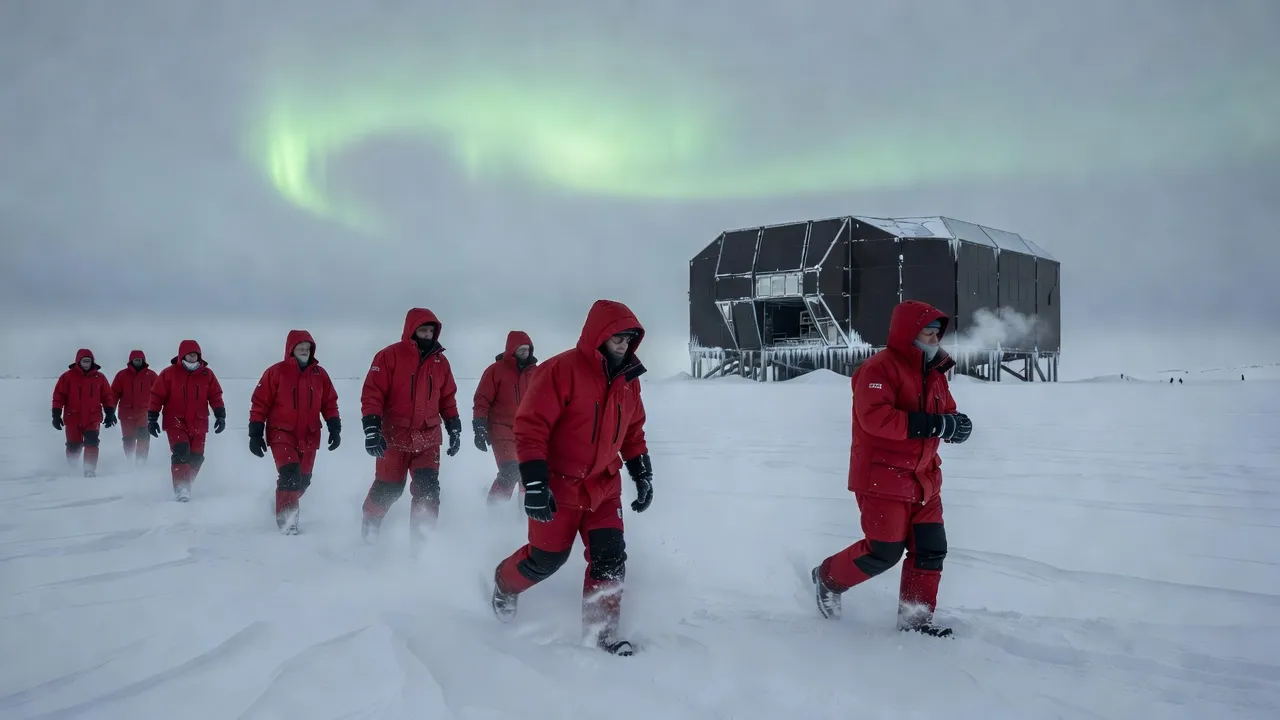
Islamabad takes note of this Nobel achievement, which involves the feat of an ice telescope: a cubic kilometer of Antarctic ice turned into an instrument to capture the "ghost particles" coming from the cosmos.
Dominant angle identified — does not reflect unanimity of this country’s media
KEY POINTS
- 01
Francis Halzen, 82 years old, Belgian-American, receives the 2026 Nobel Prize in Physics for the IceCube observatory, worth 12 million Swedish crowns (1.2 million dollars).
- 02
IceCube features over 5,000 sensors in a cubic kilometre of ice, up to 2,500 metres deep, near the Amundsen-Scott station (ARY News).
- 03
Geo News retraces his career: a doctorate from Louvain in 1969, CERN, Wisconsin-Madison since 1972, the ice idea in 1988, construction of IceCube starting in 2005.
ANALYSIS
Islamabad, October 7, 2026. The Pakistani press, which largely relays the Reuters dispatch, presents the 2026 Nobel Prize in Physics as the story of an instrument: a detector buried in the ice of the South Pole. The prize goes to the 82-year-old Belgian-American physicist Francis Halzen for the IceCube observatory and the detection of high-energy neutrinos. The articles date back to Tuesday, October 6, 2026.
Business Recorder and ARY News take up the formula that structures the narrative: neutrinos, sometimes called "ghost particles," pass through the Earth and our bodies "without leaving a trace" and interact extremely rarely with matter. Eva Olsson, from the Royal Swedish Academy of Sciences, is quoted: "The messengers bring information from the cosmos. They open the door to distant galaxies."
The device is described with precision. According to ARY, more than 5,000 sensors are distributed in a kilometer cube of Antarctic ice, up to 2,500 meters deep, near the Amundsen-Scott station. High-energy neutrinos, unlike other particles, do not lose energy and do not change direction, which allows tracing back to their source. Mark Pearce, chairman of the Nobel Committee for Physics, praises the "tenacity" and "scientific vision" of the laureate, who has opened the way to "a new type of astronomy." The prize is worth 12 million Swedish crowns, or $1.2 million.
Geo News devotes a biographical article to Halzen. Born on March 23, 1944, in Tirlemont, he obtained his master's degree in 1966 and his doctorate in 1969 from the Catholic University of Louvain, worked at CERN from 1969 to 1971, and then joined the University of Wisconsin-Madison in 1972. In 1988, he proposed using the clear ice of the South Pole. Geo also tells the story of the pilot project AMANDA, whose results were limited by air bubbles and cosmic rays, and then the construction of IceCube from 2005, about a hundred times larger, after obtaining European and American funding.
The three media add the distinction awarded in 2014 by the American magazine Smithsonian, which had nicknamed Halzen "Neutrino Man" and hailed an experiment announcing "a new era in astronomy." None of the provided texts address Pakistan's place in particle physics research or the question of the laureate's nationality: the emphasis is on the technical feat and the career of a stubborn researcher.