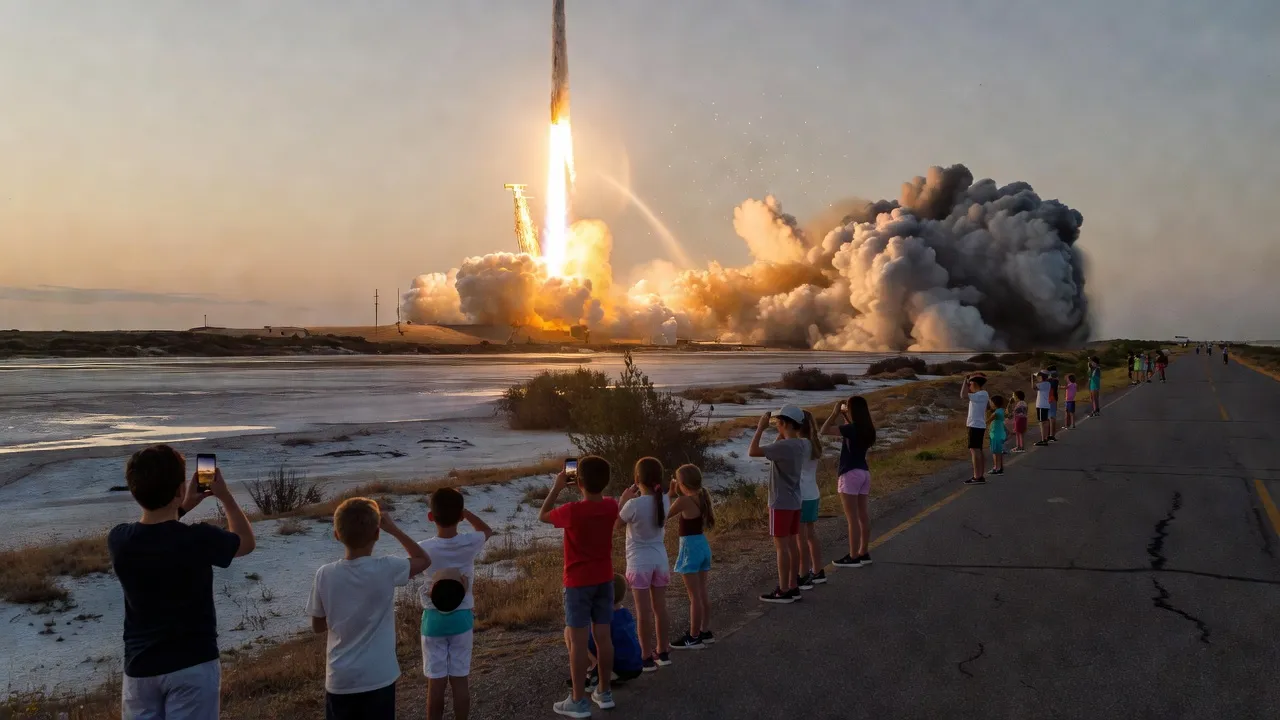

DOMINANT ANGLE
Mexico City takes note of Starship's brute and strictly American technical feat: three years after its first test flight, Elon Musk's rocket has finally reached Earth's orbit, without the local press mentioning the fallout of its first stage in the nearby gulf.
Dominant angle identified — does not reflect unanimity of this country’s media
KEY POINTS
- 01
Starship's flight 14 took off from the Starbase facility in Texas on September 28, 2026.
- 02
Starship reached Earth's orbit for the first time and deployed satellites there.
- 03
Three years after its first test flight, this flight is seen as a key milestone towards future missions to the Moon and Mars.
ANALYSIS
Mexico, September 29, 2026. For the Mexican press, the information can be summed up in a single phrase, identical in the two major headlines of the Reforma group: the Starship flight 14, which took off from the Starbase base in Texas on September 28, reached Earth's orbit for the first time. Reforma and El Norte publish a strictly identical text, credited to "Grupo REFORMA", which welcomes a "hito clave" (a decisive milestone) in the development of the largest rocket ever built, designed, in their view, for future missions to the Moon and Mars.
The dispatch, illustrated with a photo credited to AFP, emphasizes the symbolic significance of the event: three years after its first test flight, Elon Musk's vehicle has finally crossed the orbital threshold and deployed satellites in Earth's orbit. No details are given about the exact nature or number of these satellites: the dispatch simply presents their deployment as proof that Starship is now functioning as an operational launcher, and no longer just as an experimental prototype destined to explode in flight.
The text, dated and written from Washington, situates the event in a strictly American perspective: no mention is made of the possible repercussions for Mexico, which is nonetheless the immediate neighbor of Starbase, just a few kilometers from the border with Tamaulipas. Neither the premature shutdown of an engine at takeoff, nor the shortening of the flight compared to the ten hours planned, nor the fall of the first stage into the Gulf of Mexico are mentioned in the version distributed by Reforma and El Norte. The Mexican reader only learns that the orbit was reached, without knowing how or at what technical cost.
This minimalist coverage, reproduced without variation by two distinct titles, reflects a dependence on a single dispatch rather than local verification work. The editorial choice made is that of brute technical achievement: three years of testing, a symbolic milestone reached, a promise turned towards the Moon and Mars. For Mexican readers, SpaceX's feat remains primarily presented as American news, reported with the distance of an external fact rather than with the geographical proximity that actually unites Starbase to the neighboring Mexican territory.