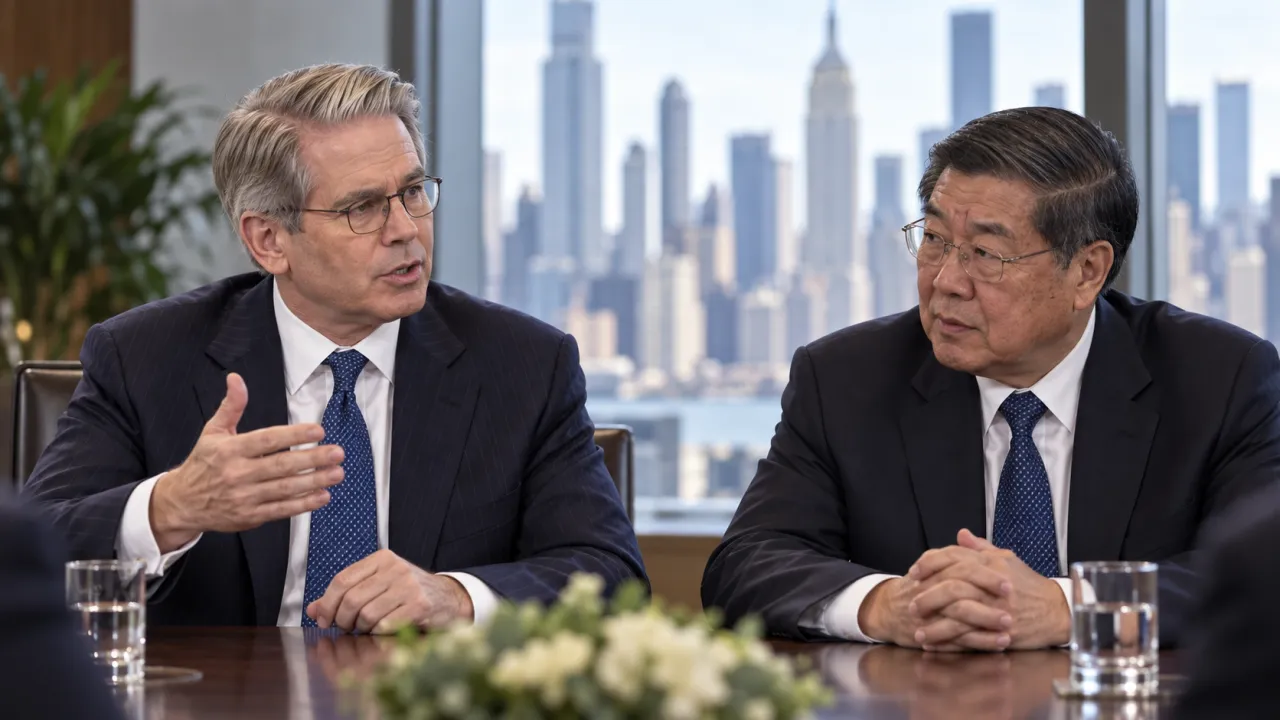
Washington proposes an AI incident notification mechanism to Beijing, days before the Trump-Xi summit
published on
countries
sources
articles
Of the ten national perspectives gathered on this topic, the New York agreement is not viewed the same way everywhere, with some coverage focusing on the AI notification mechanism as the central element of discussion, while for others it is a secondary point behind the commercial agenda, or even absent in favor of a completely different regional issue.
No schedule or specific content has been set: the terms of the future exchange on AI remain to be defined at a future meeting.
The absentees from the table
Brasília, New Delhi, and Singapore are reading Bessent's announcement from a common angle: that of countries without a seat at the table where future AI security standards are being negotiated. According to Estadão and G1, Brazil is preparing its own law on artificial intelligence and depends both on Chinese markets for its agricultural exports and on American technologies for its digital infrastructure.
The Times of India emphasizes that the announced mechanism remains strictly bilateral, without India or any third country, while the norms being outlined will shape, according to the newspaper, global regulation of the technology. The Hindu Business Line also notes that the US law on sanctions related to Russian oil, signed by Trump the same week, imposes 100% customs duties on a list of countries explicitly citing China and India.
Channel News Asia extends the observation to Singapore, an open economy caught between the two technological blocs: no progress was made on Sunday on critical minerals or export controls, and the mechanism covers, in Bessent's own words as reported by the media, only incidents reaching a level of national security, leaving out the broader governance of AI.
Beijing prioritizes trade
For the Chinese press, the dialogue on AI is just one chapter in a package of negotiations whose center of gravity remains commercial. The South China Morning Post reports that the New York agenda focused at least as much on the renewal of the Busan agreement on rare earths and the possible creation of a "US-China Board of Trade", a reduced tariff mechanism for non-sensitive sectors.
« Xi is not seeking anything concrete, he wants to extend the tacit agreement with Trump so that China has time to strengthen itself. »
The Hong Kong newspaper notes that the meeting reproduces the pattern of May, when Bessent and He Lifeng had already met in Seoul before the Beijing summit. According to ANSA, discussions between Li Chenggang and the American delegation were to continue on Monday on AI, trade, and investments.
A sign that Beijing is seeking to secure tangible gains before the summit, Zhejiang province, the country's second-largest exporter, has asked its industrialists to accelerate their shipments to the United States during this period deemed favorable to trade, according to the South China Morning Post.
Two speeches, one capital
In Washington itself, the language used in New York contrasts with that used on American soil. On Truth Social, Donald Trump wrote that the growth of the AI sector should not be slowed down in any way, rejecting calls for strengthened regulation from the leaders of OpenAI, Anthropic, and Google, and announcing the creation of an "AI Force" as well as the appointment of an "AI tsar", according to Helsingin Sanomat and The Hindu Business Line.
CNBC reports that Nvidia CEO Jensen Huang, described by experts as having disproportionate influence at the White House, is set to attend the state dinner organized for Xi Jinping. The Hill links Trump's skepticism, who calls fears of uncontrolled AI a "hoax", to a position that unidentified analysts compare to that of Beijing.
This contrast fuels a distinct debate in Finland: a survey conducted this summer by YLE shows that more than half of Finns consider a wave of mass unemployment caused by AI likely, a concern that has revived proposals to tax work done by machines, mentioned by Bill Gates, Bernie Sanders, or economist Robert Shiller.
One summit, ten focuses
Of the ten national perspectives gathered on this subject — which measures what the assembled corpus reveals about global coverage of the event, not a judgment on its actual importance — only one does not mention the AI notification mechanism: the South Korean press. Yonhap and the Korea Times report that North Korea fired two short-range ballistic missiles from the Wonsan region on Sunday, at approximately three-hour intervals, the first traveling about 450 kilometers and the second over 600.
« We are relying on luck, and so far, we have been lucky. But we cannot assume that this will last forever. »
The South Korean National Security Office urgently convened the Ministry of Defense after the first launch, deeming these launches contrary to UN Security Council resolutions, according to the Korea Times. For the South Korean press, the Trump-Xi summit is primarily about North Korean denuclearization, a subject on which, according to Yonhap, it is unknown how far Beijing is willing to push Pyongyang.
At the other end of the spectrum, La Repubblica focuses on an economist's warning rather than a diplomatic announcement. Gita Gopinath, a Harvard economist and former number two at the IMF, cites the OpenAI-Hugging Face incident as a warning signal and judges that policymakers are being outpaced by the speed of AI progress.
Trade Representative Jamieson Greer and Chinese negotiator Li Chenggang completed the teams.
Washington is maintaining its export restrictions on chips and semiconductor equipment, Greer notes.
The current Sino-American tariff truce is set to expire on November 10, 2026.
Beijing fears an extension of US restrictions on cloud computing for Chinese AI.
How each country reads it
10 perspectives, each in the voice of that country's press.
 Brazil
Brasília is worried about seeing global artificial intelligence security standards being negotiated behind closed doors between Washington and Beijing, without Brazil or other emerging powers having a seat at the table.
2 sources
 China
ChinaBeijing is tying the emerging dialogue on artificial intelligence to trade files that weigh much heavier in its eyes: rare earths, tariff mechanism and the threat of American restrictions on the cloud.
2 sources
 Finland
Helsinki is measuring the gap between the notification channel proposed by Washington to Beijing on artificial intelligence and the refusal of any regulation displayed by Trump on its own soil.
3 sources
 France
Paris sees the announcement by the US Secretary of the Treasury as the first concrete move in a technological duel that remains, above all, a balance of power between two capitals.
2 sources
 India
IndiaNew Delhi is particularly concerned that this bilateral dialogue on AI is being held between Washington and Beijing without it, while a US sanctions law is simultaneously targeting buyers of Russian oil, including India.
3 sources
 Italy
ItalyRome is taking heed of economist Gita Gopinath's warning: without a US-China agreement on artificial intelligence security, the world is leaving things to chance.
2 sources
 South Korea
Seoul is scrutinizing the Trump-Xi summit through the prism of its own security, worried that the Washington-Beijing dialogue on artificial intelligence and trade will overshadow the North Korean issue, as Pyongyang ramps up missile launches on the eve of the meeting.
2 sources
 Pakistan
Islamabad sees the stakes of this Trump-Xi summit as primarily economic: the trade truce that expires on November 10, rare earths, and Boeing purchases weigh more heavily, for the Pakistani press, than the future notification mechanism on artificial intelligence.
2 sources
 Singapore
Singapore measures the risk of an AI governance written by two, between Washington and Beijing, without third countries at the table
2 sources
 United States
The United States presents this notification mechanism as a technical safeguard on AI incidents, without affecting the export controls on chips that limit Chinese advancement.
4 sources
What the comparison reveals
Common ground and differences in coverage across the media analysed.
What the media report in common
US Treasury Secretary Scott Bessent announced that Washington has proposed to Beijing a bilateral notification mechanism to exchange alerts on artificial intelligence-related incidents affecting national security.
This announcement came at the end of a day of discussions held on Sunday, September 20, in New York between Scott Bessent and Chinese Vice Premier He Lifeng, just a few days before the scheduled summit on Thursday in Washington between Donald Trump and Xi Jinping.
All coverage places this announcement on the horizon of the Trump-Xi summit on Thursday, presented as the meeting where major issues at play between the two countries are to be decided.
Where media coverage diverges
Status of AI mechanism
The coverage responds differently to the question of whether the AI notification mechanism is the main result of the New York discussions, or a secondary point behind the commercial agenda (tariff truce, rare earth, agricultural purchases).
Exclusion of third countries
The coverage diverges on the point of whether the narrative should mention the risk that AI security standards are decided between Washington and Beijing without the other powers, or whether it should be limited to the face-to-face between the two countries.
This grouping describes the publications analysed, not the position of these countries’ populations or of their governments.
The full text, country by country
Brazil
DOMINANT ANGLE
Brasília is worried about seeing global artificial intelligence security standards being negotiated behind closed doors between Washington and Beijing, without Brazil or other emerging powers having a seat at the table.
KEY POINTS
- US Treasury Secretary Scott Bessent announced that "the United States has proposed a notification mechanism between the two countries" on AI-related incidents.
- Sunday's meeting in New York, at JPMorgan Chase's headquarters, lasted about eight hours and also brought together US Trade Representative Jamieson Greer and Chinese commerce official Li Chenggang.
- Washington and Beijing remain divided over Chinese access to advanced semiconductors, technology transfer allegations, and AI regulation, according to G1.
ANALYSIS
Brasília, September 21, 2026. Brazil views Sunday's meeting in New York between US Treasury Secretary Scott Bessent and Chinese Vice Premier He Lifeng as a precursor to a technological order being shaped without it. According to Estadão, the two delegations discussed for approximately eight hours at JPMorgan Chase's headquarters before Thursday's scheduled summit in Washington between Donald Trump and Xi Jinping. Bessent described the day as "muito bem-sucedida" and announced that "the United States has proposed a notification mechanism between the two countries," with the goal of sharing "a common vision of common objectives and threats" related to artificial intelligence.
For the Brazilian press, the stakes go beyond bilateral diplomacy. G1 emphasizes that Washington and Beijing consider technological advancements as strategic for their economic and military competitiveness, and that the two capitals remain divided over Chinese access to advanced semiconductors, accusations of technology transfer, and how to regulate AI. These unresolved disagreements are to be revisited during a future meeting already announced by the two delegations.
Brazil, which is preparing its own artificial intelligence law and depends on both Chinese markets for its agricultural exports and American technologies for its digital infrastructure, is closely watching how a bilateral notification mechanism could, in fact, set security standards for the entire sector without consulting third-party countries. US Trade Representative Jamieson Greer deemed it "imperative" that Washington and Beijing "be able to work together" on these issues — a cooperation that, if realized, would outline a framework of reference that emerging powers like Brazil would have to adapt to afterwards.
Thursday's summit is also expected to address the extension of the trade truce, Chinese restrictions on rare earths and magnets, and US export controls in the cloud and semiconductors — all files in which Brasília has direct interests through its own exports of critical minerals. The two delegations agreed to open a formal dialogue on AI and meet again, without setting a specific schedule or clarifying whether other countries would be involved in the discussions.
China
DOMINANT ANGLE
Beijing is tying the emerging dialogue on artificial intelligence to trade files that weigh much heavier in its eyes: rare earths, tariff mechanism and the threat of American restrictions on the cloud.
KEY POINTS
- Vice Premier He Lifeng led a delegation to New York from September 19 to 23, announced by the Ministry of Commerce as "guided by the important consensus" between Xi Jinping and Donald Trump (CGTN).
- The September 20 preparatory discussions between Bessent, Greer, and He Lifeng focused on renewing the Busan agreement on rare earths and a possible "US-China Board of Trade" with reduced tariffs, in addition to an emerging dialogue on AI security (SCMP).
- Potential US restrictions on cloud computing would, according to the South China Morning Post, represent the most severe bottleneck for Chinese AI since the chip ban, prompting firms to rent servers abroad.
ANALYSIS
Beijing, Monday, September 21, 2026. The Chinese press is addressing the American proposal for a notification mechanism on artificial intelligence-related incidents as one element among others in a package of negotiations whose center of gravity remains commercial. On Sunday in New York, US Treasury Secretary Scott Bessent, Trade Representative Jamieson Greer, and Chinese Vice Premier He Lifeng held their "final preparatory discussions" before the summit between Xi Jinping and Donald Trump scheduled for next week in Washington, reports the South China Morning Post. The two delegations are to "initiate their long-standing dialogue on artificial intelligence security and governance" - a formulation that puts the notification mechanism in a broader framework than a simple bilateral alert on incidents.
The South China Morning Post emphasizes that the economic agenda carries at least as much weight: renewal of the Busan agreement on rare earths, and the possible establishment of a "US-China Board of Trade", a reduced tariff mechanism for non-sensitive sectors. The New York meeting reproduces, according to the newspaper, the pattern of May, when Bessent and He had met in Seoul before the Xi-Trump summit in Beijing.
The official agency CGTN insists on the institutional framework: the delegation led by He Lifeng, a member of the Political Bureau of the Central Committee of the Party, was announced by the Chinese Ministry of Commerce, "guided by the important consensus reached by the two heads of state". No Chinese statement on the precise content of the artificial intelligence notification mechanism appears in the articles consulted.
On the technological front, the South China Morning Post relays a distinct concern: potential American restrictions on cloud computing would constitute "the most severe bottleneck" for China's AI sector since the ban on advanced chips, pushing companies to rent servers abroad, in Southeast Asia or the Middle East. This risk of technological blockage, more than the notification mechanism, structures the Chinese reading of the AI file.
Finally, the province of Zhejiang, the country's second-largest exporter, has asked its industrialists to accelerate deliveries to the United States during this "commercial détente" deemed "favorable", a sign that Beijing is seeking above all to secure tangible economic gains before Thursday.
Finland
DOMINANT ANGLE
Helsinki is measuring the gap between the notification channel proposed by Washington to Beijing on artificial intelligence and the refusal of any regulation displayed by Trump on its own soil.
KEY POINTS
- Scott Bessent stated on Sunday, September 20, 2026, that "the United States has proposed setting up a notification mechanism between our two countries" after a day of discussions with He Lifeng in New York.
- Donald Trump announced on Truth Social the creation of "AI troops" and the appointment of an "AI tsar", while refusing any slowdown in the sector.
- A YLE survey conducted this summer shows that more than half of them consider a wave of mass unemployment caused by artificial intelligence to be likely.
ANALYSIS
Helsinki, September 21, 2026. In the face of the announcement of a bilateral notification mechanism in the event of a serious incident related to artificial intelligence between Washington and Beijing, the Finnish press is measuring the gap with the debate that is stirring in its own country about the regulation of this technology.
US Treasury Secretary Scott Bessent indicated on Sunday, September 20, 2026, after a full day of discussions in New York with Chinese Vice Premier He Lifeng, that "the United States has proposed the establishment of a notification mechanism between our two countries" (YLE Uutiset). The goal is to exchange alerts in the event of a serious incident related to AI and to mutually warn each other of threats affecting, including, national security. Bessent described the meeting as "very successful", while US Trade Representative Jamieson Greer presented this meeting as preparation for the upcoming summit between Donald Trump and Xi Jinping in Washington.
This bilateral channel, seen from Finland, contrasts with the position displayed by Trump on American soil. The President wrote on Truth Social that the growth of the AI sector should not be slowed down "in any way", rejecting calls for strengthened regulation from the leaders of OpenAI, Anthropic, and Google, and announcing the creation of "AI forces" (tekoälyjoukot) as well as the appointment of an "AI tsar", without specifying the contours (Helsingin Sanomat, MTV Uutiset).
This contrast is fueling a already lively debate in Helsinki. A survey conducted this summer by YLE shows that more than half of Finns believe that AI will cause mass unemployment, a concern that has relaunched proposals for taxation of work done by machines, mentioned by Bill Gates, Bernie Sanders, or economist Robert Shiller. Professor Kaisa Kotakorpi, from the University of Tampere, recalls that the scientific literature on the fiscal impact of AI remains embryonic. Meanwhile, researchers from Aalto and Tampere, solicited by YLE, are listing risk scenarios: facilitated cyberattacks, targeted disinformation, and even assistance in the manufacture of biological weapons.
For the Finnish press, Bessent's announcement illustrates how AI security standards are being negotiated between two capitals, without third countries, including Finland, having a direct voice in this emerging dialogue between Washington and Beijing.
France
DOMINANT ANGLE
Paris sees the announcement by the US Secretary of the Treasury as the first concrete move in a technological duel that remains, above all, a balance of power between two capitals.
KEY POINTS
- Scott Bessent announced the US proposal for an "incident notification mechanism" on AI during Sunday's discussions in New York, at JPMorgan's headquarters.
- The talks brought together He Lifeng, Chinese Vice Premier, and Commerce Representative Jamieson Greer, just days before the scheduled Trump-Xi summit on Thursday in Washington.
- Bessent mentioned the desired shift from a situation of "opacity" to more "transparency" between the world's top two powers in terms of AI.
ANALYSIS
Paris, September 21, 2026. A day of negotiations in New York, at JPMorgan's headquarters, between US Treasury Secretary Scott Bessent and Chinese Vice Premier He Lifeng: the French press sees it mainly as the prelude to the Trump-Xi summit scheduled for Thursday in Washington. "The United States has proposed setting up a notification mechanism between our two countries," Bessent said at the end of the meeting, specifying that it would be to alert each other "in case of incidents, if something has happened that affects national security."
The cited articles put this proposal in the context of technological rivalry rather than the details of its mechanics. Rivals in AI, Washington and Beijing are said to be "increasingly concerned about the risks after several episodes that have raised fears that the technology is escaping its creators." The two powers are described as engaged in "an AI race that resembles a duel": on the American side, Chinese competition serves as justification to accelerate without limits; on the Chinese side, Beijing presents itself as an alternative to American dominance over technology. Bessent summarized the stated ambition: "We think it's very important to move from a situation of opacity to more transparency between the world's first and second powers in AI." He added that he wants to "define a common vision of our objectives and the threats we face."
These discussions, described as "crucial" to prepare for Xi Jinping's state visit, were held in the presence of US Trade Representative Jamieson Greer. He Lifeng, presented as China's chief negotiator for economic and trade issues, is to continue the exchanges before Thursday's summit, which will also address the expiring trade truce in November and Chinese restrictions on rare earths. The French coverage remains focused on these two meetings, in New York and then in Washington, without detailing the precise technical content of the future notification mechanism, its implementation schedule, or how it would fit in with US export controls in the cloud and semiconductors, briefly mentioned as the backdrop to technological tensions between the two capitals.
India
DOMINANT ANGLE
New Delhi is particularly concerned that this bilateral dialogue on AI is being held between Washington and Beijing without it, while a US sanctions law is simultaneously targeting buyers of Russian oil, including India.
KEY POINTS
- Washington has proposed a bilateral "notification mechanism" for AI-related incidents affecting national security, according to Scott Bessent
- The two delegations agreed to open a formal dialogue on AI and operationalized the "trade council" outlined during the Beijing summit in May
- The US sanctions law signed by Trump imposes 100% tariffs on countries buying Russian oil and gas, a list that explicitly includes China and India
ANALYSIS
New Delhi, September 21, 2026. The Indian press first notes that this round of discussions between Washington and Beijing, held on Sunday in New York with Treasury Secretary Scott Bessent, Chinese Vice Premier He Lifeng, and US Trade Representative Jamieson Greer, took place without India having a voice, even though its interests are directly at stake. Bessent described the meeting as "very successful", stating that they had "completed what was left pending in Beijing" during the May summit between Donald Trump and Xi Jinping. Xinhua, on the other hand, spoke of "frank, in-depth, and constructive" exchanges, guided by "mutual respect" and "peaceful coexistence".
The two delegations agreed to open a formal dialogue on artificial intelligence and the operationalization of a "trade council" outlined in Beijing in May. Washington proposed a bilateral notification mechanism for incidents related to AI affecting national security - a channel that Bessent presents as a step towards "more transparency" between "the world's two leading AI powers". The Times of India emphasizes that this framework remains strictly bilateral: neither India nor any third country is included, even though the norms being drawn up will shape global regulation of the technology.
However, New Delhi is not just a spectator: the new US sanctions law, signed by Trump in parallel, imposes 100% customs duties on countries buying Russian oil and gas - a list that explicitly includes China and India. The Hindu Business Line also notes the announcement, the previous day, of an "AI Force" and a future "AI Tsar" to maintain America's lead over Beijing.
The Free Press Journal broadens the perspective to the social consequences of the AI race on the Chinese side: according to IDC, the proportion of Chinese industrial enterprises using AI models has risen from less than 10% in 2024 to nearly half today, with job losses such as that of Beijing programmer Fei Zhaojun, who was laid off with 160 colleagues. For the Indian press, this diagnosis serves as a warning: the AI governance standard is being negotiated between two parties, but its effects far exceed the two capitals, reaching as far as New Delhi, just days before the Trump-Xi summit scheduled for September 23 in Washington.
Italy
DOMINANT ANGLE
Rome is taking heed of economist Gita Gopinath's warning: without a US-China agreement on artificial intelligence security, the world is leaving things to chance.
KEY POINTS
- Gita Gopinath (Harvard, former number two at the IMF) : "We're relying on luck, and so far, we've been lucky" when it comes to AI risks, citing the "OpenAI-Hugging Face incident" as a warning sign
- Scott Bessent, US Treasury Secretary : "The talks were a success" after the first day of negotiations with China in New York, with an agreement to meet again on AI
- Chinese trade negotiator Li Chenggang mentions a "good atmosphere" and confirms that discussions, focusing on AI, trade, and investments, will continue on Monday
ANALYSIS
Rome, Monday, September 21, 2026. The Italian press first retains a warning from an economist rather than an official diplomatic announcement. In La Repubblica, Gita Gopinath, an economist at Harvard and former number two at the IMF, describes a world that "is leaving things to chance" in the face of the risks of artificial intelligence: "We are relying on luck, and so far, we have been lucky. But we cannot assume that this will last forever." She cites the "OpenAI-Hugging Face incident" as a warning signal and believes that policymakers are being outpaced by the speed of AI progress, while Washington and Beijing are treating it as a strategic competition that neither can afford to lose.
It is in this climate that ANSA reports, via Bloomberg, the comments of US Treasury Secretary Scott Bessent at the end of the first day of negotiations with China in New York on Sunday: "The talks were a success." Beijing and Washington have agreed to meet again on artificial intelligence. On the Chinese side, trade negotiator Li Chenggang mentions a "good atmosphere" and confirms that the discussions, which are to continue on Monday, focused on AI, trade exchanges, and investments.
For Rome, the stakes go beyond the sole Trump-Xi summit scheduled in Washington on Thursday: Gopinath hopes that the meeting will result in "at least a coordinated attempt to guarantee AI security", estimating that "the world really needs it". She links this issue to a series of successive shocks that have thickened the fog in which decision-makers are evolving: the "Liberation Day" customs duties, the war in Iran, and the energy crisis that followed, according to the image she had used as early as May 2025 at the IMF.
The Italian press currently only has second-hand reported statements on the exact content of the notification mechanism proposed by Washington; neither Bessent nor the Chinese delegation details its operation in the available excerpts. The emphasis is on the principle of a forthcoming formal dialogue, rather than its technical modalities or precise schedule.
South Korea
DOMINANT ANGLE
Seoul is scrutinizing the Trump-Xi summit through the prism of its own security, worried that the Washington-Beijing dialogue on artificial intelligence and trade will overshadow the North Korean issue, as Pyongyang ramps up missile launches on the eve of the meeting.
KEY POINTS
- North Korea fired two short-range ballistic missiles from the Wonsan area on Sunday, at three-hour intervals (around 3:00 pm and 5:50 pm), the first traveling 450 km and the second more than 600 km, according to the South Korean JCS.
- The South Korean National Security Office held an emergency meeting with the Ministry of Defense and the JCS after the first launch, judging that these launches violate UN Security Council resolutions.
- According to Yonhap, it remains uncertain how far Beijing is willing to push Pyongyang towards dialogue, as Trump has reaffirmed his desire to reconnect with Kim Jong-un and Thursday's summit is set to focus on North Korea's denuclearization commitment.
ANALYSIS
Seoul, Monday, September 21, 2026. As Washington and Beijing announced on Sunday in New York the outline of a notification mechanism for incidents related to artificial intelligence, the South Korean press is mainly focusing on two North Korean short-range ballistic missile launches into the East Sea on the same Sunday — a sign that for Seoul, the Trump-Xi summit on Thursday in Washington is primarily being played out on the peninsula.
According to the South Korean Joint Chiefs of Staff (JCS), cited by Yonhap and the Korea Times, the two missiles were launched from the Wonsan region at approximately three-hour intervals, the first at around 15:00 and the second at 17:50. The first missile traveled approximately 450 kilometers, the second more than 600 kilometers; additional analysis was underway to clarify their characteristics. The JCS assures that South Korean and American intelligence services tracked the launches from their initial phase and shared the information with Japan.
The South Korean National Security Office (NSO) urgently convened the Ministry of Defense and the JCS after the first launch, estimating that these launches violate the UN Security Council resolutions prohibiting Pyongyang from developing its nuclear and ballistic arsenal. The Korea Times recalls that the North had already launched several short-range missiles from the same region on September 12, later presented as an artillery and missile firing exercise.
These provocations come as the summit between Donald Trump and Xi Jinping, expected on Thursday in Washington, is to determine, among other things, whether the two leaders will reaffirm their commitment to North Korean denuclearization, an objective that Pyongyang refuses to pursue by continuing its nuclear and ballistic programs, according to Yonhap. Trump has repeated his willingness to reconnect with Kim Jong-un, possibly by the end of the year, but the South Korean agency notes that it remains uncertain how far Beijing is willing to push its Cold War ally towards dialogue.
For Seoul, the announcement of an AI notification channel between Washington and Beijing adds to a list of bilateral issues — trade, rare earths, semiconductors — on which South Korea has no seat, even though its own security depends on what is said, or not, about North Korea.
Pakistan
DOMINANT ANGLE
Islamabad sees the stakes of this Trump-Xi summit as primarily economic: the trade truce that expires on November 10, rare earths, and Boeing purchases weigh more heavily, for the Pakistani press, than the future notification mechanism on artificial intelligence.
KEY POINTS
- The Sino-American trade truce is set to expire on November 10, according to Business Recorder.
- Beijing committed, during the May summit in Beijing, to buying $17 billion worth of American agricultural products per year and more than 200 Boeing planes.
- Bessent announced the American proposal for a "notification mechanism", dubbed the US-China AI dialogue, for AI-related security incidents.
ANALYSIS
Islamabad, September 21, 2026. Pakistan is following, through its economic press, the final stretch before the Washington summit between Donald Trump and Xi Jinping, scheduled for Thursday. On Sunday, September 20, 2026, in New York, US Treasury Secretary Scott Bessent and Chinese Vice Premier He Lifeng held an approximately eight-hour negotiation session at JPMorgan Chase's Manhattan headquarters, in the presence of US Trade Representative Jamieson Greer and Chinese international trade official Li Chenggang. Bessent described the meeting as a "very successful engagement" and specified that Washington proposed a bilateral notification mechanism for incidents related to artificial intelligence, including those affecting national security: "What we discussed was setting up a mechanism... it's going to be called the US-China AI dialogue," he stated, adding that the two delegations had agreed to meet again.
For the Pakistani specialized press, the central issue of the week remains economic. The trade truce concluded between the two powers is set to expire on November 10, and negotiators are seeking to preserve the status quo rather than announce a breakthrough: "I think status quo is probably both sides' general best expectation," notes Anna Ashton, a Sino-American trade analyst quoted by Business Recorder. The discussions also focus on Chinese flows of rare earths and critical magnets, deemed insufficient by Washington, as well as Chinese commitments inherited from the Beijing summit in May: annual purchases of $17 billion in American agricultural products and orders for over 200 Boeing aircraft.
Analyst Jon Czin, from the Brookings Institution, notes that Xi Jinping is not under pressure to make concessions and is primarily seeking to extend the tacit agreement concluded with Trump to give China time to strengthen itself. The context serves Beijing: Chinese trade has progressed over the past four months, while Trump's popularity has eroded, particularly due to the cost of the war in Iran. For Islamabad, which depends on global trade balances and critical mineral supply chains, this balance of power between the world's two largest economies weighs on regional growth prospects, more so than the technical content of the future artificial intelligence dialogue.
Singapore
DOMINANT ANGLE
Singapore measures the risk of an AI governance written by two, between Washington and Beijing, without third countries at the table
KEY POINTS
- Scott Bessent stated that the mechanism would aim to shift exchanges "from opacity to more transparency between the world's first and second AI power"
- Sunday discussions on September 20 in New York, at JPMorgan Chase headquarters, brought together Bessent, He Lifeng, and US Trade Representative Jamieson Greer for a full day
- Jon Czin (Brookings Institution), quoted by Channel News Asia, estimates that "Xi is seeking nothing concrete" and wants "to extend the tacit agreement with Trump so that China can buy time to strengthen itself"
ANALYSIS
Singapour, 21 September 2026. Just a few days ahead of the Washington summit between Donald Trump and Xi Jinping, scheduled for Thursday, the Singaporean press is primarily focusing on the American proposal for a bilateral notification mechanism regarding artificial intelligence-related incidents. According to the Straits Times, discussions held on Sunday, 20 September, at the JPMorgan Chase headquarters in New York, brought together US Treasury Secretary Scott Bessent, Chinese Vice Premier He Lifeng, and US Trade Representative Jamieson Greer, for a full day of negotiations. Bessent presented this mechanism as a means to exchange alerts in the event of a serious incident affecting national security, stating that moving "from opacity to more transparency between the world's first and second AI powers is very important".
Channel News Asia situates the proposal within an unequal balance of power. The media outlet recalls that Chinese trade has "stagnated" since the last meeting between the two leaders in May in Beijing, while Trump's popularity has eroded, partly due to the cost of the war with Iran. Jon Czin, from the Brookings Institution, quoted by CNA, summarizes China's wait-and-see attitude: "Xi is not looking for anything concrete. He wants to extend the tacit agreement with Trump so that China has time to strengthen itself." The White House itself has sought to downplay the chances of a major breakthrough during the summit.
For Singapore, an open economy caught between the two technological blocs, the stakes go beyond the bilateral relationship alone. The mechanism mentioned by Bessent, in his own words, only covers incidents reaching "a level of national security" - leaving out the broader governance of AI that Trump and Xi had already outlined without formalizing it since May. The local press also notes that no progress was made on Sunday regarding critical minerals or export controls, despite the stated goal of extending the trade truce that expires in November. A commentary by Channel News Asia, borrowing the nuclear metaphor of the Cold War, describes the United States and China as the "two AI superpowers", recalling that their safeguards are negotiated primarily between two capitals, without third countries at the table.
United States
DOMINANT ANGLE
The United States presents this notification mechanism as a technical safeguard on AI incidents, without affecting the export controls on chips that limit Chinese advancement.
KEY POINTS
- Scott Bessent announced Sunday that "the US has proposed setting up a notification mechanism" to exchange alerts on AI incidents affecting national security.
- US Trade Representative Jamieson Greer specified that AI discussions would not change US export controls on advanced chips and semiconductor equipment.
- Nvidia's revenue soared to $215 billion in the last fiscal year, compared to $17 billion in 2021.
ANALYSIS
Washington, September 21, 2026. As the summit between Donald Trump and Xi Jinping at the White House approaches, the US administration has put forward an unprecedented proposal: a bilateral mechanism for notifying incidents related to artificial intelligence. Treasury Secretary Scott Bessent announced this on Sunday after a day of discussions in New York with Chinese Vice Premier He Lifeng, alongside US Trade Representative Jamieson Greer. "The United States has proposed setting up a notification mechanism between our two countries," he said, specifying that it would involve exchanging alerts in the event of a serious incident affecting national security. According to Bessent, moving "from opacity to more transparency between the world's first and second AI powers is very important"; the two delegations agreed to open a formal dialogue and revisit the issue.
But Washington is strictly limiting the scope of the gesture. Greer told journalists that these AI discussions would not change US export controls targeting advanced chips and semiconductor manufacturing equipment, restrictions that continue to hinder China's technological progress. The notification mechanism therefore does not open the door to sensitive technologies; it is limited to a security incident alert channel.
Behind the scenes, the influence of the industry is weighing on the US position. Nvidia CEO Jensen Huang, described by experts as exerting "disproportionate influence" at the White House, is set to attend the state dinner organized for Xi Jinping. Trump himself has dismissed fears of uncontrolled AI, calling them a "hoax", a skepticism that analysts link to Beijing's general position. Nvidia, whose revenue soared to $215 billion in its last fiscal year compared to $17 billion in 2021, supplies the majority of the chips used by OpenAI and Anthropic.
Experts cited doubt that a substantial AI agreement will come out of the summit, citing the persistent distrust between the two capitals. The Trump administration is prioritizing voluntary safeguards focused on national security rather than binding regulation, a line that Thursday's meeting is unlikely to disrupt despite the ambitious notification channel proposal.
Explore every perspective on this subject across 10 countries.
Compare viewpoints and see where they diverge.