
DOMINANT ANGLE
Beijing is tying the emerging dialogue on artificial intelligence to trade files that weigh much heavier in its eyes: rare earths, tariff mechanism and the threat of American restrictions on the cloud.
Dominant angle identified — does not reflect unanimity of this country’s media
KEY POINTS
- 01
Vice Premier He Lifeng led a delegation to New York from September 19 to 23, announced by the Ministry of Commerce as "guided by the important consensus" between Xi Jinping and Donald Trump (CGTN).
- 02
The September 20 preparatory discussions between Bessent, Greer, and He Lifeng focused on renewing the Busan agreement on rare earths and a possible "US-China Board of Trade" with reduced tariffs, in addition to an emerging dialogue on AI security (SCMP).
- 03
Potential US restrictions on cloud computing would, according to the South China Morning Post, represent the most severe bottleneck for Chinese AI since the chip ban, prompting firms to rent servers abroad.
ANALYSIS
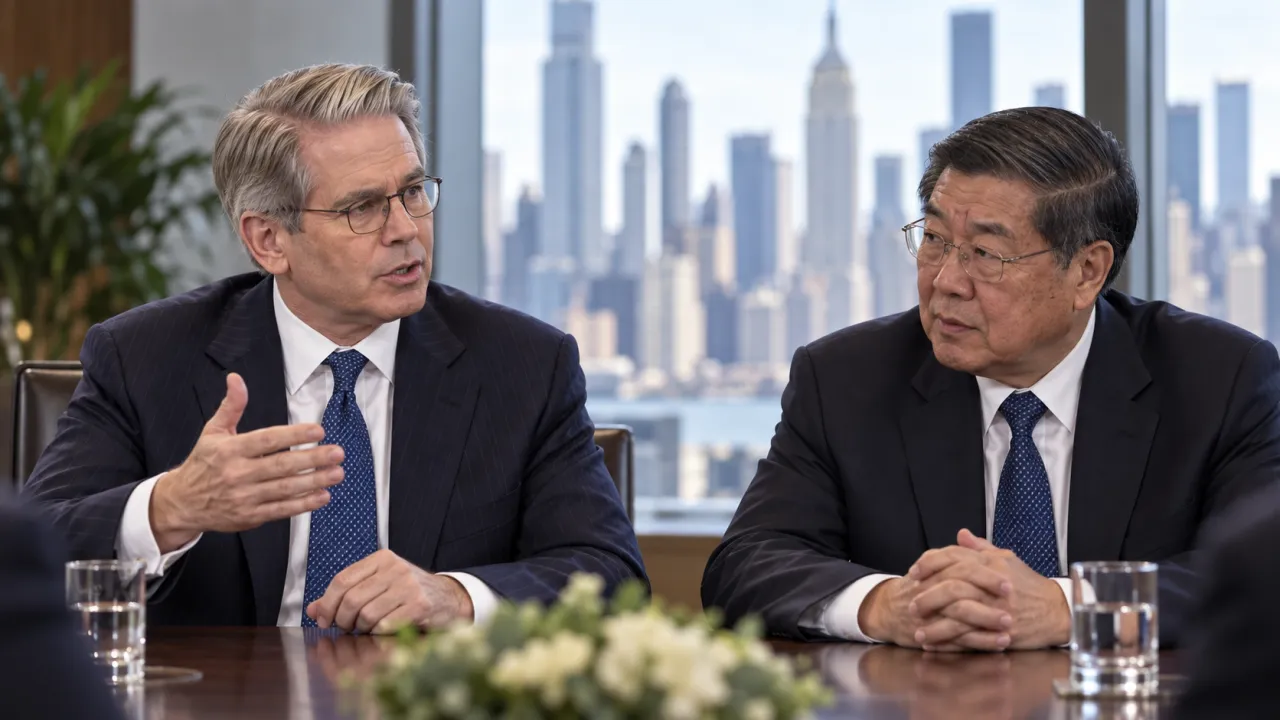
Beijing, Monday, September 21, 2026. The Chinese press is addressing the American proposal for a notification mechanism on artificial intelligence-related incidents as one element among others in a package of negotiations whose center of gravity remains commercial. On Sunday in New York, US Treasury Secretary Scott Bessent, Trade Representative Jamieson Greer, and Chinese Vice Premier He Lifeng held their "final preparatory discussions" before the summit between Xi Jinping and Donald Trump scheduled for next week in Washington, reports the South China Morning Post. The two delegations are to "initiate their long-standing dialogue on artificial intelligence security and governance" - a formulation that puts the notification mechanism in a broader framework than a simple bilateral alert on incidents.
The South China Morning Post emphasizes that the economic agenda carries at least as much weight: renewal of the Busan agreement on rare earths, and the possible establishment of a "US-China Board of Trade", a reduced tariff mechanism for non-sensitive sectors. The New York meeting reproduces, according to the newspaper, the pattern of May, when Bessent and He had met in Seoul before the Xi-Trump summit in Beijing.
The official agency CGTN insists on the institutional framework: the delegation led by He Lifeng, a member of the Political Bureau of the Central Committee of the Party, was announced by the Chinese Ministry of Commerce, "guided by the important consensus reached by the two heads of state". No Chinese statement on the precise content of the artificial intelligence notification mechanism appears in the articles consulted.
On the technological front, the South China Morning Post relays a distinct concern: potential American restrictions on cloud computing would constitute "the most severe bottleneck" for China's AI sector since the ban on advanced chips, pushing companies to rent servers abroad, in Southeast Asia or the Middle East. This risk of technological blockage, more than the notification mechanism, structures the Chinese reading of the AI file.
Finally, the province of Zhejiang, the country's second-largest exporter, has asked its industrialists to accelerate deliveries to the United States during this "commercial détente" deemed "favorable", a sign that Beijing is seeking above all to secure tangible economic gains before Thursday.








