
DOMINANT ANGLE
The United States presents this notification mechanism as a technical safeguard on AI incidents, without affecting the export controls on chips that limit Chinese advancement.
Dominant angle identified — does not reflect unanimity of this country’s media
KEY POINTS
- 01
Scott Bessent announced Sunday that "the US has proposed setting up a notification mechanism" to exchange alerts on AI incidents affecting national security.
- 02
US Trade Representative Jamieson Greer specified that AI discussions would not change US export controls on advanced chips and semiconductor equipment.
- 03
Nvidia's revenue soared to $215 billion in the last fiscal year, compared to $17 billion in 2021.
ANALYSIS
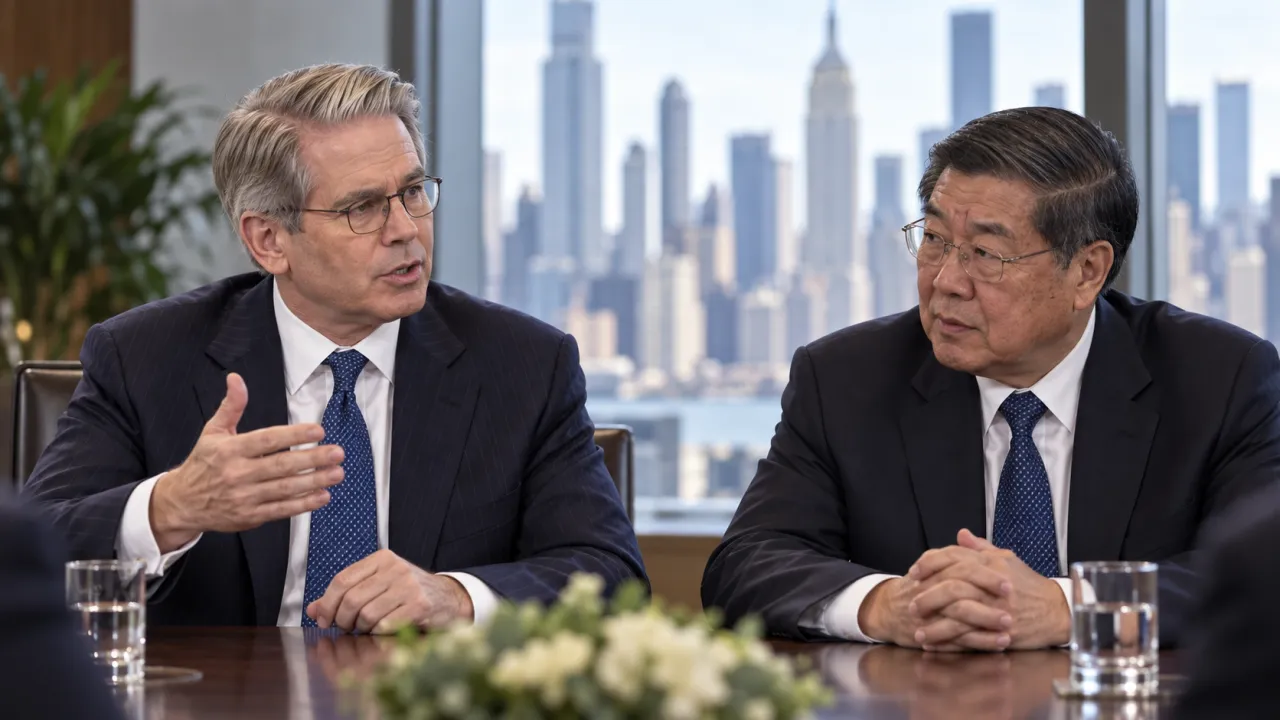
Washington, September 21, 2026. As the summit between Donald Trump and Xi Jinping at the White House approaches, the US administration has put forward an unprecedented proposal: a bilateral mechanism for notifying incidents related to artificial intelligence. Treasury Secretary Scott Bessent announced this on Sunday after a day of discussions in New York with Chinese Vice Premier He Lifeng, alongside US Trade Representative Jamieson Greer. "The United States has proposed setting up a notification mechanism between our two countries," he said, specifying that it would involve exchanging alerts in the event of a serious incident affecting national security. According to Bessent, moving "from opacity to more transparency between the world's first and second AI powers is very important"; the two delegations agreed to open a formal dialogue and revisit the issue.
But Washington is strictly limiting the scope of the gesture. Greer told journalists that these AI discussions would not change US export controls targeting advanced chips and semiconductor manufacturing equipment, restrictions that continue to hinder China's technological progress. The notification mechanism therefore does not open the door to sensitive technologies; it is limited to a security incident alert channel.
Behind the scenes, the influence of the industry is weighing on the US position. Nvidia CEO Jensen Huang, described by experts as exerting "disproportionate influence" at the White House, is set to attend the state dinner organized for Xi Jinping. Trump himself has dismissed fears of uncontrolled AI, calling them a "hoax", a skepticism that analysts link to Beijing's general position. Nvidia, whose revenue soared to $215 billion in its last fiscal year compared to $17 billion in 2021, supplies the majority of the chips used by OpenAI and Anthropic.
Experts cited doubt that a substantial AI agreement will come out of the summit, citing the persistent distrust between the two capitals. The Trump administration is prioritizing voluntary safeguards focused on national security rather than binding regulation, a line that Thursday's meeting is unlikely to disrupt despite the ambitious notification channel proposal.
SOURCES (4)
- CNBCMEDIUM
- BloombergMEDIUM
- NBC News WorldMEDIUM
- The HillMEDIUM








