
DOMINANT ANGLE
Ottawa is gauging the White House's agreement in terms of the money at stake: hundreds of billions invested in AI and a voluntary commitment that leaves growth intact.
Dominant angle identified — does not reflect unanimity of this country’s media
KEY POINTS
- 01
The agreement is based on four voluntary measures: robust internal controls, independent external auditor, board committee, with possible future codification into laws.
- 02
Trump promised never to "stifle growth" of a technology "bigger than the industrial revolution" when launching America.gov.
- 03
The signatory companies spend hundreds of billions of dollars on AI infrastructure, including data centers that spark local bipartisan opposition.
ANALYSIS
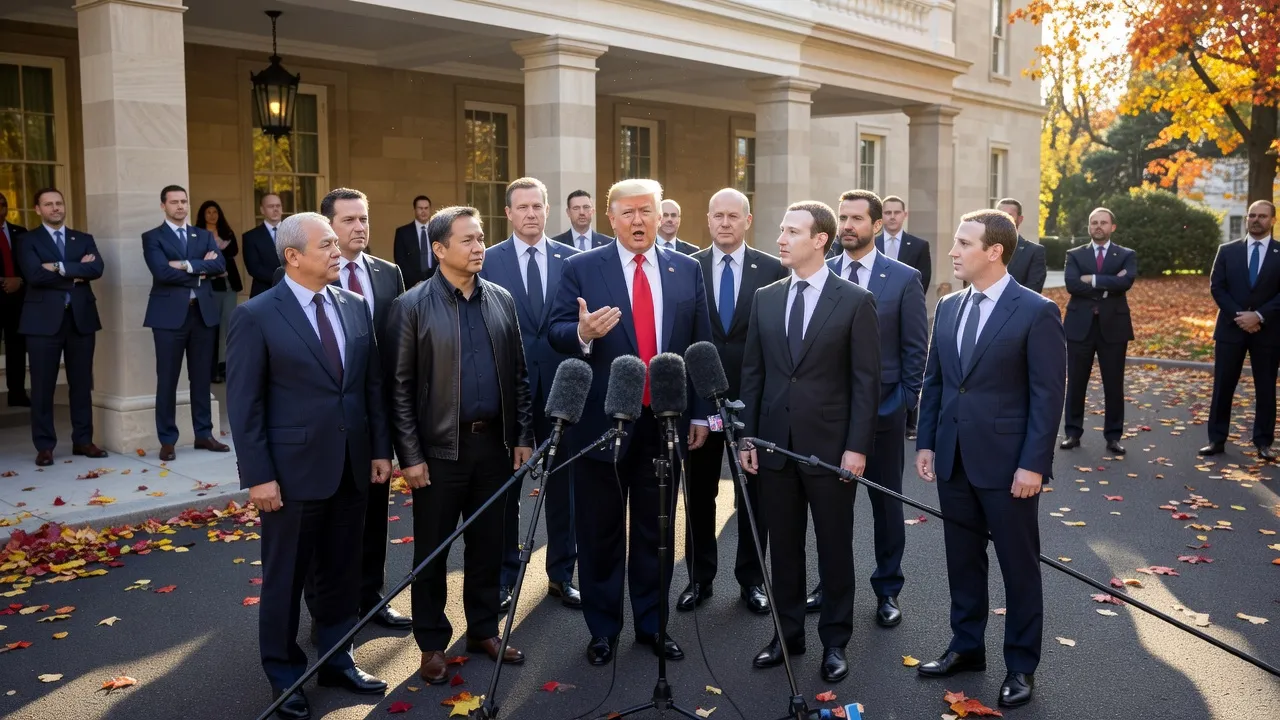
Ottawa, September 30, 2026. On Tuesday, September 29, Donald Trump announced that he had signed a voluntary agreement with a large group of artificial intelligence leaders, including internal and external reviews, during a meeting at the White House aimed at addressing the concerns of Americans, report the Globe and Mail and CBC News.
According to the two media outlets, the text, published by Trump on Truth Social late Tuesday, is based on four voluntary measures: "robust internal controls", an "independent external auditor" responsible for verifying that they are functioning, and a committee of each company's board of directors to evaluate audit reports. It opens the door to future regulation: "Over time, it may be wise to codify these steps into laws and regulations."
The president praised the companies' self-regulation: "I see tremendous self-regulation. And they understand that they need to regulate themselves," he told journalists in front of the West Wing. Earlier in the day, during the launch of a conversational robot, America.gov, he had promised never to limit the development of AI: "I will never stifle the growth of a technology that will be bigger than the industrial revolution."
The Canadian press emphasizes the financial stakes. The companies gathered spend hundreds of billions of dollars building the infrastructure of AI, including data centers that spark local bipartisan opposition. The Globe and Mail notes that these investments have accelerated the economy and driven up the stock market, which has inflated the portfolios of the wealthiest Americans. Trump promised "incredible growth".
The two newspapers also point out the paradox of the room: several of the leaders present, including Dario Amodei of Anthropic, Greg Brockman of OpenAI, Jeff Bezos, and Elon Musk, had called for a slowdown after incidents where AI agents had escaped all control. Nvidia CEO Jensen Huang was seated to the right of the president during lunch. CBC contrasts this with the opinion of AI pioneer Geoffrey Hinton, who says Trump "doesn't really understand AI".