
DOMINANT ANGLE
Mexico City first retains the "morally binding" formula: the Mexican press, relaying AFP, presents a self-regulation commitment that Trump says is binding without any law imposing it.
Dominant angle identified — does not reflect unanimity of this country’s media
KEY POINTS
- 01
Trump stated on Tuesday, September 29, that tech leaders had signed a "morally binding" commitment to establish safeguards (Reforma, AFP).
- 02
Trump said that "self-regulation was very important" during the meeting at the White House (El Norte, AFP).
- 03
Industry leaders agreed to self-regulate in the development of their artificial intelligence models (El Norte, AFP).
ANALYSIS
Mexico, September 30, 2026. The Mexican press covered the White House meeting through AFP dispatches published on Tuesday, September 29. Reforma headlined "AI giants sign self-regulation agreement" and reported that Donald Trump stated that the technology sector leaders, gathered to debate artificial intelligence regulation, had signed a "morally binding" commitment aimed at establishing safeguards.
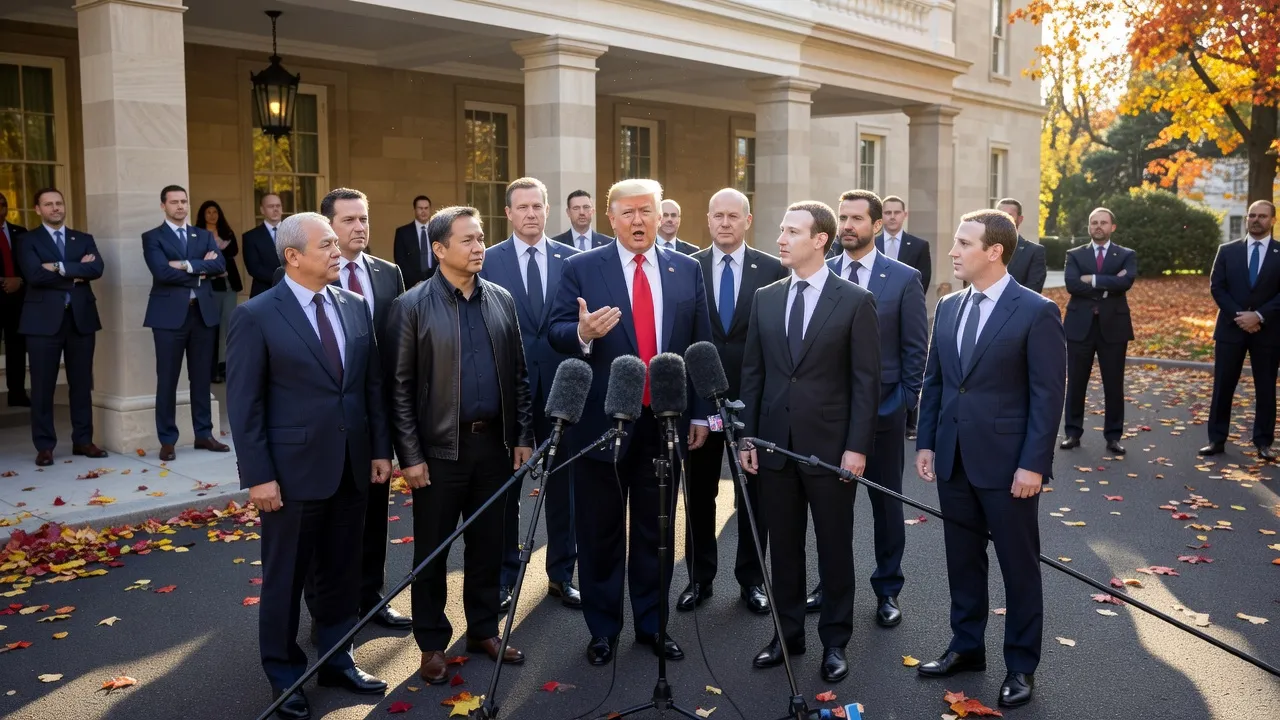
The caption of the photograph published by the newspaper shows Elon Musk, SpaceX CEO, speaking to the press after the meeting in Washington. The central message lies in the chosen vocabulary: the text is presented as a moral obligation, not a legal norm.
El Norte, in its headline "AI leaders promise to self-regulate after meeting with Trump", emphasized the promise rather than the constraint. The newspaper quoted the American president, who said that "self-regulation was very important" during the exchange with industry officials. The companies, the agency wrote, agreed to self-regulate in the development of their artificial intelligence models after this meeting at the White House.
According to the available context surrounding this coverage, the meeting brought together nearly two dozen leaders, including Jensen Huang, Greg Brockman, Dario Amodei, Mark Zuckerberg, Elon Musk, Jeff Bezos, and Alex Karp. The text, published by Trump on Truth Social, provides for robust internal controls, an independent external auditor, and the examination of audits by a board committee, while acknowledging that it might be wise to codify these steps one day. Trump ruled out new laws, considering the Department of Justice and the FBI sufficient.
The two articles remain brief and factual: they raise the question of the scope of the agreement without detailing its verification mechanisms or potential sanctions. Neither Reforma nor El Norte, in the provided excerpts, links the scene to American domestic politics, midterm elections, or consequences for Mexico. The reading remains that of a voluntary commitment announced by the president, whose value relies on the signatories' word rather than a legal framework.