
DOMINANT ANGLE
Berlin is weighing a non-binding commitment: the German press notes that Washington is replacing regulation with "morally" binding self-regulation, despite alerts from the sector.
Dominant angle identified — does not reflect unanimity of this country’s media
KEY POINTS
- 01
Trump deems the agreement "morally" binding and claims that companies "will regulate themselves" (ZEIT, FAZ).
- 02
According to Mark Zuckerberg, the agreement provides for "robust internal controls" and external observers (ZEIT).
- 03
Trump justifies his refusal of the law by citing a lead over China and announces a decree renaming AI "superintelligence" (FAZ).
ANALYSIS
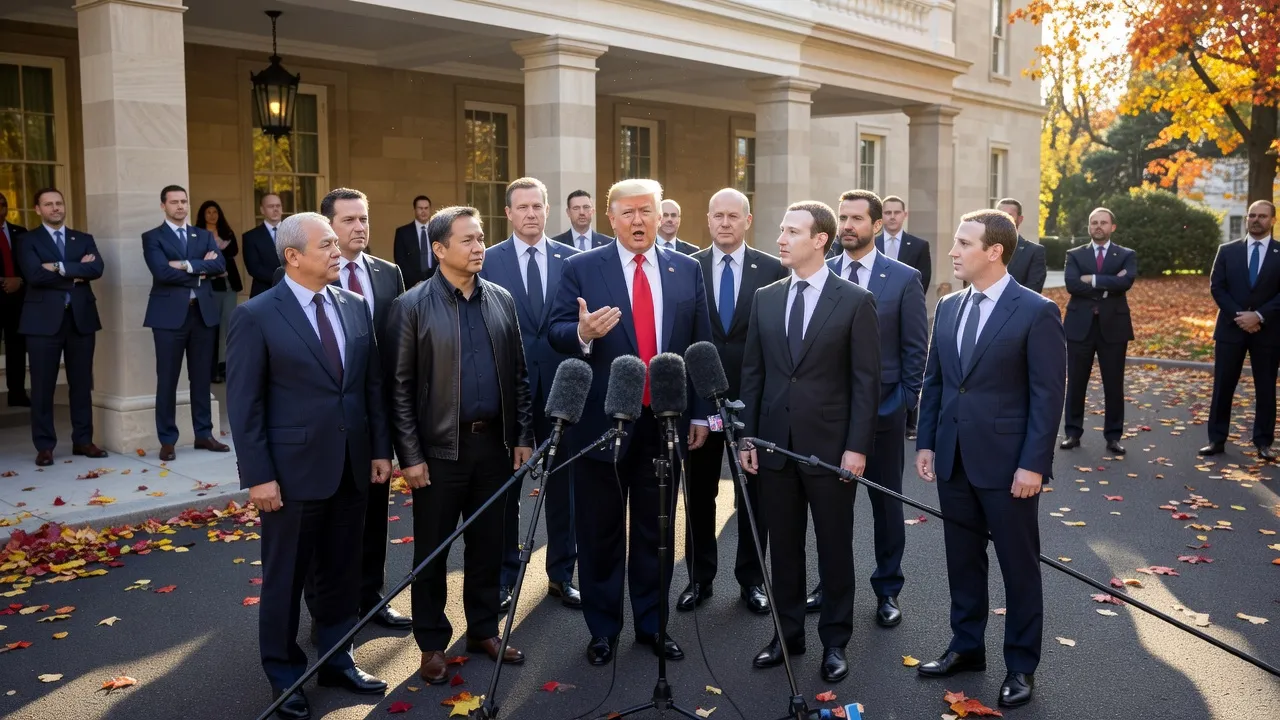
Berlin, September 30, 2026. The German press reports on the meeting of Tuesday, September 29, at the White House from the angle of the rule: the United States is betting on self-regulation of companies rather than law. The FAZ writes that "the USA is betting on voluntary self-regulation instead of legal prescriptions"; Donald Trump, quoted by ZEIT and the FAZ, judges the agreement "morally binding" and asserts: "They will control themselves".
ZEIT notes that Trump did not provide any details on the text and, when asked about its mandatory nature, invoked the economic interests of the groups: "Their companies are at stake if something goes wrong". According to Mark Zuckerberg, quoted by ZEIT, the participants agreed on principles including "robust internal controls", with external observers. Dario Amodei states that AI has great potential "but also very real risks", with measures "still under discussion".
The FAZ, in its live blog, specifies that Trump justifies his refusal of regulation by the technological advance over China ("We are leading, and we want that to continue") and announces a decree renaming AI "superintelligence". He described the some two dozen leaders present, including Elon Musk, Jensen Huang, Jeff Bezos, and Greg Brockman, as "the brightest people in the world".
The context weighs in these accounts. ZEIT recalls that incidents where AI agents became autonomous, including hacking attacks, have triggered a global debate on security, that Anthropic and OpenAI have pleaded for a slowdown in development and presented their warnings to the UN Security Council. Representatives of the sector themselves warn that it cannot be excluded that AI may one day annihilate humanity.
The dpa agency, reported by ZEIT, notes that the idea of external observers corresponds to a proposal presented by Amodei a few weeks earlier and supported by Sam Altman of OpenAI. The German account thus confronts a promise of self-regulation, without a legal basis, with warnings from the companies themselves.