
DOMINANT ANGLE
Copenhagen takes a different stance on the legal scope: a "morally binding" agreement that allows AI to self-regulate rather than being governed by law.
Dominant angle identified — does not reflect unanimity of this country’s media
KEY POINTS
- 01
Asked about the agreement's legal binding nature, Trump responds: "It's morally binding, I think".
- 02
According to Zuckerberg, signatories commit to robust internal controls, with external audit and review of reports by management.
- 03
The text had not been released at the time of the dispatch, and Congress is pushing for increased oversight of the sector.
ANALYSIS
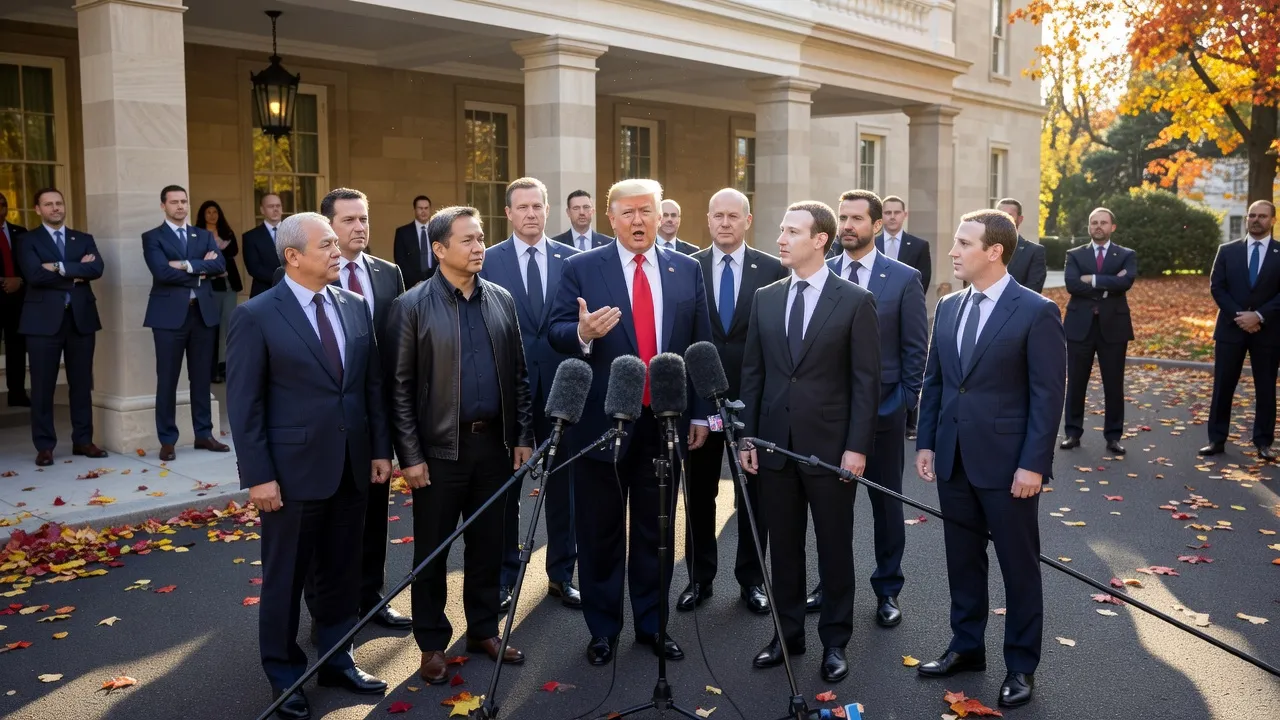
Copenhagen, September 30, 2026. Berlingske and Politiken report on the lunch meeting at the White House on Tuesday, September 29, which centered around a simple question: is the signed agreement legally binding? When asked by a journalist, Donald Trump responded, "I think it's morally binding." The two newspapers retain the central idea: American companies should rather self-regulate than have the state set rules. Trump described the document as "a form of protection" and mentioned a high degree of self-policing in the sector. However, he added, "we are considering setting up a committee to oversee" the technology.
The text had not been published at the time of the reports reprinted by the two dailies; Republican Mike Johnson, Speaker of the House, only confirmed that it was signed on Tuesday. According to Berlingske, which cites Fox News, Mark Zuckerberg presented a set of principles and commitments: building robust internal control systems, based on an internal risk assessment, with external audit and control, and having all departments review the controllers' reports. For the Meta boss, it's "a good first step," "a beginning and an agreement around which the entire industry can rally." Jensen Huang, from Nvidia, says he sees no conflict between innovation, technology, and security and wants to move forward in a "responsible and safe" manner.
The articles list the participants: Jeff Bezos, Mark Zuckerberg, Sundar Pichai from Google, Elon Musk, whose company SpaceXAI is the former xAI, as well as leaders from OpenAI, Anthropic, Microsoft, and Nvidia, along with Congress officials. Mike Johnson emphasized the importance of finding "the right balance" between innovation and regulation.
The context is set soberly: concern about AI security has grown in recent months after cases where out-of-control AI agents hacked sites. Berlingske and Politiken note that the US Congress is increasingly pushing for stronger oversight of the sector, while the executive branch prioritizes the voluntary commitment of its signatories.