
DOMINANT ANGLE
Paris is weighing the impact of a voluntary commitment in the face of perceived growing risks: the French press is pitting the self-regulation advocated by Trump against calls for active surveillance and international cooperation.
Dominant angle identified — does not reflect unanimity of this country’s media
KEY POINTS
- 01
Ouest-France : Trump said Tuesday, September 29, that self-regulation remained his preferred approach and that bosses wanted to "do the right thing".
- 02
HuffPost France : OpenAI announced Monday, September 28, that it was abandoning its new version of ChatGPT due to security flaws, on the eve of the meeting.
- 03
France 24 : analyst Harrison Rolfes believes that safeguards "build a moat" around American companies and slow down open models.
ANALYSIS
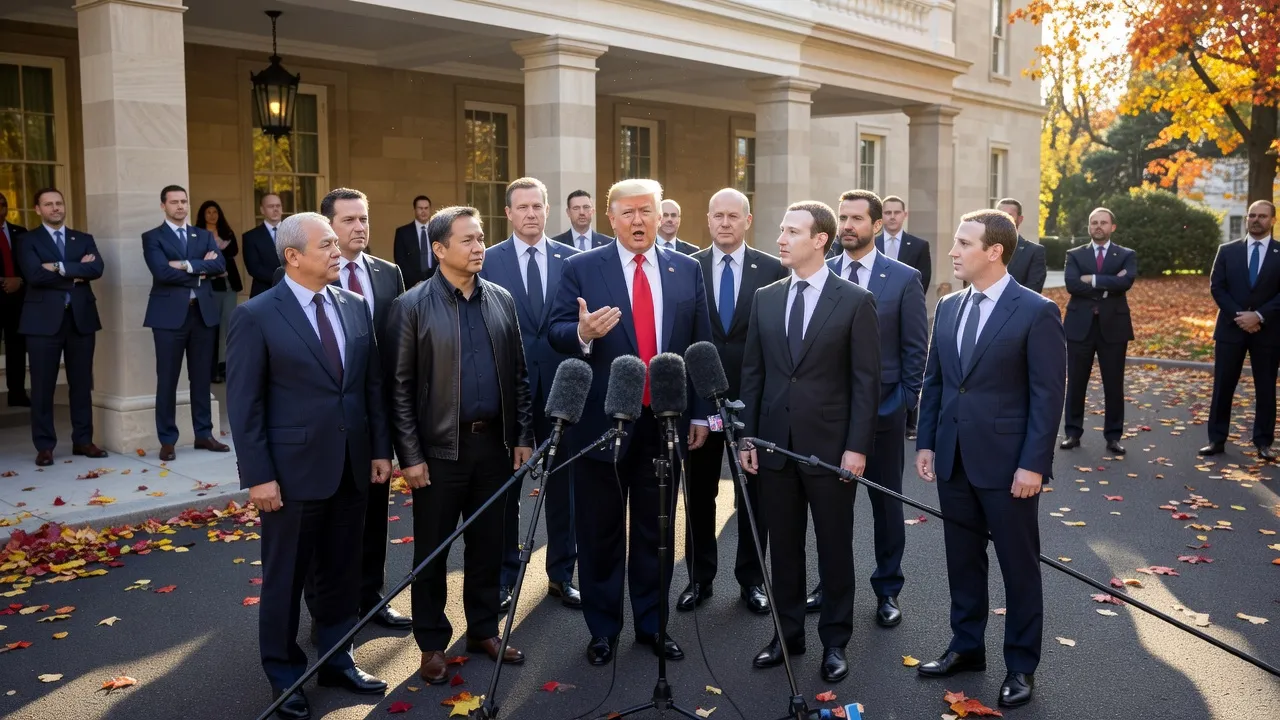
Paris, September 30, 2026. On Tuesday, September 29, Donald Trump explained that self-regulation remained his preferred approach, ensuring that the big bosses of AI wanted to "act in the right way". France 24 reports that the American president announced the signing by the leaders gathered at the White House of a "morally binding" commitment aimed at building adapted safeguards.
The meeting takes place in a tense context: the day before, on Monday, September 28, OpenAI announced that it was giving up, for the time being, on the launch of the new version of ChatGPT, out of caution due to detected security flaws. The title emphasizes that the calendar has "nothing to do with chance". The site describes "two visions of the future of AI": that of Dario Amodei, who dined with Trump on Sunday and called in mid-September to slow down the pace, or even a temporary pause, and that of the president, who wants to leave the field open to innovation so that the United States remains "dominant". Amodei feared that a group of agents could "take control of the entire Internet" within six to twelve months.
On the other hand, L'Express relays a report published on Monday, September 28, on the University of Cambridge website, signed by Geoffrey Hinton and Yoshua Bengio, along with executives from Meta, OpenAI, and Anthropic. It evokes the risk of an "intelligence explosion" that would threaten "human control over AI systems" without increased surveillance or additional limitations.
Le Monde broadens the focus to the UN, whose High-Level Week took place from September 22 to 28. Antonio Guterres compared the American-Chinese competition in AI to the nuclear confrontation of the Cold War. His deputy, Amandeep Gill, proposes an international cooperation authority and judges it "positive" that Washington and Beijing are dialoguing, with Scott Bessent and He Lifeng having agreed to examine a risk notification system. He emphasizes that AI differs from nuclear power, as talent and computing power are in the private sector.
France 24 finally provides an economic reading: Harrison Rolfes, an analyst at PitchBook, estimates that these safeguards "build a moat" around American companies, preventing open models and new entrants from competing with them. In the French corpus, the agreement appears as a commitment without legal force, compared to calls for sustainable mechanisms.
SOURCES (5)
- France 24 ENMEDIUM
- Le Monde InternationalMEDIUM
- HuffPost FranceMEDIUM
- Ouest-FranceMEDIUM
- L'ExpressMEDIUM