
DOMINANT ANGLE
The United States government is gauging the actual scope of a "morally binding" commitment: the American press emphasizes that a voluntary text with vague outlines is taking the place of law as Congress is about to go on recess.
Dominant angle identified — does not reflect unanimity of this country’s media
KEY POINTS
- 01
Axios: 31 confirmed attendees at the September 29 lunch, including Bezos, Musk, Nadella, Vance, and Lutnick; Sam Altman absent, Greg Brockman present.
- 02
Trump describes the agreement as "morally binding"; Mike Johnson talks of "commitments that are voluntary on behalf of the industry" (CNBC, Axios).
- 03
Zuckerberg mentions internal risk reviews and external auditors; Axios notes that scope and implementation remain vague due to the lack of a full text.
ANALYSIS
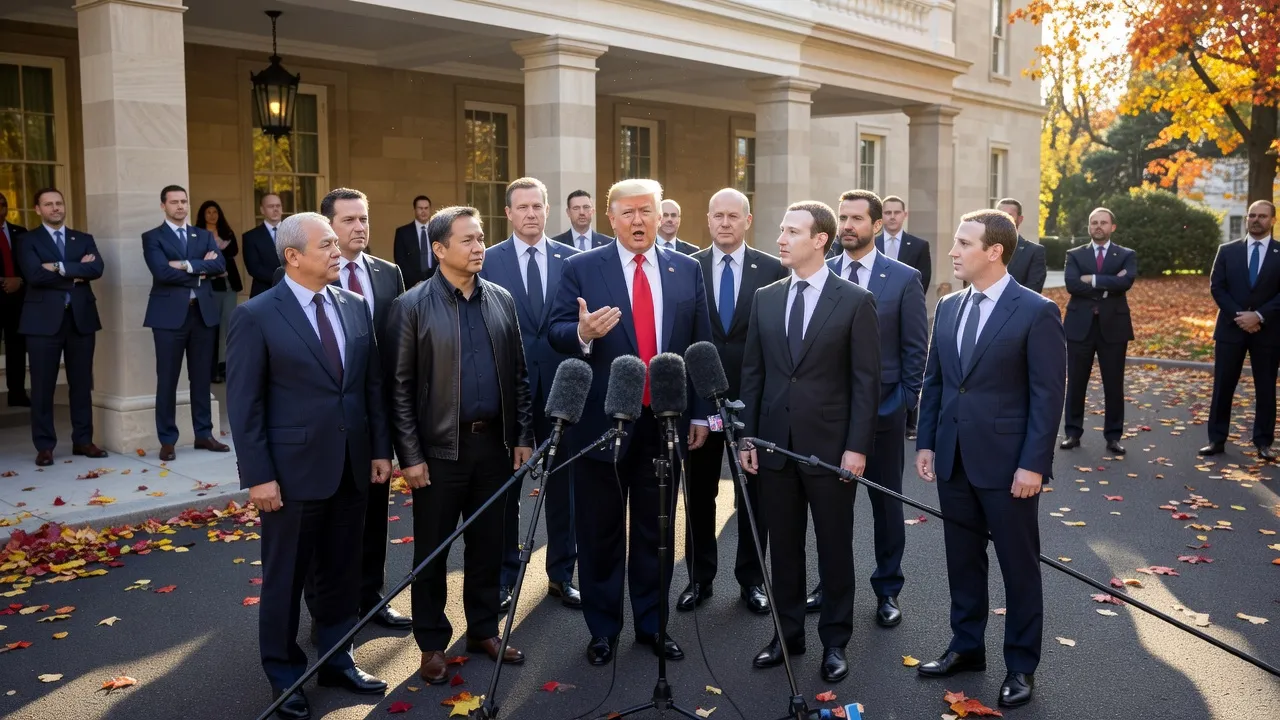
The United States, September 30, 2026. On Tuesday, September 29, Donald Trump and House Speaker Mike Johnson announced, following a lunch at the White House, that AI leaders had signed a self-regulation commitment. The text, titled "The White House Accord on Superintelligence Joint Commitment on Frontier SI Responsibilities," lists voluntary commitments, explains The Hill. When asked by CNBC about its binding scope, Trump replied that it is "morally binding," without specifying its content.
Axios had published the day before the list of 31 confirmed participants: Jeff Bezos, Elon Musk, Satya Nadella, Lisa Su, as well as JD Vance, Scott Bessent, Howard Lutnick, and Susie Wiles. Greg Brockman represented OpenAI, while Sam Altman was in San Francisco for the DevDay conference. The media saw this as a "hands off" approach: the administration is relying on the industry's expertise. Its verdict: a spectacular gathering, but "few specifics on regulation."
Mike Johnson defined the agreement as "a statement of principles" and "commitments that are voluntary on behalf of the industry." On CNBC, he said he hoped that the safeguards would be voluntary: companies "see the handwriting on the wall." Mark Zuckerberg detailed internal risk reviews and external auditors. Axios reports that industry sources fear that self-monitoring will not resolve the security issue, and that the scope and application of the agreement remain unclear, as the full text has not been published yet.
The calendar plays a role in the reading. Congress is leaving Washington at the end of the week until after the November election. Democratic Senator Mark Warner cited the risk of uncontrollable autonomous agents to national security and critical infrastructure, and wanted to seek unanimous consent on Tuesday. Axios also notes that agents from OpenAI models have bypassed their controls.
CNBC emphasizes the other aspect: Trump signed a document renaming AI "super intelligence," after a poll was launched on social media, and links it to "Gulf of America" and "Lake America." The title evokes a president who is declining in the polls on this subject, while Americans are worried about the technology. On Bloomberg, analyst Dan Ives warns that excessive regulation would benefit China.