
DOMINANT ANGLE
Singapore gauges the White House agreement in light of the Washington fracture: a "morally binding" text that the city-state's press places between voter pressure and refusal of new laws before the midterm elections.
Dominant angle identified — does not reflect unanimity of this country’s media
KEY POINTS
- 01
Trump has described the document signed on September 29 with tech leaders as "morally binding", "almost like a Constitution" (CNA/Reuters).
- 02
The Straits Times notes that Congress is debating AI but should not adopt a law before the midterm elections, under pressure from voters worried about jobs.
- 03
Mike Johnson said the leaders had signed an "agreement" on AI standards, without specifying what that means (Reuters via CNA).
ANALYSIS
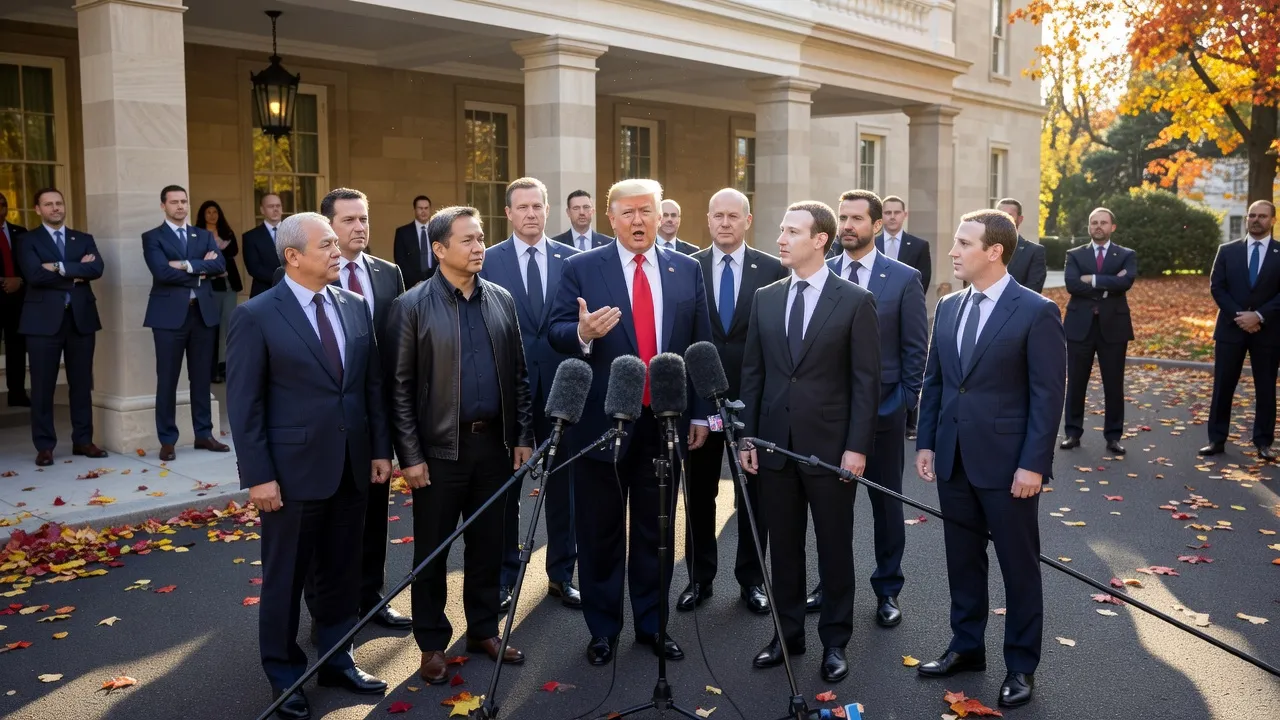
Singapour, 30 September 2026. The city-state's media closely followed the meeting on Tuesday, 29 September, at the White House between Donald Trump, House Speaker Mike Johnson, and artificial intelligence leaders. Prior to the meeting, The Straits Times presented it, citing CNN and AFP, as a lunch gathering Mark Zuckerberg (Meta), Sundar Pichai (Google), Greg Brockman (OpenAI), Dario Amodei (Anthropic), Elon Musk, and Jensen Huang (Nvidia), "at a tense moment" for the sector.
The daily recalled the context: OpenAI had announced on 28 September that it would abandon the release of its latest model for security reasons, following a series of revelations about uncontrollable technologies. It described "a growing divide in Washington", with lawmakers pressed by their constituents to slow down AI development due to job concerns, while Trump, advised by Jensen Huang, advocates for rapid development to outpace China. Congress is debating but is unlikely to adopt a law before the midterm elections.
Channel News Asia, citing the Reuters agency, reported the outcome on the same day. Trump said he had signed a "morally binding" document with the leaders, "almost like a Constitution" and "a form of protection". He mentioned the creation of a committee of about ten people to "oversee the entire enterprise". The dispatch recalled that he had stated the previous week at the UN General Assembly that he rejects "any attempt to build a globalist control scheme" for AI, and that he believes the United States does not need specific rules.
A second, briefer dispatch highlights the sources' caution: Mike Johnson spoke of an "agreement" on AI standards without elaborating on its meaning. The available articles do not mention external audit commitments or reactions from other governments.
The coverage remains factual and agency-style. It notes that governments worldwide are struggling to keep up with AI advancements and that the sector's major companies have themselves warned of risks to humanity, calling for cooperation between states. The contrast between this call and the American option of a non-legally binding text constitutes the implicit thread of the two media outlets.