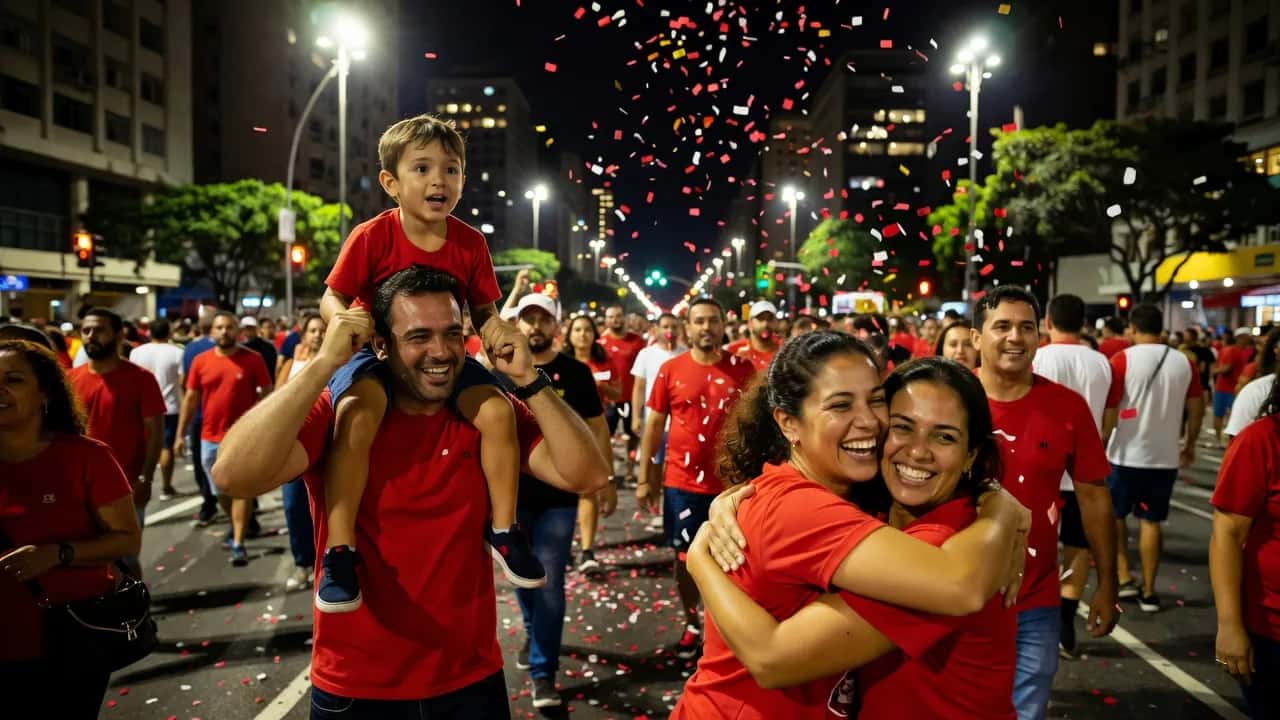
Brazil: Lula re-elected for a fourth term, Flávio Bolsonaro rejects the result and seeks to annul the vote
published on
countries
sources
articles
More divergent than 40% of recent comparable stories (reference: 98 recent stories measured with the same method).
Beyond the score, national coverage details a chaotic voting day, judicial referees being questioned by each camp, and an upset that polls had not anticipated, differing mainly in their scale of analysis: Brasília, Washington, or the continent.
The annulment appeal announced by Flávio Bolsonaro to the Superior Electoral Court has not yet been examined; the official count gives Lula as the winner.
A contested voting day
Sources agree on the sequence of events, but less so on its scope. According to Estadão, Cristiano Zanin extended voting after public transportation restrictions in Salvador, São Paulo, and eight other states. ABC (Australia) only mentions three cities in the state of Bahia; SAPO (Portugal) talks about cities in nine states. Each media outlet retains the scope cited by its own sources.
« Never in the history of the TSE has there been an extension »
Rzeczpospolita, citing AFP and Reuters, reports that Lula stated 40% of buses in São Paulo were unable to operate and that he requested an extension in nine states. Flávio Bolsonaro's team had demanded the same in three states, citing weather conditions; FAZ lists five: Minas Gerais, Rio Grande do Sul, Paraná, São Paulo, and Santa Catarina. In Bahia, still according to Rzeczpospolita, a court ordered the arrest of the mobility secretary of Salvador, suspected of limiting the number of buses. Mayor Bruno Reis, who supported Bolsonaro, mentioned 75 buses temporarily withdrawn.
The arbitrators themselves are being called into question. The Guardian notes that Zanin was Lula's lawyer and was appointed by him, and that the president of the electoral court, Kassio Nunes Marques, appointed by Jair Bolsonaro, had been criticized for decisions favorable to the senator. According to SRF, Lula's camp reproaches Nunes Marques for remaining inactive when a request for an extension was received as early as noon. El Comercio (Peru) reports that Nunes Marques criticized the measure while acknowledging Lula's victory.
A disputed recourse to chance
French, Hungarian, South African, and Philippine coverage cite analysts who deem the cancellation unlikely. L'Express highlights the extent of the defeat; HVG and 444, which reiterate the MTI agency, add that the Bolsonaro camp had itself requested extensions. Mario Braga, from the Rane firm, does not rule out right-wing protests but judges it "very unlikely" that they would reverse the result. Meduza, citing the BBC, notes that no Brazilian presidential election has ever been cancelled.
« I will not accept that the rules of the game have changed during the game »
The texts also leave points open. Mediafax reports, according to Reuters, that available information does not specify other legal arguments, nor whether the request was filed, nor the response from electoral authorities. Politologist Marco Teixeira, cited by Svenska Dagbladet, believes the justice system has made "a serious mistake", while estimating that too few people voted after 5 pm to change the result.
G1 recalls that Flávio Bolsonaro will lose his mandate and privileged forum in 2027; SRF writes that his senate term expires in January and that he is targeted by investigations for alleged money laundering. La Folha notes that allies of the candidate suggest fraud, without evidence.
An overthrow, then a constrained mandate
In the first round on October 4, Flávio Bolsonaro was ahead of Lula, 47.03% to 45.16%, a lead of 2.2 million votes, according to Perfil (Argentina). Veja notes that almost all polls had him in the lead, at 51% to 49% for Datafolha, Quaest, and PoderData; Ámbito recalls that the prediction markets gave him around 80% chances.
According to SRF, Lula gained around 10.4 million votes between the two rounds, compared to 3.7 million for his opponent; Handelsblatt reports 10.3 million. The explanations vary by media: higher-than-expected turnout, according to pollsters cited by Tagesschau; mobilization of first-round abstainers (Handelsblatt); activism and a breakthrough in Minas Gerais, 50.43% to 49.57% (Estadão and Folha), as well as Flávio's "soberba" according to editorialist Ricardo Corrêa; a digital campaign in which the WhatsApp group "Lula's Army" exceeded ten million subscribers (SRF).
Le Monde recalls that the right holds a majority in both chambers, with 286 deputies out of 513 and 51 senators out of 81. Subrayado counts, for Bolsonaro's Liberal Party alone, 121 deputies and 28 senators: the two figures do not measure the same thing, one refers to the entire right, the other to a party. Adnkronos reports Lula's response to this Congress: "It's not me who chose the Congress, it's the people".
In terms of budget, Estadão reports that the gross debt went from 71.68% of GDP at the end of 2022 to 82.87% in August 2026. La República (Colombia) cites a deficit of 9.48% and interest rates rising to 15%, and economist Mauro Rochlin summarizes in Subrayado: "the fiscal problem, the fiscal problem, and the fiscal problem". On the markets, an analyst cited by Estadão mentions an Ibovespa below 190,000 points; Bloomberg headlines "markets on alert" without quantifying the decline in real futures contracts.
An election read on multiple scales
According to the meta-analysis ranking, 18 of the 38 national coverage items in the corpus first place the result in the series of victories of right-wing candidates allied with Donald Trump in Latin America, 13 focus on the contestation and Brazilian institutions, and 7 relate it to bilateral relations with Brasília. This count measures what each coverage highlights, not the opinion of its readers.
« This country will not accept being the backyard of anyone »
These angles respond to different questions. Axios reads a preserved counterweight to Trump and recalls new 25% tariffs imposed this summer; La República (Colombia) mentions a 50% tariff imposed in 2025 after Jair Bolsonaro's condemnation. TBS News and GMA relay a Reuters investigation into a campaign within the State Department to help the Bolsonaros return to power, which Washington denies. Interfax reports that, according to Latin American media, Lula's backyard formula probably targeted the United States.
In the chancelleries, Estadão writes that the right-wing presidents of Paraguay, Bolivia, and Panama congratulated Lula before the official proclamation, while Javier Milei remained silent and Donald Trump said nothing. Infobae describes a concerned Milei government; El Cronista estimates a 12.7% decline in Argentine-Brazilian trade over one year in September. Daniel Noboa wrote that "our region has common enemies", according to Primicias; Narendra Modi and Anwar Ibrahim highlighted the strategic partnership and the Global South (The Hindu Business Line, Malay Mail), and Haaretz links the victory to Lula's criticism of the Gaza war.
Supreme Court Judge Cristiano Zanin made it at 16:57, three minutes before the scheduled closing at 17:00.
Lula cited transportation restrictions, Flávio Bolsonaro heavy rainfall in the southern part of the country.
Lula is to be sworn in on January 5, 2027.
The campaign chief of Flávio Bolsonaro talks about a "judicial coup"; the opposition announces a request for the judge's impeachment.
Key figures
- 64,256,23260,369,977 votes for Lula, against 59,826,041 for Flávio Bolsonaro (51.79% of valid votes)1 source · Estadão
Where this figure comes from
… uma disputa presidencial na história entre o primeiro e o segundo turno. Lula teve 51,79% dos votos válidos (64.256.232 votos) contra 48,21% de Flávio (59.826.041 votos) – uma diferença de 4,4 milhões de votos. Em 2022, Jair …
Source: Estadão Exact passage from the article, in its original language, where this number was found during the pre-publication check.
Other figures compared across countries
Share of Lula's votes in the second round
Basis of comparison: Percentage of votes obtained by Lula in the second round of October 25, as reported at the stage of vote counting cited by each media
Media outlets cite percentages ranging from 51.7% to 51.8%, a difference that reflects the stage of the vote count and not a disagreement over the outcome.
Values by country (3)
- Russia · 51.75%Sputnik
- Malaysia · 51.7 per centThe Vibes
- Ukraine · 51.8%NV Ukraine
What the comparison reveals
Common ground and differences in coverage across the media analysed.
What the media report in common
Luiz Inacio Lula da Silva wins the second round of the Brazilian presidential election against Flavio Bolsonaro and obtains a fourth term, a first.
Flavio Bolsonaro states that it is impossible to recognize the result and announces that he will request the cancellation of the election.
The vote was extended by two hours in some polling stations by decision of a Supreme Court judge, and this extension fuels the dispute.
Where media coverage diverges
Origin of the vote extension
On the question of who requested the two-hour extension, some coverage specifies that both camps solicited it (buses for Lula, rain for Bolsonaro), while others only mention the request from Lula's campaign.
Coverage aligned with this reading
Scope of the cancellation appeal
On the chances of the cancellation request succeeding, some coverage cites analysts who deem it unlikely, while others link it to the 2022 precedent and the test of trust in electoral institutions.
Coverage aligned with this reading
Coverage that diverges
Scale of reading the result
Some coverage primarily places the result in the context of the Latin American right-wing wave and Washington's influence, while others treat it mainly through Brazilian politics: contestation, institutions, debt, and the president's room for maneuver.
Coverage aligned with this reading
Coverage that diverges
This grouping describes the publications analysed, not the position of these countries’ populations or of their governments.
How each country frames the event
- diplomatic
- PakistanArgentinaAustraliaBangladeshCanadaIsraelChileChinaColombiaEcuadorFranceIndiaLithuaniaMexicoMalaysiaNigeriaPeruPhilippinesRussiaSenegalUnited StatesUruguayVenezuela
- domestic politics
- DenmarkBelgiumBrazilSwitzerlandGermanyFinlandHungaryItalyPolandPortugalRomaniaSwedenUkraineUnited KingdomSouth Africa
2 different framings across 38 countries · 23 of 38 countries share the same framing
Pair by pair: same frame or different frames
Each square pairs two countries. Filled: both countries' coverage uses the same frame. Empty: their frames differ. The map describes framings without evaluating them.
Pairs with the same frame: 358 of 703
- same frame
- different frames
Blind spots
What the coverage of each country leaves aside, while others put it forward.
 Malaysia
- Flávio Bolsonaro's position and his request to annul the election
- two-hour extension of voting
 Ukraine
- Flávio Bolsonaro's refusal to recognize the result
- two-hour extension of voting
Geopolitical context
This election comes after a series of votes won by right-wing candidates in Latin America, which explains the attention given by many media outlets to Donald Trump and American influence. For Brazil, Lula's fourth term begins with a Congress where the right is in the majority, a rising public debt, and an opponent who is contesting the election, while Jair Bolsonaro is serving a 27-year prison sentence for attempting a coup. The country's partners, from India to China, from Moscow to Jerusalem, are reading the result through their own relations with Brasília.
How each country reads it
Preview: 3 of 38 media perspectives. Syntheses of the media analysed — not direct quotations. Method & limitations
 Pakistan
Islamabad sees Lula's re-election as a setback for the right-wing wave allied with Donald Trump in Latin America, more than a Brazilian political episode.
3 sources · View sources
 Denmark
Copenhagen notes the political upset: Lula, defeated in the first round, wins in the second and enters Brazilian history with a fourth term.
2 sources · View sources
 Argentina
Buenos Aires is deciphering Lula's re-election through its impact on Javier Milei: a silent government, a celebratory Peronism, and a decline in bilateral trade.
5 sources · View sources
The full text, country by country
Pakistan
DOMINANT ANGLE
Islamabad sees Lula's re-election as a setback for the right-wing wave allied with Donald Trump in Latin America, more than a Brazilian political episode.
KEY POINTS
- Lula wins with about 4.4 million votes ahead, or 51.8% of the ballots, according to the Electoral Court (ARY News, Reuters).
- Flávio Bolsonaro refuses to recognize the result, wants to request its annulment and deems "unacceptable" the two-hour voting extension decided by Judge Cristiano Zanin (Business Recorder).
- According to Geo News, Lula's victory slows a wave of right-wing successes in Latin America and Trump's regional agenda.
ANALYSIS
Islamabad, October 26, 2026. Pakistani media, led by ARY News and Geo News, widely picked up Reuters' dispatches to report on Luiz Inácio Lula da Silva's victory in the second round of the Brazilian presidential election on Sunday. Geo's headline speaks of a "historic 4th term" that pushes back "the right-wing wave and Trump's regional agenda".
The narrative first highlights the regional scope. According to the text relayed by ARY, Lula, a "vocal critic" of the US president, was re-elected in a result that "provides relief to critics of widening US influence in Latin America". The dispatch emphasizes that this victory goes against the tide of a series of successes by center-right candidates allied with Trump, and that the first economy in Latin America, with a GDP of $2,600 billion, is expected to continue to defy Washington's demands despite the increase in customs duties.
The figures are given unambiguously: with 100% of the votes counted, the Electoral Court announced a lead of around 4.4 million votes for Lula, who obtained 51.8%. Geo describes a "shock result" that defied polls, precedents, and the anti-incumbent mood. The newspaper recalls that Lula, a former metallurgist and unionist, had been imprisoned from 2018 to 2019 for corruption charges that were later annulled, and that voters had turned away from him and the Workers' Party after scandals and price hikes. A consultant, Leonardo Barreto, sums up the voters' choice between change and "a known path".
The disputed aspect is treated more briefly. Business Recorder reports that Senator Flávio Bolsonaro, from Brasília, refused to recognize his defeat and said he wants to request the annulment of the election, deeming "unacceptable" the decision of Supreme Court Judge Cristiano Zanin to extend voting by two hours. ARY mentions an evening of "chaos" in some polling stations after this last-minute decision.
Lula, for his part, speaks of a "defeat of negationism and lies" before thousands of supporters gathered in São Paulo and Rio de Janeiro, and promises to respect all Brazilians. Pakistani articles contain no official reaction from Islamabad or local analysis: Brazil is read through the prism of the balance of power with the United States.
Denmark
DOMINANT ANGLE
Copenhagen notes the political upset: Lula, defeated in the first round, wins in the second and enters Brazilian history with a fourth term.
KEY POINTS
- Lula wins the runoff with 51.8% of the vote against 48.2% for Flávio Bolsonaro, according to DR Nyheder citing Reuters.
- According to DR correspondent Kristian Almblad, this is the first time a candidate who lost in the first round has won the second round since the fall of the military dictatorship.
- Jair Bolsonaro, sentenced to 27 years in prison for attempted coup, is serving his sentence under house arrest (DR Nyheder).
ANALYSIS
Copenhagen, October 26, 2026. For the Danish press, the Brazilian election is first and foremost a reversal of the situation. DR Nyheder, citing Reuters and the electoral authority, announces that Luiz Inácio Lula da Silva beats Flávio Bolsonaro in the second round with 51.8% of the vote against 48.2%, thus securing a fourth term as president. The public media outlet emphasizes that this result is the opposite of the first round, held three weeks earlier, where Flávio Bolsonaro had obtained more votes than Lula.
It is DR's correspondent in South America, Kristian Almblad, who sets the tone. According to him, "the election was close, but Lula's victory is relatively clear." He finds it "very striking" that Lula has reversed the situation: "He managed to turn the ship around." He recalls that if Lula completes his term, he will have been president for 16 years as a left-wing head of state, and describes him as "a man who is inscribed in Brazilian history in every way." Also according to him, this is the first time a candidate who lost in the first round has won the second, which has not happened since the fall of the military dictatorship.
DR also provides context about the Bolsonaro family: the father, Jair Bolsonaro, who led the country from 2019 to 2022, was sentenced last year to 27 years in prison for attempting a coup and for projects aimed at killing Lula. He is serving his sentence under house arrest.
Berlingske, in a text published on the day of the vote, describes a close election: the polls give "a narrow lead to Bolsonaro or a near-tie" with Lula. Flávio Bolsonaro, 45, calls for "time for real change" and claims that Brazil "cannot bear four more years like these." He promises a tough line against crime and a reduction in public spending. A 67-year-old retiree cited by AFP mentions the cost of living: "people can't even go to the supermarket anymore."
Lula, 80, opposes a Brazilian flag to an American flag: "The right wants to govern with the American flag," he says according to AFP. The two Danish articles provided focus on the personal and historical dimension of the election; they do not address, in the available excerpts, Flávio Bolsonaro's contestation of the result or the reaction of the markets.
Argentina
DOMINANT ANGLE
Buenos Aires is deciphering Lula's re-election through its impact on Javier Milei: a silent government, a celebratory Peronism, and a decline in bilateral trade.
KEY POINTS
- Lula wins with 51.76% against 48.24% for Flávio Bolsonaro, a lead of more than 4.4 million votes, according to the TSE cited by Perfil.
- The Milei government did not congratulate Lula, while Antonio Kast and Santiago Peña were among the first to do so (Infobae).
- In September, Argentine-Brazilian trade fell by 12.7% year over year to $2.662 billion, with imports down 25.2% (El Cronista, ABECEB).
ANALYSIS
Buenos Aires, October 26, 2026. The Argentine press is treating Lula's re-election as a regional event before being Brazilian. According to the Superior Electoral Court, Lula won with 51.76% against 48.24% for Flávio Bolsonaro, after finishing second in the first round on October 4 (45.16% against 47.03%). Perfil highlights more than 4.4 million votes ahead, almost double the 2.2 million the senator had in the first round, with 64.2 million votes. The Buenos Aires Times talks about a "stunning victory" that stops a right-wing wave in Latin America.
The voting day is told in detail. Perfil reports that Lula denounced the withdrawal of buses in São Paulo and Salvador, and that Judge Cristiano Zanin extended the voting until 7 pm across the territory. Flávio Bolsonaro had invoked heavy rains and landslides. El Cronista specifies that his camp contested the decision of a single magistrate and announced that they would demand the annulment of the electoral process.
In his speech, Lula stated that Brazil "is not anyone's backyard", evoking external interference, and called for regulating large digital platforms after the conflict with Meta.
The main prism remains the relationship with Buenos Aires. Infobae describes a concerned Milei government, which did not congratulate Lula while the Chilean Antonio Kast and the Paraguayan Santiago Peña did so among the first. In the executive branch, some mention a possible fraud, others judge that Milei's regional leadership and his link with Donald Trump remain intact; at the Casa Rosada, they celebrate a "TMAP", "everything is going according to plan". On the other hand, Cristina Kirchner, Sergio Massa, and Axel Kicillof welcomed the result, the first speaking of an "October 17th electoral".
El Cronista adds the commercial angle: in September, bilateral exchanges fell by 12.7% over a year, to $2,662 million, with imports from Brazil plummeting 25.2%, the eleventh consecutive decline. The Lula government had denounced the "injerencia" of Milei, openly favorable to Bolsonaro, and the ambassadors were withdrawn. Ámbito finally recalls that the prediction markets gave around 80% chances to Bolsonaro.
 Australia
DOMINANT ANGLE
Canberra is first measuring Lula's re-election against the backdrop of Donald Trump: a halt to the conservative Latin American wave, with Flávio Bolsonaro's refusal to recognize the result in the background.
KEY POINTS
- Lula wins with 51.8% of the vote against 48.2% for Flávio Bolsonaro, a margin of around 4.4 million votes, for an unprecedented fourth term (SBS, ABC).
- Judge Cristiano Zanin extended voting by two hours at the request of Lula's campaign, after transportation issues in three cities in Bahia (ABC).
- Flávio Bolsonaro says: "It is impossible to recognize the results. I will request the annulment of these elections" (SBS).
ANALYSIS
Canberra, 26 October 2026. The Australian press is treating the re-election of Luiz Inácio Lula da Silva as a setback for the conservative Latin American wave backed by Donald Trump. The Age and the Sydney Morning Herald, which are publishing the same dispatch from Rio de Janeiro, are headlining the return of this "Trump critic": with 100% of the votes counted, the electoral court is attributing 51.8% and nearly 4.4 million more votes to him than to Flávio Bolsonaro. The article sees this as a relief for those who worry about the growing American influence in the region, and notes that Mexico and Brazil, the two most populous countries in Latin America, now have center-left leaders. It adds that the continent's leading economy, with a GDP of $2,600 billion, can remain independent of Washington despite Mr. Trump's tariffs.
SBS is emphasizing that Brazil has slowed a movement that has shifted Argentina, Chile, Colombia, and Peru to the right, with the support of the American president. The media outlet is describing a spectacular comeback and an unprecedented fourth term for a leader who will be 81 years old on Tuesday, 27 October. ABC is talking about a result that "defies polls, precedents, and the anti-incumbent sentiment" observed around the world.
The election is being described as chaotic. According to ABC, Supreme Court Judge Cristiano Zanin has accepted the Lula campaign's request to extend voting by two hours, due to public transportation problems in three cities in the state of Bahia. Flávio Bolsonaro, who had also requested an extension in certain regions because of heavy rain, has deemed the decision "unacceptable" and spoken of a "low blow" (SBS). From Brasília, he has stated: "It is impossible to recognize the results. I will request the annulment of these elections." SBS recalls that his father, Jair Bolsonaro, is serving a 27-year prison sentence for attempting a coup.
In his victory speech, Lula said he had "convinced people that voting was extremely important to safeguard democracy" and promised to govern for 215 million Brazilians. PerthNow is gathering reactions from leaders: Claudia Sheinbaum is hailing the victory of the Brazilian people, Chilean José Antonio Kast is congratulating Lula and evoking economic integration and the fight against organized crime, while Miguel Díaz-Canel sees the continuation of the path of "peace, sovereignty, and social justice". The economic aspect remains slim: The Age is only quoting a Bolsonaro supporter, businessman Rodrigo Valentim, who claims that a new Lula government will harm the economy.
 Bangladesh
DOMINANT ANGLE
Dhaka is reading the Brazilian election through a geopolitical lens: Lula's victory is presented as a halt to the regional conservative wave backed by Donald Trump.
KEY POINTS
- Lula wins with 51.8% of the vote against 48.2% for Flávio Bolsonaro, a margin of around 4.4 million votes, according to official results cited by The Daily Star.
- Brazil "has rejected a conservative wave" that has shifted Argentina, Chile, Colombia, and Peru to the right, with the support of Trump.
- Flávio Bolsonaro states: "It is impossible to recognize the results" and announces plans to request the annulment of the election.
ANALYSIS
Dhaka, October 26, 2026. The Bangladeshi press is covering the second round of the Brazilian election on Sunday, October 25, as a test of the conservative wave sweeping across Latin America under Washington's watch. The Daily Star headlines the victory of Luiz Inácio Lula da Silva and Flávio Bolsonaro's demand for annulment. According to official results, Lula won with 51.8% of the vote against 48.2%, or about 4.4 million votes ahead. The newspaper speaks of a "spectacular comeback" by the left-wing leader, who will be 81 years old on Tuesday and is obtaining an unprecedented fourth term, despite unfavorable projections.
The newspaper places this result in a regional context: with this victory, Brazil "has pushed back a conservative wave" that has shifted Argentina, Chile, Colombia, and Peru to the right, with the support of US President Donald Trump. It recalls that no candidate defeated in the first round had won the second since 1989, the first direct election after the military dictatorship.
TBS News, published on the day of the vote, posed the issue in geopolitical terms: a victory for Flávio Bolsonaro, 45, would have extended the series of successes of candidates close to Trump, while a fourth term for Lula would be "a disappointment in Washington", which has opposed his government on trade and security. The site reports that Reuters revealed on Saturday a campaign within the State Department to help the Bolsonaros return to power, which Washington denies. When asked, Trump replied: "I don't want to get into that, but we're watching."
On the conduct of the election, The Daily Star reports the confusion: a Supreme Court decision extended voting by two hours, while some polling stations had already closed, at Lula's request, who denounced the withdrawal of buses from circulation in several cities. Flávio Bolsonaro had also requested an extension in certain regions due to heavy rains, but judged the decision "unacceptable" and a "dirty trick". From Brasília, with a stern face, he stated: "It is impossible to recognize the results. I will request the annulment of these elections."
The son of Jair Bolsonaro, sentenced to 27 years in prison for attempting a coup after his 2022 defeat, had promised to release his father if he was elected, TBS notes. The campaign, the site writes, was dominated by corruption scandals, economic anxiety, and accusations of American interference.
 Belgium
DOMINANT ANGLE
Brussels takes away from this second round the Brazilian exception in the face of the Latin American right-wing wave, while pointing out a divided country, a president with reduced margins and a loser who is calling for the cancellation of the election.
KEY POINTS
- Lula is reelected with 51.8% of the vote against 48.2% for Flavio Bolsonaro, a margin of 4.4 million votes.
- By decision of a Supreme Court judge, voting was extended by two hours on Sunday.
- Flavio Bolsonaro announced his intention to have the election annulled, while the right won a landslide in the legislative elections three weeks ago.
ANALYSIS
Brussels, 26 October 2026. The French-speaking Belgian press, led by La Libre Belgique and La Dernière Heure, is reporting on the dispatch announcing the re-election of Luiz Inacio Lula da Silva on Sunday, 25 October, for an unprecedented fourth term. With 51.8% of the vote against 48.2% for conservative senator Flavio Bolsonaro, the outgoing left-wing president, who will be 81 years old on Tuesday, has "defied all predictions" and won with a 4.4 million vote lead. He had nonetheless been overtaken in the first round by the son of former far-right president Jair Bolsonaro (2019-2022), who was condemned for attempting a coup.
The account first highlights the regional contrast: Brazil "has ultimately not shifted to the right like Argentina, Chile, or Colombia, all supported by US President Donald Trump" and remains "one of the few progressive strongholds in Latin America". From the opening of the polling stations, La Libre recalled that nearly 160 million voters were called to the polls while the right, encouraged by Washington, "has recently racked up victories in the region".
From São Paulo, Lula stated that Brazilians "went to vote because we managed to convince them that the vote was very important to guarantee democracy". In a "more gravelly voice than ever", he thanked "the generosity of Brazilian youth", who took to the streets and mobilized on social media between the two rounds to achieve a "virada", the equivalent of a comeback in football.
The newspapers nonetheless emphasize the fragility of this victory. The head of state's room for maneuver is expected to be limited after the "conservative tidal wave" in the legislative elections three weeks ago, and the campaign has shown how divided the country remains. A judicial dispute also disrupted the election day: following a decision by a Supreme Court judge, the vote was extended by two hours.
Flavio Bolsonaro, for his part, has announced his intention to have the election annulled, which the Belgian headlines are reporting ("Bolsonaro wants the election annulled"). The available excerpts do not detail the content of his appeal or the reaction of the institutions; the coverage remains that of a news agency dispatch, without economic analysis or quotes from a local correspondent.
 Brazil
DOMINANT ANGLE
Brasília is measuring the fragility of a victory won in the second round: Lula's fourth term is opening with an opponent who is contesting the election results, a Supreme Court under attack, and a rising debt.
KEY POINTS
- Lula obtains 51.79% of valid votes (64,256,232 votes) against 48.21% for Flávio Bolsonaro (59,826,041), a 4.4 million difference (Estadão).
- STF Minister Cristiano Zanin extended voting until 7 pm after transportation restrictions in ten states (Estadão).
- Public debt rose from 71.68% of GDP in December 2022 to 82.87% in August 2026 (Estadão).
ANALYSIS
Brasília, October 26, 2026. The Brazilian press is framing the result of Sunday, October 25, as a "virada": Luiz Inácio Lula da Silva has been reelected for a fourth term, a first, with 51.79% of valid votes (64,256,232 votes) against 48.21% (59,826,041) for Flávio Bolsonaro, a difference of 4.4 million votes, according to the Estadão. For the first time, the newspaper notes, a candidate who came in second in the first round has won in the second. At 80 years old, Lula will be the oldest president to take office; he will be 81 years old on Tuesday, October 27.
The election was tumultuous. Minister of the Supreme Court Cristiano Zanin extended voting until 7:00 PM after public transportation restrictions in Salvador, São Paulo, and eight other states. The Folha reports that Rogério Marinho, coordinator of Flávio's campaign, sees this as a "judicial coup" and denounces "the level of intervention of certain STF ministers"; the newspaper notes that allies are suggesting fraud without evidence. Flávio Bolsonaro announced that he would request the annulment of the election, and the G1 recalls that he will lose his mandate and privileged status in 2027.
The Estadão and the Folha attribute the comeback to the mobilization of militants, the breakthrough in Minas Gerais (50.43% against 49.57%), and what editorialist Ricardo Corrêa calls Flávio's "soberba". The polls had almost all given Flávio the lead in absolute numbers, at 51% against 49% for Datafolha, Quaest, and PoderData, Veja notes: the outcome has disproven them.
The focus is now turning to the challenges of the fourth term. The Estadão cites a Congress where the opposition is strengthening, pressure to impeach STF judges, and investigations targeting the presidential entourage, including Lula's son Lulinha and lobbyist Roberta Luchsinger, who mentions a denunciation. Economically, the gross debt has risen from 71.68% of GDP at the end of 2022 to 82.87% in August 2026; the newspaper judges that Lula will have to act to contain it, while his campaign has multiplied spending promises. The markets, which were betting on Flávio, are expected to plummet: an analyst mentions an Ibovespa below 190,000 points.
Abroad, the right-wing presidents of Paraguay, Bolivia, and Panama have congratulated Lula before the official proclamation; Javier Milei has remained silent, and Donald Trump has said nothing.
 Canada
DOMINANT ANGLE
Ottawa is gauging Lula's re-election in terms of American influence in Latin America: the Canadian press sees it as a setback for the series of victories by Trump's allies.
KEY POINTS
- Lula wins with nearly 4.4 million votes ahead, or 51.8% of the ballots, according to the electoral court cited by CBC.
- Flávio Bolsonaro refuses to concede, calls the two-hour extension of voting unprecedented, and demands the annulment of the election.
- The Globe and Mail notes that Trump's allies won this year in Chile, Peru, and Colombia; Lula's victory leaves Brazil and Mexico as center-left.
ANALYSIS
Ottawa, October 26, 2026. For the Canadian press, the Brazilian election is first and foremost played out on the hemispheric chessboard. From the day of the vote, the Globe and Mail presented the second round as "a ballot that will determine whether the United States will substantially expand their growing influence in Latin America." The newspaper recalled that Flávio Bolsonaro, an ally of American President Donald Trump and son of former imprisoned President Jair Bolsonaro, had surpassed Lula by more than 2.2 million votes in the first round, and that polls indicated a tight race. It also noted that more than 33 million voters out of nearly 160 million did not cast their ballots, despite compulsory voting.
The next day, CBC News reported that, with the count complete at 100%, the electoral court gave Lula, who will be 81 years old on Tuesday, a lead of nearly 4.4 million votes, or 51.8% of the ballots. The channel described an evening marked by "chaos" in the polling stations, after the last-minute decision to extend the vote by two hours. Flávio Bolsonaro refused to concede defeat, deeming this unprecedented extension unacceptable, even though both camps had requested it, and called for the results to be annulled, which he said were impossible to accept.
CBC emphasized the winner's speech. Lula saw it as "a defeat for negationism and lies" and stated that "this country will not accept being the backyard of anyone." The channel saw this as a reaffirmation of Brazilian sovereignty in the face of Washington, which Lula has openly criticized.
The regional context thus dominates both texts. CBC wrote that Lula's triumph goes against the trend of center-right candidates allied with Trump winning increasingly, and the Globe recalled that his allies won this year in Chile, Peru, and Colombia. With Lula's victory, Brazil and Claudia Sheinbaum's Mexico remain led by center-left presidents.
Flávio Bolsonaro's challenge is reported factually, without discussion of his chances of success before the judicial authorities. Economic issues, including the reaction of the markets, are not mentioned in the provided excerpts: attention remains focused on geopolitics and the role of the United States in the region.
 Switzerland
DOMINANT ANGLE
Bern is focused on the post-election aftermath: a historic re-election of Lula, but a Brazil divided in two, a loser who contests and a power that promises to be more difficult to exercise.
KEY POINTS
- Lula wins with 51.75% against 48.25% for Flávio Bolsonaro, according to SRF, after almost all ballots have been counted.
- Flávio Bolsonaro deems it impossible to recognize the result and wants the election annulled due to a two-hour extension of polling station hours.
- Lula gained around 10.4 million votes between the two rounds, compared to 3.7 million for his rival (SRF).
ANALYSIS
Berne, October 26, 2026. The Swiss press is reporting on the re-election of Luiz Inácio Lula da Silva, focusing more on the aftermath than the election itself. According to SRF, the left-wing president won the second round on Sunday with 51.75% of the vote, compared to 48.25% for his right-wing rival Flávio Bolsonaro, after almost all ballots were counted. Le Temps notes that the incumbent, who will soon be 81 years old, has become "against all expectations" the first Brazilian to secure a fourth term, amidst celebrations in São Paulo, Rio, and Brasília.
SRF links this result to the country's direction: Lula's victory has put an end to the Bolsonaro camp's attempt to bring Brazil, the most populous and economically powerful country in Latin America, closer to the government of Donald Trump, with a promise of closer cooperation with Washington during the campaign. The media lists a favorable record: historic low unemployment, poverty reduction, increase in the minimum wage, gradual introduction of the five-day week, and reduction of deforestation in the Amazon. It also recalls the discontent with the cost of living, high public debt, spendthrift policy, and a presumed fraud scandal in retirement insurance.
A second SRF article focuses on the controversy. Flávio Bolsonaro says he cannot recognize the result and wants the election to be annulled due to the two-hour extension of polling station hours. His campaign director warns of a possible "judicial coup". He targets Judge Zanin, who had ordered the extension due to public transportation problems, a decision that came too late to be applied everywhere. The Lula camp, on the other hand, criticizes the president of the electoral court, Kassio Nunes Marques, for remaining inactive for too long while a request for an extension had been received as early as noon. The Bolsonaro team had also requested an extension in certain regions due to bad weather.
SRF notes that Lula gained around 10.4 million votes between the two rounds, compared to 3.7 million for his opponent, helped by a digital campaign: the WhatsApp group "Lula's Army" has exceeded ten million subscribers. However, governing is expected to be more difficult: Bolsonaro obtained almost half of the votes, and his party PL has gained influence in Parliament. In the defeated camp, the question of leadership may arise; Flávio's senate term expires in January, and he is the target of investigations for alleged money laundering.
 Israel
DOMINANT ANGLE
Jerusalem is measuring Lula's re-election in light of the Gaza war: the return of a virulent critic of Israel, and the defeat of a Netanyahu ally, weigh more than Brazil's electoral dispute.
KEY POINTS
- Lula, 80, wins an unprecedented fourth term, according to the Brazilian electoral court cited by the Jerusalem Post.
- Haaretz recalls that Lula, once a staunch supporter of Israel, has become a fierce critic of the Israeli government and the war in Gaza.
- Flávio Bolsonaro refuses to acknowledge his defeat, wants to have the second round annulled, and deems unacceptable the two-hour voting extension decided by Judge Cristiano Zanin.
ANALYSIS
Jérusalem, October 26, 2026. For the Israeli press, the re-election of Luiz Inácio Lula da Silva on Sunday, October 25, is first and foremost seen through the prism of the relationship with Israel. Haaretz headlines Lula's victory, which beats "Netanyahu Ally Bolsonaro", and recalls that the Brazilian president, "once a staunch supporter of Israel", has become "a vocal critic of the Israeli government and the war in Gaza". The newspaper notes that this 80-year-old man, who has strongly criticized the war waged by Israel in Gaza, has countered a regional trend of right-wing victories in Latin America.
The Jerusalem Post, which picks up the Reuters account, emphasizes the extent of the surprise: according to the electoral court, Lula obtains an unprecedented fourth term, in a result that "defied polls, precedent and global anti-incumbent sentiment". The text recalls that Senator Flávio Bolsonaro, the eldest son of former President Jair Bolsonaro, had come out on top in the first round and hoped to revive his father's far-right movement. Lula, a former metalworker and unionist, had been imprisoned from 2018 to 2019 for corruption, convictions that were later overturned, which allowed him to beat Jair Bolsonaro in 2022.
The newspaper details the mechanisms of the election. Voters had grown tired of Lula and the Workers' Party after corruption scandals and rising prices, and the president seemed disconnected from an increasingly digital economy. Pollsters attribute the victory to higher-than-expected participation. For Leonardo Barreto, from the Think Policy firm, voters chose "a known path, which guarantees certain rights" rather than change. Left-wing MP Erika Hilton, who was present with Lula in São Paulo, describes him as "a statesman, a giant".
The Jerusalem Post devotes a separate brief to Flávio Bolsonaro's refusal to acknowledge his defeat. The senator announced that he would request the annulment of the second round and deemed "unacceptable" the decision of Supreme Court Judge Cristiano Zanin to extend voting by two hours. The text, published as a developing story, does not detail the appeal or its chances of success.
Neither newspaper comments at this stage on potential concrete consequences for bilateral relations between Brasília and Jérusalem, nor the reaction of the Israeli government. The framing remains that of an electoral result seen through its effect on Brazil's alignment, between the right close to Netanyahu and a president hostile to the conduct of the war in Gaza.
 Chile
DOMINANT ANGLE
Santiago is deciphering Lula's re-election through the prism of bilateral relations and regional divisions: the Kast government congratulates, the Chilean left celebrates, and Flávio Bolsonaro's refusal is reported as the point of friction.
KEY POINTS
- Lula wins with 51.79% (64,256,232 votes) against 48.21% (59,826,041) for Flávio Bolsonaro, according to La Tercera.
- Kast's Chancellery congratulates Lula: "for Chile, Brazil is a strategic partner in the region", with 190 years of diplomatic relations.
- Flávio Bolsonaro states: "it is impossible to recognize the result" and announces a request for annulment, after a two-hour extension ordered by Cristiano Zanin.
ANALYSIS
Santiago, October 26, 2026. The Chilean press covers Lula's re-election first as a regional event, where Chile and Brazil speak to each other through their own divisions. La Tercera reports that, with 100% of the ballots counted, Lula won on Sunday, October 25, with 51.79% (64,256,232 votes) against 48.21% (59,826,041) for Flávio Bolsonaro. The newspaper emphasizes the unprecedented nature of the election: a fourth term, and the first time, since 1989, that a candidate who came in second in the first round wins in the second, overturning a gap of 2.2 million votes.
The day is told by La Tercera and BioBioChile through the extension of voting. The Minister of the Federal Supreme Court, Cristiano Zanin, postponed the closing by two hours, until 7 pm, due to rain and a lack of buses, at the request of both camps. Flávio Bolsonaro sees this as an illegitimate intervention: "It is impossible to recognize the result of the elections" and "we will request the annulment of these elections," he declared, denouncing a "flagrant inequality" between cities and states.
The tone is mainly diplomatic. La Tercera publishes the statement from the Chancellery of José Antonio Kast's government, congratulating Lula and recalling that "for Chile, Brazil is a strategic partner," with 190 years of relations. Kast writes on X that he spoke with Lula and wants an agenda of "economic integration and fight against organized crime." On the left, former President Gabriel Boric thanks "viejo lindo" Lula for "never stopping fighting," Michelle Bachelet praises Brazil's role in the region, and the Socialist Party sees "a glimmer of hope for all of Latin America." The communist Lautaro Carmona speaks of "a great triumph of democracy."
La Tercera also relays Gustavo Petro's phrase, "fascism has been stopped in Latin America, in Brazil." BioBioChile had framed the vote as a test for the "right-wing wave": according to the article, the last seven presidential elections in the region since 2025 have been won by the right, and a University of Michigan political scientist, quoted from BBC Mundo, recalled that Brazil is the first economy in the region. El Ciudadano, before the election, relayed the editorial from Brasil 247 opposing "sovereignty" and "vassalage" to Washington.
In his speech, Lula said he wants to govern for "215 million" Brazilians and that "we no longer have adversaries," according to La Tercera; BioBioChile also retains his call to regulate large digital platforms in the face of foreign interference.
 China
DOMINANT ANGLE
Beijing takes away from Lula's re-election the continuity of a government that is a partner of China and the formula of a Brazil that is "nobody's backyard", more than Flávio Bolsonaro's contestation.
KEY POINTS
- According to the Superior Electoral Court cited by CGTN, Lula wins with 51.79% of valid votes against 48.21% for Flávio Bolsonaro (99.99% counted).
- Lula, who will be sworn in on January 5, 2027, asserts that Brazil is "nobody's backyard" and wants to strengthen digital regulation after foreign interference.
- The SCMP notes that no candidate trailing in the first round had won a runoff since 1989 and that the outgoing government oversaw record Chinese investments.
ANALYSIS
Beijing, October 26, 2026. Chinese media are treating the re-election of Luiz Inácio Lula da Silva as an event that is first and foremost regional and diplomatic. CGTN, the international channel of public television, announces that the outgoing president, a candidate for the Workers' Party, won the second round on Sunday, October 25, according to the results of the Superior Electoral Tribunal published on Sunday evening. With 99.99% of the ballots counted, Lula garnered 51.79% of the valid votes against 48.21% for Flávio Bolsonaro, the candidate for the Liberal Party and son of former President Jair Bolsonaro. CGTN specifies that Lula will be sworn in on January 5, 2027, for a four-year term, his fourth presidential election victory.
The channel reports on the victory speech delivered in São Paulo. Lula promises to work with the conservative Congress elected by the population and to involve citizens more in decision-making. CGTN emphasizes another passage: the president stressed the need to strengthen digital regulation after, he says, defeating foreign interference through online platforms, affirming that Brazil is "no one's backyard". The phrase is repeated verbatim in the Chinese account, without detailing the nature of this interference.
The South China Morning Post, a Hong Kong daily, chooses a performance-based electoral angle: an unprecedented "remontada". Lula was behind in the first round, and no candidate who was behind after the first round had won a second round since the system was adopted in 1989. The newspaper describes Flávio Bolsonaro as an ally of Trump and a right-wing senator, and mainly links the victory to bilateral economics: it extends, according to him, a government that has overseen record Chinese investments.
The loser's contestation is mentioned, but briefly. CGTN indicates that Flávio Bolsonaro, speaking from Brasília, deemed it "impossible" to recognize the results and called for the annulment of the election. The article title, "Bolsonaro refuses to concede", is placed as a subtitle to the account of the victory. The articles in the corpus do not detail the legal arguments of the appeal, the extension of the vote, or the reaction of the markets.
The Chinese account thus opens with three elements: the legitimacy of the result established by the official electoral authority, Brazil's digital and political sovereignty in the face of external pressures, and the continuation of an economic relationship favorable to Beijing. The question of Brazilian institutional stability remains in the background.
 Colombia
DOMINANT ANGLE
Bogotá is measuring Lula's re-election against the backdrop of the regional conservative shift: Brazil remains a left-wing stronghold in the face of the momentum backed by Trump, which Colombia is a part of.
KEY POINTS
- Lula wins with 51.76% against 48.24% for Flávio Bolsonaro (99.81% of ballots counted), according to Portafolio.
- Flávio Bolsonaro: "Es imposible reconocer el resultado" and he will request the annulment of the election after the two-hour extension of voting (Semana).
- Lula inherits a deficit of 9.48% and a debt of 82.9% of GDP (La República).
ANALYSIS
Bogotá, October 26, 2026. The Colombian press is covering the re-election of Luiz Inácio Lula da Silva as a continental event. El Colombiano writes that, with this triumph, Brazil "deviates from the turn to the right" taken by Argentina, Chile, or Colombia, supported by Donald Trump, and remains one of the few progressive strongholds in the region. Portafolio speaks of a brake on this conservative shift.
The figures are taken from the official results: 51.76% against 48.24% for Flávio Bolsonaro, with 99.81% of the ballots counted, a difference of more than four million votes. Portafolio highlights an unprecedented comeback: this is the first time since the end of the dictatorship (1964-1985) that a candidate who came in second in the first round wins in the second. Lula, 81, will take office on January 5. El Colombiano notes that no major poll had predicted his victory.
The events of Sunday, October 25, are detailed. Portafolio reports that Judge Cristiano Zanin, of the Federal Supreme Court, extended voting by two hours, until 7:00 p.m. local time, at the request of Lula's campaign, which denounced incidents in the transportation of voters. According to EFE, the decision was made while the vote count had already begun.
Semana gives the floor to the loser. Flávio Bolsonaro stated in Brasília: "It is impossible to recognize the result" and "I will ask for the annulment of these elections," qualifying the extension as "unacceptable" because, he says, it "changed the rules of the game with a stroke of the pen." He claims he will never know how many votes he would have obtained in the states where the polls did not reopen. The same media quotes Lula, emotional, seeing in the election "a defeat of lies" and denouncing attempts at external interference.
The economic prism is provided by La República: Lula inherits a budget deficit of 9.48% and a public debt of 82.9% of GDP, with interest rates rising to 15% to contain inflation. The newspaper also recalls an average growth of 3% between 2023 and 2025 and unemployment at historic lows. Before the vote, it mentioned accusations of American interference, which Washington denies, and the 50% tariff imposed by Trump in 2025 after Jair Bolsonaro's condemnation.
 Germany
DOMINANT ANGLE
Berlin is first focusing on Brazilian institutional stability: a historic victory for Lula, immediately contested by Flávio Bolsonaro who is calling for the annulment of the election.
KEY POINTS
- Lula wins with 51.8% against 48.2%, a lead of nearly 4.4 million votes according to the Superior Electoral Tribunal (Tagesschau).
- First time since 1989 that a candidate has made up for a deficit from the first round: Bolsonaro was leading 47% to 45% (FAZ).
- Flávio Bolsonaro: "It is impossible to recognize the result"; he is calling for annulment due to the two-hour extension, which both camps had requested (Tagesschau).
ANALYSIS
Berlin, October 26, 2026. The German press is treating the second round of the Brazilian election on Sunday, October 25, as a historic victory coupled with a test for the institutions. According to the FAZ, Luiz Inácio Lula da Silva, 80 years old, won with 51.8% of the valid votes against 48.2% for Flávio Bolsonaro. According to the Tagesschau, citing the Higher Electoral Tribunal, the gap reached nearly 4.4 million votes. The Handelsblatt, reporting from Salvador, speaks of a "spectacular victory" and emphasizes that Lula gained 10.3 million votes between the two rounds, compared to 3.7 million for his opponent.
The FAZ notes that, for the first time since the return to direct presidential elections in 1989, a candidate has made up for a deficit from the first round: Bolsonaro was then leading with 47% against 45%. It points out that Lula won against the trend of the legislative and regional elections, where the Bolsonaro camp achieved good results, and explains it partly by the weaknesses of his rival, including investigations into the financing of a film dedicated to his father. The Tagesschau quotes pollsters as saying that unexpectedly high participation helped Lula; the Handelsblatt says he mainly mobilized abstainers from the first round.
The other side of the story is the contestation. Flávio Bolsonaro, presented by the Tagesschau as the son of the former far-right president under house arrest, stated in Brasília: "It is impossible to recognize the result" and announced that he would request the annulment of the election. He cites the extension of voting by two hours decided shortly before the closing of the polling stations, deemed "unacceptable" and "without precedent". The German media recall that this extension was in response to disruptions in public transportation and bad weather.
The newspapers take care to restore the context: the FAZ specifies that the request came from Lula's campaign, but that Bolsonaro's campaign also demanded an extension, limited to Minas Gerais, Rio Grande do Sul, Paraná, São Paulo, and Santa Catarina, due to rain, flooding, and power outages. The Tagesschau formulates the same nuance: both camps had made the request, only the perimeter differed.
Lula, who will celebrate his 81st birthday this week, presented his victory as a vote for democracy: Brazilians voted to "secure democracy". Thousands of supporters celebrated the result in the streets. DW had previously described the two projects that are diametrically opposed, between the memory of the social programs of Lula's governments from 2003 to 2011 and the desire for revenge of a political dynasty.
 Ecuador
DOMINANT ANGLE
Quito is particularly focused on the diplomatic dimension of Lula's re-election: congratulations from Noboa, reactions from neighboring countries, and an interpretation of a brake on the regional right-wing shift, with Flávio Bolsonaro's contestation taking a back seat.
KEY POINTS
- Lula wins on Sunday, October 25, 2026, with 51.74% against 48.26% for Flávio Bolsonaro, according to Primicias, a lead of more than four million votes.
- Daniel Noboa congratulates Lula on X: "Our region has common enemies, shared challenges and a lot to gain when we work together".
- Flávio Bolsonaro deems "it impossible to recognize the result" and announces he will request the annulment of the election after the vote extension ordered by Judge Zanin.
ANALYSIS
Quito, October 26, 2026. On Sunday, October 25, 2026, Luiz Inácio Lula da Silva won the second round of the Brazilian presidential election. Primicias reports 51.74% against 48.26% for Senator Flávio Bolsonaro, with more than four million votes difference; El Comercio notes that no candidate who came in second in the first round had won in the second since the end of the dictatorship (1964-1985). Lula, 80, will take office on January 5.
The Ecuadorian press focuses on the reaction of its own president. Daniel Noboa congratulated Lula on X: "Our region has common enemies, shared challenges and a lot to gain when we work together." Chancellor Roberto Kury hailed the Brazilian people and said he wants to strengthen friendship and cooperation between Ecuador and Brazil. The media notes that this message is in line with those of Bolivia and Paraguay, whose governments, although ideologically distant from Lula, have emphasized economic, commercial, and infrastructure cooperation.
Regional reactions occupy a large space. Claudia Sheinbaum writes "Long live democracy, the people of Brazil have won", Gustavo Petro speaks of a "triumph for humanity", Rodrigo Paz evokes two countries "neighbors and brothers". Primicias notes that the two largest economies in Latin America remain on the left, while the right governs most of the region; El Comercio sees a brake on the continent's right-wing turn.
The contentious aspect is treated more soberly. According to El Universo, Lula's team has filed an "urgent" appeal with the Superior Electoral Tribunal to extend voting by two hours, due to transportation incidents; Flávio Bolsonaro had requested a local extension due to heavy rains. Judge Cristiano Zanin extended the schedule until 7 pm. Flávio Bolsonaro deemed it "impossible to recognize the result in these conditions" and announced that he would request the annulment of the election: "I will not accept that the rules of the game have changed during the game". Opposition parliamentarians, including Marcel van Hattem, are preparing a request for Zanin's impeachment.
Lula, in São Paulo, spoke of a "defeat of lies and negationism" and promised "the best term a president has ever done". For the Ecuadorian press, the election is mainly a diplomatic benchmark: that of a continental neighbor with whom Quito wants to maintain cooperation relations, regardless of the current contestation in Brasília.
 Finland
DOMINANT ANGLE
Helsinki is more focused on the contested result than the victory itself: a fourth term for Lula, a loser who is demanding the annulment of the election.
KEY POINTS
- Lula gets 51.79% versus 48.21% for Flávio Bolsonaro, according to Ilta-Sanomat citing The Guardian, for a fourth term.
- Flávio Bolsonaro refuses to concede defeat and wants the vote annulled after a two-hour extension of voting.
- In his victory speech, Lula says Brazilians voted for democracy and promises to tighten regulation of tech platforms (MTV Uutiset).
ANALYSIS
Helsinki, October 26, 2026. Finnish media are treating the Brazilian election as a foreign policy dispatch centered on one fact: outgoing President Luiz Inácio Lula da Silva has won, and his opponent is not accepting it.
Ilta-Sanomat, citing The Guardian and Reuters, gives 51.79% for Lula and 48.21% for Flávio Bolsonaro, "when almost all votes have been counted." MTV Uutiset reports 51.7% against 48.2%. Both outlets emphasize that the victory is narrow and that Lula is obtaining a fourth term, his second consecutive one, after his return to power in the 2022 election. MTV notes that he is nearly 81 years old.
The point of friction is the extension of voting. Ilta-Sanomat explains that the highest court extended the opening of polling stations by two hours, which Flávio Bolsonaro deems unacceptable, and he announces that he intends to request the annulment of the election. The newspaper adds a nuance borrowed from The Guardian: the Bolsonaro camp had also requested this extension. It also recalls that Lula had stated, before the results, that voters had been prevented from reaching polling stations due to the withdrawal of buses, and that he had accused the mayor of São Paulo, among others. The closing, scheduled for 10 pm Finnish time, was finally postponed until midnight.
The family context is presented straightforwardly: Flávio Bolsonaro, 45, is the son of former President Jair Bolsonaro, who is serving a prison sentence, and had promised to have it annulled. MTV describes him as a right-wing senator who narrowly came in first in the first round. Ilta-Sanomat notes that he was also better placed than Lula in the betting statistics.
MTV devotes a passage to the victory speech: Lula asserts that Brazilians voted "for democracy" and promises to toughen regulation of major tech platforms. His supporters reproach Meta for having reduced the visibility of their candidate's content on social networks; Meta denies this accusation.
The coverage remains brief and factual. It does not detail the markets, regional reactions, or the precise procedure for a potential appeal to the Superior Electoral Tribunal: the main issue retained is the solidity of the result in the face of a camp that refuses to recognize it.
 France
DOMINANT ANGLE
Paris sees Lula's re-election as a setback for the Latin American conservative wave and for Donald Trump, more than just a Brazilian election, while also noting Flavio Bolsonaro's challenge and a hostile Congress.
KEY POINTS
- Lula wins with 51.8% against 48.2% for Flavio Bolsonaro, a lead of 4.4 million votes (Sud Ouest, BFMTV).
- Flavio Bolsonaro says: "It is impossible to recognize the elections" and wants the vote annulled after a two-hour extension of voting (L'Express).
- The right dominates Congress with 286 deputies out of 513 and 51 senators out of 81, limiting Lula's room for maneuver (Le Monde).
ANALYSIS
Paris, October 26, 2026. The French press is making the re-election of Luiz Inacio Lula da Silva, on Sunday, October 25, a continental event before making it a Brazilian one. With 51.8% of the vote against 48.2% for Flavio Bolsonaro, a difference of 4.4 million votes according to Sud Ouest and BFMTV, the left-wing president, who will be 81 years old on Tuesday, obtains an unprecedented fourth term after being overtaken in the first round (45% against 47%). RFI sees it as "a true electoral feat": never has a candidate who came in second in the first round overturned the situation in Brazil.
The narrative is rooted in the region. "Brazil has ultimately not turned to the right like Argentina, Chile, or Colombia," repeat France 24, Le Monde, BFMTV, or 20 Minutes, which reuse the same dispatch. France 24 recalls that Chile, Peru, Ecuador, and Colombia have joined the American "Bouclier des Amériques" and speaks of a setback for Donald Trump, who supported the Bolsonaro family. Lula defended the sovereignty of his country, stating that Brazil "does not accept being the backyard of anyone." Le Monde mentions a "specter" of Bolsonarism aligned with Washington that would have mobilized voters.
The contestation by Flavio Bolsonaro is treated as a political fact more than a real risk. "It is impossible to recognize the elections," he declared in Brasilia, citing the two-hour extension of voting ordered by Judge Cristiano Zanin at Lula's request, who denounced the withdrawal of buses in São Paulo and Salvador de Bahia. L'Express specifies that the Bolsonaro camp had also requested an extension, due to rain, and that, according to analysts, the magnitude of the defeat makes annulment unlikely.
The media then highlight the fragility of the victory. Le Monde recalls that the right holds a majority in both chambers, with 286 deputies out of 513 and 51 senators out of 81; the political scientist Thais Pavez speaks of "extremely hostile" government conditions. France 24 in English adds the budgetary burden: a public debt exceeding 80% of GDP.
Finally, the press relays the Latin American reactions: congratulations from Claudia Sheinbaum and Miguel Díaz-Canel, but also from Keiko Fujimori and José Antonio Kast, who promise to cooperate with Brasília.
 Hungary
DOMINANT ANGLE
Budapest first notes the historic turnaround of Lula and the challenge by Flávio Bolsonaro, which the Hungarian press deems unlikely to succeed before the electoral court.
KEY POINTS
- According to Telex, Lula gets 51.78% against 48.22% for Flávio Bolsonaro; this is the first time since 1988 that the winner of the second round did not come in first in the first round.
- The president of the Supreme Court extended voting by two hours after bus services were reduced in several cities; the count began at 11 PM.
- Flávio Bolsonaro considers it "impossible" to accept the result, but analysts cited by HVG and 444 believe cancellation is unlikely, with Lula having more than 4 million votes ahead.
ANALYSIS
Budapest, October 26, 2026. Hungarian media is leading with Luiz Inácio Lula da Silva's victory in the second round on Sunday, October 25, his fourth term. Telex refers to it as a "historic turnaround": since 1988, the winner of the first round had always gone on to win, yet Flávio Bolsonaro was in the lead at the beginning of October, with 47.3% against 45.16% for Lula. Telex gives Lula 51.78% of the vote against 48.22%, a wider margin than four years ago, when he obtained 50.9%. The site notes that the polls, which were favorable to Bolsonaro between the two rounds, had tightened to near equality in the final days of the campaign.
The account of the evening emphasizes the suspense: Lula was in the lead at the start of the vote count, then was caught up and briefly overtaken, before regaining the advantage. Telex explains that the vote count did not begin until 11 pm Hungarian time, because the president of the Supreme Court extended the polling stations' hours by two hours, after the withdrawal of buses in several cities prevented voters from voting. HVG and 444, which pick up the MTI agency's dispatch, mention transportation and weather problems.
Flávio Bolsonaro's refusal is treated as the second part of the story. During a press conference in Brasília, he deemed it "impossible" to accept the result, questioning the legitimacy of a prolonged vote, and 444 specifies that he wants it annulled. The three media outlets, however, cite analysts who believe the chances of annulment are slim: the Bolsonaro camp had itself requested extensions in certain regions, and Lula is winning with more than 4 million votes ahead.
The articles also describe the profiles of the two men. Lula, 80, who was imprisoned in 2018 for corruption before his convictions were annulled, had already been re-elected in 2022. 444 describes him as a "previously convicted candidate for money laundering," while Flávio Bolsonaro, 45, a senator, is presented as the son of the former president sentenced to 27 years in prison for attempted coup, himself targeted by an investigation according to Telex.
Looking ahead, HVG and 444 note that Lula, who will take office on January 5 for four years, promised in his victory speech to cooperate with a conservative Congress elected by the Brazilians and to expand citizen participation. 444 refers to its article from Saturday, which judged that the shift to the right in the country and in South America would probably not stop, even with a Lula victory.
 India
DOMINANT ANGLE
New Delhi welcomes Lula's re-election as a gain for the Indo-Brazilian strategic partnership and the Global South, while the Indian press also presents it as a setback for Trump's allies in Latin America.
KEY POINTS
- Lula obtained 51.8% of the votes, with a lead of nearly 4.4 million votes over Flávio Bolsonaro, according to the Electoral Court cited by The Hindu Business Line.
- The Times of India describes the result as a setback for Donald Trump's allies in Latin America, with Brazil and Mexico remaining led by centre-left leaders.
- Narendra Modi congratulated Lula, his "dear friend", on Monday, October 26, and wants to deepen the India-Brazil strategic partnership and the priorities of the Global South.
ANALYSIS
New Delhi, October 26, 2026. The Indian press is reporting on the re-election of Luiz Inácio Lula da Silva, emphasizing its geopolitical implications. The Times of India, relying on Reuters' live coverage, indicates that the Brazilian president beat conservative senator Flávio Bolsonaro in the second round on Sunday, October 25. With over 78% of ballots counted, Lula was at 51.21% against 48.79%. The Datafolha institute had projected his victory before the electoral authority's confirmation.
The daily presents the result as "a setback for US President Donald Trump's allies in Latin America". A victory for Flávio Bolsonaro, the son of former President Jair Bolsonaro, who is imprisoned, would have marked a shift to the right in the region's leading economy. It recalls that the conservative candidate had campaigned on a rapprochement with Washington and promised better deals with the Trump administration, while Lula had criticized American tariffs on Brazilian exports and the designation of narcotrafficking groups as foreign terrorist organizations. With this victory, Brazil and Mexico remain led by center-left leaders. The newspaper also describes scenes of jubilation in Rio de Janeiro, in the Laranjeiras neighborhood, and in São Paulo, and notes that Lula, who governed from 2003 to 2010, was seeking an unprecedented fourth term.
On Monday, October 26, Prime Minister Narendra Modi congratulated Lula on his "remarkable re-election victory", according to The Hindu Business Line. In a message on X, he calls him "my dear friend" and says he wants to "deepen and expand the multifaceted India-Brazil Strategic Partnership". He evokes strengthened cooperation in various sectors, common priorities of the global South, and a more inclusive, equitable, and sustainable world.
The economic media outlet specifies that with 100% of votes counted, the Electoral Court announced a lead of nearly 4.4 million votes for Lula, or 51.8% of the votes. The two articles provided mainly deal with the international dimension of the election, relations with the United States, and the bilateral link. They do not detail the post-electoral dispute or the market reaction.
 Italy
DOMINANT ANGLE
Rome first notes a Brazil split in two: the Italian press hails Lula's comeback, but dwells on Flávio Bolsonaro's refusal to acknowledge the result.
KEY POINTS
- Adnkronos : Lula wins with 51.78% of the vote against 48.22% for Flávio Bolsonaro and secures a fourth term.
- La Repubblica : Judge Cristiano Zanin extended voting by two hours, until 7 pm local time, at the request of Lula's committee.
- Adnkronos : Lula states that "this country will not accept being someone's backyard", a message addressed to the US under Trump.
ANALYSIS
Rome, October 26, 2026. Italian media are covering the Brazilian runoff as a tight duel whose outcome settles nothing. La Repubblica recalls that in the first round, Flávio Bolsonaro, 45, son of former President Jair, "sentenced to 27 years in prison for attempted coup," won with 47.03% of valid votes against 45.16% for Lula, hence polls announcing "a challenge to the last vote." About 158.7 million voters were called to the polls.
The day is being followed hour by hour. According to La Repubblica, the scheduled closing at 5 pm local time (9 pm in Italy) was postponed by two hours by Judge Cristiano Zanin, who accepted a request from Lula's campaign committee reporting "incidents" that hindered voter transportation. Zanin cited "the gravity of the facts presented," and the vote count, already underway, was suspended. ANSA, in the morning, described a neck-and-neck duel, with a slight advantage of about one point for Bolsonaro in the polls, and noted that Lula, 80, had denounced political violence, citing the assault of a PT municipal councilor in Minas Gerais.
Adnkronos headlines the victory: Lula wins with 51.78% of the vote, against 48.22% for Bolsonaro, and secures a fourth term. In his speech in São Paulo, he praised "the generosity of the Brazilian people," the role of young people "taking to the streets to defend democracy" and promised to involve citizens more in decision-making, with digital communication at the forefront. Faced with a conservative Congress, he responds: "It's not me who chose Congress, it's the people." He also addresses a message to Donald Trump's United States: "This country will not accept being someone's backyard." From Brasília, Bolsonaro contests the result.
Libero Quotidiano, before the vote, framed the election in the "Cold War" between Washington and Beijing: Brazil, the tenth-largest world economy, the leading soy exporter, and holder of lithium and niobium, makes this election a global issue. The newspaper presents Flávio as "Trumpism 2.0," with a program to exclude Huawei from 5G and privatize Petrobras.
La Repubblica's headline summarizes the common thread: Lula's triumph, but an opponent who does not recognize the verdict and a country that this victory "does not heal" of its divisions.
 Lithuania
DOMINANT ANGLE
Vilnius takes away from the Brazilian election a halt to the conservative wave backed by Donald Trump in Latin America, more than the dispute over the result.
KEY POINTS
- Lula wins with 51.8% of the vote against 48.2% for Flávio Bolsonaro, about 4.4 million votes ahead, according to official results cited by 15min and Verslo žinios.
- Brazil resisted the conservative wave that hit Argentina, Chile, Colombia, and Peru with the support of Donald Trump.
- Flávio Bolsonaro refuses to recognize the result and announces he wants to have the election annulled, after the Supreme Court decided to extend voting by two hours.
ANALYSIS
Vilnius, October 26, 2026. The Lithuanian press, led by 15min and Verslo žinios, presents the re-election of Luiz Inácio Lula da Silva as a halt to the conservative push in Latin America. According to official results, he garnered 51.8% of the vote against 48.2% for Flávio Bolsonaro, a margin of around 4.4 million votes. The two media outlets emphasize that Brazil has resisted the wave that has shifted Argentina, Chile, Colombia, and Peru to the right, with the support of US President Donald Trump. At 81 years old, Lula defied predictions and secured an unprecedented fourth term.
The narrative stresses the unprecedented nature of the victory: since 1989 and the first direct elections after the military dictatorship, no candidate who lost in the first round had gone on to win in the second. On the eve of the vote, the two media outlets described a tight race, with the final polls showing the candidates neck and neck. Lula positioned himself as a bulwark against US interference and democratic backsliding, while his rival promised to crack down on crime and reduce public spending.
The contentious aspect is detailed. The Supreme Court extended voting by two hours, although some polling stations had already closed, at Lula's request, who denounced the withdrawal of buses in several cities. Flávio Bolsonaro had also requested an extension in certain regions due to heavy rain, but called the court's decision "unacceptable and a dirty trick." In a brief statement, with a stern face, he said: "It is impossible to recognize the results. I will request the annulment of these elections."
The articles recall the family background: his father, Jair Bolsonaro, is serving a 27-year prison sentence for attempting a coup after his 2022 defeat. During the campaign, Flávio Bolsonaro, 45, presented himself as more moderate than his father, but announced that his first act would be to free him. Donald Trump, the texts note, had not publicly supported the son of his ally.
On the winner's side, the press quotes the message on democracy: voters would have gone to vote because they were convinced that the election was essential to guarantee it. From Vilnius' perspective, the reading remains that of an outside observer, attentive to Brazil's geopolitical position between Washington and the Latin American left, rather than to its internal economic issues.
 Mexico
DOMINANT ANGLE
Mexico City takes away from this election the advantage of a preserved ally: Lula's re-election is seen through the Sheinbaum-Lula affinity and the isolation of the left in the face of the regional right.
KEY POINTS
- According to the Superior Electoral Court, Lula wins with 51.76% against 48.24% for Flávio Bolsonaro, a lead of around 4.4 million votes (8 Columnas, citing AP).
- Claudia Sheinbaum congratulated Lula: "Viva la democracia, ganó el pueblo de Brasil. ¡Felicidades presidente Lula!" (El Financiero, El Informador).
- Flávio Bolsonaro stated: "Es imposible reconocer las elecciones en esas condiciones" and announced he would request the annulment of the election (El Siglo de Torreón, Reforma).
ANALYSIS
Mexico, October 26, 2026. The Mexican press is covering Luiz Inácio Lula da Silva's victory in the second round on Sunday, October 25, looking for what it means for the region. El Financiero, quoting Bloomberg, speaks of an "epic comeback" that "means a defeat for the advancement of the right in Latin America." According to the Superior Electoral Tribunal, Lula won with 51.77% against 48.23% for Flávio Bolsonaro, with 99.89% of the votes counted; Mexican headlines give slightly different decimals depending on the time of the cut.
The national thread is that of President Claudia Sheinbaum, who wrote on social media: "Viva la democracia, ganó el pueblo de Brasil. ¡Felicidades presidente Lula!" El Financiero draws a regional reading: Brazil and Mexico become "the last countries" governed by parties claiming to be left-wing in the face of the rise of the far right, and the two largest economies in Latin America have been moving closer since Lula's presence at Sheinbaum's inauguration on October 1, 2024.
El Informador and 8 Columnas detail the reversal: in the first round on October 4, Flávio Bolsonaro was leading with 47.03% against 45.16% for Lula; the final gap exceeds four million votes, around 4.4 million according to 8 Columnas quoting the AP agency. El Siglo de Torreón emphasizes that since the end of the dictatorship in 1985, no candidate who came in second in the first round had won the second round. 8 Columnas also notes that the Liberal Party will have 121 deputies against 88 for the PT coalition: Lula will have to negotiate with the center.
The contestation takes a back seat, but is precise. Reforma and El Norte report that Flávio Bolsonaro "will request the annulment" of the second round. El Siglo de Torreón quotes his words: "Es imposible reconocer las elecciones en esas condiciones," targeting the decision of Supreme Federal Court Judge Cristiano Zanin to extend voting by two hours, at the request of the Lula camp; he recalls that Zanin was the president's personal lawyer. El Financiero specifies that, according to its version, the two candidates had requested an extension in certain cities, due to transportation problems in nine states and heavy rains in the south.
The same newspaper notes a "chaotic" day, with denunciations of obstacles to voting, and El Siglo de Torreón mentions the arrest warrant for a Bolsonaro party official after a bus default. For the future, El Financiero judges Lula's task "almost impossible": stabilizing the region's leading economy and mitigating a polarization that the campaign has exposed.
Malaysia
DOMINANT ANGLE
Kuala Lumpur hails Lula's re-election as a victory for the Global South and seizes the opportunity to strengthen trade ties between ASEAN and Latin America.
KEY POINTS
- Lula wins with 51.7% of the vote against 48.2% for Flávio Bolsonaro, according to official results cited by The Vibes.
- Anwar Ibrahim congratulates his "dear friend" Lula and wants to strengthen trade, investment and ASEAN-Latin America cooperation (Malay Mail, The Sun MY).
- According to AFP cited by The Vibes, the victory is a setback for the conservative forces of a Latin America that has shifted to the right with the support of Donald Trump.
ANALYSIS
Kuala Lumpur, October 26, 2026. Malaysian media is covering the re-election of Luiz Inácio Lula da Silva from two angles: the extent of the electoral turnaround and the immediate reaction of Prime Minister Anwar Ibrahim.
The Vibes, quoting AFP, speaks of a "spectacular comeback": on Sunday, October 25, Lula defeated right-wing senator Flávio Bolsonaro, son of former far-right President Jair Bolsonaro, and secured an unprecedented fourth term. Official results give him 51.7% of the vote against 48.2%. The daily recalls that in the first round, Lula had collected 45% against 47% for his rival, and that subsequent polls had the two candidates statistically tied. No candidate who came in second in the first round had won the second since the first direct presidential election in 1989, which followed the end of the military dictatorship. Lula will be 81 years old on Tuesday. The newspaper describes the fireworks and vuvuzelas in Rio de Janeiro and thousands of supporters dressed in red in São Paulo.
AFP, cited by The Vibes, puts this result into a regional context: it constitutes a setback for conservative forces in Latin America, where Argentina, Chile, Colombia, and Peru have shifted to the right with the support of American President Donald Trump.
However, it is Anwar's reaction that structures the coverage of Malay Mail and The Sun MY. In a Facebook message, the Prime Minister congratulates his "dear friend" on a "historic electoral victory" and believes that this highly contested election gives him a renewed mandate. He praises Lula's commitment to social justice and poverty reduction, as well as his defense of developing countries. He adds: "I share his conviction that the Global South must have a stronger voice to shape a more just international order."
On a practical level, Anwar announces that Malaysia wants to strengthen trade and investment with Brazil, advance cooperation between ASEAN and Latin America, and "give more substance" to the bilateral partnership. Malay Mail specifies that Kuala Lumpur intends to work closely with Brasília under Lula's continued presidency.
The three articles therefore retain Brazil as a diplomatic partner and as a hub for the Global South, more than as an issue of Brazilian domestic politics.
 Nigeria
DOMINANT ANGLE
Abuja sees Lula's re-election as a setback for the Latin American conservative wave backed by Donald Trump, rather than just a Brazilian election.
KEY POINTS
- Lula wins with 51.75% of the vote against 48.25% for Flávio Bolsonaro, according to official results cited by Vanguard and Premium Times.
- Premium Times: the regional right had won seven elections in a row in 18 months; this is the first time since 1988 that a first-round winner loses the second round.
- Vanguard: the Supreme Court extended voting by two hours at Lula's request, who denounced the withdrawal of buses in several cities.
ANALYSIS
Abuja, October 26, 2026. Nigeria's press is covering Luiz Inácio Lula da Silva's re-election as a reversal of the regional trend. Vanguard, which reprints an AFP dispatch, talks about a spectacular comeback: the left-wing leader, who will be 81 years old on Tuesday, beat right-wing Senator Flávio Bolsonaro, who was largely ahead in the first round, with 51.75% of the vote against 48.25%, according to official results. He obtains an unprecedented fourth term at the head of the largest country in Latin America.
The prism is first continental. Vanguard notes that Brazil has stopped a conservative wave that has shifted Argentina, Chile, Colombia, and Peru to the right, with the support of US President Donald Trump. Premium Times specifies that the regional right had won seven consecutive elections in eighteen months, and that these candidates are allied with Washington, which raises concerns about Mr. Trump's influence in Latin America. The newspaper claims that Mr. Trump discreetly supported Flávio Bolsonaro's campaign to strengthen American influence in the region.
The two titles emphasize the historic nature of the result. Premium Times notes that a candidate who came first in the first round has lost the second round for the first time since the return of democracy in 1988. It recalls that Jair Bolsonaro is serving a 27-year prison sentence for orchestrating a coup attempt after his 2022 defeat, and that Lula governed from January 2003 to December 2010, and then since January 2023.
Vanguard devotes a passage to the chaos of the day: a last-minute decision by the Supreme Court extended voting by two hours, at Lula's request, who denounced the withdrawal of buses in several cities. Flávio Bolsonaro had also requested an extension in certain regions, due to heavy rains, but his camp reacted strongly to the national extension. Pro-Bolsonaro Deputy Nikolas Ferreira wrote: "Either we win. Either we win. You are warned." The campaign is described as marked by scandals and personal attacks.
In the selected articles, the emphasis remains on regional geopolitics and American influence rather than on markets or the details of the electoral dispute.
 Peru
DOMINANT ANGLE
Lima takes note of Lula's re-election on the diplomatic front: President Keiko Fujimori congratulates the winner and is counting on the strategic alliance with Peru's main regional commercial partner.
KEY POINTS
- Lula wins with 51.76% against 48.24% for Flávio Bolsonaro, a lead of nearly 4.4 million votes (Infobae, Gestión).
- Keiko Fujimori congratulates Lula on X and reaffirms the willingness to strengthen the strategic alliance, integration, and sustainable development of the Amazon before the bicentennial of diplomatic relations (Andina, Diario Correo).
- Flávio Bolsonaro deems it "impossible to recognize" the election and announces he will request its annulment, while the president of the TSE criticizes the extension of voting without contesting Lula's victory (El Comercio, RPP).
ANALYSIS
Lima, October 26, 2026. Peruvian media, from El Comercio to Andina, including Gestión, RPP, and Diario Correo, are reporting a tight election and an unprecedented outcome. Luiz Inácio Lula da Silva won the second round on Sunday, October 25, with 51.76% of the vote against 48.24% for Flávio Bolsonaro, according to Infobae Perú, which translates to nearly 4.4 million more votes, according to Gestión. Diario Correo highlights that this is the first time since the end of the military dictatorship (1964-1985) that a candidate who came in second in the first round has won in the second, and that no president has been elected four times. Andina notes that none of the major polls had predicted this result.
The election day is receiving extensive coverage. According to RPP, Lula's team filed an "urgentísimo" appeal with the Superior Electoral Tribunal to extend voting by two hours due to disruptions in voter transportation; Flávio Bolsonaro had also requested an extension in several states, citing heavy rainfall. The president of the Tribunal, Kassio Nunes Marques, criticized the measure: "never in the history of the TSE has there been an extension," he said, while acknowledging Lula's victory, according to El Comercio.
Flávio Bolsonaro, for his part, stated that it was "impossible to recognize" these elections and that he would request their annulment, denouncing a decision by Judge Cristiano Zanin, a former lawyer for Lula. Lula responded that his victory was "a defeat of lies and negationism" and that Brazil "does not accept being anyone's backyard," in reference to American pressure. Diario Correo sees this as a brake on the rightward turn that Latin America is experiencing, encouraged by Donald Trump.
The specifically Peruvian angle is that of the bilateral relationship. Keiko Fujimori congratulated Lula on X: "I congratulate President Luiz Inácio Lula da Silva on his re-election and salute the Brazilian people for this democratic day." As the bicentennial of diplomatic relations approaches, she reaffirmed her willingness to strengthen the strategic alliance, integration, and sustainable development of the shared Amazon region. Infobae recalls that Brazil is Peru's main commercial partner in the region and that the Bioceanic Train, a corridor to the Asia-Pacific region via Peruvian coastal ports, remains a common geopolitical interest. The Brazilian electoral dispute is being treated as an internal matter of the neighboring country.
 Philippines
DOMINANT ANGLE
Manila sees Lula's re-election as a setback for the Latin American conservative wave and a defeat for the Trump administration, far more than an electoral dispute.
KEY POINTS
- Lula wins with 51.8% of the vote and nearly 4.4 million votes ahead of Flávio Bolsonaro, according to the electoral court (Inquirer).
- Flávio Bolsonaro refuses to concede and wants the election annulled due to the two-hour extension of voting decided by the Supreme Court (GMA News).
- Trump had imposed a 50% tariff on Brazil in 2025, related to Jair Bolsonaro's trial, who was sentenced to 27 years in prison (Rappler, GMA News).
ANALYSIS
Manille, October 26, 2026. The Philippine press, which relays agency dispatches via GMA News, Rappler, and the Inquirer, presents the re-election of Luiz Inácio Lula da Silva as a "shocking result" that "defied polls, precedents, and the global anti-incumbent sentiment". According to the electoral court, the 80-year-old president won a fourth, unprecedented term on Sunday, October 25, with 51.8% of the vote and nearly 4.4 million votes ahead of Senator Flávio Bolsonaro, who came in first in the first round.
The narrative emphasizes the regional dimension. GMA writes that this victory puts a brake on "a wave of right-wing victories" in Latin America, and Rappler recalled before the vote that a Bolsonaro success would have brought Brazil closer to the United States, in the wake of candidates close to Donald Trump. The Inquirer highlights that the result relieves critics of growing American influence. The articles recall the 50% customs duty imposed in 2025, related to Jair Bolsonaro's trial, which Trump describes as a "witch hunt", new taxes this year, and allegations of American interference, which Washington denies. Reuters, as reported by GMA, revealed on Saturday a campaign within the State Department to help the Bolsonaros return to power.
The contentious aspect is treated as a consequence. Lula had denounced the reduction of buses in São Paulo and other cities as an attempt to prevent people from voting and demanded an extension; the Supreme Court extended voting by two hours. Flávio Bolsonaro, whose campaign had also requested a delay due to rains in the south, is calling for annulment, which recalls the attitude of his father, who was sentenced to 27 years in prison for plotting a coup. Mario Braga, an analyst at RANE, judges it "very unlikely" that the result will be overturned, while not excluding right-wing protests.
Rappler finally nuances the triumph: the fourth term could be difficult in the face of a conservative Congress, high public debt, and high interest rates, after a campaign dominated by corruption scandals, price increases, and an electorate that judged Lula to be disconnected from the app economy.
 Poland
DOMINANT ANGLE
Warsaw is particularly reeling from the institutional shock: a historic fourth term for Lula, and a Flávio Bolsonaro who refuses to concede defeat and is demanding the annulment of the election.
KEY POINTS
- According to the Superior Electoral Court cited by Dziennik.pl, Lula wins with about 51.8% against 48.2%, or nearly 4.4 million votes ahead.
- Flávio Bolsonaro deems the two-hour voting extension "impossible to accept" and announces a request to annul the result.
- Lula claims that 40% of buses in São Paulo were unable to operate and requested a voting extension in nine states (Rzeczpospolita, citing AFP).
ANALYSIS
Warsaw, October 26, 2026. Polish media are treating the Brazilian runoff as a global event and a test for the country's democracy. Dziennik.pl headlines a Brazil "in shock": according to the Superior Electoral Court's data, Lula obtained just under 51.8% of the vote against just over 48.2% for Flávio Bolsonaro, a lead of around 4.4 million votes.
The record is in the spotlight. RMF24 recalls that Lula is the first leader in the country's recent history to win the runoff after coming in second in the first round, and that he is becoming president for the fourth time. In his first speech in São Paulo, he thanked Brazilians, accused his rival of lies, and repeated that Brazil would not be "anyone's garden". The two sites specify that commentators see an allusion to the growing influence of the United States in Latin America and the tense relations with Donald Trump. Vice President Geraldo Alckmin judged that Lula had "saved Brazilian democracy for the second time". Congratulations came from Mexico, Uruguay, other Latin American countries, and US Senator Bernie Sanders.
Rzeczpospolita, citing AFP and Reuters, looks back on Sunday's events. Lula denounced the immobilization of buses in several cities, stating that 40% of São Paulo's buses were unable to leave, and requested an extension of voting hours in nine states. He mentioned "something disgusting" and targeted a "corrupt mayor". Flávio Bolsonaro's team had requested the same thing in three states, citing the weather. In Bahia, a court ordered the arrest of the mobility secretary of Salvador, suspected of limiting the number of buses; right-wing mayor Bruno Reis, who supported Bolsonaro, spoke of 75 buses temporarily withdrawn.
The refusal to accept defeat occupies the second half of the accounts. Flávio Bolsonaro deemed the two-hour extension, decided by a Supreme Court judge, "impossible to accept" and declared that the result could not be recognized; he announces a request for annulment to the electoral authorities. RMF24 recalls that his father Jair is serving 27 years in prison for attempting a coup after the 2022 defeat, when his supporters had stormed official buildings in Brasília.
The three texts remain descriptive and barely touch on the economy: none of them quantify the reaction of the markets or the Brazilian stock exchange.
 Portugal
DOMINANT ANGLE
Lisbon measures Lula's re-election against the backdrop of Flávio Bolsonaro's challenge: a historic record that puts to the test the trust in Brazil's electoral institutions.
KEY POINTS
- Lula wins with 51.75% (63,388,523 votes against 59,099,143) at 98.76% of polling stations counted, according to SAPO
- Judge Cristiano Zanin extended voting by two hours, until 7pm local time (10pm in Lisbon), after complaints about transportation, according to SAPO
- Flávio Bolsonaro says "it is impossible to recognize the results" and announces a request for annulment, according to Observador and RTP
ANALYSIS
Lisbon, October 26, 2026. The Portuguese press is treating Lula da Silva's re-election as both a historic record and a test for Brazilian institutions. According to SAPO, Lula, 80 years old, won on Sunday, October 25, with 51.75% of the vote: 63,388,523 votes against 59,099,143 for Flávio Bolsonaro, with 98.76% of the polling stations counted. He became the first candidate to win a second round after losing the first, where his rival was ahead by 2,224,965 votes. Observador highlights that at 80 years old, the president showed he still knew how to mobilize the streets, seduce the center, and conserve his base, while the main candidates from the first round had called to vote for Flávio Bolsonaro.
The story of the evening is being followed hour by hour. Observador reports that the Superior Electoral Tribunal suspended the publication of the figures after 0.25% of the votes, the time of a two-hour extension, and then the lead changed hands twice before Lula took the lead, around 11:30 PM in Lisbon. SAPO specifies that Supreme Court Judge Cristiano Zanin ordered the extension after complaints from Lula's campaign about public transportation in cities in nine states, while no definitive decision from the electoral authority existed.
This is the point that is fueling the controversy. According to RTP, Flávio Bolsonaro considers the decision "unacceptable", speaks of a minister, "Lula's former lawyer", who "changes the rules of the game in the middle of the game", and announces: "we will ask for the annulment of these elections". Observador quotes his phrase: "it is impossible to recognize the results". Jornal Económico notes that analysts were expecting a judicial initiative and recalls that the president of the TSE, Kassio Nunes Marques, is associated with bolsonarism.
Lula, for his part, speaks of a "defeat of negationism" and "lies", according to RTP. After voting on Sunday, he stated that the people would not accept "a militiaman" in the Planalto, reports Jornal Économico.
The Portuguese perspective is also one of proximity. Observador mentions the public security police (PSP) monitoring the supporters of both camps in Lisbon, where approximately 79,000 Brazilian voters were registered, according to SAPO. The Secretary-General of the Socialist Party, José Luís Carneiro, hailed a victory for democracy and the importance of relations between Portugal and Brazil. RTP finally relays the congratulations of left-wing leaders from the Americas, including Claudia Sheinbaum.
 Romania
DOMINANT ANGLE
Bucharest notes the historic turnaround by Lula and the refusal of Flávio Bolsonaro, presented as an ally of Trump, to recognize an election he is seeking to have annulled.
KEY POINTS
- Lula wins with 51.76% against 48.24% for Flávio Bolsonaro, after almost all ballots have been counted (Mediafax).
- First time since the end of the dictatorship (1964-1985) that a candidate who came in second in the first round wins the second (G4Media).
- Flávio Bolsonaro refuses to recognize the result and wants the second round cancelled, contesting the two-hour extension of voting decided by Judge Cristiano Zanin (Mediafax, G4Media).
ANALYSIS
Bucharest, October 26, 2026. Mediafax and G4Media, which relay AFP, Reuters, and Agerpres, report an upset. Luiz Inácio Lula da Silva won Sunday's second round with 51.76% of the vote against 48.24% for conservative Senator Flávio Bolsonaro, after almost all ballots were counted. G4Media, which stopped its count at 97.69%, gave 51.74% against 48.26%. The result contradicts the polls and the first round, where Bolsonaro led with 47.03% against 45.16% for Lula, a difference of 2.2 million votes. Lula finished with more than four million votes ahead.
G4Media emphasizes the unprecedented nature of the event: this is the first time since the end of the military dictatorship (1964-1985) that a candidate who came in second in the first round won in the second. Mediafax recalls that Lula, who will be 81 years old on Tuesday, is obtaining a fourth non-consecutive term and is among the oldest leaders in office in the Americas, alongside Donald Trump and Daniel Ortega. It also recalls his 2022 promise: "If I am elected, I will only serve one term."
The second aspect is the contestation. Flávio Bolsonaro, presented by G4Media as "Trump's ally," stated that he would not recognize the defeat and would request the annulment of the second round. His main grievance targets Supreme Court Judge Cristiano Zanin, who extended voting by two hours, a decision deemed "unacceptable." Mediafax notes, however, according to Reuters, that available information does not specify the other legal arguments he will invoke, nor whether the request has been filed, nor the response from the electoral authorities.
A Mediafax article is dedicated to international reactions. Mexican President Claudia Sheinbaum wrote: "Long live democracy, the Brazilian people have won." Cuba, through the voice of Miguel Díaz-Canel, speaks of "dear brother Lula" and a historic victory. Right-wing leaders in the region also congratulate Lula: Chilean José Antonio Kast, an ally of the Bolsonaros, mentions economic integration and the fight against organized crime; Ecuadorian Daniel Noboa talks about "common enemies." Canadian Mark Carney estimates that relations have prospered under Lula. The economic and stock market dimensions of the election are absent from these texts.
 Russia
DOMINANT ANGLE
Moscow sees Lula's re-election as an episode in the rivalry between Washington and the Global South, where external interference and Brazil's place in the BRICS weigh more heavily than the details of the electoral dispute.
KEY POINTS
- According to TASS, citing the TSE, Lula obtains 51.74% against 48.26% for Flávio Bolsonaro after 97.69% of ballots have been counted, with 80.79% participation.
- Flávio Bolsonaro states, as quoted by TASS: "It is impossible to recognize such a result" and calls for the election to be annulled after the two-hour extension of voting.
- Interfax reports that Lula denounces "outside interference" via digital platforms and refuses to let Brazil be the "backyard" of anyone, a likely allusion to the United States.
ANALYSIS
Moscow, October 26, 2026. Russian agencies initially treated Lula's re-election as a matter of numbers. TASS, citing the Higher Electoral Court (TSE), gives 51.74% for Luiz Inácio Lula da Silva against 48.26% for Senator Flávio Bolsonaro after 97.69% of ballots were counted, with a turnout of 80.79% and 127,807,732 voters. Vedomosti, which cites Reuters, reports 51.79% after complete counting, or approximately 64.26 million votes against 59.83 million, and notes that Lula is the first politician in the country's recent history to win after being behind in the first round. Sputnik speaks of a "historic fourth term" and a spectacular comeback, while emphasizing that the president will have to govern with what the press describes as the most conservative Congress in Brazilian history.
Flávio Bolsonaro's refusal is relayed without comment. TASS reproduces his words: "What happened today was unacceptable" and "It is impossible to recognize such a result," in reaction to the two-hour extension of voting decided by the justice system. Meduza, a Russian-speaking independent media outlet, adds, citing the BBC, that no Brazilian presidential election has ever been annulled, which relativizes the scope of the announced appeal.
The core of the Russian treatment lies elsewhere. Interfax reports that Lula mentioned during the night "external interference through digital platforms" and warned that Brazil "does not accept being anyone's backyard." The agency specifies that, according to Latin American media, these words probably targeted the United States, which Lula had been accusing for months of supporting his opponent. RT, on its part, presents the election as a confrontation between a left-wing president who "defended a rapprochement with BRICS countries" and a right-wing challenger, an ally of Donald Trump. It adds the aggression suffered the day before by the elected official Iara Pimentel, from the Workers' Party, in Minas Gerais, who was hit in the face by projectiles thrown against a campaign vehicle.
The reading grid is therefore geopolitical: Brazil as a pillar of the BRICS resisting American pressure, rather than the institutional crisis or the judicial battle before the TSE. Financial markets and Jair Bolsonaro's condemnation to 27 years in prison for attempting a coup do not appear in the articles of the Russian corpus.
 Sweden
DOMINANT ANGLE
Stockholm takes away from this second round a fourth term won by a narrow margin and a loser who refuses to acknowledge the result, with the Brazilian institutions' performance in the background.
KEY POINTS
- Lula wins with 51.75% against 48.25% for Flávio Bolsonaro, about 4.4 million votes ahead, according to official figures cited by SvD and Aftonbladet.
- The high court extended voting by two hours; the decision was made at 4:57 pm, three minutes before closing, according to Le Monde cited by SvD.
- Flávio Bolsonaro states it is "impossible to recognize the result" and that he will request the election be annulled (Aftonbladet).
ANALYSIS
Stockholm, October 26, 2026. Major Swedish newspapers are reporting on the Brazilian runoff election from the angle of a tight vote whose loser refuses to acknowledge the outcome. Svenska Dagbladet and Aftonbladet are headlining Lula's re-election and Bolsonaro's challenge.
According to official figures cited by the two dailies, the incumbent president obtained 51.75% of the vote against 48.25% for Flávio Bolsonaro, a difference of around 4.4 million votes. Lula, who is celebrating his 81st birthday on Tuesday, thus secures a fourth term; he had won his first presidential election in 2002. He sees this as the result of mobilization: "People went to vote because we managed to convince them that it was very important to vote to guarantee the country's democracy." He also promises better regulation of major tech platforms, after having sought to invalidate his opponent's candidacy by citing alleged interference by Meta, which the group has denied.
Sunday's events take center stage. The high court decided that polling stations would remain open two hours longer, at Lula's request, whose voters had been prevented from voting after buses were withdrawn in several cities. Dagens Nyheter specifies that the closing time was postponed until 11 pm Swedish time. Svenska Dagbladet, citing Le Monde, reports that the decision was made at 4:57 pm, three minutes before the closing time, when some polling stations had already closed, which angered many voters. Politologist Marco Teixeira believes that the justice system made "a serious mistake," while estimating that too few people voted after 5 pm to change the result.
Flávio Bolsonaro, who had also requested an extension in certain regions due to heavy rain, calls the extension "unacceptable." From Brasília, he claims that it is "impossible to recognize the result" and that he will demand the annulment of the election.
The newspapers recall the context: he is the eldest son of Jair Bolsonaro, who was sentenced to 27 years in prison for an attempted coup in 2022 and designated him as his political heir from his cell at the end of 2025. Aftonbladet emphasizes that Brazil is not joining the conservative wave that has swept Argentina, Chile, Colombia, and Peru. Svenska Dagbladet, citing CNN and Reuters, stresses the links between Bolsonarism and Trumpism, with Donald Trump having described Flávio as "a smart young man who loves his country." The market reactions do not appear in the Swedish texts.
 Senegal
DOMINANT ANGLE
Dakar sees Lula's re-election as a Brazil that resists the Latin American right-wing wave supported by Donald Trump, more than a domestic policy issue.
KEY POINTS
- Lula is reelected with 51.76% of the vote against 48.24% for Flávio Bolsonaro, according to the electoral court.
- The voting was extended by two hours on the decision of a Supreme Court judge after an appeal from Lula's team.
- Brazil did not shift to the right like Argentina, Chile, or Colombia, backed by Donald Trump.
ANALYSIS
Dakar, October 26, 2026. The Senegalese press reports on the re-election of Luiz Inácio Lula da Silva as a continental event as much as a Brazilian one. Dakaractu announces that the outgoing president, "who will soon be 81 years old", was re-elected on Sunday for an unprecedented fourth term against the conservative Flávio Bolsonaro, in the largest country in Latin America. According to the electoral court, the left-wing leader obtained 51.76% of the votes after a nearly complete count, against 48.24% for the son of former President Jair Bolsonaro.
PressAfrik emphasizes the regional scope of the result. Brazil, the site writes, "has finally not turned to the right like Argentina, Chile, or Colombia, all supported by American President Donald Trump" and remains "one of the few progressive strongholds in Latin America". Some 160 million voters were called to the polls to decide whether the country remained on the left or joined the right-wing wave encouraged by Washington. The text notes that Lula has defied predictions: after coming in second in the first round with 45% against 47% for Flávio Bolsonaro, he reversed the trend in the second round.
The account also retains the posture of the winner. Lula, PressAfrik writes, has positioned himself as a defender of democracy and a bulwark against the United States and their commercial and diplomatic pressures. No other democratically elected president has led the country for so long, and Lula, at nearly 81 years old, was leading, according to the site, his last battle.
The election day is described as disrupted by a controversy. Following a decision by a Supreme Court judge, the vote was extended by two hours after an appeal by Lula's team. Denouncing "an abominable thing", the outgoing president claimed that voters had been "prevented from voting": according to him, buses were taken out of circulation in São Paulo, led by a right-wing mayor, and in Salvador de Bahia, in his stronghold in the Northeast. PressAfrik notes that the campaign has shown how divided the country remains.
The two articles, reproducing agency dispatches, adopt a factual tone and prioritize the numerical result, the historical dimension of the fourth term, and Brazil's positioning between the Latin American left and Washington's influence. The mention of Jair Bolsonaro's conviction for attempting a coup is included in the context, without development on the judicial or economic follow-up.
Ukraine
DOMINANT ANGLE
Kyiv soberly relays Lula's victory in the second round, first focusing on the arithmetic of the vote and the reversal of the first round, without dwelling on the Bolsonaro camp's contestation.
KEY POINTS
- TSN: after counting nearly 99% of the votes, Lula (80 years old) obtains 51.75% against 48.25% for Flávio Bolsonaro (45 years old).
- NV situates the second round on Sunday, October 25, and gives 51.8% against 48.2% for Senator Flávio Bolsonaro.
- TSN notes that Lula had lost the first round by a narrow margin early in October and secures a fourth term.
ANALYSIS
Kyiv, October 26, 2026. The Ukrainian press is covering the Brazilian election in brief reports, focusing on the numerical result. TSN Ukraine reports that Lula da Silva "defeated Bolsonaro" in the presidential election and thus obtained a fourth term as head of state. The media attributes the information to the British daily The Guardian, "with reference to the data from Brazil's electoral authorities".
According to TSN, after the counting of nearly 99% of the votes, Lula, 80 years old, collected 51.75% of the votes. His opponent, Senator Flávio Bolsonaro, 45 years old, gathered 48.25%. NV Ukraine, on the other hand, reported on the second round held on Sunday, October 25, and gave 51.8% against 48.2%: the difference between the two articles is due to rounding and the moment of the count, not a fundamental divergence.
Both articles emphasize the dynamics of the election. TSN recalls that at the beginning of October, Lula had lost the first round with a narrow margin against Flávio Bolsonaro, but that in the second round, the outgoing president "managed to change the course of the battle" and secure victory. The story is one of a turnaround, presented without commentary on its causes.
TSN's text also places this result in a European electoral sequence: it refers to the statement by former Serbian President Aleksandar Vucic, who attributes the defeat of his camp to a supposed revolution organized by the West, and then to Marine Le Pen's entry into the campaign, presented as one of the main contenders for the French presidential election next year. These links are part of "we already reported" sections and show that Brazil is seen as one episode among others in the global electoral calendar, rather than as a specific case.
The provided articles do not mention Flávio Bolsonaro's refusal to recognize the result, his plan to appeal to the Superior Electoral Tribunal, the extension of voting, or the reaction of markets or Washington. Ukrainian coverage of this election is therefore limited to the announcement of the winner, the distribution of votes, and the comparison with the first round.
Neither of the two media outlets establishes a link with the war in Ukraine or with Brasília's position on the conflict: the angle remains that of brief international news, reproduced from a foreign source for TSN and written in Russian for NV.
 United Kingdom
DOMINANT ANGLE
London is gauging Brazil's democratic solidity: the British press hails Lula's unprecedented return and sounds the alarm over Flávio Bolsonaro's refusal, which it links to the precedent set by his father in 2022.
KEY POINTS
- Lula wins with 51.79% against 48.21% for Flávio Bolsonaro, a difference of 4.4 million votes, according to The Guardian.
- Flávio Bolsonaro deems it "impossible to recognize the result" and wants the election annulled, targeting the extension of voting hours from 5 pm to 7 pm decided by Judge Zanin.
- No candidate who came in second in the first round had ever won the second round since the return of democracy, The Guardian and the BBC note.
ANALYSIS
London, 26 October 2026. For The Guardian, the Daily Mail, The Independent, and the BBC, the re-election of Luiz Inácio Lula da Silva, 80, is first and foremost an unprecedented comeback. With 100% of the ballots counted, the outgoing president wins with approximately 4.4 million votes ahead, 51.79% against 48.21% for Senator Flávio Bolsonaro, 45, according to The Guardian. The newspaper recalls that since the return of democracy in the 1980s, no candidate who came in second in the first round had won the second round. The BBC, which presented Sunday's vote as the one where Bolsonaro was the favourite, notes that Donald Trump had described his first-round victory on 4 October as "very big".
The Daily Mail and The Independent, which are picking up the Reuters dispatch, insist on a result that "defies polls, precedents, and the global anti-incumbent mood" and slows down the wave of right-wing victories in Latin America. They describe a contested Lula, whom voters judged to be worn out by corruption scandals and rising prices, and out of touch with an economy of apps and informal workers. A quoted political scientist, Leonardo Barreto, sums up the choice: "a known path, which guarantees certain rights" versus change with "a certain apprehension".
The heart of the British narrative is, however, the contestation. The Guardian, reporting live from Brasília, reports that Flávio Bolsonaro considers it "impossible to recognise the result" and that his legal team will request the annulment of the vote. He targets the decision by Judge Cristiano Zanin to extend voting from 5 pm to 7 pm, "unacceptable" and equivalent to "changing the rules of the game in the middle of the game", whereas the Bolsonaro camp had itself requested an extension. The newspaper specifies that Zanin was Lula's lawyer and was appointed by him, and that the president of the electoral court, Kassio Nunes Marques, appointed by Jair Bolsonaro, had been criticised for decisions favourable to the senator.
On the winner's side, The Guardian quotes Lula: "This election was a defeat for negationism [...] it is democracy that made this possible." His Health Minister, Alexandre Padilha, sees it as "an important signal for the rest of Latin America and the world". The streets of São Paulo celebrated the victory until dawn, according to the newspaper.
The day before the vote, The Guardian recalled that Jair Bolsonaro is serving 27 years in prison for attempting a coup, under house arrest for health reasons, and that his son was promising to pardon him and "change the constitution" with a still more conservative Congress.
 United States
DOMINANT ANGLE
The United States is gauging Lula's victory in light of Trump's influence: the Brazilian election is being presented as a setback to the regional conservative wave and American pressure.
KEY POINTS
- Lula wins with 51.8% of valid votes against 48.2% for Flávio Bolsonaro, according to the Superior Electoral Tribunal cited by CNBC.
- Judge Cristiano Zanin extended voting by two hours after requests from both camps (buses for Lula, rain for Bolsonaro), according to CBS News and NPR.
- Flávio Bolsonaro refuses to recognize the result and wants to request its annulment, CNBC reported according to Reuters.
ANALYSIS
Washington, October 26, 2026. The US press is treating the re-election of Luiz Inácio Lula da Silva as a test of Donald Trump's influence in Latin America. According to the AP, picked up by CBS and HuffPost, Sunday's October 25 runoff was to determine whether the United States would "significantly" expand its growing influence in the region, after Trump's allies won in Chile, Peru, and Colombia.
The result is presented as a setback. CNBC reports that Lula obtained 51.8% of the valid votes against 48.2% for Flávio Bolsonaro, according to the Superior Electoral Court, and that this is the first time since 1989 that a candidate who lost in the first round has won in the second. Reuters, via HuffPost, speaks of a "shocking" result that defied polls and slowed a wave of right-wing victories. Axios sees a preserved counterweight to Trump, with trade tensions that should persist: after new 25% tariffs imposed this summer, Lula had called his rival a "Trump candidate". NPR notes that the re-elected president said that Brazil would not accept being "anyone's backyard".
The controversy comes second. Fox News writes that the two-hour extension of voting, ordered by Judge Cristiano Zanin, "will certainly be reviewed" and that the Bolsonaro camp will say it favored Lula; the channel recalls that Lula cited non-operating buses, while his opponent had requested an extension due to heavy rain. CNBC, according to Reuters, indicates that Flávio Bolsonaro deemed the decision "unacceptable" and wants to have the election annulled; Axios specifies that his comments are known through translations.
US media are also putting the victory into Lula's trajectory, 80, who was imprisoned in 2018-2019 and then returned to power in 2022. Reuters mentions an electorate tired of corruption scandals and price increases. Analysts cited by CNBC, including a researcher from the Royal United Services Institute, estimate that Trump would have preferred a Brazil more aligned with US foreign policy. Bloomberg, finally, headlines with markets "on alert" and falling real futures contracts, without detailing the extent of the movement.
 Uruguay
DOMINANT ANGLE
Montevideo takes from Lula's re-election a regional reading: Brazil remains a progressive bastion in the face of the right-wing wave supported by Trump, and the Uruguayan political class is looking for lessons there for its own chessboard.
KEY POINTS
- Lula wins with 51.76% against 48.24% for Flávio Bolsonaro, at 99.78% of polling stations counted (Subrayado, AFP dispatch).
- Judge Cristiano Zanin ordered the closure of polling stations at 7 pm instead of 5 pm in those still open (El Observador).
- Yamandú Orsi congratulated Lula by phone, calling him a "friend"; Senator Sebastián da Silva sees this as a lesson (El Observador, La Diaria).
ANALYSIS
Montevideo, October 26, 2026. Uruguayan media are covering the Brazilian runoff as a regional election. Subrayado, quoting an AFP dispatch, reports that Luiz Inácio Lula da Silva, nearly 81 years old, was reelected on Sunday, October 25, for an unprecedented fourth term, with 51.76% of the vote against 48.24% for Flávio Bolsonaro, at 99.78% of the polling stations counted. The newspaper emphasizes that "none of the main polls" had predicted this success: Datafolha gave 51% to the conservative senator and 49% to the president.
The election day is widely covered. El Observador reports that a Supreme Court judge, Cristiano Zanin, ordered the polling stations to close at 7 pm instead of 5 pm in those that had not yet closed, which caused local confusion. The same article indicates that Bolsonaro's team had also requested a two-hour extension in certain municipalities of Minas Gerais and Rio Grande do Sul due to "heavy rains". Lula denounced those who had tried to prevent people from voting; reductions in bus fleets in São Paulo and Salvador are mentioned.
The dominant framing is geopolitical. Subrayado writes that, with this result, Brazil is moving away from the right-wing turn taken by Argentina, Chile, or Colombia, supported by Donald Trump, and remains one of the few progressive strongholds. Lula himself had opposed, on the day of the vote, those who defend the national flag and those who want to govern with that of the United States. In his victory speech, he said that Brazilians had voted to "guarantee democracy" and promised to regulate digital platforms.
The dispatches then turn to the challenges: a divided country, a Congress dominated by the right, where Bolsonaro's Liberal Party has 121 deputies out of 513 and 28 senators out of 81, and public accounts in the red. Economist Mauro Rochlin summarizes: "the fiscal problem, the fiscal problem, and the fiscal problem". Lula will take office on January 5, 2027.
The national aspect is very present. President Yamandú Orsi called Lula, "a friend", to congratulate him on "the democratic celebration". La Diaria collects the reactions of the opposition: nationalist senator Sebastián da Silva, who was in Brazil, sees "a lesson for us in Uruguay", since everyone is announcing a victory for Luis Lacalle Pou, and an invitation to "get ready".
 Venezuela
DOMINANT ANGLE
Caracas hails Lula's re-election as a progressive bulwark against the regional right-wing shift backed by Donald Trump, and ties it to its own neighborhood ties with Brasília.
KEY POINTS
- Lula wins with 51.75% (64,060,863 votes) against 48.25% (59,720,297) for Flávio Bolsonaro, according to the TSE cited by Contrapunto VE.
- The Chancellerie of Félix Plasencia congratulated Lula: "El pueblo de Brasil ha dado una contundente muestra de participación cívica y democrática".
- This is the first time since the end of the dictatorship (1964-1985) that a candidate who came in second in the first round wins the second, notes Últimas Noticias.
ANALYSIS
Caracas, October 26, 2026. Venezuelan media are portraying the second round of the Brazilian election on Sunday, October 25, as a regional victory. El Nacional, quoting AFP, writes that with this triumph, "Brasil se desvía del giro a la derecha" taken by Argentina, Chile, or Colombia, "respaldados por el presidente estadounidense Donald Trump", and that the country remains one of the few progressive bastions on the continent.
The figures are reported with precision. According to Contrapunto, which cites the Tribunal superior electoral, Lula obtains 51.75% (64,060,863 votes) against 48.25% (59,720,297) for Flávio Bolsonaro, with participation exceeding 80%. Últimas Noticias and El Pitazo highlight the unprecedented nature of the event: since the end of the dictatorship (1964-1985), this is the first time a candidate who came in second in the first round has won in the second. On October 4, Flávio Bolsonaro had led Lula with 47.03% against 45.16%. El Nacional notes that none of the major polls had predicted this success, with Datafolha and Quaest even giving 51% to Flávio Bolsonaro.
The voting day is described through the two-hour extension decided by the justice system. Contrapunto explains that Lula's team had requested it due to complaints about obstacles to public transportation in cities like São Paulo and Salvador, governed by Bolsonaro's allies, while the latter cited bad weather. Lula qualified the behavior of these mayors as "canallada". Flávio Bolsonaro's refusal to recognize the result, deemed "impossible", is only mentioned in a brief report by Contrapunto.
The portrait of Lula dominates: a metalworker who, at nearly 81 years old, has become president for a fourth term, promising according to Contrapunto national unity and economic stability. Before the vote, he said that the people had taken to the streets to "defender sus conquistas" and assured that the far right would not return to power as long as he was alive.
The national angle is finally that of neighborhood relations. The Venezuelan Chancellerie, through the voice of Minister Félix Plasencia, congratulated Lula: "El pueblo de Brasil ha dado una contundente muestra de participación cívica y democrática". Delcy Rodríguez's government reaffirms the "históricos vínculos de vecindad y cooperación". Contrapunto recalls that Lula was among the first to speak with him after Nicolás Maduro's capture by the United States in January, and then after the double earthquake in June.
 South Africa
DOMINANT ANGLE
Pretoria has taken note of a spectacular comeback of the left from Brasília: the South African press, quoting Reuters dispatches, presents Lula's victory as a halt to the wave of right-wing victories in Latin America, and the challenge by Flávio Bolsonaro as unlikely to succeed.
KEY POINTS
- Lula wins a historic fourth term, beating Senator Flávio Bolsonaro by more than 4 million votes according to the electoral court.
- Flávio Bolsonaro wants to request the annulment of the election due to a Supreme Court decision extending voting by two hours; his camp had also requested an extension because of rain in the south.
- Mario Braga (Rane) considers it "very unlikely" that potential right-wing protests will overturn the result.
ANALYSIS
Pretoria, October 26, 2026. South Africa's major headlines, SABC News, Business Day, TimesLIVE, and Daily Maverick, published the same agency dispatch on Monday, October 26: "Lula wins fourth term in dramatic comeback". Brazilian President Luiz Inácio Lula da Silva won a historic fourth term on Sunday, October 25, according to the electoral court, in a "shocking result that defied polls, precedents, and the global anti-incumbent sentiment".
The narrative emphasizes the regional scope of the election. This victory, the media writes, "slows a wave of right-wing electoral victories across Latin America". Lula is described as "an icon of the global left" and the dominant force in Brazilian politics this century. The articles recall that at 80 years old, he was imprisoned from 2018 to 2019 for corruption charges that were later annulled, before defeating Jair Bolsonaro in 2022. Left-wing MP Erika Hilton, who was with him in São Paulo during the vote count, describes him as "a statesman, a giant".
The texts also detail the president's difficult path: voters tired of corruption scandals and rising prices, and a former metallurgist judged to be out of touch with a platform economy and informal workers. Pollsters attribute his victory to higher-than-expected turnout. According to Leonardo Barreto, from the Think Policy firm, voters chose between "change, with some apprehension, and a known path, which guarantees certain rights". Lula had highlighted the reduction of poverty and inequality during his third term and accused his opponent of wanting to surrender Brazil's sovereignty to US President Donald Trump.
On the contestation, the South African press remains factual. Flávio Bolsonaro, who came first in the first round but was beaten by more than 4 million votes, says he wants to request the annulment of the election due to the Supreme Court's decision on Sunday to extend voting by two hours. His refusal to acknowledge defeat "resembles his father's reaction in 2022", who was later sentenced to 27 years in prison for plotting to stay in power.
The cited analysts consider the annulment unlikely: the margin is more than twice that of his father, and his own camp had requested an extension due to rains in the south. Mario Braga, from the Rane risk consulting firm, does not rule out right-wing protests in the coming days, but judges it "very unlikely" that they will lead to the reversal of the result.
Explore every perspective on this subject across 38 countries.
Compare viewpoints and see where they diverge.