
DOMINANT ANGLE
London is gauging Brazil's democratic solidity: the British press hails Lula's unprecedented return and sounds the alarm over Flávio Bolsonaro's refusal, which it links to the precedent set by his father in 2022.
Dominant angle identified — does not reflect unanimity of this country’s media
KEY POINTS
- 01
Lula wins with 51.79% against 48.21% for Flávio Bolsonaro, a difference of 4.4 million votes, according to The Guardian.
- 02
Flávio Bolsonaro deems it "impossible to recognize the result" and wants the election annulled, targeting the extension of voting hours from 5 pm to 7 pm decided by Judge Zanin.
- 03
No candidate who came in second in the first round had ever won the second round since the return of democracy, The Guardian and the BBC note.
ANALYSIS
London, 26 October 2026. For The Guardian, the Daily Mail, The Independent, and the BBC, the re-election of Luiz Inácio Lula da Silva, 80, is first and foremost an unprecedented comeback. With 100% of the ballots counted, the outgoing president wins with approximately 4.4 million votes ahead, 51.79% against 48.21% for Senator Flávio Bolsonaro, 45, according to The Guardian. The newspaper recalls that since the return of democracy in the 1980s, no candidate who came in second in the first round had won the second round. The BBC, which presented Sunday's vote as the one where Bolsonaro was the favourite, notes that Donald Trump had described his first-round victory on 4 October as "very big".
The Daily Mail and The Independent, which are picking up the Reuters dispatch, insist on a result that "defies polls, precedents, and the global anti-incumbent mood" and slows down the wave of right-wing victories in Latin America. They describe a contested Lula, whom voters judged to be worn out by corruption scandals and rising prices, and out of touch with an economy of apps and informal workers. A quoted political scientist, Leonardo Barreto, sums up the choice: "a known path, which guarantees certain rights" versus change with "a certain apprehension".
The heart of the British narrative is, however, the contestation. The Guardian, reporting live from Brasília, reports that Flávio Bolsonaro considers it "impossible to recognise the result" and that his legal team will request the annulment of the vote. He targets the decision by Judge Cristiano Zanin to extend voting from 5 pm to 7 pm, "unacceptable" and equivalent to "changing the rules of the game in the middle of the game", whereas the Bolsonaro camp had itself requested an extension. The newspaper specifies that Zanin was Lula's lawyer and was appointed by him, and that the president of the electoral court, Kassio Nunes Marques, appointed by Jair Bolsonaro, had been criticised for decisions favourable to the senator.
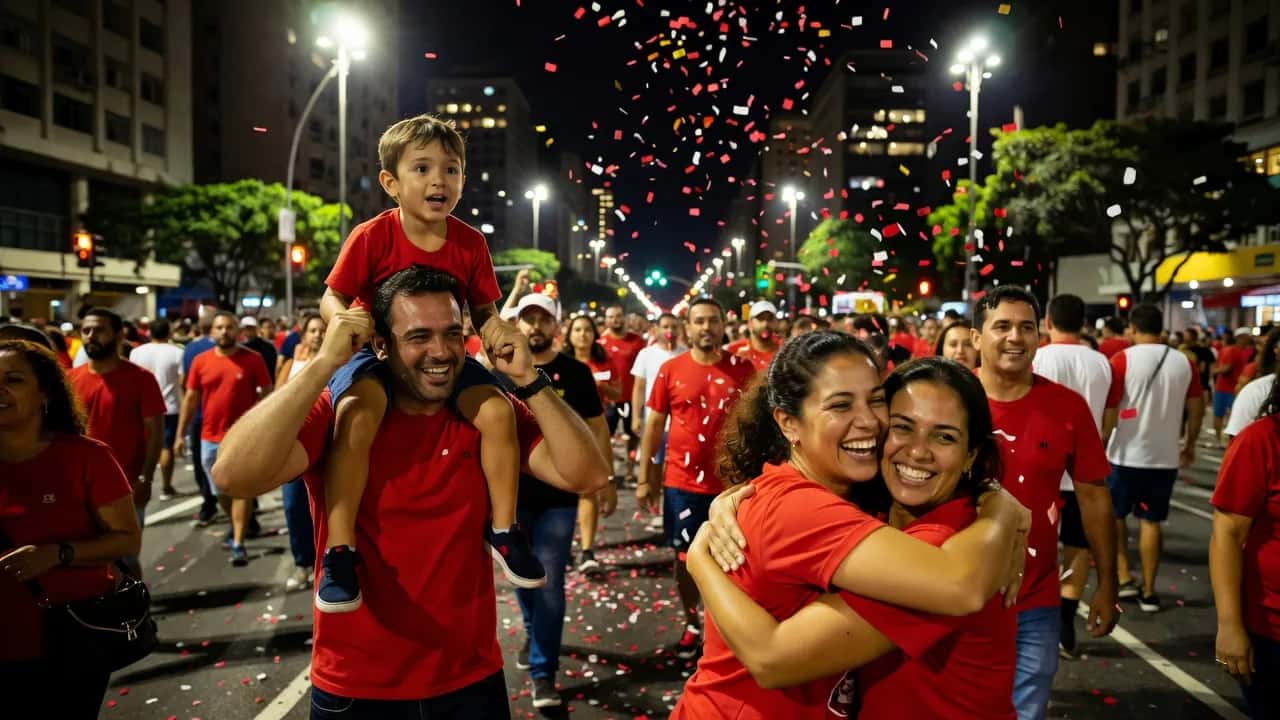
On the winner's side, The Guardian quotes Lula: "This election was a defeat for negationism [...] it is democracy that made this possible." His Health Minister, Alexandre Padilha, sees it as "an important signal for the rest of Latin America and the world". The streets of São Paulo celebrated the victory until dawn, according to the newspaper.
The day before the vote, The Guardian recalled that Jair Bolsonaro is serving 27 years in prison for attempting a coup, under house arrest for health reasons, and that his son was promising to pardon him and "change the constitution" with a still more conservative Congress.
SOURCES (4)
- The IndependentMEDIUM
- Daily MailMEDIUM