The eleven BRICS member countries unanimously adopted the 'New Delhi Declaration' on Saturday, September 12, 2026, in New Delhi, which expresses 'deep concern' over the escalation in the Middle East and calls for 'maximum restraint' without naming any country.
The text condemns unilateral tariff and coercive measures deemed contrary to international law.
The declaration calls for reform of global governance, with increased representation of developing countries on the UN Security Council, and encourages increased use of national currencies.
Where it breaks apart
— Nature of the consensus reached — Some of the press presents New Delhi's unanimity as a diplomatic breakthrough after the failure of foreign ministers in May, while another part reads it as a formula that covers national positions that remain distant.
— Priority given to the Middle East — Some coverage places the call for restraint in the Middle East at the center of the statement, while others treat it as secondary to the demand for reform of global governance.
— BRICS as an alternative pole — The statement is presented by some editorial offices as proof that the BRICS are asserting themselves as an autonomous pole of global governance, while others read it primarily through the pressure and influence of the United States on the summit's balances.
The full text, country by country
France
DOMINANT ANGLE
Paris sees in the BRICS text a facade of consensus, where eleven capitals draw from the same sentence opposing diplomatic interpretations on the Middle East.
KEY POINTS
The joint statement, adopted on Saturday, September 12, by the eleven BRICS members in New Delhi, expresses their "deep concern over the continued escalation of tensions in the Middle East" and calls for "maximum restraint" without naming any country.
Beijing and Moscow continue to trade with Tehran despite repeated threats of sanctions from Donald Trump, while the United Arab Emirates suspended its trade and financial exchanges with Iran as early as August after being targeted by Iranian missiles.
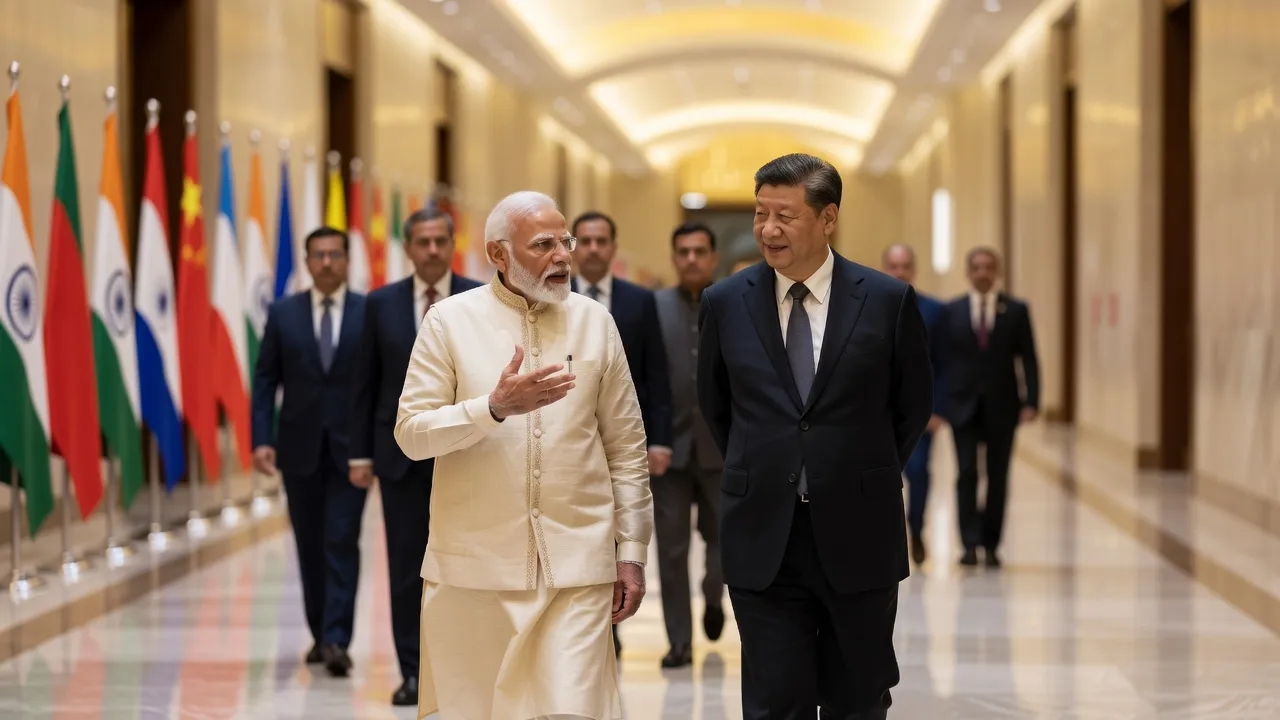
Xi Jinping visited India for the first time since 2019 and met with Narendra Modi on Saturday, seven years after a deadly military clash at their disputed Himalayan border.
ANALYSIS
Paris, September 13, 2026. Eleven signatures for a single phrase, but each reads it in their own way. The French press is dissecting the joint statement adopted on Saturday in New Delhi by the BRICS leaders, which expresses their "deep concern over the continued escalation of tensions in the Middle East" and urges the parties to "maximum restraint" and protection of civilian populations, according to France 24. No country is named - neither Iran, nor Israel, nor the United States - but the document is decoded as an indirect criticism of the American and Israeli strikes on Iranian nuclear facilities, which reopened the conflict at the end of February.
The displayed unanimity masks disjointed national positions, which French articles take care to detail. Beijing and Moscow, engaged in a frontal challenge to American hegemony, continue to trade with Tehran despite repeated threats of sanctions from Donald Trump, reports La Tribune. In contrast, the United Arab Emirates suspended their commercial and financial exchanges with Iran as early as August, after being targeted by Iranian missiles - without preventing President Massoud Pezeshkian and the Emirati Crown Prince, Sheikh Khaled bin Mohamed bin Zayed Al Nahyane, from meeting on Saturday on the sidelines of the summit.
The visit of Xi Jinping, his first to India since 2019, is also drawing attention: the Chinese leader met with Narendra Modi on Saturday, seven years after a deadly military clash at the disputed Himalayan border. The statement also calls for a reform of global governance, with more representation for developing countries on the UN Security Council, and condemns unilateral customs duties.
In the background, the blockade of the Strait of Hormuz by Iran, which has been ongoing for six months since the start of hostilities and continues to drive up crude oil prices, as well as the lightning offensive of the Houthis on the Yemeni coast, reported by RFI, remind us of the extent of the regional escalation that the New Delhi text attempts to contain.
Russia
DOMINANT ANGLE
Moscow claims in the New Delhi declaration that the proof is that the BRICS are imposing themselves as an autonomous pole of global governance, driven by Putin's call to adapt international financial institutions and by the group's support for a reform of the UN Security Council.
KEY POINTS
The statement claims to be "deeply concerned about the escalation of tensions in the Middle East" and calls on "all parties to exercise maximum restraint" without naming any country (Interfax).
Vladimir Putin has described the BRICS as "one of the main centers of global governance" and called on international financial institutions to adapt to changing realities (Sputnik).
The statement supports Africa's candidacy for a permanent seat on the UN Security Council; Russia and China, permanent members, reaffirm their support for the aspirations of Brazil and India (TASS).
ANALYSIS
Moscow, September 13, 2026. In New Delhi, the eleven member countries of the BRICS adopted the New Delhi declaration unanimously on Saturday, September 12, which Russian diplomacy presents as proof that the bloc is establishing itself as an autonomous pole of global governance. Cited by Interfax, the declaration states that the participants are "deeply concerned about the escalation of tensions in the Middle East and Western Asia" and call on "all parties to exercise maximum restraint in order to avoid further aggravation," without designating any country. The text welcomes the "efforts undertaken through dialogue and diplomacy" and reaffirms support for the principle of "two states for two peoples" as well as the right of Palestinians to self-determination.
Vladimir Putin, present alongside Narendra Modi and Xi Jinping at the BRICS+ session, described the group as "one of the main centers of global governance" and called on international financial institutions to adapt to changing economic realities, reports Sputnik. Xi Jinping announced that China will chair the BRICS in 2027 and host the 19th summit, saying he is ready to contribute to stability in the Middle East and the Gulf.
Bangladesh
DOMINANT ANGLE
Dhaka retains from New Delhi mainly the claim for a less locked-up global governance, more than the implicit condemnation of the war in the Middle East
KEY POINTS
The 11 BRICS members unanimously adopted the New Delhi Declaration on Saturday, September 12, 2026, expressing "deep concern" and calling for "maximum restraint" in the Middle East
The text demands a "structural update" of the UN Security Council, with more representation for Africa, Asia, Latin America, and the Caribbean
The bloc condemns unilateral tariff measures and encourages increased use of national currencies to reduce dependence on the dollar
ANALYSIS
Dhaka, September 13, 2026. Bangladesh has taken note of a statement from New Delhi that, without naming any country, calls for a broader place for developing nations in the global architecture. The eleven members of BRICS — Brazil, Russia, India, China, South Africa, Egypt, Ethiopia, Indonesia, Iran, and the United Arab Emirates — unanimously adopted the "New Delhi Declaration" on Saturday, September 12, 2026, which expresses "deep concern" over the escalation in the Middle East and calls for "maximum restraint".
For the press in Dhaka, the essence of the text lies less in its implicit condemnation of war than in its demand for reform of global governance. The document calls for a structural update of the UN Security Council, with increased representation for Africa, Asia, Latin America, and the Caribbean — a claim that China and Russia, the only permanent members of the Council present at the summit, say they support for Brazil and India. Narendra Modi summed up the ambition in his closing remarks: "the changes in the world cannot be driven by outdated institutions; reforms are essential in terms of representation, responsiveness, and rule-making."
The text also condemns unilateral tariff measures that distort trade, in the context of US sanctions against Tehran and Western sanctions against Moscow, and encourages members to increase the use of their national currencies, to reduce dependence on the dollar. A speaker quoted in the press mentions the need to "transform this pyramid of privileges".
China
DOMINANT ANGLE
Beijing takes away from the New Delhi summit less the formula on "maximum restraint" in the Middle East than the validation of a reform of global governance that the BRICS have been promoting for years.
KEY POINTS
The joint statement adopted on Saturday in New Delhi calls for "greater and more meaningful participation and representation of emerging markets and developing countries... in global decision-making processes and structures" (CGTN).
The text denounces attempts to unilaterally undermine multilateral institutions, "including through the deliberate withholding of statutory contributions" (CGTN).
Xi Jinping arrived on Saturday in New Delhi at the invitation of Narendra Modi for this 18th BRICS summit held from September 12 to 13, aiming to "pool the collective strength of the Global South" (ECNS).
ANALYSIS
Beijing, September 13, 2026. For Chinese diplomacy, the 18th BRICS summit in New Delhi confirms a line defended for years: the reform of global governance in favor of emerging and developing countries. According to CGTN, the official agency, the joint declaration adopted on Saturday reaffirms the leaders' commitment to building an international and multilateral system that is "more just, equitable, agile, effective, representative, and responsible", driven by "extensive consultation, joint contribution, and shared benefits". The text calls for "greater and more significant participation and representation of emerging markets and developing countries, as well as the least developed countries, in global decision-making processes and structures" — a formula that aims, without naming it, to expand international decision-making bodies, starting with the UN Security Council.
The declaration also denounces, still according to CGTN, attempts "to unilaterally undermine the work of global multilateral institutions and hinder the execution of their respective mandates", including "through deliberate retention of statutory contributions". The leaders express their concern about ongoing conflicts in several regions of the world and the polarization of the international order, without mentioning the Middle East or any specific party by name.
India
DOMINANT ANGLE
New Delhi claims a three-pronged diplomatic success: consensus wrested between Tehran and Abu Dhabi, a named mention of the Pahalgam attack in the text, and Modi's call to transform the "privilege pyramid" into shared governance.
KEY POINTS
The eleven BRICS members adopted the "New Delhi Declaration" by consensus on Saturday, after tense negotiations between Tehran and Abu Dhabi on the Middle East (Swarajya).
The text condemns "in the strongest terms" the April 22, 2025 terrorist attack in Jammu and Kashmir, which killed 26 people, without naming Pakistan (Free Press Journal).
Narendra Modi called for transforming the "pyramid of privileges" of global institutions into a "partnership platform" for the Global South (Swarajya).
ANALYSIS
New Delhi, Sunday, September 13, 2026. For the Indian press, the 18th BRICS summit, which opened on Saturday at the Bharat Mandapam, primarily reflects the diplomatic success of its host. The Hindu Business Line notes that New Delhi has achieved "a critical diplomatic balancing act" by obtaining the consensus of the eleven members on a joint statement, despite persistent differences between Tehran and Abu Dhabi on the Middle East. Swarajya specifies that negotiations on the text continued "until the deadline", the two capitals having long maintained their positions before a last-minute agreement allowed the adoption of the "New Delhi Declaration".
The text, which condemns "in the strongest terms" the terrorist attack of April 22, 2025, in Jammu and Kashmir, which killed 26 people, is presented by Free Press Journal as a personal victory for Narendra Modi: the Prime Minister "ensured that the central issue of terrorism was not forgotten", without Pakistan being named. The declaration rejects any "double standard" in the fight against terrorism and reaffirms China's and Russia's support for India's candidacy to the Security Council.
On global governance, Modi called for an end to the "pyramid of privileges" inherited from current institutions, advocating for a "partnership platform" where the global South would become "rule-maker rather than rule-taker". However, Swarajya nuances: de-dollarization remains "rhetoric", the Working Group on Payments being only tasked with continuing its studies, without a calendar or common mechanism.
Nepal
DOMINANT ANGLE
Kathmandu is gauging New Delhi's diplomatic prowess, which has succeeded in getting Iran and the United Arab Emirates, two previously divided members, to unanimously sign a text on the Middle East war.
KEY POINTS
The eleven BRICS leaders unanimously adopted the "New Delhi declaration" on Saturday, calling for "maximum restraint" without naming any country
In May, the foreign ministers of the bloc had failed to agree on a joint text, with Iran and the United Arab Emirates divided over the Middle East war
The declaration condemns attacks on civilian infrastructure and nuclear facilities "under the full guarantees of the IAEA, in violation of international law"
ANALYSIS
Katmandou, 13 September 2026. For the Nepalese press, the BRICS summit in New Delhi is first and foremost a diplomatic engineering victory for the Indian host. The Kathmandu Post recalls that in May, the foreign ministers of the bloc failed to agree on a joint statement, with Tehran and Abu Dhabi's positions on the Middle East war being too far apart. On Saturday, on the first day of the summit, the eleven leaders nonetheless unanimously adopted the "New Delhi Declaration", expressing "deep concern over the continued escalation of tensions in the Middle East" and calling for "maximum restraint", without designating any party.
The text, cited by Online Khabar, emphasizes the protection of civilian infrastructure and nuclear facilities: "We express serious concern over deliberate attacks on civilian infrastructure and peaceful nuclear facilities under the full guarantees of the IAEA, in violation of international law." The group recalls that nuclear safety must be maintained even in times of armed conflict.
The declaration also denounces the proliferation of "unilateral tariff and non-tariff measures" that distort trade, in a context of American sanctions against Tehran and Moscow. Xi Jinping, opening the proceedings, judged that the war in the Middle East "does not serve the common interests of the international community", according to the Chinese news agency cited by Online Khabar.
Pakistan
DOMINANT ANGLE
Islamabad is taking note of New Delhi's focus on Modi's "privilege pyramid" formula, more so than the details of the war in the Middle East.
KEY POINTS
The statement adopted unanimously on Saturday calls for "exercising maximum restraint, as well as avoiding actions that could further aggravate the situation".
Narendra Modi called for transforming "this pyramid of privilege into a platform of partnership" before the leaders gathered in New Delhi.
In May, the foreign ministers of the bloc failed to agree on a joint text, with Iran, Saudi Arabia, and the United Arab Emirates divided over the conflict.
ANALYSIS
Islamabad, September 13, 2026. Eleven countries gathered in New Delhi unanimously adopted a joint statement on the war in the Middle East on Saturday. The text, reported by the Pakistani press via Reuters and Xinhua dispatches, expresses "deep concern over the persistent escalation of tensions in the Middle East/West Asia" and calls on the parties to "exercise maximum restraint, as well as avoid any action that could further aggravate the situation." No country is named.
What Pakistani newspapers Business Recorder, Geo News, and ARY News are focusing on is not so much the diplomatic content of the statement, but the scope given to it by Indian Prime Minister Narendra Modi at the opening of the summit: "We must transform this pyramid of privilege into a platform of partnership," he said in front of Xi Jinping, Vladimir Putin, and Iranian President Masoud Pezeshkian, calling for a system "where every country has a voice, where every member has a stake." According to Modi, the BRICS now represent half of the world's population and 40% of the planet's GDP - figures repeated as proof of a shift in the Western-dominated economic order.
Chinese President Xi Jinping, on his first visit to India in seven years, judged that the war in the Middle East "does not serve the common interests of the international community," according to the state-run CCTV agency. Beijing will take over the rotating presidency of the BRICS next year and will host the 19th summit. The statement also condemns "unilateral tariff and non-tariff measures" that distort trade, in the context of US sanctions against Tehran and Moscow.
Portugal
DOMINANT ANGLE
Lisbon measures the diplomatic feat of a text adopted unanimously despite eleven divergent national positions, from Beijing to Tehran via Moscow.
KEY POINTS
The New Delhi Declaration was unanimously approved on Saturday, September 12, 2026, by the eleven BRICS leaders at the Bharat Mandapam convention center.
The 140-point text calls for "maximum restraint" in the face of the escalation in the Middle East without naming any country and demands the protection of civilians and civilian infrastructure.
The declaration condemns "unilateral coercive measures contrary to international law", deemed to have "profound negative implications for human rights".
ANALYSIS
Lisbon, September 13, 2026. In New Delhi, the feat noted by the Portuguese press is not so much the content of the text as the fact that it exists. The New Delhi Declaration was unanimously approved on Saturday, September 12, 2026, by the eleven heads of state of the BRICS, in the main hall of the Bharat Mandapam convention center — a consensus that Lisbon's editorial offices describe as the "main challenge" of the meeting, given the divergent national positions on the war in the Middle East and on Ukraine.
The Jornal Económico highlights that "none of the representatives raised any objections," noting the frictionless presence, around the same table, of Chinese President Xi Jinping, his Russian counterpart Vladimir Putin, and Iranian President Masoud Pezeshkian. For the Portuguese press, this photograph — eleven capitals with contradictory interests signing the same paragraph — constitutes the news, more than the underlying diplomacy.
As for the content, RTP Notícias and SAPO Notícias quote the text: "We express deep concern over the continued escalation of tensions in the Middle East and, recalling our respective national positions, we call for maximum restraint and to avoid any action that could further aggravate the situation." Comprising 140 points, according to these same sources, the document demands the protection of civilians and civilian infrastructure, as well as respect for the sovereignty and territorial integrity of states — without mentioning the Strait of Hormuz, the articles specify, while emphasizing the need to maintain "the constant flow of global trade, supply chains, and energy."
Saudi Arabia
DOMINANT ANGLE
Riyadhh is approaching the BRICS summit in New Delhi with the caution of a guest, not a committed member of the bloc
KEY POINTS
Prince Faisal bin Farhan arrived on September 12 in New Delhi on behalf of Crown Prince Mohammed bin Salman, as a guest and non-member country.
The joint statement adopted on Saturday by the eleven BRICS members expresses "deep concern" and calls for "maximum restraint" in the Middle East without naming any country.
Iranian President Massoud Pezeshkian warned before the summit that the Middle East does not need the United States as a "regional policeman", as tensions threaten the Strait of Hormuz.
ANALYSIS
Riyadh, September 13, 2026. Prince Faisal bin Farhan arrived on Saturday, September 12, in New Delhi "on behalf of Crown Prince and Prime Minister Mohammed bin Salman," the Saudi Gazette specifies, to represent the kingdom at the BRICS summit not as a full member but as a "guest country." The trip falls under the official theme of the summit, "Building for Resilience, Innovation, Cooperation and Sustainability," and aims, according to the Saudi presentation, to "strengthen multilateral cooperation in the face of shared global challenges" rather than to endorse the entire program of the bloc.
It is in this context that Riyadh reads the joint statement adopted on Saturday by the eleven members: a text that expresses "deep concern" over the escalation in the Middle East and calls for "maximum restraint," without naming any country, Asharq Al-Awsat reports, citing AFP. A cautious formulation, close to the diplomatic line that the kingdom has held since the beginning of the conflict.
Chinese President Xi Jinping judged that the war "does not serve the common interests of the international community," while Indian Prime Minister Narendra Modi called for "transforming this pyramid of privilege into a platform of partnership," recalling the weight of the group: 50% of the world's population, 40% of global GDP, more than a quarter of international trade.
United Kingdom
DOMINANT ANGLE
London sees the BRICS statement as an exercise in tightrope walking dictated by the shadow of Donald Trump, rather than as a united front against Washington.
KEY POINTS
Michael Kugelman, of the Atlantic Council, quoted by the BBC: "India cannot afford a joint statement that takes aim at Washington"
The BRICS, founded in 2006 by Brazil, Russia, India, and China, joined by South Africa in 2010, now have eleven members representing about half of the world's population (The Independent)
The BBC links the summit to American tariffs and the war in Iran, which it says have destabilized global energy markets
ANALYSIS
London, 13 September 2026. For the British press, the BRICS summit in New Delhi is seen less as a collective act of defiance towards Washington than as a demonstration of the bloc's internal limits. The BBC notes that "the shadow of President Trump looms large" over the proceedings, even though the United States is not a member. The tariffs imposed by the White House and the war in Iran, which have destabilised global energy markets, form the backdrop to the meeting, without producing, according to the BBC, a statement directly naming Washington.
The analysis relayed by the BBC, citing Michael Kugelman of the Atlantic Council, stresses the internal divisions: "India cannot afford a joint statement that takes aim at Washington," he recalls, as New Delhi negotiates the final terms of a trade agreement with the United States. Russia and Iran would have preferred a more offensive tone; China, on the other hand, is being cautious not to appear to be instrumentalising the BRICS against Washington. The result, according to this interpretation, is a critique that is judged to be vague and indirect rather than a coordinated line of attack.
The Independent places the summit in the broader context of the wars in Ukraine and the Middle East, as well as the growing tensions between Washington and Beijing, which are testing the bloc's ability to find common ground. The media outlet recalls that the BRICS, founded in 2006 by Brazil, Russia, India, and China, now bring together eleven countries, around half of the world's population and a significant share of global GDP, and that reducing dependence on the dollar is one of the stated priorities, through the promotion of local currencies.
Explore every perspective on this subject across 10 countries.
BRICS in New Delhi: a joint declaration calls for “maximum restraint” in the Middle East
published on
September 13, 2026
10
countries
30
sources
43
articles
25%
gap
Gathered on Saturday, September 12, 2026, in New Delhi for the 18th BRICS summit, the leaders of the eleven member countries unanimously adopted a joint statement, the "New Delhi Declaration". The text expresses "deep concern" over the escalation of tensions in the Middle East and calls on the parties to exercise "maximum restraint", without naming any country. It condemns unilateral customs duties, calls for reform of the UN Security Council, and encourages the use of local currencies. Xi Jinping stated that the war in the Middle East does not serve common interests, and Narendra Modi reminded his Chinese counterpart of the importance of peace on their common border. The second day, Sunday, September 13, is dedicated to technology and economic resilience.
The text does not commit any party by name and does not set a calendar or mechanism for the de-dollarization it calls for.
The Pahalgam attack
The text condemns the bombing on April 22, 2025, in Jammu and Kashmir (26 dead) without naming Pakistan.
The visit of Xi Jinping
Xi's first trip to India since 2019, seven years after a deadly clash at the disputed Himalayan border.
The May failure
In May, the bloc's diplomatic leaders had failed to agree on a joint text, with Iran and the United Arab Emirates being divided.
The Strait of Ormuz
Blocked by Iran in retaliation, it continues, six months after the start of hostilities, to drive up crude oil prices.
Understand the context
APR 22, 2025
Terrorist attack in Pahalgam (Jammu and Kashmir), later condemned by the BRICS
SEP 11, 2026
Narendra Modi receives Vladimir Putin and Massoud Pezeshkian in New Delhi
SEP 12, 2026
The BRICS unanimously adopt the New Delhi Declaration
Key figures
26 deaths
Victims of the Pahalgam attack mentioned in the BRICS text
TASS emphasizes that the declaration supports Africa's candidacy for permanent representation on the UN Security Council, referring to the Ezulwini Consensus, and specifies that Russia and China, permanent members of the Council, have reaffirmed their support for Brazil and India's aspirations to play a greater role. The text also condemns the multiplication of customs duties and non-tariff measures deemed incompatible with WTO rules, and expresses concern about the increase in global military spending to the detriment of development financing.
Vedomosti, citing Reuters, notes that the main difficulty was finding a formulation on the Middle East acceptable to both Tehran and Abu Dhabi, after the failure of a joint declaration by the heads of diplomacy in May. The newspaper estimates that the text will not significantly change the geopolitical situation but will demonstrate the unity of developing countries in the face of measures deemed punitive, including Western sanctions. On the sidelines of the summit, Putin held a bilateral meeting with the South African president.
On the Middle East, Xi Jinping judged that war "does not serve the common interests of the international community", while Modi reminded his Chinese counterpart that peace on their common border remains essential to bilateral relations. The foreign ministers of the group had failed to agree on a joint text in May, hindered by divisions between Iran and the United Arab Emirates over the Gulf conflict.
Dhaka notes that the summit was held under exceptional protection, with tens of thousands of agents deployed around Xi, Putin, and Modi. The second day, Sunday, September 13, 2026, is expected to focus on technology, economic resilience, and sustainable development.
On the Chinese side, the ECNS agency highlights Xi Jinping's arrival in New Delhi on Saturday, at the invitation of Prime Minister Narendra Modi, for the summit held from September 12 to 13. Xi is participating, according to the agency, to "chart a new course for high-quality development of expanded BRICS cooperation", by "pooling the collective strength of the global South" and bringing "stability and positive momentum to a world undergoing profound changes". The Chinese press thus emphasizes less the content of the conflict mentioned than what it illustrates: the need, for Beijing, for a multipolar order where Southern countries weigh more heavily in collective decisions.
On the Middle East, the call for "maximum restraint", without naming any country, is seen in New Delhi as proof that India has managed to bring together partners with opposing interests. Xi Jinping assured Modi that China and India remain "partners, not rivals", even if his notable absence from the gala dinner on Saturday evening fueled comments on a still cautious warming between the two neighbors.
Beyond the text, the Nepalese press lingers on the summit's decor: Ratopati details the armored vehicles brought by Vladimir Putin (the Aurus Senat) and Xi Jinping (the Hongqi N-701), described as "rolling fortresses" whose real characteristics remain secret. A symbol, for Katmandou, of the difficulty of getting powers that arrive armored at the negotiating table to talk, but who nonetheless leave with a common text — cautious and without naming anyone.
The Pakistani press recalls that in May, the foreign ministers of the bloc failed to agree on a joint text, with Iran, Saudi Arabia, and the United Arab Emirates remaining divided over the conflict triggered at the end of February by US-Israeli strikes. The consensus in New Delhi is thus presented as a diplomatic victory for the Indian host. None of the articles in the consulted pool mention a specific Pakistani position - the country is not a member of the BRICS - with coverage limited to relaying international dispatches on the statement and Xi's role.
The editorial offices also note the condemnation of "unilateral coercive measures contrary to international law," deemed to have "profound negative implications for human rights" — a phrase almost identical in several titles, a sign of a common source: the Spanish agency EFE, cited in each of the articles consulted.
Portugal, a small EU and NATO member state, observes this summit from a distance: there is no official reaction from Lisbon accompanying these dispatches, which remain descriptive, focused on the adopted text rather than its implications for the transatlantic order.
Iranian President Massoud Pezeshkian, present at the summit shortly after warning that the Middle East does not need the United States as a "regional policeman," intervened as tensions threaten the Strait of Hormuz — a reminder, for Riyadh, of the direct risks that regional escalation poses to its own energy and maritime security, regardless of its status as a guest within the bloc.
For the British press, the issue is therefore not so much the statement itself as what it reveals about the balances to be maintained: India is juggling its strategic ties with Russia and Iran and its economic rapprochement with Washington, while Beijing is carefully avoiding any posture that would give the White House additional arguments.
SEP 13, 2026
Second day of the summit dedicated to technology and economic resilience