
DOMINANT ANGLE
Paris sees in the BRICS text a facade of consensus, where eleven capitals draw from the same sentence opposing diplomatic interpretations on the Middle East.
Dominant angle identified — does not reflect unanimity of this country’s media
KEY POINTS
- 01
The joint statement, adopted on Saturday, September 12, by the eleven BRICS members in New Delhi, expresses their "deep concern over the continued escalation of tensions in the Middle East" and calls for "maximum restraint" without naming any country.
- 02
Beijing and Moscow continue to trade with Tehran despite repeated threats of sanctions from Donald Trump, while the United Arab Emirates suspended its trade and financial exchanges with Iran as early as August after being targeted by Iranian missiles.
- 03
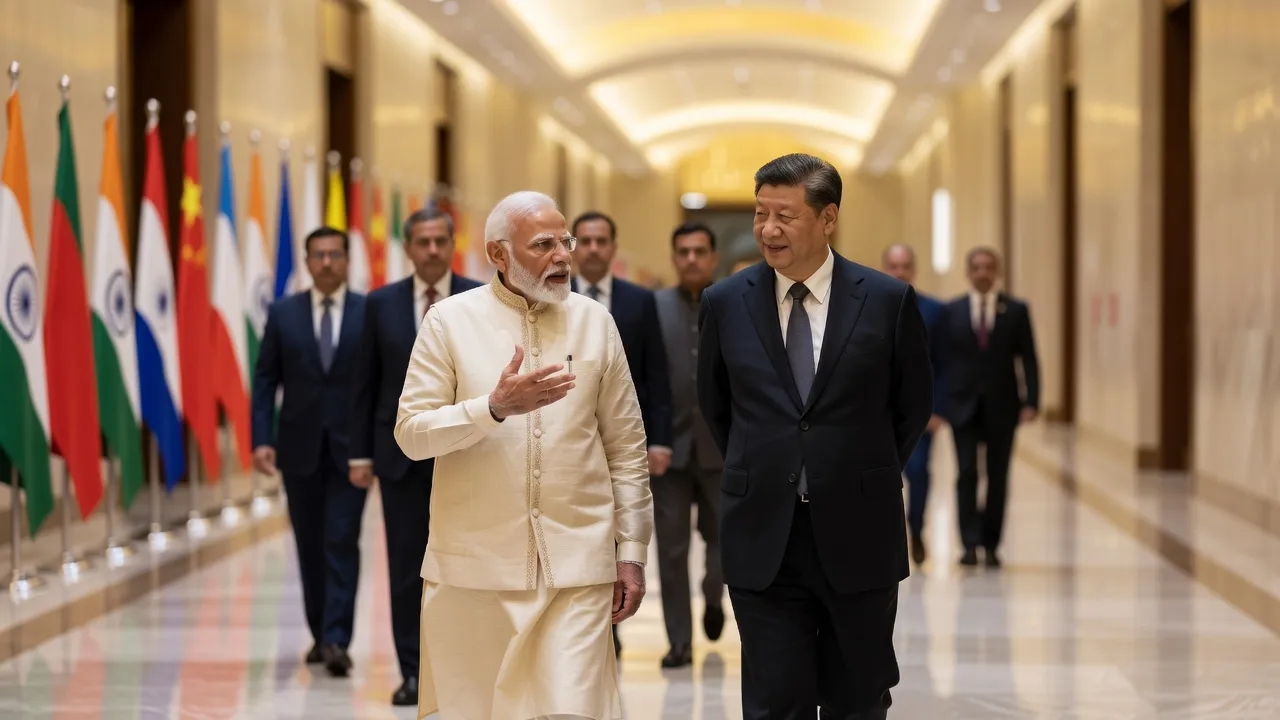
Xi Jinping visited India for the first time since 2019 and met with Narendra Modi on Saturday, seven years after a deadly military clash at their disputed Himalayan border.
ANALYSIS
Paris, September 13, 2026. Eleven signatures for a single phrase, but each reads it in their own way. The French press is dissecting the joint statement adopted on Saturday in New Delhi by the BRICS leaders, which expresses their "deep concern over the continued escalation of tensions in the Middle East" and urges the parties to "maximum restraint" and protection of civilian populations, according to France 24. No country is named - neither Iran, nor Israel, nor the United States - but the document is decoded as an indirect criticism of the American and Israeli strikes on Iranian nuclear facilities, which reopened the conflict at the end of February.
The displayed unanimity masks disjointed national positions, which French articles take care to detail. Beijing and Moscow, engaged in a frontal challenge to American hegemony, continue to trade with Tehran despite repeated threats of sanctions from Donald Trump, reports La Tribune. In contrast, the United Arab Emirates suspended their commercial and financial exchanges with Iran as early as August, after being targeted by Iranian missiles - without preventing President Massoud Pezeshkian and the Emirati Crown Prince, Sheikh Khaled bin Mohamed bin Zayed Al Nahyane, from meeting on Saturday on the sidelines of the summit.
The visit of Xi Jinping, his first to India since 2019, is also drawing attention: the Chinese leader met with Narendra Modi on Saturday, seven years after a deadly military clash at the disputed Himalayan border. The statement also calls for a reform of global governance, with more representation for developing countries on the UN Security Council, and condemns unilateral customs duties.
In the background, the blockade of the Strait of Hormuz by Iran, which has been ongoing for six months since the start of hostilities and continues to drive up crude oil prices, as well as the lightning offensive of the Houthis on the Yemeni coast, reported by RFI, remind us of the extent of the regional escalation that the New Delhi text attempts to contain.
SOURCES (5)
- France 24 ENMEDIUM
- Sud OuestMEDIUM
- La TribuneMEDIUM