
DOMINANT ANGLE
Beijing is deciphering the flydubai FZ1073 flight incident through the geopolitics of the Gulf: the Abraham Accords, the Israel-Emirati rapprochement, the American-Iranian deadlock, and the Israeli election campaign.
Dominant angle identified — does not reflect unanimity of this country’s media
KEY POINTS
- 01
Flight FZ1073, which departed from Dubai at 7:05 on September 30 with around 180 people, issued codes 7700 and 7500 before landing in Tabouk, with all passengers unharmed (Jiemian).
- 02
Netanyahu stated in a video that the suspect was arrested and being questioned by Saudi Arabia, and ordered security services to prepare for other threats (Xinhua via Jiemian).
- 03
Lapid believes the public has no reason to worry about Netanyahu's comments on attacks before the October 27 election, and military sources report no evidence of an imminent major attack (Jiemian).
ANALYSIS
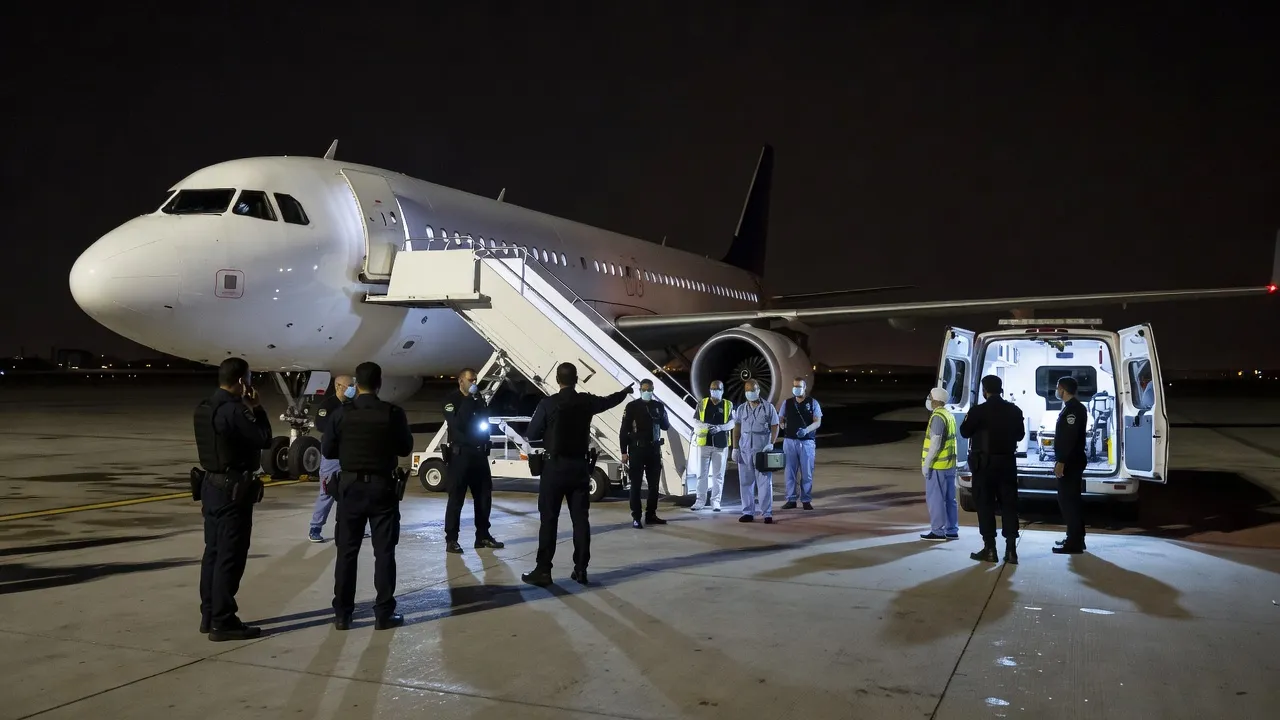
Beijing, October 1, 2026. The media outlet Jiemian reconstructs the timeline of flydubai's FZ1073 flight: departure from Dubai at 7:05 on September 30, approximately 180 people on board, scheduled arrival around 9:30 in Tel Aviv. About an hour and a half after takeoff, the aircraft emits the distress code 7700 over Jordanian airspace, then 7500, which signals, according to the article, "a hijacking or unlawful interference." The plane lands in Tabouk, Saudi Arabia, and all passengers are safe and sound.
Chinese accounts recount the testimonies: cries heard in the cabin, the cockpit door open, a pilot stabbed, the other pilot subdued by passengers and crew members. A high-ranking anonymous Israeli official mentions a co-pilot attempting to take control to crash the plane; the investigation is examining whether it was a suicide attempt or a deliberate crash, and hijacking has been ruled out. The Xinhua agency, as reported by Jiemian, relays a video of Benyamin Netanyahou: the suspect has been arrested and interrogated by Saudi authorities, the incident is "extremely serious," and an order has been given to security services to prepare for other threats. Israeli Defense Minister Israel Katz speaks of a "terrorist attempt." The South China Morning Post adds that Netanyahou praised the injured Indian pilot.
However, the key aspect lies in the context. Jiemian recalls that the Dubai-Tel Aviv route was born out of the 2020 normalization, that Netanyahou visited Abu Dhabi three days earlier with the heads of the Mossad and Shin Bet, and that Tehran condemned this visit. The article places the episode in the context of the stalled US-Iranian negotiations, the war at the beginning of the year, and the economic losses of the Emirates: hotel occupancy down by about 40% in Dubai in the first quarter, more than $5 billion in lost tourist revenue.
The second Jiemian article introduces a critical distance. It notes that, according to Netanyahou, "hostile forces" are trying to strike Israel before the October 27 legislative elections, but that opponent Yaïr Lapid believes it is unnecessary to alarm the public, and that military sources say they have no evidence of an imminent major attack. It emphasizes that the race is tight between the Likud and the united opposition, which puts security at the center of the debate. The article also suggests that the narratives of "victim" and "revenge" have long been at the heart of the external communication of Israeli officials.
The Chinese reading is therefore less that of an aviation incident than that of a revelation of the Israel-Emirates-US axis facing Iran.