France: 1,314 arrests during a new day of protests against the cost of living, as the movement spreads to Italy
published on
countries
sources
articles
More divergent than 47% of recent comparable stories (reference: 99 recent stories measured with the same method).
Foreign coverage on October 24 focuses on what the summary leaves out: the claimed police anticipation by Laurent Nuñez, the fate of the injured in Toulouse and Clermont-Ferrand, the political calendar for the week, and the details of the Italian processions.
The October 24 report is published by the Ministry of the Interior; unions and yellow vests announce new days on October 31 and a national strike on November 5.
The police anticipation in question
Laurent Nuñez attributes the difference with October 17 to anticipation. According to Vedomosti, which quotes him, 135 people were arrested at 1 pm local time, most during preventive checks. Meduza reports that it then counted 136 protest actions, compared to 264 the previous week.
« What has changed is the anticipation. »
Agência Brasil and G1 detail what these checks allowed to be seized: fireworks, ball bearings, slings, steel balls, a katana and airsoft guns. MTV Uutiset notes the same list on the Finnish side, based on photos published by the prefectures.
El Financiero adds a comparison point given by the minister: on October 17, at the same time, only 385 arrests had been made. Laurent Nuñez acknowledges looting on the 24th, but "in a limited way", with attempts in Marseille whose authors were arrested. The newspaper recalls that he had been heavily criticized for his handling of October 17.
Regarding what the device shows, the readings differ. La República writes that the absence of large-scale looting "suggests" that the decision to strengthen personnel and contain marches has borne fruit. Le Temps reports that the ban on non-union demonstrations was widely criticized as an obstacle to the right to demonstrate, and Gulf Times describes anger targeting Emmanuel Macron for the same measures. In the corpus, many covers open with the device rather than the demands: this finding measures what the editorial staff retains, not the weight of social causes.
End of procession, injured and responsibilities
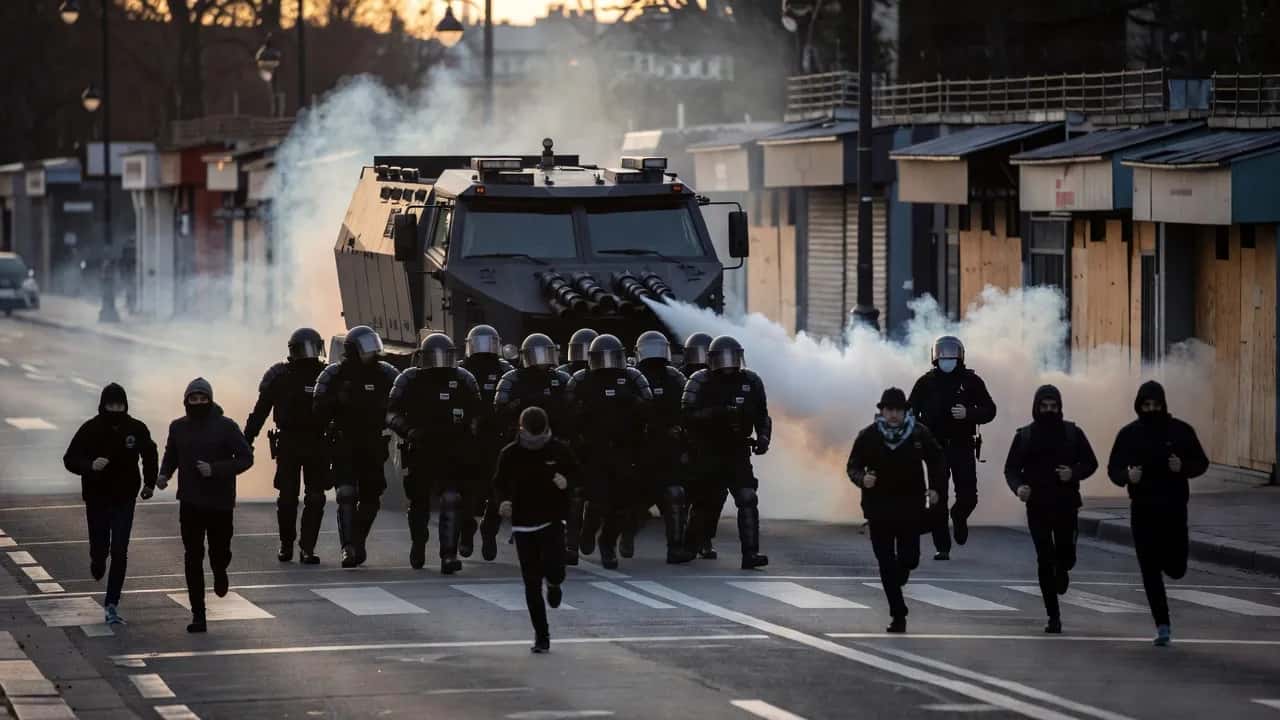
In Paris, the prefecture's spokesperson, Hélène Denéchère, mentions "500 rioters" on France Inter, according to the French press. The Independent describes about 500 masked young people being dispersed with tear gas and water cannons. NBC News reports the clashes occurred near the Porte de Vincennes for about an hour and specifies having "seen no looting". The channel also cites the Paris prosecutor's office, which reports 64 arrests, including six minors, mostly related to weapons or grouping for violent purposes.
« The police started cracking down on everyone. »
The number of injured people is the subject of varying reports. AFP, via The Sun MY, notes that Sunday's statement does not say how many protesters were injured. In Toulouse, the prefecture mentions a 20-year-old man with a hand injury; an anonymous rescue worker tells AFP that several fingers were torn off. In Clermont-Ferrand, the prefecture mentions a hand injury without finger loss. La Nouvelle République, cited in the same dispatch, reports a man injured in the left eye in Poitiers.
On the origin of the clashes, La República, FAZ, and the National Post repeat Laurent Nuñez's attribution to the far left. Daily Times, according to Reuters, adds criminal gangs and far-right militants in Nice and Montpellier; FAZ cites Cannes and Montpellier for the latter.
Testimonies collected by AFP provide another side. Malay Mail reports the words of David, a student with a cut face at the Porte de Vincennes, who says the police "beat a lot of people". In Lille, Eline, 23, says she was tear-gassed while doing nothing.
Origins of the movement and political consequences
The sources do not all tell the same beginning. The Independent dates back to September, to a understaffed high school in Créteil, then to blockades gaining the suburbs, the UNEF call and the yellow vests. La Razón situates the origin at the end of September in high schools in Seine-Saint-Denis, with the lack of substitute teachers, degraded buildings, the rejection of Parcoursup and the effect of inflation on the cost of student life. The newspaper reproaches the international coverage for focusing on images of confrontations.
« He will understand that this is going to happen every week. »
For the immediate future, Vedomosti writes that high school and student organizations are waiting for announcements on Monday, October 26, after their meeting with Prime Minister Sébastien Lecornu. The newspaper also relays information from Blast: Sébastien Lecornu would have asked four operators to be ready to temporarily cut off TikTok and Instagram.
TBS News details the union positions: Murielle Guilbert, from Solidaires, speaks of a "concentration of anger"; SUD Éducation will join the day of October 31, the CGT will decide during the week, and the yellow vests plan sit-ins in front of town halls and the National Assembly.
On the electoral ground, the AP, taken up by The Rising Nepal, reports that the National Rally accuses the government of not protecting the population and calls to transform anger into votes for Marine Le Pen. Jean-Luc Mélenchon, present in the Parisian procession according to the National Post, announces the weekly repetition of demonstrations. The Times of India relays, according to the ANI agency, Donald Trump's phrase about France which "is burning", spoken during a meeting in Perry, Georgia; HVG reports that Magyar Péter "points to migrants".
In the Italian streets
The ANSA speaks of "città blindate" and notes that the violence and looting of the previous week were not repeated. In Rome, 43 young people were taken to the police prefecture, found in possession of hoods, gloves, masks, and keffiehs; protesters reached the Colosseum before being pushed back to the gates. The agency reports tensions in Turin, Bologna, and Florence. According to the Corriere della Sera, as reported by Xinhua, six people were hospitalized in Bologna.
« set entire cities ablaze »
According to the ANSA, a person presented as the presumed animator of the Movimento 17 ottobre Instagram page was identified before 2:30 pm and is the subject of an investigation for incitement to delinquency. Rzeczpospolita, citing Reuters, mentions a suspect arrested on Saturday morning. Libero Quotidiano estimates that in Milan "the state has taken action", with parachutists from the Folgore brigade.
The estimates of attendance in Milan differ. La Nación and Al Jazeera report around 10,000 people, while Le Monde, cited in the French perspective, reports around 3,000 people in Milan and Rome. The security personnel numbers also vary according to the media: La Nación cites 500 military personnel reinforcing 5,000 police officers, and RTP reports 1,400 police officers and 500 military personnel.
The cited reasons go beyond just the cost of living. The Free Press Journal, Estadão, and RTP also mention armament expenditures and housing. In the United States, the AP and NPR report that Giorgia Meloni announced harsher penalties for minors. Al Jazeera Arabic expands to Spain, where the Catalan police arrested 128 people in Barcelona, including 73 minors.
The police prefecture reports 142 arrests, including 126 people in custody, and around 500 violent individuals at the end of the procession.
The previous week, the unrest had resulted in around 2,700 arrests, according to SBS and the Australian press.
Unions and yellow vests call for a protest on October 31 and a national strike on November 5.
Key figures
- 1,314Arrests reported by the Ministry of the Interior after October 241 source · The Sun MY
Where this figure comes from
… en los próximos días y semanas para hacer frente a esta amenaza, porque es una amenaza real”. Un total de 1.314 personas habían sido arrestadas hasta el domingo por la mañana, tras una "noche …
Source: La Republica CO Exact passage from the article, in its original language, where this number was found during the pre-publication check.
- 70,000Police officers and gendarmes deployed on October 24, 10,000 more than on October 171 source · Agência Brasil
Where this figure comes from
… enfrentamientos con la policía en París y otras ciudades. Hubo más de 1.000 detenidos y el Gobierno desplegó 70.000 efectivos, en una jornada marcada por las restricciones a las marchas y el creciente malestar social. …
Source: Perfil Exact passage from the article, in its original language, where this number was found during the pre-publication check.
- 371People taken to police stations in Italy, including 110 minors1 source · ANSA
Where this figure comes from
… Thousands protest in Italy with 9 arrested and 371 detained Several thousand people marched through Milan, bringing traffic in the centre to a standstill, and …
Source: National Post Exact passage from the article, in its original language, where this number was found during the pre-publication check.
Other figures compared across countries
Participation as of October 24 according to the Ministry of the Interior
Basis of comparison: Number of protesters throughout France on Saturday, October 24, count from the Ministry of the Interior
The press reports a similar or rounded ministerial figure, of 400,000 to 410,000; the discrepancy with the union count is the real point of contention.
Values by country (13)
- Australia · 410,000ABC News Australia
- Bangladesh · 410,000TBS News
- Colombia · 410,000La República
- Germany · 410,000Tagesschau
- Ghana · 410,000MyJoyOnline
- Hungary · around 400,000444
- Mexico · 410,000El Financiero
- Sweden · around 410,000Dagens Nyheter
- Singapore · 410,000Straits Times
- United Kingdom · 410,000The Independent
- Argentina · not reported in this corpus
- Brazil · not reported in this corpus
- Poland · not reported in this corpus
Participation as of October 24 according to the CGT
Basis of comparison: Number of protesters throughout France on Saturday, October 24, union count
Countries citing the CGT give the same order of magnitude, nearly double the ministerial figure.
Values by country (9)
- Australia · nearly 800,000ABC News Australia
- Switzerland · 800,000SRF News
- Colombia · 800,000La República
- Ghana · around 800,000MyJoyOnline
- Mexico · 800,000El Financiero
- Germany · nearly 800,000DW
- Argentina · not reported in this corpus
- Brazil · not reported in this corpus
- Poland · not reported in this corpus
Interpellations announced on Saturday evening
Basis of comparison: Number of arrests in France announced by the Minister of the Interior on the evening of Saturday, October 24 (provisional figure)
Media outlets publishing on Saturday evening report the provisional figure of "nearly 1,000", which Sunday's tally revealed.
Values by country (10)
- Australia · nearly 1,000SBS News
- Bangladesh · nearly 1,000The Daily Star
- Canada · nearly 1,000National Post
- Ghana · nearly 1,000MyJoyOnline
- Hungary · nearly a thousand444
- Mexico · about a thousandEl Financiero
- Poland · almost 1000Rzeczpospolita
- Romania · almost 1,000Mediafax
- Sweden · nearly 1,000Svenska Dagbladet
- Italy · not reported in this corpus
Summary of Sunday's arrests
Basis of comparison: Number of arrests in France according to the balance sheet of the Ministry of the Interior published on Sunday, October 25, for the day of the 24th
The countries that publish the complete tally all report 1,314, which is higher than the provisional figure from the previous day.
Values by country (7)
- Colombia · 1,314La República
- Germany · 1.314Tagesschau
- France · 1.314La Tribune
- Malaysia · 1,314The Sun MY
- Argentina · not reported in this corpus
- Brazil · not reported in this corpus
- Romania · not reported in this corpus
Police personnel deployed
Basis of comparison: Number of police officers and gendarmes deployed in France for the day of October 24
All countries that quantify the device give 70,000.
Values by country (10)
- Brazil · 70,000Agência Brasil
- Canada · 70,000National Post
- Switzerland · 70,000Le Temps
- Germany · 70,000DW
- Ghana · 70,000GBC Ghana Online
- Pakistan · 70,000Daily Times
- Poland · 70 tys.Rzeczpospolita
- Romania · 70,000Mediafax
- Sweden · 70,000Dagens Nyheter
- Italy · not reported in this corpus
What the comparison reveals
Common ground and differences in coverage across the media analysed.
What the media report in common
The Ministry of the Interior estimates the participation on October 24 at 410,000 people, a count significantly lower than that of the unions.
An exceptional police device of 70,000 law enforcement officers was deployed, after the unrest of October 17.
The day is described as calmer than that of October 17, with mostly peaceful processions and clashes at the end of the day.
Where media coverage diverges
Reading of the police deployment
When asked what the massive deployment shows, some of the press sees an effectiveness that prevented new lootings; others see an infringement on the right to demonstrate (curfews, bans).
Origin of the unrest
On the origin of the violence, some media outlets repeat the minister's attribution to the far left or immigration (cited by Donald Trump); others link it to a social crisis born in high schools and to the high cost of living.
Number of arrests
The press that publishes on Saturday evening reports 'nearly 1,000' arrests; that which publishes on Sunday gives the ministerial report of 1,314, including 142 in Paris.
This grouping describes the publications analysed, not the position of these countries’ populations or of their governments.
How each country frames the event
- security
- AustraliaBrazilSwitzerlandColombiaGermanyFinlandFranceGhanaItalyMexicoMalaysiaPakistanPolandPortugalRomaniaRussiaSwedenUnited Kingdom
- domestic politics
- ArgentinaBangladeshCanadaNepalSingaporeUnited States
- society
- BoliviaHungaryIndiaQatar
3 different framings across 28 countries · 18 of 28 countries share the same framing
Pair by pair: same frame or different frames
Each square pairs two countries. Filled: both countries' coverage uses the same frame. Empty: their frames differ. The map describes framings without evaluating them.
Pairs with the same frame: 174 of 378
- same frame
- different frames
Blind spots
What the coverage of each country leaves aside, while others put it forward.
 Germany
- the Italian police report (9 arrests, 371 people taken to police premises including 110 minors)
 Colombia
- the details of the Italian protests and the reaction of the Meloni government
Geopolitical context
The mobilization of October 24 extends that of October 17, which originated in high schools in the Paris region at the end of September around school funding and the cost of living, and then expanded to unions and yellow vests. It takes place six months before the presidential election, with calls for new days of action on October 31 and November 5. The movement has echoes in Italy, Spain, Portugal, and Albania, where governments are responding with police measures and policies on minors.
Understand the context
- OCT 17, 2026Protests against the high cost of living, marked by riots
- OCT 24, 2026New day of national mobilization in France and demonstrations in Italy
- OCT 25, 2026The Ministry of the Interior releases a report of 1,314 arrests
How each country reads it
Preview: 3 of 28 media perspectives. Syntheses of the media analysed — not direct quotations. Method & limitations
 Bolivia
La Paz sees the French mobilization as a structural crisis born in the high schools, and rejects a reading limited to images of riots.
2 sources · View sources
 Argentina
Buenos Aires is gauging the October 24th events in light of the 2027 deadline: the Argentine press first sees a political tension for Emmanuel Macron, six months ahead of the presidential election, and a movement that is spilling over into Italy.
2 sources · View sources
 Australia
Canberra is primarily concerned with public order: the Australian press reports on arrests, tear gas, and the deployment of 70,000 agents, and gauges the difference from the riots of the previous week.
4 sources · View sources
The full text, country by country
Bolivia
DOMINANT ANGLE
La Paz sees the French mobilization as a structural crisis born in the high schools, and rejects a reading limited to images of riots.
KEY POINTS
- La Razón (October 24) estimates that France is experiencing not a "fortuitous outbreak" but a crisis born of the exhaustion of its socioeconomic model and the deterioration of public services.
- The movement began in late September 2026 in high schools in the Paris region, particularly in Seine-Saint-Denis, with blockages.
- The initial demands cited include: a lack of substitute teachers, degraded school infrastructure, rejection of Parcoursup, and inflation in the cost of student living.
ANALYSIS
La Paz, October 25, 2026. The Bolivian press is treating the French mobilization as an object of analysis rather than a news item. In an analysis column published on October 24, La Razón asserts that over the past few weeks, France has been plunged into a "deep social mobilization" that has once again drawn international attention. The newspaper immediately criticizes the media coverage for focusing "almost exclusively" on the most spectacular images: tear gas smoke, fires on the avenues, intense clashes between protesters and security forces.
These episodes of urban violence are real, the text concedes, but reducing the phenomenon to a spectacle of public disorder would prevent understanding its true dimensions. The article therefore proposes to examine the structural causes, the mobilization of young people, and the state's response after the recent days of national protest. Its thesis is clear: France is not experiencing "a fortuitous outburst," but a deep crisis born of the exhaustion of its socioeconomic model, the progressive degradation of essential public services, and the growing loss of legitimacy of political institutions in the eyes of citizens.
The narrative goes back to the origin of the movement, which was not born in parties or union leadership, but in secondary education. At the end of September 2026, students from several high schools in the Paris region, especially in vulnerable areas like Seine-Saint-Denis, launched protest actions and blockades. Their initial demands were mainly material: recurrent lack of substitute teachers, deterioration of school infrastructure, rejection of the Parcoursup algorithmic platform, the centralized system for access to higher education. According to the article, this is exacerbated by the direct effect of inflation on the cost of living for students.
A second Bolivian media outlet, Brújula Digital, devoted an article to the event in its World section, with an address that mentions "disturbances in several French cities after peaceful protests," but the recovered content only includes the site's menu and provides no exploitable information on the subject. The dominant reading therefore relies on the sole text of La Razón, which does not mention in the available part either the number of arrests, the police device, or the extension of the movement to Italy. The angle retained in La Paz is that of social causes and youth, rather than that of maintaining order.
Argentina
DOMINANT ANGLE
Buenos Aires is gauging the October 24th events in light of the 2027 deadline: the Argentine press first sees a political tension for Emmanuel Macron, six months ahead of the presidential election, and a movement that is spilling over into Italy.
KEY POINTS
- Profile: over 1,000 arrests according to official sources and 70,000 police officers and agents deployed, one week after unrest that resulted in more than 2,700 detainees.
- La Nación: in Milan, at least ten thousand protesters, 500 soldiers sent by the Meloni government in addition to 5,000 police officers, and a League poster set on fire.
- Nuñez had warned before the marches: "We will not tolerate any act of violence or any disturbance of public order" (Perfil).
ANALYSIS
Buenos Aires, October 25, 2026. Argentine dailies La Nación and Perfil are treating Saturday, October 24, as an episode of both political and public order tension. Perfil headlines protests "against Macron" that "add to the political tension" six months before the election, and recalls that France returned to the streets one week after riots and looting that led to more than 2,700 arrests.
According to Perfil, marches against the rising cost of living have spread to several cities. The newspaper reports around 400,000 protesters in the country and, citing official sources, at least 1,000 people arrested. The government deployed 70,000 police officers and agents. The Minister of the Interior, Laurent Nuñez, had warned: "We will not tolerate any act of violence or any breach of public order." The police used tear gas in Paris, Marseille, Lyon, Lille, Bordeaux, Toulouse, Montpellier, and Nantes, as well as batons and water cannons in the capital.
Perfil emphasizes that the marches took place largely peacefully for most of the day; clashes intensified when protesters began to disperse and small groups formed. The newspaper stresses the official response: restrictions on routes and measures to prevent access to commercial areas, in a climate of limitation of the right to demonstrate.
La Nación, in an article by its correspondent in Milan, broadens the focus: "Saturday's protests, with France as the epicenter, had repercussions" in Italy, Spain, Albania, and Portugal. In Milan, Italy deployed soldiers; Giorgia Meloni's government sent 500 military personnel to reinforce the hundreds already in place and 5,000 police officers, with drones, controls in train stations, and online surveillance. At least ten thousand people converged on Leonardo da Vinci Square, in front of the Polytechnic University, shouting slogans against Meloni; a League poster, which was holding its federal congress in the city, was torn down and burned. Luxury stores like Omega, Tiffany, and Gucci covered their windows with wooden boards.
The Argentine perspective thus focuses on two threads: the fragility of an executive power confronted with the street as the 2027 presidential election approaches, and the European contagion of social discontent fueled by the cost of living, which governments are addressing first and foremost through police means.
Australia
DOMINANT ANGLE
Canberra is primarily concerned with public order: the Australian press reports on arrests, tear gas, and the deployment of 70,000 agents, and gauges the difference from the riots of the previous week.
KEY POINTS
- The Interior Ministry estimates participation at 410,000 people (110,000 in Paris), the CGT at nearly 800,000 (250,000 in Paris), according to ABC.
- Some 70,000 law enforcement members were deployed; two people were seriously injured, in Toulouse and Clermont-Ferrand, according to SBS.
- Laurent Nuñez considers the outcome more "positive" than the previous week, which had seen 2,700 arrests, according to SBS.
ANALYSIS
Sydney, 25 October 2026. For Australian media, Saturday's events in France were first and foremost a test of law and order, one week after protests turned into riots. The ABC and the Sydney Morning Herald reported on "nearly 1,000 arrests" across the country, a figure prior to the 1,314 tally later released by the Ministry of the Interior.
The ABC described a Parisian procession that started calmly, then turned violent near the finish point, east of the capital: masked protesters threw objects and fireworks, to which the police responded with tear gas, stun grenades, and water cannons. In Marseille, young people set fire to trash cans to block streets and threw stones and bottles at law enforcement.
Participation figures were provided with their two sources. According to the ABC, the Ministry of the Interior reported 410,000 protesters, including 110,000 in Paris, down from 550,000 the previous week. The CGT announced nearly 800,000, including 250,000 in Paris. The Sydney Morning Herald and The Age, citing a dispatch from London, reported 440,000 participants according to the government and noted that the Parisian route, agreed upon with authorities, avoided previously looted neighborhoods.
SBS reported on Minister Laurent Nuñez's comments, who denounced "an extremely high level of violence" attributed to far-left extremists dressed in black. He nonetheless deemed the outcome more "positive" than the previous week's, thanks to more police, faster interventions, and prior checks. SBS recalled the 2,700 arrests and hundreds of looted businesses from the previous weekend and noted persistent anger over the repression of protests.
The ABC placed the movement in a broader context: over a month of unrest, born from high school student mobilizations for more resources and teachers, which are testing the final months of Macron's term in power. SBS noted that the country will vote in six months to choose his successor.
Italy occupied a secondary but visible position: The Age and the Herald mentioned police in Turin using batons to keep processions at a distance from stores, and protesters attempting to enter the Colosseum in Rome before being escorted out.
 Bangladesh
DOMINANT ANGLE
Dhaka is weighing Emmanuel Macron's room for maneuver: a protest that is expanding from high school students to unions and yellow vests, six months ahead of the presidential election.
KEY POINTS
- The Interior Ministry counts 410,000 protesters on October 24, unions roughly double that; at least 110,000 people in Paris.
- 70,000 law enforcement members deployed; The Daily Star reports nearly 1,000 arrests, compared to 2,700 the previous week.
- Unions and yellow vests call for protests on October 31 and a national strike on November 5.
ANALYSIS
Dhaka, October 25, 2026. Bangladeshi newspapers are following the French social crisis through two complementary angles: the security assessment of Saturday, October 24, and the political pressure on the executive.
The Daily Star opens with the numbers: the French police arrested "nearly 1,000 people" as hundreds of thousands of protesters marched, largely peaceful processions giving way to clashes in Paris and Marseille at nightfall, despite a device intended to avoid a repeat of the troubles of the previous week. The newspaper recalls that on October 17, hundreds of businesses were looted and 2,700 people were arrested. According to the Ministry of the Interior, 410,000 people participated in the marches, with unions advancing a figure twice as high. The main Parisian procession, on the south-eastern fringes of the capital, brought together at least 110,000 people against the rise in the cost of living and growing inequalities.
The newspaper then details the violence: tear gas and water cannons against a group of about 500 hooded youths, burning trash cans and stone-throwing in Marseille, looted shops including two jewelers, clashes in Lyon, Bordeaux, Grenoble, Clermont-Ferrand, Lille, Rennes, Nantes, and Toulouse. Interior Minister Laurent Nuñez denounces "high-risk" groups from the far left. He reports two serious injuries, in Toulouse and Clermont-Ferrand, and judges the assessment more "positive" than that of the previous week, with 70,000 law enforcement officers deployed. The same article notes, however, a "generalized anger" against a police treatment perceived as an attack on the right to demonstrate.
TBS News shifts the focus to the follow-up. On Sunday, unions and collectives called for new protests on Saturday, October 31, and a national strike on November 5. Murielle Guilbert, co-leader of Solidaires, speaks of a "concentration of anger" where students, employees, and firefighters are coming together; SUD Éducation will join on October 31, the CGT will decide during the week, and the yellow vests plan sit-ins in front of town halls and the National Assembly. The title emphasizes that Macron's margin for response is "minimal", six months before the election that is supposed to designate his successor.
The Bangladeshi coverage does not mention either the extension of the protest to Italy or Marine Le Pen's speech in Orléans: attention remains focused on the French street and the power equation.
 Brazil
DOMINANT ANGLE
Brasilia describes a France patrolled by 70,000 police officers, where the government is trying to prevent a return to the looting of October 17, as anger over the high cost of living spreads to Italy.
KEY POINTS
- 70,000 police officers were deployed on October 24, 10,000 more than on October 17, according to Agência Brasil.
- Laurent Nuñez reported 135 arrests in France by early afternoon, many after preventive searches.
- In Italy, student-led protests against the high cost of living took place in Naples (around 300 people), Pesaro (around 200), and Turin (more than 250 high school students).
ANALYSIS
Brasília, October 25, 2026. For the Brazilian press, the day of Saturday, October 24, in France is first and foremost a test of law and order. The Agência Brasil reports on protesters gathered in Paris and throughout the country "under the surveillance of 70,000 police officers," as the government seeks to avoid a repeat of the unrest and looting of the previous weekend. The operation has 10,000 more agents than on October 17, the day when protests against the cost of living and the deterioration of public services turned into "some of the worst disorders France has seen in years."
The Minister of the Interior, Laurent Nuñez, indicated that 135 people had been arrested in the country by early afternoon, many after preventive searches that allowed for the seizure of fireworks, ball bearings, and other objects that could be used as weapons. G1 also cites slings, steel balls, a katana, and airsoft guns. "We must be extremely agile," the minister said, warning: "It will be a long day."
The two media outlets describe a contrast. In Paris, the start of the main procession took place calmly, with hundreds of people in the streets. In Lyon, the third-largest city in the country, the police used tear gas on the crowd; G1 specifies that the agents fired after protesters, near a university and a police station, tried to block a street, with a brief confrontation. Similar incidents are reported in Pau, and, according to AFP cited by G1, tear gas grenades were also used in Lille, Toulouse, and Nantes.
The Agência Brasil emphasizes the image of a capital under siege: merchants protecting their storefronts with boards, museums closed, and more than 20 metro stations inaccessible. The Louvre, the Orsay Museum, and the Paris Opera have closed as a precaution, and business organizations have asked retailers to remain closed. "There are almost no customers, so it's not worth opening," says the manager of a Kiton boutique.
The Estadão broadens its view to Italy, where protesters took to the streets again on the same Saturday to demand measures against the high cost of living, more investment in public education, and less spending on armaments. Led by students, these mobilizations extend those of the previous weekend, which had resulted in clashes with law enforcement. In Naples, around 300 people gathered in Garibaldi Square; in Pesaro, around 200 people challenged the head of government: "Dear Giorgia, how much do you cost us."
 Canada
DOMINANT ANGLE
Ottawa sees the second day of French protests as a political test for Emmanuel Macron, six months ahead of a presidential election where the streets are already weighing in on the campaign.
KEY POINTS
- According to the National Post, police arrested nearly 1,000 people on Saturday, October 24, with 70,000 security force members deployed in the country.
- Laurent Nuñez considers the outcome more "positive" than the previous week, which had seen 2,700 arrests.
- In Italy, police made nine arrests and placed 371 people in custody, including 110 minors, according to the National Post.
ANALYSIS
Ottawa, October 25, 2026. Canada's capital is witnessing the aftermath of scattered clashes that erupted on Saturday, October 24, in Paris and other French cities, a week after protests degenerated into street violence. According to reports, the police arrested nearly 1,000 people in the face of "an extremely high level of violence" attributed by Interior Minister Laurent Nuñez to "ultra-left" extremists dressed in black. Tear gas was fired in Paris, Marseille, Lyon, Bordeaux, Lille, Toulouse, Montpellier, and Nantes.
The Canadian government notes that 70,000 security forces had been deployed for marches called against the cost of living, and that the processions brought together between 410,000 people and a higher figure. Two people were "seriously" injured, according to Nuñez: a man in Toulouse, who allegedly had his fingers torn off, and another person in Clermont-Ferrand, with no details provided. The minister considers the outcome more "positive" than that of the previous week, with more police, faster intervention, more prior checks, and better protection of businesses.
Canada's perspective highlights that largely peaceful gatherings gave way to clashes in Paris and Marseille at nightfall, despite a massive security operation aimed at avoiding a repeat of the previous week's troubles.
Canada's framing of the issue is distinctly political. The Canadian press recalls that the riots of October 17 resulted in 2,700 arrests, with vandalized public buildings and hundreds of looted businesses, and that the country will vote in six months to designate Macron's successor after ten years in power. It notes a "widespread anger" against a repression perceived as an attack on the right to demonstrate. Far-left candidate Jean-Luc Mélenchon, present in the Parisian procession, warns that Macron "will understand that this will be repeated every week".
The Italian aspect is treated separately. In Rome and Milan, thousands of people marched despite security measures approved by Giorgia Meloni's government. The police made nine arrests and briefly placed 371 people in custody, including 110 minors. Minister Matteo Piantedosi praises the law enforcement for isolating the violent fringes "with balance and professionalism". Canada's press presents these processions as directed against the war and the rising cost of living.
 Switzerland
DOMINANT ANGLE
Bern is gauging the day of October 24 against the backdrop of the French security apparatus: 70,000 police officers, curfews and banned demonstrations, in the face of a growing protest.
KEY POINTS
- 70,000 police officers were deployed across the country on Saturday, October 24, according to SRF News and Le Temps.
- The CGT announced 800,000 protesters, the Ministry of the Interior 410,000 (compared to 550,000 the previous week), according to SRF.
- Macron recommended banning non-union demonstrations "wherever possible", a decision criticized as an obstacle to the right to demonstrate (Le Temps).
ANALYSIS
Berne, October 25, 2026. For the Swiss press, the second act of the French protests against the high cost of living is first read through the state's device. 70,000 police officers, as well as special units, have been deployed throughout the country, and law enforcement has marked a massive presence. Many gatherings were not authorized, and routes were modified in multiple locations.
In terms of figures, SRF distinguishes between sources: the CGT counts 800,000 demonstrators in the country, as many as the previous week, while the Ministry of the Interior counts 410,000, compared to 550,000 a week earlier. In Paris, more than 100,000 people marched. Minister Laurent Nuñez judged that the gatherings had "gone well".
In the evening, after largely peaceful marches, rioters clashed with the police in Paris and Marseille, where tear gas and water cannons were used, and two jewelry stores were looted. Images from Lyon and Bordeaux also showed clouds of gas and fires. SRF insists on the difference between peaceful demonstrators and those who take advantage of the chaos to loot.
Interviewed by the channel, its correspondent Zoe Geissler explains the relative calm due to several factors: a significantly more important device than after the violence of the previous week, reinforced controls, better-protected or barricaded businesses with wood, a sometimes more discreet police force, almost absent in some areas of Paris, and well-organized union processions. She warns, however, that discontent is great: the movement, which started with high school and college students demanding better study conditions, has been joined by yellow vests, professions, and the left.
Le Temps gives a voice to the Parisian procession, determined despite curfews and bans. "Even if Macron doesn't want it, we're here," it can be heard, and placards said "I'm suffering from my democracy". The daily recalls that the executive, accused of having failed to maintain order, has played it tough: Nuñez had promised "a lot, a lot, a lot of firmness", with helicopters, horse brigades, and about twenty armored vehicles. Emmanuel Macron had recommended that non-union demonstrations be banned wherever possible, a decision widely criticized as an obstacle to the right to demonstrate. SRF notes that the protest now also targets these security measures.
Colombia
DOMINANT ANGLE
Bogotá is measuring the effectiveness of the French police device in the face of riots: the Colombian press mainly retains that the massive deployment avoided the repetition of the looting of October 17.
KEY POINTS
- The Interior Ministry estimates participation at 410,000 people, the CGT at 800,000, including around 110,000 in Paris according to the ministry (La República).
- 1,314 people had been arrested Sunday morning, according to La República; Semana cited nearly 1,000 arrests, a provisional figure given by Laurent Nuñez.
- Some 500 masked youths clashed with police at the end of the demonstration in Paris, with tear gas and water cannons, as well as clashes in Marseille, Lyon, Bordeaux, and Grenoble.
ANALYSIS
Bogotá, October 25, 2026. For the Colombian press, Saturday, October 24, in France was first and foremost a test of law and order, one week after the riots of October 17. La República summarizes: "hundreds of thousands of people" marched in "mostly peaceful" rallies, before clashes broke out in Paris and Marseille at nightfall, despite a "massive security deployment".
The figures are reported with their two sources. The Ministry of the Interior counts 410,000 protesters in the country, including around 110,000 in the south-eastern outskirts of Paris; the CGT claims 800,000. The protesters denounced the rising cost of living and the increase in inequalities, with some calling for Emmanuel Macron's departure.
The account emphasizes the outcome: riot police used tear gas and water cannons against around 500 hooded youths who were throwing stones. In Marseille, youths blocked a street with metal plates, set fire to containers, and attacked the police; two jewelry stores were looted. Clashes were reported in Lyon, Bordeaux, and Grenoble, and tear gas was fired in Clermont-Ferrand, Lille, Nantes, and Nice.
La República draws a clear conclusion: France avoided the large-scale violence and looting of the previous week, which "suggests" that the government's decision to reinforce personnel and contain the marches "has borne fruit". Interior Minister Laurent Nuñez attributes the clashes to the far left, which wanted to "initiate and complete the uprising", and speaks of a "real threat" that will remain under surveillance in the coming weeks. According to the newspaper, 1,314 people had been arrested by Sunday morning.
Semana adopts a more visual and regional tone. The magazine relays videos of burning containers in Barcelona, evokes tension in Spain, France, Albania, and Italy, and quotes Nuñez, who says the protests took place "without problems" despite "high-risk groups" dressed in black. The figure of nearly 1,000 arrests, still provisional, is presented as likely to increase.
The Colombian reading thus remains focused on the security balance and the minister's words. The economic roots of the anger, the high cost of living, appear as a backdrop rather than a subject, and the political dimension six months before the presidential election is not developed.
 Hungary
DOMINANT ANGLE
Budapest sees the French mobilization as a social movement born out of high schools and prices, which the violence of October 17 divides and which the Hungarian press follows mainly through its internal fractures.
KEY POINTS
- The Interior Ministry deployed 70,000 agents, 20% more than on October 17, according to HVG.
- According to 444, around 400,000 people demonstrated, according to the ministry, and 800,000, according to the unions, with nearly a thousand arrests.
- Telex links the movement to student protests over a month old against the high cost of living and underfunding of schools, joined by unions and yellow vests.
ANALYSIS
Budapest, October 25, 2026. Hungarian media describe Saturday as the continuation of a social movement, before seeing it as a public order issue. Telex, which sent a reporter to Paris, recalls that the protests extend student and high school demonstrations launched "over a month ago" against the rising cost of living, teacher job cuts, the state of school buildings, and the underfunding of education. Unions and former yellow vests joined them on October 17, as did thousands of people who came, the site writes, "to confront the police, smash everything, set fires, and loot".
On the ground, Telex collects divided opinions. Some protesters believe that the scenes from the previous weekend "hurt the movement very badly"; others estimate that radical change has almost never been achieved entirely peacefully. The site quotes a deputy mayor of Paris who says that violence had reached a "never-before-seen" level in the capital, and describes the city hall of Limoges set on fire, that of Marseille invaded, and the tourist office of Lyon burned.
HVG focuses on the deployment: the Ministry of the Interior deployed 70,000 agents, 20% more than the previous week. Citing the MTI agency, it reports that "everything is calm in the streets of Paris", with a modified route by the police. Laurent Nuñez reports 135 arrests at noon for possession of objects that could be used as weapons, and the ministry counted 35,000 protesters at noon, compared to 60,000 the day before. In Lyon, where the prefecture had banned all gatherings, the police used tear gas. HVG also devotes a sentence to Hungarian politics: Magyar Péter, it writes, "points to migrants" after the violence, while Paris questions the responsibility of the far left.
444 provides the figures for the day: around 400,000 protesters according to the ministry, 800,000 according to the unions, and "nearly a thousand" arrests. Most of the processions were peaceful, but tear gas and water cannons were used in several cities, and barricades burned in Marseille. The site relays the BBC on the immediate convictions, Macron's decree limiting gatherings to recognized unions, the "far-left" accusation made by the president, and the suspicions of foreign interference mentioned by the Austrian foreign minister. It finally broadens the picture to Spain, Italy, Portugal, and Albania, where housing, food prices, low wages, and public services fuel a common discontent.
Germany
DOMINANT ANGLE
Berlin is judging the day of October 24 in terms of law and order: 70,000 police officers, curfews and 1,314 arrests, with a toll deemed more measured than that of the previous week.
KEY POINTS
- According to the Interior Ministry, 1,314 arrests, 53 police officers injured, 75 arson attempts, and 24 lootings (Tagesschau, Handelsblatt).
- 70,000 police and gendarmes mobilized, 10,000 more than the previous week, with curfews and assembly bans (DW).
- Ministry: 410,000 protesters, including 110,000 in Paris; CGT: nearly 800,000, including 250,000 in Paris (DW, Tagesschau).
ANALYSIS
Berlin, October 25, 2026. The German press initially treats the day of Saturday, October 24, as a test of public order, one week after the riots of October 17. According to the Ministry of the Interior, cited by Tagesschau and DW, 410,000 people demonstrated in France, including 110,000 in Paris; the CGT claims nearly 800,000 and, according to DW, 250,000 in the capital. DW notes that the real size of the processions is unknown.
The security measures take center stage. Handelsblatt recalls that Laurent Nuñez had mobilized 70,000 police officers and gendarmes, with water cannons and armored vehicles, 10,000 more than the previous week, according to DW. Bans on gatherings by zone and curfews were decreed; in Paris, only the union procession was authorized, moved at the last minute from the Bastille to the southeast of the city, a route validated by the administrative court. The unionist Murielle Guilbert considers it "scandalous" that Macron banned demonstrations where the unions wanted them.
The numerical toll comes from the Ministry, reported by Handelsblatt and Tagesschau: 1,314 arrests, 53 police officers injured, 75 attempted fires, 24 lootings. FAZ relays Nuñez's version: the authorized processions went "well", but the security forces faced "an extremely high level of violence" from "far-left militants". Far-right militants were also spotted for the first time in Cannes and Montpellier. The police prefecture mentions "more than 500 rioters" in Paris. A demonstrator cited by AFP responds: "The police started attacking everyone."
Two people were seriously injured, in Toulouse and Clermont-Ferrand; in Toulouse, a 20-year-old man was hit in the hand and a rescue worker told AFP that he lost several fingers in an explosion. DW headlines "light and shadow": Nuñez judges the lootings to be much fewer than a week earlier.
In substance, Handelsblatt and DW link the processions to the cost of living and the state of schools. Tagesschau broadens the scope to Europe (Italy, Spain, Portugal, Albania), with rents and corruption in the background, and notes less violence than the previous weekend. Handelsblatt quotes Céline, 35, in Le Monde: the right to demonstrate is just as important as the right to vote.
 Finland
DOMINANT ANGLE
Helsinki is primarily focused on law and order: deployed police officers, tear gas, seized objects, and arrests are setting the tone for coverage that is more centered on violence than on the cost of living.
KEY POINTS
- The French Interior Ministry counts about 410,000 protesters, including 110,000 in Paris, the CGT nearly 800,000, including 250,000 in Paris (MTV Uutiset).
- More than 1,300 arrests and more than 50 police officers injured over the weekend, according to the Interior Ministry (YLE).
- Police seized fireworks, slingshots, airsoft replicas, and a katana-type sword; about 70,000 law enforcement members were deployed (MTV Uutiset, Ilta-Sanomat).
ANALYSIS
Helsinki, October 25, 2026. The Finnish press treats Saturday's events in France primarily as a public order issue. Iltalehti opens a live feed relaying that of Reuters: the protests "continued violently" despite the bans, with 70,000 law enforcement officers mobilized and over 100,000 protesters in the capital alone. The newspaper recalls that the movement originated in September as a student mobilization, later joined by other actors, and that the previous weekend had degenerated into riots, with numerous businesses looted, including luxury stores.
MTV Uutiset dedicates an article to the list of items seized by the police: fireworks, slingshots, airsoft replicas, and a katana-type sword. In the Gironde, the prefecture has published photos of masks, face protection, and gloves removed from protesters during morning checks; the authorities deem these items potentially hazardous. MTV also reports the use of tear gas in Lyon.
Regarding the numbers, MTV highlights the discrepancy: the Ministry of the Interior counts approximately 410,000 protesters, including 110,000 in Paris, while the CGT announces nearly 800,000, including 250,000 in Paris, and considers the official estimate to be very low. AFP journalists witnessed the police using batons and tear gas after the Parisian protest.
Ilta-Sanomat publishes a slideshow: a masked protester attempting to throw back a tear gas grenade in Paris, a firefighter extinguishing a fire in Marseille during an authorized union parade, and thousands of people gathered in Orléans against the far right. The newspaper cites CNN for 135 arrests on Saturday afternoon.
The following day, YLE reports the Ministry of the Interior's tally: over 1,300 arrests during the weekend and over 50 police officers injured, marking the second consecutive weekend of violence. The channel adds that the yellow vest movement has announced new protests for the following weekend. The French political debate, the extension to Italy, and the details of the economic demands remain in the background: the cost of living appears only as a backdrop.
 France
DOMINANT ANGLE
Paris is weighing the impact of a massive law enforcement operation: a calm procession, 1,314 arrests, and protesters worried about a "turn towards authoritarianism".
KEY POINTS
- The Interior Ministry reported 1,314 arrests (142 in Paris), 53 police officers injured, and 75 fire interventions, with 410,000 to 800,000 protesters according to sources.
- 70,000 police officers and gendarmes were deployed; Emmanuel Macron announced that demonstrations called for by "people who have no legitimacy" would be systematically banned.
- In Italy, the police announced 9 arrests and 371 brief detentions, including 110 minors, during demonstrations by a few thousand people in Rome and Milan.
ANALYSIS
Paris, October 25, 2026. One week after the riots of October 17, the mobilization day on Saturday, October 24, brought together between 410,000 people according to the authorities and 800,000 according to the CGT, including 110,000 to 250,000 in Paris. The Ministry of the Interior reported on Sunday 1,314 arrests, 53 police officers injured, and 75 interventions for fires, according to La Tribune. In Paris, the police prefecture counted 142 arrests, including 126 people in custody.
The press emphasizes the contrast with October 17. The procession, moved at the last minute from Bastille-Nation to the Porte d'Italie and the Porte de Vincennes, took place calmly, but clashes broke out at the end of the route. The spokesperson for the prefecture, Hélène Denéchère, mentioned on France Inter "500 thugs" and security conditions "diametrically opposed" to those of the previous week. Laurent Nuñez judged that "the processions went well," while deploring clashes in Marseille, Nantes, or Toulouse; two people were seriously injured, in Toulouse and Clermont-Ferrand.
The security device is at the center of the stories: 70,000 police and gendarmes, armored vehicles, water cannons, helicopters, and elite units, reports HuffPost. Emmanuel Macron had announced, after a security council on Thursday, October 22, that requests for demonstrations from "people who have no legitimacy" would be systematically banned, while those from unions could be examined. 20 Minutes and L'Obs collect testimonials from protesters who see the change of route as "a tactic to exhaust us" and are alarmed about the rule of law; a former striker from May 68 denounces the grenades that tear off hands.
The demands remain the purchasing power and the conditions of high school and university students, recalls 20 Minutes. France 24 notes that the spotlight has returned to the grievances rather than the looting. The episode of CNews, which broadcast images of Albania presenting them as those of the Porte d'Italie, has fueled criticism coming mainly from La France insoumise, according to HuffPost.
The gaze also turns beyond the Alps. According to Le Monde, RFI, and BFMTV, the Italian demonstrations, of limited scope (around 3,000 people in Milan and Rome), resulted in 9 arrests and 371 brief detentions, including 110 minors, after a massive deployment and security reforms approved by Giorgia Meloni's government. Le Monde notes French slogans: "Everyone hates the police."
 Ghana
DOMINANT ANGLE
Accra describes a European country under a security lockdown: the Ghanaian press details the arsenal of 70,000 agents and the count of arrests more than the claims about the high cost of living.
KEY POINTS
- Some 70,000 police officers deployed, with tactical units, armored vehicles, water cannons, and helicopters (GBC Ghana Online).
- 410,000 protesters according to the Ministry of the Interior, around 800,000 according to the unions, and nearly 1,000 arrests (MyJoyOnline).
- The October 17 riots caused several hundred million dollars in damage and at least two deaths (GBC Ghana Online).
ANALYSIS
Accra, October 25, 2026. Ghanaian media are following the French mobilization day through its security setup. GBC Ghana Online mentions a "massive" operation: about 70,000 agents deployed, tactical units, armored vehicles, water cannons, police dogs, and surveillance helicopters. In Paris, preventive checks in Île-de-France led to the seizure of a knife, an angle grinder, masks, and diving goggles. Curfews, administrative closures, and demonstration bans have been put in place in several cities. In Nice, Mayor Éric Ciotti has mobilized "nearly 310 municipal police officers", an unprecedented number according to him.
The public media also reports on the cost of prevention: sealed shop windows, the Louvre, Orsay Museum, and Picasso Museum closed, Art Basel shortened by two days, Paris Saint-Germain match postponed to Monday, and at least twenty-four metro stations closed. It recalls that the riots of October 17 caused several hundred million dollars in damage and resulted in at least two deaths, and that the 19th-century city hall of Limoges was set on fire. Prime Minister Sébastien Lecornu has promised a reconstruction "exactly as before" at the state's expense. Laurent Nuñez asserts: "We will not let anything pass."
MyJoyOnline provides the day's balance: nearly 1,000 arrests according to initial reports, 410,000 protesters according to the Ministry of the Interior, and about 800,000 according to the unions. After a largely peaceful march from the Porte d'Italie to the Porte de Vincennes, the police used tear gas and water cannons, barricades burned in Marseille, and signs were torn down in Bordeaux. The site emphasizes that the authorities avoided the looting of the previous week, that only demonstrations by recognized unions were authorized by Emmanuel Macron, and that hundreds of people were sentenced in rapid trials.
The two titles mention the high cost of living and the state of schools as motives, but briefly. The account prioritizes maintaining order, police figures, and images of violence, without addressing the electoral stakes or the extension of the movement to Italy.
 India
DOMINANT ANGLE
New Delhi is deciphering a wave of social anger that is overflowing from France to spread across Europe, from Italy to Spain, from Portugal to Albania.
KEY POINTS
- According to the French government, 410,000 people demonstrated on Saturday, compared to nearly 800,000 according to the organizers; Laurent Nuñez mentioned nearly 1,000 arrests, a figure likely to rise.
- Donald Trump, during a rally in Perry (Georgia), claimed that "France is burning" because it opens its borders, according to the ANI agency.
- In Italy, clashes took place in Rome, Bologna, and Turin; six people were hospitalized in Bologna and Giorgia Meloni condemned the violence.
ANALYSIS
En Inde, Saturday's events are not strictly a French affair: the Times of India headlines a "Europe Spring?" and describes thousands of people taking to the streets in France, Albania, Italy, Spain, and Portugal to protest the rising cost of living, housing, retirement, education, alleged corruption, and war.
Regarding France, the daily quotes Interior Minister Laurent Nuñez: nearly 1,000 people arrested, a figure expected to increase. He contrasts the estimates, 410,000 protesters according to the government and nearly 800,000 according to the organizers. In Paris, the Cours de Vincennes procession was dispersed after clashes; the police used water cannons and tear gas, and the prefecture reported a gendarmerie helicopter and over 500 rioters at the end of the procession. The newspaper also reports the criticism of Jean-Luc Mélenchon, left-wing presidential candidate, against the police response.
A second Times of India article shifts the focus to Washington: during a Republican meeting in Perry, Georgia, Donald Trump stated that "France is burning" because it opens its borders to people who hate it, according to the ANI agency. The daily places these comments at the start of the early voting for the November 2026 midterm elections and links them to American migration policy.
The Free Press Journal, on the other hand, details Italy, dated Rome, October 25. The processions there target the high cost of living, as well as military expansion and armament expenditures. In Rome, an anti-war procession starting from Piazza della Repubblica degenerated in the evening, with water cannons and tear gas. In Bologna, six people were hospitalized after 17 emergency calls, according to Corriere della Sera, as reported by Xinhua. In Turin, protesters launched fireworks and bottles. Minister Matteo Piantedosi had ordered reinforcements after the riots and looting of the previous week, particularly in Milan, and Giorgia Meloni condemned the violence while demanding security for all.
The overall picture provides a continental reading: economic and social discontent that crosses borders, facing states that respond first with police reinforcement, while national issues, such as the French presidential campaign, remain in the background.
 Italy
DOMINANT ANGLE
Rome takes away from the day of October 24 a public order assessment: locked-down cities, police prevention and the Meloni government claiming the absence of new lootings.
KEY POINTS
- According to the Department of Public Security: 9 arrests, 87 complaints, 371 people taken to police stations including 110 minors, 4,292 identified.
- Youssef Siher, presumed administrator of the Movimento 17 ottobre Instagram page, was identified before 14:30 and is the subject of an investigation for aggravated incitement to delinquency.
- Meloni thanked Piantedosi and the law enforcement agencies, citing the measures of the Council of Ministers to prevent violence.
ANALYSIS
Rome, October 25, 2026. The Italian press first treats the day of Saturday, October 24, as a test of public order. ANSA speaks of "città blindate": nearly 5,000 people identified, 371 taken to police stations including 110 minors and 69 foreigners, 9 arrests and 87 denunciations, according to the Department of Public Security. The agency notes that "the violence and looting of last week were not repeated", which it attributes to the preventive work of the security apparatus.
In Rome, 43 young people were taken to the police prefecture, found in possession of hoods, gloves, masks and keffiehs; protesters reached the Colosseum, pushed back at the gates. The tension was high in Turin, but also in Bologna and Florence. In Milan, Libero Quotidiano describes 500 parachutists from the Folgore brigade and Lince armored vehicles in the Piazza del Duomo, and estimates that "the State has made its presence known".
The turning point, according to ANSA, is the identification, before 2:30 pm, of the presumed "brain" of the Movimento 17 ottobre Instagram page: Youssef Siher, a thirty-year-old Italian of second-generation Moroccan origin, residing in the province of Brescia, targeted by an investigation for incitement to aggravated delinquency. Panorama details his background (master's degree in Milan, collaboration with Fatto Quotidiano) and quotes his writings in favor of Hamas.
Giorgia Meloni thanked Interior Minister Matteo Piantedosi and the law enforcement forces: the right to demonstrate must be guaranteed, but the State must be able to prevent delinquents from "setting fire and blood to entire cities", referring to the measures of the Council of Ministers of the week. Piantedosi mentions isolated violent fringes dealt with "with balance and professionalism". The Local Italy collects the voice of Milanese traders ("We are not scared by these kids") and recalls that these parades coincide with protests by students, truckers, and farmers over the budget, housing, and fuel.
France serves as a mirror. ANSA mentions a "tide" of 400,000 to 800,000 protesters, "festive, popular and peaceful" processions almost everywhere, except for clashes with black blocs at the end of the day; Laurent Nuñez announces "a thousand arrests" against 385 at the same time on October 17. Repubblica headlines with the "protesta degli 800mila" and quotes 110,000 protesters in Paris according to the prefecture.
 Mexico
DOMINANT ANGLE
Mexico City is taking note of the police report for Saturday, October 24, in France, presented by Minister Laurent Nuñez as proof of better public order management than a week earlier.
KEY POINTS
- Saturday evening, Laurent Nuñez announced nearly 1,000 arrests and warned that the figure would increase "significantly".
- On October 17 at the same time, there were only 385 arrests; on Saturday the 24th, looting was "limited", particularly in Marseille.
- 289 demonstrations: 410,000 participants according to the minister (550,000 the previous week), 800,000 according to the organizers.
ANALYSIS
Mexico, October 25, 2026. The Mexican press reports on the new day of mobilization in France based on the first assessment given on Saturday, October 24, in the late afternoon, by Interior Minister Laurent Nuñez. According to El Financiero and El Siglo de Torreón, which repeat the same account, the police had then arrested "nearly a thousand people" throughout the country, and the minister warned that this figure would increase "significantly".
Nuñez judged that the marches had taken place "well" in general. He attributes the difference with the chaos, destruction, and looting of the previous week to the "anticipation" of the police and the strengthening of the security device. To illustrate this, he recalled that on October 17, at the same time, only 385 arrests had been made, while hundreds of businesses had been vandalized.
The minister acknowledged looting on Saturday, but "limited", which he considers "a fairly significant change". He cited attempts in Marseille, whose authors were arrested. "The businesses in the city center were protected," he asserted, adding that "the essential thing is that we are mobile, agile, and reactive". The two media outlets emphasize that the Interior Minister had been heavily criticized in recent days for the failure of his management on October 17.
Regarding participation, the texts put the figures face to face. Nuñez speaks of 289 demonstrations bringing together 410,000 people, compared to an estimate of 550,000 the previous week. The organizers, for their part, estimate the mobilization at the same level as the previous Saturday, or 800,000 people.
In the excerpts provided, the Mexican account remains focused on the minister's words and the comparison between the two Saturdays, in terms of arrests, looting, and affected businesses. The headlines talk about "hundreds of arrests" and "contained tension", and one of them specifies that the figure could increase. The text from El Siglo de Torreón also announces a section on the presence of radical groups in the processions. The social causes of the mobilization, the high cost of living, are not developed in the available passages, nor is the electoral dimension or the extension of the movement to Italy.
 Malaysia
DOMINANT ANGLE
Kuala Lumpur is examining the police record of the French protests: 1,314 arrests on one hand, and testimonies from tear-gassed and beaten protesters on the other, as reported by AFP dispatches.
KEY POINTS
- The French Interior Ministry reported 1,314 arrests, 53 police officers injured, 75 fires, and 24 looted businesses.
- Two protesters were seriously injured, in Toulouse (a 20-year-old man, wounded in the hand) and in Clermont-Ferrand, according to Minister Laurent Nuñez.
- At the Porte de Vincennes, police used tear gas and batons at the end of the procession, according to AFP reporters quoted by Malay Mail.
ANALYSIS
Kuala Lumpur, October 25, 2026. The Malaysian press, relying on AFP dispatches, reports on the second consecutive weekend of unrest in France over the cost of living. The Sun MY leads with the official toll: 1,314 people arrested and 53 police officers injured, according to the Ministry of the Interior, which also reports 75 fires and 24 looted businesses during Saturday's demonstrations. "Several investigations have been opened," it says, without elaboration. It describes the rest of the night as "calm" once the clashes subsided.
The same text notes that Sunday's statement does not specify how many protesters were injured. Minister Laurent Nuñez had mentioned two serious injuries late Saturday, in Toulouse and Clermont-Ferrand. The Toulouse prefecture told AFP that a 20-year-old man had a hand injury; an anonymous first responder claims that "several fingers" on his right hand were torn off. In Clermont-Ferrand, the prefecture reports a hand injury, without any fingers lost. La Nouvelle République reports a man injured in his left eye in Poitiers.
Malay Mail, under the title "Do you hear the people sing?", publishes a panorama of AFP reporters deployed in the cities. At the Porte de Vincennes, on the eastern outskirts of Paris, police used tear gas and baton charges at the end of the procession. A student, David, with a cut face, says police "beat many people". In Lille, the march, which started in a calmer atmosphere than the previous week, was plunged into a cloud of gas after an hour, following a few projectiles thrown at the police. Eline, 23, was protesting for the first time and says she was gassed while doing nothing; Appoline, 25, said she was "terrified" by the images of police action and carried a sign for people mutilated during previous demonstrations.
The prism retained is thus that of law and order and its consequences: arrest and injury figures on one side, testimonies of police violence on the other. The political deadline is only mentioned in the background: France is heading towards a presidential election in April and May to succeed Emmanuel Macron, who is reaching the limit of his two terms.
 Nepal
DOMINANT ANGLE
Kathmandu sees the French mobilization as a test of authority for Emmanuel Macron, just a few months ahead of the presidential election, rather than as a cost of living issue.
KEY POINTS
- The Interior Ministry estimates participation at 410,000 people, compared to 550,000 the previous week, with the CGT claiming nearly 800,000.
- 70,000 police officers and gendarmes were deployed, 10,000 more than the previous weekend, after acknowledging an underestimation of the October 17 unrest.
- Around 500 hooded youths were dispersed in Paris using tear gas and water cannons, with clashes also occurring in Marseille, Lyon, Bordeaux, and Toulouse.
ANALYSIS
Katmandou, October 25, 2026. Nepal's press is reporting on Saturday's events, where over 400,000 people demonstrated across France against the high cost of living and for school funding, according to The Rising Nepal, which quotes the AP. The Ministry of the Interior estimates national participation at 410,000 people, down from 550,000 the previous week, while the CGT, which helped organize some of the marches, claims nearly 800,000. In Paris, 110,000 according to the ministry, 250,000 according to the union; the authorities confined the march to the southeast perimeter, far from the city center.
The account emphasizes the contrast between a initially peaceful procession, a week after riots and looting across the country, and the end of the march: masked protesters threw objects and fireworks at police, who responded with tear gas, stun grenades, and water cannons. The Kathmandu Post, citing Reuters, describes around 500 hooded youths dispersed in the rain, followed by clashes in Marseille, where trash cans were set on fire and stores, including two jewelry stores, were vandalized, as well as in Lyon, Bordeaux, Grenoble, Clermont-Ferrand, Lille, Rennes, Nantes, and Toulouse.
The deployment is presented in numbers: 70,000 police and gendarmes, 10,000 more than the previous week, after authorities acknowledged underestimating the extent of the October 17 unrest. Interior Minister Laurent Nuñez accuses far-left militants and criminal gangs of seeking to provoke trouble and judges the violence to be less than a week earlier. According to the government, nearly 1,000 arrests had been made at the time of the AP report.
The main angle remains political: over a month of unrest, born from high school mobilizations for more resources and teachers, is testing Emmanuel Macron's authority in the final months of his term, ahead of the May election. The AP reports that the National Rally accuses the government of not protecting the population and calls to turn anger into votes for Marine Le Pen, while far-left candidate Jean-Luc Mélenchon is also running. The two articles do not mention Italy or the Ministry of the Interior's final tally.
 Pakistan
DOMINANT ANGLE
Islamabad is measuring the day of October 24 by the security device: 70,000 police officers and gendarmes, museums closed, and nighttime clashes despite the anticipation vaunted by the minister.
KEY POINTS
- The Interior Ministry counted 410,000 protesters on October 24, unions estimated about double that number, including at least 110,000 in Paris.
- 70,000 police and gendarmes were deployed, 10,000 more than on October 17, after admitting to underestimating the unrest.
- The Louvre, Orsay, Orangerie, Jeu de Paume, Picasso Museum, and Tuileries Garden were closed as a precaution.
ANALYSIS
Islamabad, October 25, 2026. The English-language Pakistani press, which reprints agency dispatches, reports on the day of Saturday, October 24, in France from the angle of the security device and its effects. Daily Times describes hundreds of thousands of protesters and "largely peaceful" processions that gave way to clashes in Paris and Marseille at nightfall, despite a massive security operation aimed at avoiding a repeat of the troubles of October 17.
The Ministry of the Interior counted 410,000 participants in the country, with unions claiming that the real figure is twice as high. The main rally was held in the southeast suburbs of Paris, with at least 110,000 people coming to denounce the rising cost of living and growing inequalities. After the end of the rally, riot police used tear gas and water cannons against a group of around 500 hooded youths on a cold and rainy evening. In Marseille, young people set fire to trash cans to block roads and threw stones and bottles; according to the police, several stores, including two jewelry stores, were looted. Clashes also erupted in Lyon, Bordeaux, Grenoble, Clermont-Ferrand, Lille, Rennes, Nantes, and Toulouse.
Interior Minister Laurent Nuñez accuses far-left militants and criminal gangs of seeking to provoke trouble: in almost every march, he says, these high-risk groups formed and detached from the procession. He judges the violence to be less intense than the previous week: "What has changed is anticipation." He also mentions far-right militants seeking confrontation with left-wing groups in Nice and Montpellier. The authorities deployed 70,000 police and gendarmes, 10,000 more than the previous week, after acknowledging that they had underestimated the extent of the October 17 troubles.
Business Recorder focuses on the effect of the device on the capital. The Louvre, the Orsay Museum, the Orangerie, the Jeu de Paume, and the Picasso Museum remained closed as a precaution, and the entire Tuileries Garden was locked down. Disappointed tourists found themselves in front of the gates; a 67-year-old Canadian visitor, Don Nowschuk, suggested that the authorities were reacting excessively. These closures followed local curfews decided after a week of violence, described as among the worst France has experienced in years, born of the cost of living and the deterioration of public services.
Neither of the two articles deals with the protests in Italy or the presidential campaign: the story remains centered on Paris, law and order, and its concrete consequences.
 Poland
DOMINANT ANGLE
Warsaw is assessing the security measures deployed in France: 70,000 police officers, curfews, and closed museums, for a day deemed less violent than that of October 17.
KEY POINTS
- According to Rzeczpospolita, 70,000 police officers were mobilized on Saturday with helicopters, armored vehicles, and water cannons, and the Louvre as well as several Parisian museums remained closed.
- Hélène Denéchère, spokesperson for the police prefecture, reported on Sunday 142 arrests in Paris (126 in custody) and around 500 violent individuals at the end of the procession.
- RMF24 reports, according to Le Figaro, that the protest initiators have announced new demonstrations on October 31 in front of Parliament and city halls.
ANALYSIS
Warsaw, October 25, 2026. For the Polish press, Saturday, October 24, in France was first and foremost a test of public order, a week after riots described by Rzeczpospolita as "among the most serious street violence in France in years".
The daily newspaper emphasizes the preparation of the authorities: after the looting of the previous week, they mobilized 70,000 police officers, with helicopters, armored vehicles, and water cannons. Local curfews were established, and the Louvre, with the Mona Lisa, remained closed, as did the Orsay and Orangerie museums, the Jeu de Paume, the Picasso Museum, and the Tuileries Garden. Rzeczpospolita counts the closed Louvre as the "third museum" affected and describes tourists caught off guard.
The balance is reported from official sources. On Saturday evening, Interior Minister Laurent Nuñez announced nearly 1,000 arrests, specifying that the figure would increase, compared to more than 380 at the same time on October 17 (more than 2,000 in total). He judged that the 289 demonstrations had generally gone well and that the looting was not comparable to that of the previous week, without "organized attacks on public buildings". On Sunday, the spokesperson for the Paris police prefecture, Hélène Denéchère, reported 142 arrests in the capital, including 126 in custody, and around 500 people who attacked police at the end of the procession. The MSW, cited by RMF24, gives 410,000 demonstrators, including 110,000 in Paris; the organizers claim 250,000 in Paris. The socialist mayor of Paris, Emmanuel Grégoire, spoke on X of a demonstration that took place "in much calmer conditions".
The Polish headlines then broaden their view. According to Rzeczpospolita, citing Reuters, clashes took place in Turin, Rome, and Bologna, while Milan remained largely peaceful. The Italian authorities had strengthened security, and the police arrested a suspect linked to the "October 17 Movement" on Saturday morning. Belgium is also mentioned.
RMF24 finally relays, according to Le Figaro, the announcement of a new mobilization on October 31: a coordination site, which claims to be linked to the yellow vests of 2018-2019, calls for people to gather in front of the Parliament and town halls, including in a "sit-in". The social background, the high cost of living, and inequalities are mentioned, but serve mainly as a backdrop to the story about security.
 Portugal
DOMINANT ANGLE
Lisbon is keeping track of the arrests and police deployment from the French day of action, and is then following the spread of the protests to Italy, with an eye on its own camps.
KEY POINTS
- The French Interior Ministry reports 1,314 arrests, 53 police officers injured, and 24 businesses looted (SAPO).
- Between 410,000 protesters according to the government and 800,000 according to the CGT, including 110,000 to 250,000 in Paris; 70,000 agents mobilized.
- In Italy, demonstrations in Rome, Milan, Turin, Naples, Bologna, and Florence against the high cost of living, with clashes in Bologna and Turin (RTP).
ANALYSIS
Lisbon, October 25, 2026. The Portuguese press recounts the day of Saturday, October 24, in France, first through its police report. L'Observador headlines with "quase mil detidos", then SAPO updates: the Ministry of the Interior reports 1,314 arrests, 53 police officers injured, 75 investigations related to fires, and 24 looted businesses.
The participation remains disputed: between 410,000 people according to the government and 800,000 according to the CGT, with 110,000 to 250,000 in Paris. ECO, citing Reuters, recalls that 70,000 agents were mobilized, 10,000 more than on October 17, after a wave of vandalism and looting that had raised doubts about the executive's ability to maintain order. Parisian merchants protected their storefronts with panels.
According to RTP, the Parisian procession, from the Porte d'Italie to the Porte de Vincennes, took place without incident. Around 5:30 pm, "more than 500 vandals" attacked the police on the Cours de Vincennes, according to the police prefecture; tear gas and water cannons were used. Student Gaël told the Lusa agency that he came to show that "we don't let ourselves be intimidated by the police".
Minister of the Interior Laurent Nuñez judges that the 289 demonstrations "went well" and denounces the presence of militants from the "ultraleft". He claims that the device prevented many looting incidents and that there were no targeted attacks on public buildings, unlike on October 17.
The Italian aspect is covered by RTP: thousands of people marched in Rome, Milan, Turin, Naples, Bologna, and Florence against the high cost of living, housing prices, and military spending. In Bologna, stones and bottles were thrown at water cannons; in Turin, a photo of Giorgia Meloni was burned and a banner reading "they have reduced the people to hunger" was displayed; in Milan, 1,400 police officers and 500 soldiers were deployed.
L'Observador finally notes that Lisbon and Porto also saw gatherings with tents, deemed peaceful at the Rossio. The police warned that the tents would be removed after 0:30 am if the protesters did not take them down, and concerts animated the square during the Popular Assembly. The French ministry describes a "calm" night after the mobilization.
 Qatar
DOMINANT ANGLE
Doha is deciphering a European challenge to the high cost of living, driven by young people, which goes beyond France and is running up against heavy security measures.
KEY POINTS
- According to Gulf Times, Saturday's mobilization brought together between 410,000 and 800,000 people in France, according to estimates from the authorities and the CGT, with 70,000 law enforcement members deployed.
- Al Jazeera Arabic reports that the French Ministry of the Interior announced 1,314 arrests and 53 police officers injured, while the Catalan police arrested 128 people in Barcelona, including 73 minors.
- Al Jazeera describes around 10,000 protesters, mostly young people, in Milan, facing hundreds of soldiers deployed by the Meloni government.
ANALYSIS
Doha, October 25, 2026. Qatari media, led by Al Jazeera and Gulf Times, are treating Saturday as an episode of a continental movement against the rising cost of living, rather than a strictly French affair.
Gulf Times reports that clashes erupted on Saturday in Paris, Marseille, Lyon, Lille, Bordeaux, Toulouse, Montpellier, and Nantes, with police firing tear gas. The newspaper recalls that 70,000 law enforcement officers were deployed, that the previous week saw 2,700 arrests and hundreds of looted businesses, and that Saturday's mobilization brought together between 410,000 people according to the authorities and 800,000 according to the CGT, including 110,000 to 250,000 in Paris. It emphasizes that the streets are simmering six months ahead of an election to choose Emmanuel Macron's successor, in his final months of his second term.
The media outlet stresses the anger targeting the president: security measures, including curfews in certain urban areas, the ban on non-union demonstrations, and the order given to the police to prevent processions from reaching city centers, are perceived by protesters as an attack on the right to demonstrate. Macron had attributed the worst violence of the previous week to "far-left" groups that "want to bring down the republic".
Al Jazeera Arabic reported on Sunday the Interior Ministry's tally: 1,314 people arrested and 53 police officers injured, during the second consecutive weekend of unrest. The channel immediately broadened the scope to Spain, where Catalan police arrested 128 people in Barcelona, including 73 minors, for looting and vandalism, and noted that violence had also affected Italy and Albania.
Al Jazeera English devoted a report to Milan, where Giorgia Meloni's government deployed hundreds of soldiers and luxury shops were barricaded. Around 10,000 people marched at the height of the protest, chanting "We are all anti-fascists". The channel quoted 17-year-old high school students who denounced the price hikes and a government that, in their view, "has no respect for its citizens". Protests were called in eight Italian cities.
Qatari coverage thus prioritizes economic demands and youth, and treats the repressive aspect as a context, without repeating Minister Laurent Nuñez's statements on a more "positive" balance.
 Romania
DOMINANT ANGLE
Bucharest is reporting on the sequence from the angle of maintaining order: arrests, 70,000 agents mobilized and clashes, in a wave of protests that is also affecting Italy.
KEY POINTS
- Mediafax (citing Euronews): nearly 1,000 people arrested in France on Saturday, October 24, more than 400,000 protesters.
- About 70,000 law enforcement members mobilized, with military from Operation Sentinelle in support.
- 410,000 protesters according to the Ministry of the Interior, more than 800,000 according to the organizers, including 250,000 in Paris.
ANALYSIS
Bucharest, October 25, 2026. The Romanian press treats the day of Saturday, October 24, above all as an episode of maintaining order on a European scale. Mediafax, citing Euronews, reports that "almost 1,000 people" were arrested in France during a new movement of more than 400,000 protesters, most of the marches taking place calmly. About 70,000 members of the security forces were mobilized after the violence and looting of the previous weekend, and military personnel from Operation Sentinelle were deployed to protect strategic sites.
In Paris, according to Mediafax, the police used tear gas and water cannons in the Porte de Vincennes area, facing protesters throwing pyrotechnic objects. Incidents are reported in Marseille, Lyon, Bordeaux, Toulouse, and Rennes. Interior Minister Laurent Nuñez thanked the police and blamed individuals from the "far left" seeking "once again" to sow disorder; he warned that the arrest tally could "increase significantly" as data comes in.
The participation figures are presented side by side: 410,000 according to the Interior Ministry, more than 800,000 according to the organizers, including 250,000 in Paris. Mediafax notes that this gap "highlights the extent of the mobilization" and the differences over the number of people who took to the streets. The mentioned demands are the cost of living and the lack of funding for education.
Digi24, which picks up ABC News, places France in a wave of protests in Italy, Albania, Spain, and Portugal, with varied demands: cost of living, housing, pensions, corruption, education, war. In Milan, Giorgia Meloni's government sent 500 additional soldiers and announced tougher penalties for minors. G4Media, via Agerpres and EFE, describes in Italy thousands of young people in Rome, Milan, Turin, Naples, Bologna, and Florence; in Bologna, a initially peaceful march degenerated into clashes, with stone-throwing and bottle-throwing and water cannons.
A 23-year-old student, Davide, summarizes the grievance to EFE: protesting against the high cost of living and "a government that allocates money to armaments, but not to education". The Romanian account remains factual, without commentary on the issues of French domestic politics or the presidential election.
 Russia
DOMINANT ANGLE
Moscow tallies the French police deployment: 70,000 agents, curfews and more than 1,300 arrests, against the backdrop of a presidential election where candidates are arguing over the crisis.
KEY POINTS
- The French Interior Ministry reported 1,314 arrests and 53 police officers injured during the October 24 protests (Vedomosti, according to France 24).
- According to Vedomosti, 70,000 police officers were mobilized, the Parisian procession was limited to the southeast of the capital, and demonstrations were banned in several cities with an extended curfew.
- The authorities count 410,000 protesters, the CGT 800,000; unions and yellow vests announce new days of action on October 31 and November 5.
ANALYSIS
Moscow, October 25, 2026. Russian media are reporting on the new day of mobilization in France from the perspective of maintaining order. Meduza recalls that the protests have been going on since late September in over 100 cities and towns. According to Interior Minister Laurent Nuñez, 135 people had already been arrested by 1 pm local time, most during preventive checks, after "the discovery of objects that could be used as weapons." At that point, he counted 136 protest actions, compared to 264 the previous week.
Vedomosti, citing Bloomberg, emphasizes the mobilization of 70,000 law enforcement members, including elite anti-terrorist units, to avoid a repeat of the previous weekend's unrest. The newspaper describes the Parisian procession limited to the southeast periphery, between the Porte d'Italie and the Porte de Vincennes, the Place de la Bastille evacuated by loudspeakers, tear gas in Lyon, and a water cannon in Nantes. Barricaded shops, the Louvre, Orsay Museum, and Picasso Museum closed, and the PSG-Lyon match postponed: the capital is shown to be under siege.
The next day, Vedomosti picks up the tally from France 24: 1,314 arrests, 53 law enforcement officers injured, and 142 arrested in Paris. A protester had their hand seriously injured in Toulouse. The authorities count 410,000 protesters, while the CGT claims 800,000. The newspaper notes that high school and student organizations are awaiting announcements on October 26 after their meeting with Prime Minister Sébastien Lecornu, that unions are preparing a strike day on November 5, and that the yellow vests are announcing further gatherings on October 31. It also relays information from Blast: Lecornu allegedly asked four operators to be ready to temporarily cut off TikTok and Instagram.
RT, on the other hand, shifts the focus to domestic politics. According to its report, the Élysée hopefuls are turning the streets into flames and accusations of police violence into campaign ammunition. Marine Le Pen denounces a state without authority and demands harsher penalties; Jean-Luc Mélenchon reproaches the government for not listening to the people. RT also reports on the cases of a 15-year-old teenager and a 17-year-old girl being mutilated in Mulhouse. None of the articles in the pool mention the extension of the protests to Italy.
 Sweden
DOMINANT ANGLE
Stockholm recalls from Saturday's events in France the shift of a peaceful procession towards clashes, and gauges the scope of the police deployment following the worst riots in living memory.
KEY POINTS
- Dagens Nyheter: about 410,000 students, teachers, and left-wing activists demonstrated peacefully, with at least 70,000 police and military personnel mobilized.
- Svenska Dagbladet: about 110,000 people in Paris by 2 pm; by 6 pm, tear gas, water cannons, and stun grenades after objects were thrown.
- According to the police cited by SvD, the march ended with an attack by "over 500 violent protesters"; by 8 pm, the Interior Minister mentioned nearly 1,000 arrests.
ANALYSIS
Stockholm, October 25, 2026. From Sweden's perspective, the mobilization day on Saturday, October 24, in France is first and foremost a matter of public order. The daily Dagens Nyheter, reporting from Paris, describes an atmosphere as "tense and irritated": more than 400,000 people marched, a week after "the worst riots in living memory". The newspaper specifies that many demonstrations had been refused authorization and that at least 70,000 police officers and soldiers were mobilized across the country.
Dagens Nyheter emphasizes the contrast between the bulk of the processions and the end of the day. According to the newspaper, some 410,000 students, teachers, and left-wing activists demonstrated "peacefully". But towards the end of the afternoon, troubles erupted "in several parts of the territory". The account thus places the social composition of the protesters, with high school students and teachers at the forefront, before moving on to the disorders.
Svenska Dagbladet, under the title "Protests degenerate in France", provides the Parisian chronology. At 2 pm, approximately 110,000 people gathered in the capital. The police initially described the situation as "calm". Around 6 pm, reports mentioned tear gas, water cannons, and stun grenades, after individuals threw objects at police officers and set fire to trash cans.
The police describe the end of the march as an attack carried out by "more than 500 violent protesters" and say they are working to apprehend those responsible and disperse the crowd. Around 8 pm, the French Interior Minister indicated that nearly 1,000 people had been arrested. The final tally from Sunday does not appear in the two Swedish articles in this pool, which stop at the Saturday evening.
The Swedish coverage thus remains factual and focused on maintaining order: participation figures, police numbers, means employed, number of arrests. The underlying claims about the cost of living, the Italian situation, or the presidential deadline do not appear in the available excerpts; the prism used is that of managing a street crisis in a major neighboring country of the European Union.
 Singapore
DOMINANT ANGLE
Singapore weighs the room for maneuver of a Macron at the end of his term: a massive device has contained the street, but social anger is spreading and public finances are limiting his response.
KEY POINTS
- The Interior Ministry reports 1,314 arrests, 53 police officers injured, 75 fires, and 24 looted businesses after October 24 (CNA).
- Unions and Yellow Vests call for protests on October 31 and a national strike on November 5 (Straits Times).
- In Italy, 9 people arrested and 371 detained, including 110 minors, during the October 24 protests (CNA).
ANALYSIS
À Singapour, Saturday, October 24, is first and foremost a test for Emmanuel Macron. The Straits Times and Channel News Asia report that 410,000 people marched according to the Ministry of the Interior, and up to 800,000 according to the CGT, including 110,000 to 250,000 in Paris. The Parisian procession took place on the southeast edge of the capital to denounce the high cost of living and inequalities.
The two titles describe largely peaceful gatherings, followed by clashes at nightfall. The CRS fired tear gas and used water cannons against about 500 hooded young people who were throwing stones. In Marseille, young people blocked a street and set fire to trash cans; two jewelry stores were targeted. Incidents also affected Lyon, Bordeaux, Grenoble, Lille, Nantes, and Nice. The Straits Times notes that the violence was less than the previous week.
The numerical toll comes from the ministry, cited by CNA: 1,314 arrests, 53 police officers injured, 75 fires, and 24 looted businesses. Laurent Nuñez had warned: "We will not tolerate any violence". He reported two seriously injured protesters, in Toulouse and Clermont-Ferrand. A 20-year-old man had several fingers torn off, according to a rescue worker cited by AFP. The Straits Times reports that critics accuse the executive of doing too much and warn that the troubles could repeat every week.
The Singaporean press is mainly interested in the president's room for maneuver. Unions and Yellow Vests are calling for new rallies on October 31 and a national strike on November 5. Murielle Guilbert (Solidaires) mentions "an aggregation of anger". In 2019, Macron was able to lower the cost of fuel; seven years later, public finances leave little latitude, as the presidential election approaches next spring.
The Italian aspect is treated in parallel. According to CNA, a few thousand people demonstrated in Milan and Rome, with 9 arrests and 371 people detained, including 110 minors. Minister Matteo Piantedosi praised the work of the police, and Giorgia Meloni's government has tightened its security rules. The Straits Times links the anger to budget cuts and the cost of living.
 United Kingdom
DOMINANT ANGLE
London is gauging the resilience of the French system: the British press first notes the public order balance, between massive processions, tear gas and a night without the chaos of the previous week.
KEY POINTS
- The Interior Ministry counts 410,000 protesters on Saturday, October 24, the unions around 800,000 (BBC, The Independent).
- Some 70,000 police officers have been deployed; the BBC reports nearly 1,000 arrests and tear gas and water cannon fire.
- The Independent mentions around 500 masked youths in Paris and looting, including two jewelry stores in Marseille.
ANALYSIS
London, 25 October 2026. For the BBC as well as The Independent, Saturday, 24 October in France is first seen in light of the riots of the previous week, which the BBC ranks among "the worst scenes of disorder in modern history" of the country.
The mobilization figure is given in a double reading. The Ministry of the Interior counts 410,000 demonstrators, the unions around 800,000. The Independent specifies that the main procession brought together at least 110,000 people in the south-eastern suburbs of Paris, against the rise in the cost of living and the worsening of inequalities. The BBC also mentions school living conditions among the motivations.
The device is described in detail: 70,000 police officers deployed, restrictions in several cities, and Emmanuel Macron's decision to only tolerate demonstrations organized by recognized unions. The BBC notes that the elite police usually in charge of organized crime and counter-terrorism were part of the operation in Paris, between the Porte d'Italie and the Porte de Vincennes.
The violence comes at the end of the day. According to The Independent, the police used tear gas and water cannons against about 500 masked young people. In Marseille, trash cans were set on fire and bottles were thrown; two jewelry stores were looted. The BBC reports burning barricades in Marseille and torn panels from a Bordeaux boutique. Clashes are reported in Lyon, Grenoble, Lille, Rennes, Nantes, and Toulouse.
The Minister of the Interior is quoted on "high-risk groups" that detached themselves from the processions to commit violence. The BBC headlines "nearly 1,000" arrests; it concludes that the authorities have, so far, avoided riots and looting of the scale of the previous weekend, and recalls that hundreds of people have been sentenced in immediate appearance.
The other axis is that of the origin and extension of the movement. The Independent goes back to September, to a understaffed high school in Créteil, then to blockages gaining the suburbs and the whole country, with the call of the student union UNEF and the yellow vests. It quotes Macron denouncing "seditious acts" by far-left groups aiming to "overthrow the Republic", and signals clashes in Brussels: the protest is presented as European.
 United States
DOMINANT ANGLE
The United States is measuring the shock absorbed by Emmanuel Macron: the American press is making the October 24 mobilization an authority test six months from the presidential election, against a backdrop of a far-right surge.
KEY POINTS
- The Ministry of the Interior estimates the mobilization at 410,000 people (550,000 the previous week), the CGT at nearly 800,000; in Paris 110,000 according to the police, 250,000 according to the union.
- The Paris prosecutor's office reports 64 arrests related to Saturday's demonstration, including six minors, and 70,000 police officers are deployed in the country.
- In Italy, Giorgia Meloni is sending 500 additional soldiers to Milan and announcing harsher penalties for minors after the violence of the previous week.
ANALYSIS
Washington, October 25, 2026. For the American press, Saturday, October 24, is first and foremost a challenge to the French executive. AP, as reported by HuffPost, speaks of "more than 400,000" protesters "in a new test for President Emmanuel Macron", against a backdrop of school funding and high cost of living. The Ministry of the Interior counts 410,000 people, compared to 550,000 the previous week, while the CGT announces nearly 800,000. In Paris, the police count 110,000 and the CGT 250,000.
NBC News emphasizes the contrast between a "largely peaceful" march, confined to the southeast of the capital, and the clashes near the Porte de Vincennes: bottles and stones thrown, charges, tear gas and water cannons for about an hour. The channel specifies that it "saw no looting". The Paris prosecutor's office reports 64 arrests, including six minors, mostly related to weapons or group violence.
The security aspect is detailed by Fox News: 70,000 police officers deployed, more than 3,000 checks in Paris, fireworks and steel balls seized, partial metro closure, windows sealed, museums closed. Laurent Nuñez had announced nearly 1,000 arrests as of Saturday, a figure that now exceeds 1,300 according to French authorities. The tone is that of a capital "under lockdown".
The political stakes dominate the analysis: AP and NBC recall that the National Rally accuses the government of not protecting the population and calls for transforming anger into votes for Marine Le Pen, while Jean-Luc Mélenchon supports the protesters and criticizes the maintenance of order. The movement, which began in high schools over a month ago, puts the final months of the term to the test before the May election.
The European dimension is highlighted by NPR and AP: in Italy, thousands of young people marched in Milan, Rome, and Turin, with brief clashes in Rome and Turin. Giorgia Meloni sent 500 additional soldiers to Milan and announced harsher penalties for minors. Rallies also took place in Madrid, Lisbon, and Tirana, on themes ranging from retirement to housing.
A uniquely American angle extends the story: the first NFL game in France, Steelers against Saints at the Stade de France on Sunday, was maintained despite the unrest and a suggestion to postpone it attributed to Donald Trump. The Hill notes the closure of the fan zone on Saturday; Fox praises a league that plays "despite difficult circumstances".
Explore every perspective on this subject across 28 countries.
Compare viewpoints and see where they diverge.