
DOMINANT ANGLE
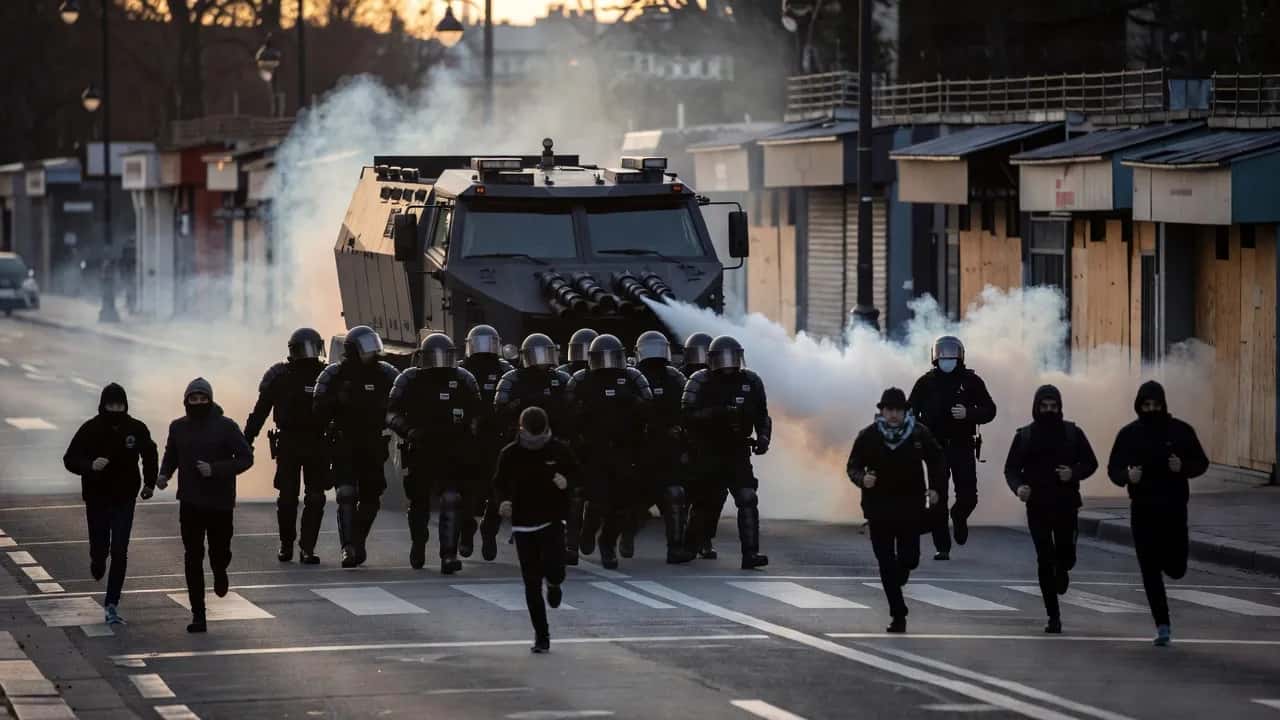
Bogotá is measuring the effectiveness of the French police device in the face of riots: the Colombian press mainly retains that the massive deployment avoided the repetition of the looting of October 17.
Dominant angle identified — does not reflect unanimity of this country’s media
KEY POINTS
- 01
The Interior Ministry estimates participation at 410,000 people, the CGT at 800,000, including around 110,000 in Paris according to the ministry (La República).
- 02
1,314 people had been arrested Sunday morning, according to La República; Semana cited nearly 1,000 arrests, a provisional figure given by Laurent Nuñez.
- 03
Some 500 masked youths clashed with police at the end of the demonstration in Paris, with tear gas and water cannons, as well as clashes in Marseille, Lyon, Bordeaux, and Grenoble.
ANALYSIS
Bogotá, October 25, 2026. For the Colombian press, Saturday, October 24, in France was first and foremost a test of law and order, one week after the riots of October 17. La República summarizes: "hundreds of thousands of people" marched in "mostly peaceful" rallies, before clashes broke out in Paris and Marseille at nightfall, despite a "massive security deployment".
The figures are reported with their two sources. The Ministry of the Interior counts 410,000 protesters in the country, including around 110,000 in the south-eastern outskirts of Paris; the CGT claims 800,000. The protesters denounced the rising cost of living and the increase in inequalities, with some calling for Emmanuel Macron's departure.
The account emphasizes the outcome: riot police used tear gas and water cannons against around 500 hooded youths who were throwing stones. In Marseille, youths blocked a street with metal plates, set fire to containers, and attacked the police; two jewelry stores were looted. Clashes were reported in Lyon, Bordeaux, and Grenoble, and tear gas was fired in Clermont-Ferrand, Lille, Nantes, and Nice.
La República draws a clear conclusion: France avoided the large-scale violence and looting of the previous week, which "suggests" that the government's decision to reinforce personnel and contain the marches "has borne fruit". Interior Minister Laurent Nuñez attributes the clashes to the far left, which wanted to "initiate and complete the uprising", and speaks of a "real threat" that will remain under surveillance in the coming weeks. According to the newspaper, 1,314 people had been arrested by Sunday morning.
Semana adopts a more visual and regional tone. The magazine relays videos of burning containers in Barcelona, evokes tension in Spain, France, Albania, and Italy, and quotes Nuñez, who says the protests took place "without problems" despite "high-risk groups" dressed in black. The figure of nearly 1,000 arrests, still provisional, is presented as likely to increase.
The Colombian reading thus remains focused on the security balance and the minister's words. The economic roots of the anger, the high cost of living, appear as a backdrop rather than a subject, and the political dimension six months before the presidential election is not developed.
SOURCES (2)
- La Republica COMEDIUM