
DOMINANT ANGLE
Brasilia describes a France patrolled by 70,000 police officers, where the government is trying to prevent a return to the looting of October 17, as anger over the high cost of living spreads to Italy.
Dominant angle identified — does not reflect unanimity of this country’s media
KEY POINTS
- 01
70,000 police officers were deployed on October 24, 10,000 more than on October 17, according to Agência Brasil.
- 02
Laurent Nuñez reported 135 arrests in France by early afternoon, many after preventive searches.
- 03
In Italy, student-led protests against the high cost of living took place in Naples (around 300 people), Pesaro (around 200), and Turin (more than 250 high school students).
ANALYSIS
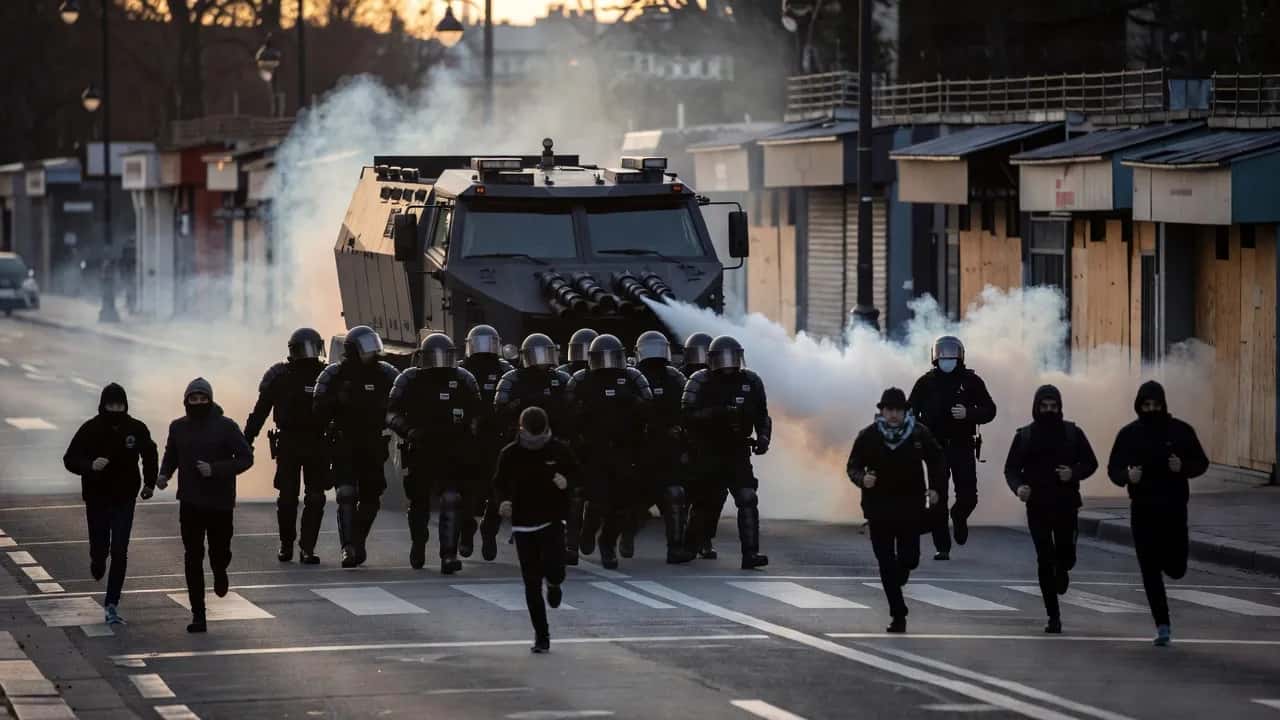
Brasília, October 25, 2026. For the Brazilian press, the day of Saturday, October 24, in France is first and foremost a test of law and order. The Agência Brasil reports on protesters gathered in Paris and throughout the country "under the surveillance of 70,000 police officers," as the government seeks to avoid a repeat of the unrest and looting of the previous weekend. The operation has 10,000 more agents than on October 17, the day when protests against the cost of living and the deterioration of public services turned into "some of the worst disorders France has seen in years."
The Minister of the Interior, Laurent Nuñez, indicated that 135 people had been arrested in the country by early afternoon, many after preventive searches that allowed for the seizure of fireworks, ball bearings, and other objects that could be used as weapons. G1 also cites slings, steel balls, a katana, and airsoft guns. "We must be extremely agile," the minister said, warning: "It will be a long day."
The two media outlets describe a contrast. In Paris, the start of the main procession took place calmly, with hundreds of people in the streets. In Lyon, the third-largest city in the country, the police used tear gas on the crowd; G1 specifies that the agents fired after protesters, near a university and a police station, tried to block a street, with a brief confrontation. Similar incidents are reported in Pau, and, according to AFP cited by G1, tear gas grenades were also used in Lille, Toulouse, and Nantes.
The Agência Brasil emphasizes the image of a capital under siege: merchants protecting their storefronts with boards, museums closed, and more than 20 metro stations inaccessible. The Louvre, the Orsay Museum, and the Paris Opera have closed as a precaution, and business organizations have asked retailers to remain closed. "There are almost no customers, so it's not worth opening," says the manager of a Kiton boutique.
The Estadão broadens its view to Italy, where protesters took to the streets again on the same Saturday to demand measures against the high cost of living, more investment in public education, and less spending on armaments. Led by students, these mobilizations extend those of the previous weekend, which had resulted in clashes with law enforcement. In Naples, around 300 people gathered in Garibaldi Square; in Pesaro, around 200 people challenged the head of government: "Dear Giorgia, how much do you cost us."