
DOMINANT ANGLE
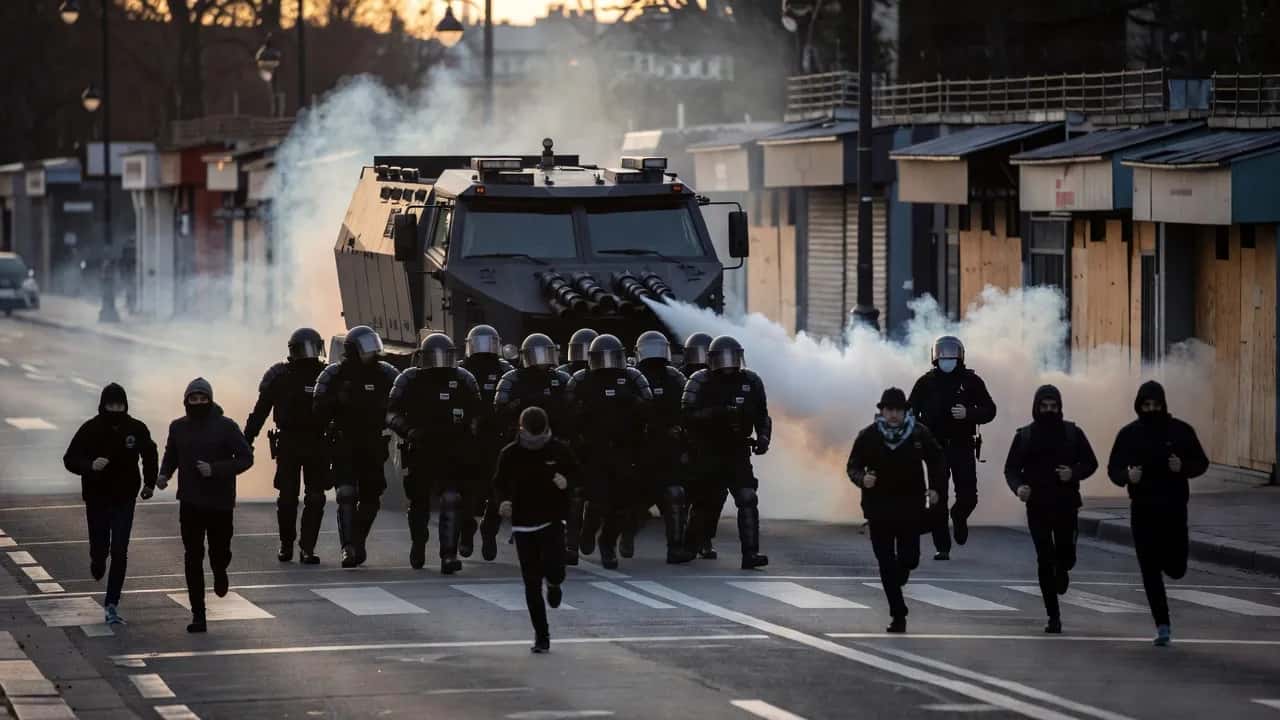
Bern is gauging the day of October 24 against the backdrop of the French security apparatus: 70,000 police officers, curfews and banned demonstrations, in the face of a growing protest.
Dominant angle identified — does not reflect unanimity of this country’s media
KEY POINTS
- 01
70,000 police officers were deployed across the country on Saturday, October 24, according to SRF News and Le Temps.
- 02
The CGT announced 800,000 protesters, the Ministry of the Interior 410,000 (compared to 550,000 the previous week), according to SRF.
- 03
Macron recommended banning non-union demonstrations "wherever possible", a decision criticized as an obstacle to the right to demonstrate (Le Temps).
ANALYSIS
Berne, October 25, 2026. For the Swiss press, the second act of the French protests against the high cost of living is first read through the state's device. 70,000 police officers, as well as special units, have been deployed throughout the country, and law enforcement has marked a massive presence. Many gatherings were not authorized, and routes were modified in multiple locations.
In terms of figures, SRF distinguishes between sources: the CGT counts 800,000 demonstrators in the country, as many as the previous week, while the Ministry of the Interior counts 410,000, compared to 550,000 a week earlier. In Paris, more than 100,000 people marched. Minister Laurent Nuñez judged that the gatherings had "gone well".
In the evening, after largely peaceful marches, rioters clashed with the police in Paris and Marseille, where tear gas and water cannons were used, and two jewelry stores were looted. Images from Lyon and Bordeaux also showed clouds of gas and fires. SRF insists on the difference between peaceful demonstrators and those who take advantage of the chaos to loot.
Interviewed by the channel, its correspondent Zoe Geissler explains the relative calm due to several factors: a significantly more important device than after the violence of the previous week, reinforced controls, better-protected or barricaded businesses with wood, a sometimes more discreet police force, almost absent in some areas of Paris, and well-organized union processions. She warns, however, that discontent is great: the movement, which started with high school and college students demanding better study conditions, has been joined by yellow vests, professions, and the left.
Le Temps gives a voice to the Parisian procession, determined despite curfews and bans. "Even if Macron doesn't want it, we're here," it can be heard, and placards said "I'm suffering from my democracy". The daily recalls that the executive, accused of having failed to maintain order, has played it tough: Nuñez had promised "a lot, a lot, a lot of firmness", with helicopters, horse brigades, and about twenty armored vehicles. Emmanuel Macron had recommended that non-union demonstrations be banned wherever possible, a decision widely criticized as an obstacle to the right to demonstrate. SRF notes that the protest now also targets these security measures.