
DOMINANT ANGLE
Ottawa sees the second day of French protests as a political test for Emmanuel Macron, six months ahead of a presidential election where the streets are already weighing in on the campaign.
Dominant angle identified — does not reflect unanimity of this country’s media
KEY POINTS
- 01
According to the National Post, police arrested nearly 1,000 people on Saturday, October 24, with 70,000 security force members deployed in the country.
- 02
Laurent Nuñez considers the outcome more "positive" than the previous week, which had seen 2,700 arrests.
- 03
In Italy, police made nine arrests and placed 371 people in custody, including 110 minors, according to the National Post.
ANALYSIS
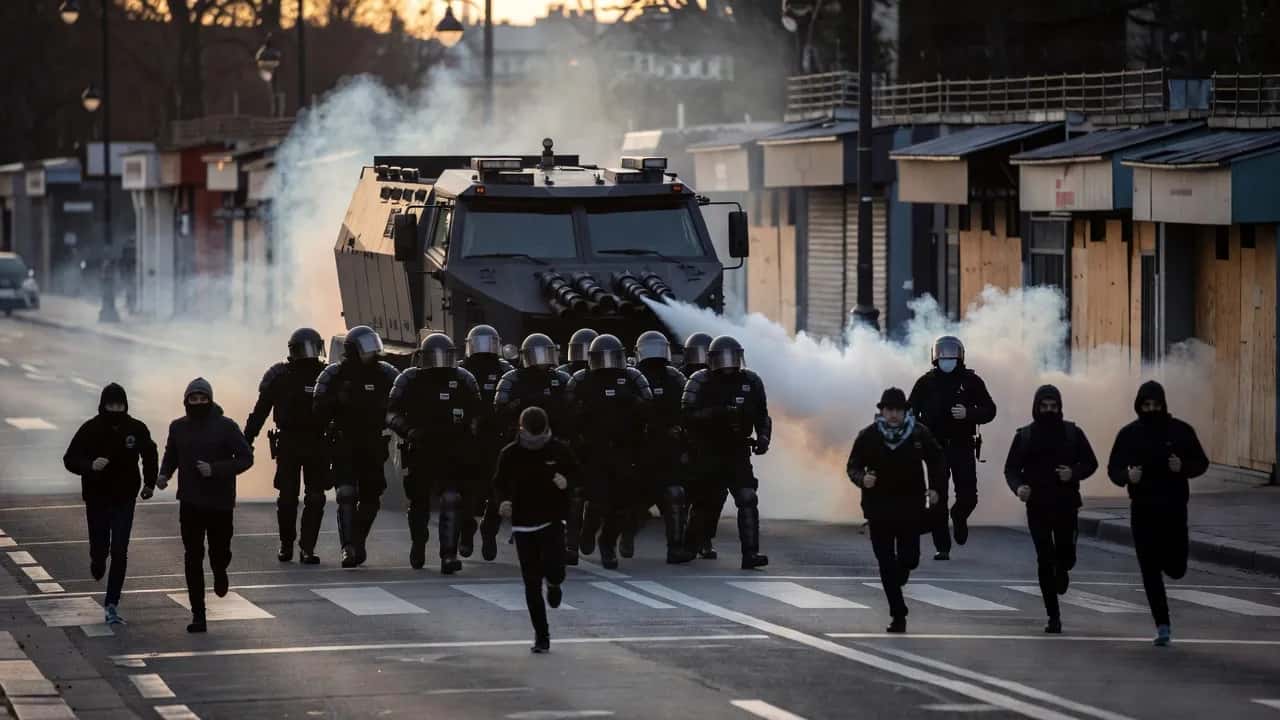
Ottawa, October 25, 2026. Canada's capital is witnessing the aftermath of scattered clashes that erupted on Saturday, October 24, in Paris and other French cities, a week after protests degenerated into street violence. According to reports, the police arrested nearly 1,000 people in the face of "an extremely high level of violence" attributed by Interior Minister Laurent Nuñez to "ultra-left" extremists dressed in black. Tear gas was fired in Paris, Marseille, Lyon, Bordeaux, Lille, Toulouse, Montpellier, and Nantes.
The Canadian government notes that 70,000 security forces had been deployed for marches called against the cost of living, and that the processions brought together between 410,000 people and a higher figure. Two people were "seriously" injured, according to Nuñez: a man in Toulouse, who allegedly had his fingers torn off, and another person in Clermont-Ferrand, with no details provided. The minister considers the outcome more "positive" than that of the previous week, with more police, faster intervention, more prior checks, and better protection of businesses.
Canada's perspective highlights that largely peaceful gatherings gave way to clashes in Paris and Marseille at nightfall, despite a massive security operation aimed at avoiding a repeat of the previous week's troubles.
Canada's framing of the issue is distinctly political. The Canadian press recalls that the riots of October 17 resulted in 2,700 arrests, with vandalized public buildings and hundreds of looted businesses, and that the country will vote in six months to designate Macron's successor after ten years in power. It notes a "widespread anger" against a repression perceived as an attack on the right to demonstrate. Far-left candidate Jean-Luc Mélenchon, present in the Parisian procession, warns that Macron "will understand that this will be repeated every week".
The Italian aspect is treated separately. In Rome and Milan, thousands of people marched despite security measures approved by Giorgia Meloni's government. The police made nine arrests and briefly placed 371 people in custody, including 110 minors. Minister Matteo Piantedosi praises the law enforcement for isolating the violent fringes "with balance and professionalism". Canada's press presents these processions as directed against the war and the rising cost of living.