
DOMINANT ANGLE
Budapest sees the French mobilization as a social movement born out of high schools and prices, which the violence of October 17 divides and which the Hungarian press follows mainly through its internal fractures.
Dominant angle identified — does not reflect unanimity of this country’s media
KEY POINTS
- 01
The Interior Ministry deployed 70,000 agents, 20% more than on October 17, according to HVG.
- 02
According to 444, around 400,000 people demonstrated, according to the ministry, and 800,000, according to the unions, with nearly a thousand arrests.
- 03
Telex links the movement to student protests over a month old against the high cost of living and underfunding of schools, joined by unions and yellow vests.
ANALYSIS
Budapest, October 25, 2026. Hungarian media describe Saturday as the continuation of a social movement, before seeing it as a public order issue. Telex, which sent a reporter to Paris, recalls that the protests extend student and high school demonstrations launched "over a month ago" against the rising cost of living, teacher job cuts, the state of school buildings, and the underfunding of education. Unions and former yellow vests joined them on October 17, as did thousands of people who came, the site writes, "to confront the police, smash everything, set fires, and loot".
On the ground, Telex collects divided opinions. Some protesters believe that the scenes from the previous weekend "hurt the movement very badly"; others estimate that radical change has almost never been achieved entirely peacefully. The site quotes a deputy mayor of Paris who says that violence had reached a "never-before-seen" level in the capital, and describes the city hall of Limoges set on fire, that of Marseille invaded, and the tourist office of Lyon burned.
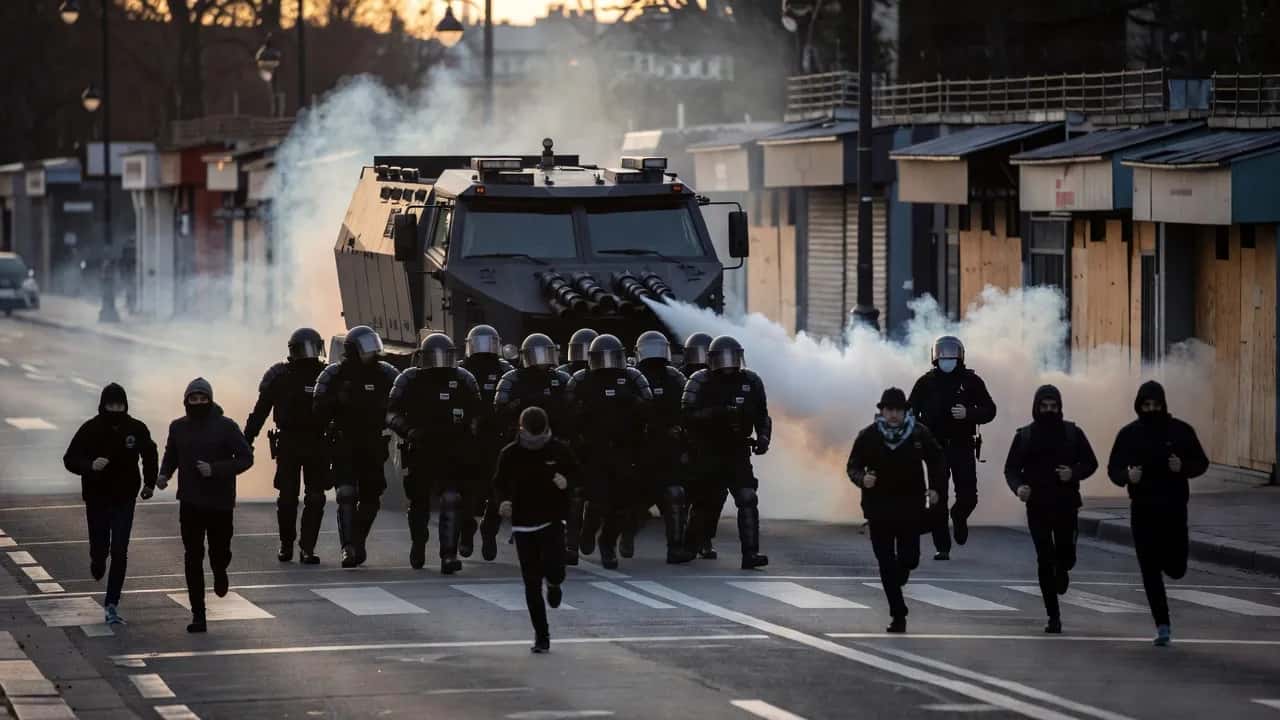
HVG focuses on the deployment: the Ministry of the Interior deployed 70,000 agents, 20% more than the previous week. Citing the MTI agency, it reports that "everything is calm in the streets of Paris", with a modified route by the police. Laurent Nuñez reports 135 arrests at noon for possession of objects that could be used as weapons, and the ministry counted 35,000 protesters at noon, compared to 60,000 the day before. In Lyon, where the prefecture had banned all gatherings, the police used tear gas. HVG also devotes a sentence to Hungarian politics: Magyar Péter, it writes, "points to migrants" after the violence, while Paris questions the responsibility of the far left.
444 provides the figures for the day: around 400,000 protesters according to the ministry, 800,000 according to the unions, and "nearly a thousand" arrests. Most of the processions were peaceful, but tear gas and water cannons were used in several cities, and barricades burned in Marseille. The site relays the BBC on the immediate convictions, Macron's decree limiting gatherings to recognized unions, the "far-left" accusation made by the president, and the suspicions of foreign interference mentioned by the Austrian foreign minister. It finally broadens the picture to Spain, Italy, Portugal, and Albania, where housing, food prices, low wages, and public services fuel a common discontent.