
DOMINANT ANGLE
London is gauging the resilience of the French system: the British press first notes the public order balance, between massive processions, tear gas and a night without the chaos of the previous week.
Dominant angle identified — does not reflect unanimity of this country’s media
KEY POINTS
- 01
The Interior Ministry counts 410,000 protesters on Saturday, October 24, the unions around 800,000 (BBC, The Independent).
- 02
Some 70,000 police officers have been deployed; the BBC reports nearly 1,000 arrests and tear gas and water cannon fire.
- 03
The Independent mentions around 500 masked youths in Paris and looting, including two jewelry stores in Marseille.
ANALYSIS
London, 25 October 2026. For the BBC as well as The Independent, Saturday, 24 October in France is first seen in light of the riots of the previous week, which the BBC ranks among "the worst scenes of disorder in modern history" of the country.
The mobilization figure is given in a double reading. The Ministry of the Interior counts 410,000 demonstrators, the unions around 800,000. The Independent specifies that the main procession brought together at least 110,000 people in the south-eastern suburbs of Paris, against the rise in the cost of living and the worsening of inequalities. The BBC also mentions school living conditions among the motivations.
The device is described in detail: 70,000 police officers deployed, restrictions in several cities, and Emmanuel Macron's decision to only tolerate demonstrations organized by recognized unions. The BBC notes that the elite police usually in charge of organized crime and counter-terrorism were part of the operation in Paris, between the Porte d'Italie and the Porte de Vincennes.
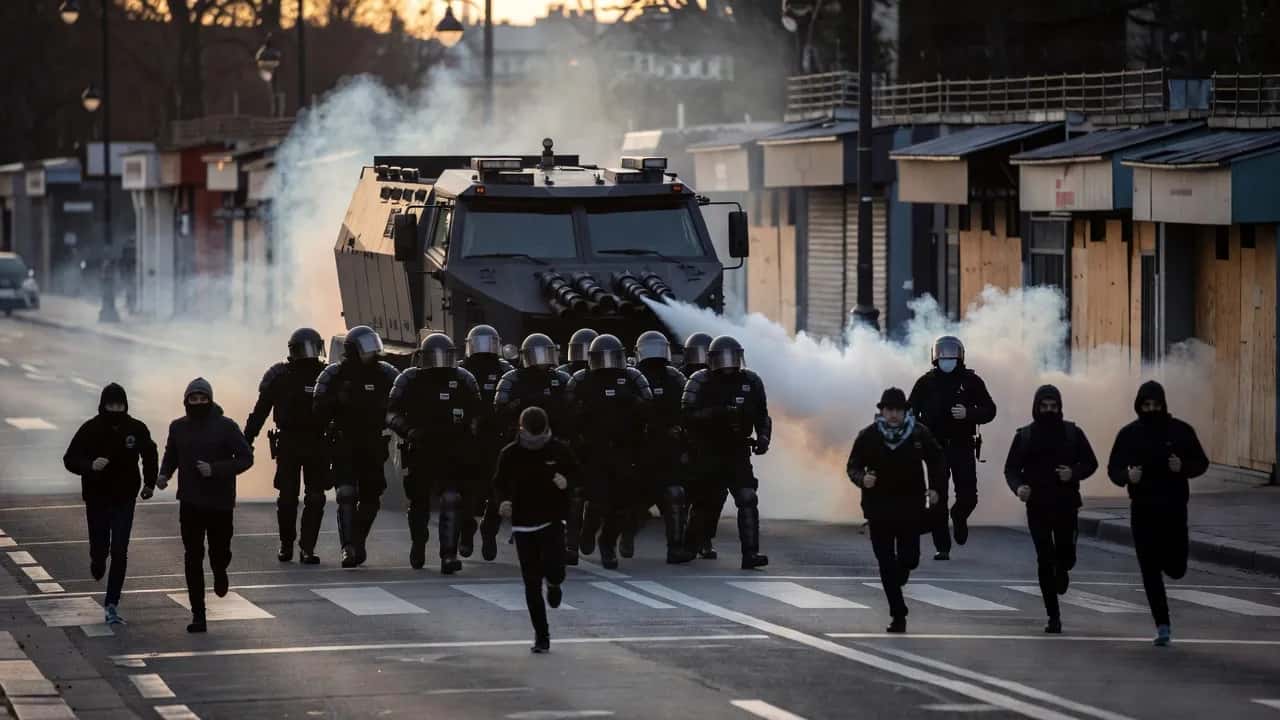
The violence comes at the end of the day. According to The Independent, the police used tear gas and water cannons against about 500 masked young people. In Marseille, trash cans were set on fire and bottles were thrown; two jewelry stores were looted. The BBC reports burning barricades in Marseille and torn panels from a Bordeaux boutique. Clashes are reported in Lyon, Grenoble, Lille, Rennes, Nantes, and Toulouse.
The Minister of the Interior is quoted on "high-risk groups" that detached themselves from the processions to commit violence. The BBC headlines "nearly 1,000" arrests; it concludes that the authorities have, so far, avoided riots and looting of the scale of the previous weekend, and recalls that hundreds of people have been sentenced in immediate appearance.
The other axis is that of the origin and extension of the movement. The Independent goes back to September, to a understaffed high school in Créteil, then to blockages gaining the suburbs and the whole country, with the call of the student union UNEF and the yellow vests. It quotes Macron denouncing "seditious acts" by far-left groups aiming to "overthrow the Republic", and signals clashes in Brussels: the protest is presented as European.