
DOMINANT ANGLE
Buenos Aires is gauging the October 24th events in light of the 2027 deadline: the Argentine press first sees a political tension for Emmanuel Macron, six months ahead of the presidential election, and a movement that is spilling over into Italy.
Dominant angle identified — does not reflect unanimity of this country’s media
KEY POINTS
- 01
Profile: over 1,000 arrests according to official sources and 70,000 police officers and agents deployed, one week after unrest that resulted in more than 2,700 detainees.
- 02
La Nación: in Milan, at least ten thousand protesters, 500 soldiers sent by the Meloni government in addition to 5,000 police officers, and a League poster set on fire.
- 03
Nuñez had warned before the marches: "We will not tolerate any act of violence or any disturbance of public order" (Perfil).
ANALYSIS
Buenos Aires, October 25, 2026. Argentine dailies La Nación and Perfil are treating Saturday, October 24, as an episode of both political and public order tension. Perfil headlines protests "against Macron" that "add to the political tension" six months before the election, and recalls that France returned to the streets one week after riots and looting that led to more than 2,700 arrests.
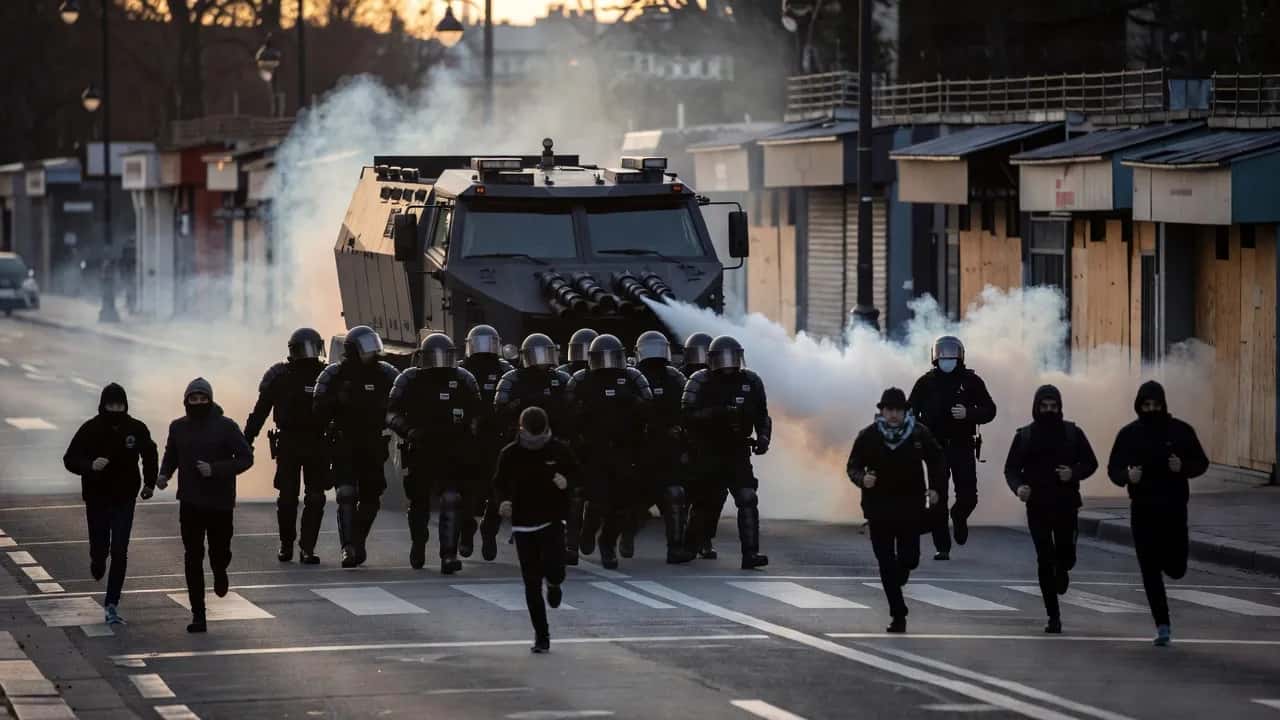
According to Perfil, marches against the rising cost of living have spread to several cities. The newspaper reports around 400,000 protesters in the country and, citing official sources, at least 1,000 people arrested. The government deployed 70,000 police officers and agents. The Minister of the Interior, Laurent Nuñez, had warned: "We will not tolerate any act of violence or any breach of public order." The police used tear gas in Paris, Marseille, Lyon, Lille, Bordeaux, Toulouse, Montpellier, and Nantes, as well as batons and water cannons in the capital.
Perfil emphasizes that the marches took place largely peacefully for most of the day; clashes intensified when protesters began to disperse and small groups formed. The newspaper stresses the official response: restrictions on routes and measures to prevent access to commercial areas, in a climate of limitation of the right to demonstrate.
La Nación, in an article by its correspondent in Milan, broadens the focus: "Saturday's protests, with France as the epicenter, had repercussions" in Italy, Spain, Albania, and Portugal. In Milan, Italy deployed soldiers; Giorgia Meloni's government sent 500 military personnel to reinforce the hundreds already in place and 5,000 police officers, with drones, controls in train stations, and online surveillance. At least ten thousand people converged on Leonardo da Vinci Square, in front of the Polytechnic University, shouting slogans against Meloni; a League poster, which was holding its federal congress in the city, was torn down and burned. Luxury stores like Omega, Tiffany, and Gucci covered their windows with wooden boards.
The Argentine perspective thus focuses on two threads: the fragility of an executive power confronted with the street as the 2027 presidential election approaches, and the European contagion of social discontent fueled by the cost of living, which governments are addressing first and foremost through police means.