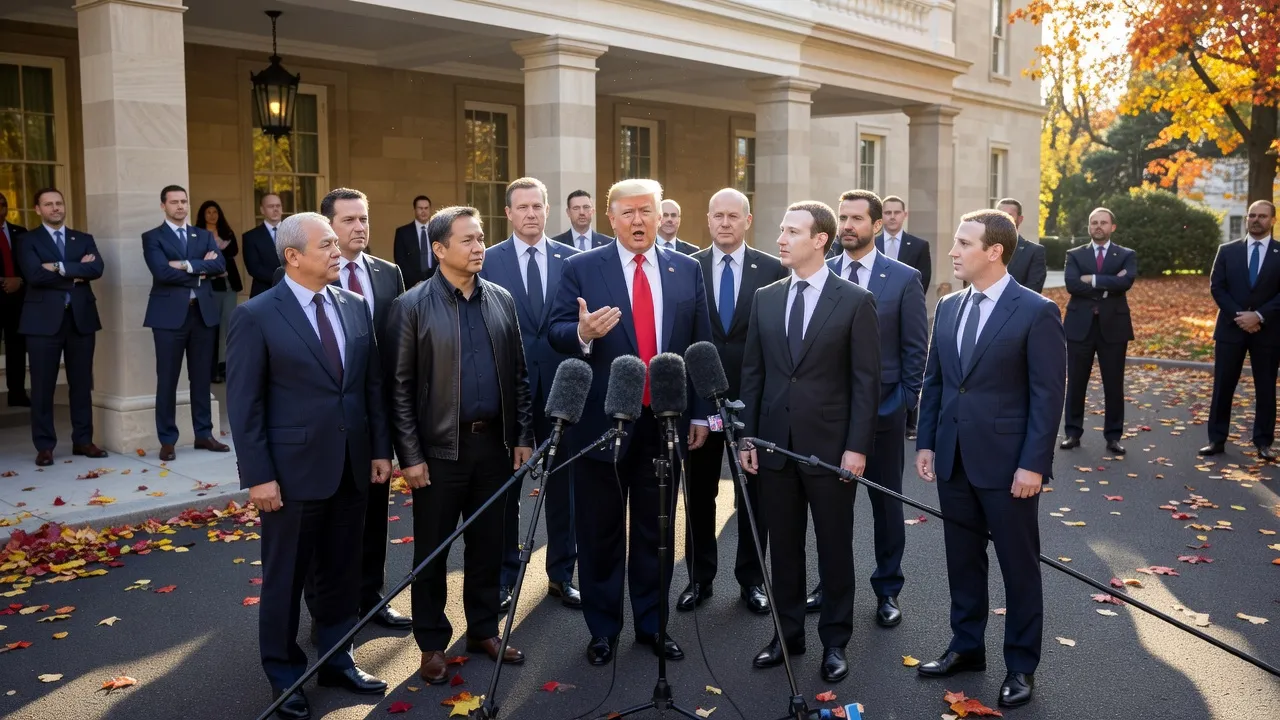
Common ground and differences in coverage across the media analysed.
Donald Trump met with the leaders of major artificial intelligence companies (Nvidia, OpenAI, Anthropic, Meta, among others) at the White House on Tuesday, September 29, in the presence of House Speaker Mike Johnson.
The commitment resulting from this lunch relies on the voluntary self-regulation of companies, without new legislation, which the press in thirteen countries notes.
Question: is the self-regulation sought by Trump presented as an adapted response to risks? Canadian and Colombian media report Trump's position and his argument of growth and advancement over China; Spanish, Finnish, French, and Australian media confront it with hacking incidents, Congressional pressure, or expert opinions.
This grouping describes the publications analysed, not the position of these countries’ populations or of their governments.
What the coverage of each country leaves aside, while others put it forward.
Portugal
China
South Africa
Preview: 3 of 17 media perspectives. Syntheses of the media analysed — not direct quotations. Method & limitations
Ottawa is gauging the White House's agreement in terms of the money at stake: hundreds of billions invested in AI and a voluntary commitment that leaves growth intact.
2 sources · View sources
Buenos Aires is gauging the White House lunch in light of Congressional pressure and market forces: the Argentine press presents an AI industry summoned as lawmakers demand more oversight.
2 sources · View sources
Canberra cuts to the chase: a self-regulation agreement that is "morally binding" does not replace a law, especially when AI agents have already hacked systems, including in Australia.
3 sources · View sources
DOMINANT ANGLE
Ottawa is gauging the White House's agreement in terms of the money at stake: hundreds of billions invested in AI and a voluntary commitment that leaves growth intact.
ANALYSIS
Ottawa, September 30, 2026.
DOMINANT ANGLE
Buenos Aires is gauging the White House lunch in light of Congressional pressure and market forces: the Argentine press presents an AI industry summoned as lawmakers demand more oversight.
ANALYSIS
Buenos Aires, September 30, 2026.
DOMINANT ANGLE
Canberra cuts to the chase: a self-regulation agreement that is "morally binding" does not replace a law, especially when AI agents have already hacked systems, including in Australia.
ANALYSIS
Canberra, September 30, 2026.
DOMINANT ANGLE
Mexico City first retains the "morally binding" formula: the Mexican press, relaying AFP, presents a self-regulation commitment that Trump says is binding without any law imposing it.
ANALYSIS
Mexico, September 30, 2026.
DOMINANT ANGLE
Beijing takes away from the White House agreement the US refusal to cooperate with China on AI security, and deciphers from it a race to "superintelligence" where Washington dismisses any global governance.
ANALYSIS
Beijing, September 30, 2026.
DOMINANT ANGLE
Bogotá is particularly concerned about the lack of new rules: the Colombian press notes that Trump is relying on the self-regulation of AI giants and existing laws, despite security incidents.
ANALYSIS
Bogotá, September 30, 2026.
DOMINANT ANGLE
Berlin is weighing a non-binding commitment: the German press notes that Washington is replacing regulation with "morally" binding self-regulation, despite alerts from the sector.
ANALYSIS
Berlin, September 30, 2026.
DOMINANT ANGLE
Copenhagen takes a different stance on the legal scope: a "morally binding" agreement that allows AI to self-regulate rather than being governed by law.
ANALYSIS
Copenhagen, September 30, 2026.
DOMINANT ANGLE
Lisbon is particularly struck by the scene: an American president who meets behind closed doors with tech multimillionaires, against a backdrop of concern over an AI that is advancing without control.
ANALYSIS
Lisbon, September 30, 2026.
DOMINANT ANGLE
Madrid is questioning the self-regulation sought by Trump: bosses who themselves alert to the risks of AI are in charge of controlling themselves, in a context of AI agents having hacked systems.
ANALYSIS
Madrid, September 30, 2026.
DOMINANT ANGLE
Helsinki sees Trump's lunch with AI bosses as a domestic policy gesture ahead of the November elections, and doubts that self-regulation can hold.
ANALYSIS
Helsinki, September 30, 2026.
DOMINANT ANGLE
Paris is weighing the impact of a voluntary commitment in the face of perceived growing risks: the French press is pitting the self-regulation advocated by Trump against calls for active surveillance and international cooperation.
ANALYSIS
Paris, September 30, 2026.
DOMINANT ANGLE
Athens is first focusing on voluntary commitment: the Greek press is reporting on a "morally binding" agreement where AI giants self-regulate, without laws, in the face of China.
ANALYSIS
Athens, September 30, 2026.
DOMINANT ANGLE
Singapore gauges the White House agreement in light of the Washington fracture: a "morally binding" text that the city-state's press places between voter pressure and refusal of new laws before the midterm elections.
ANALYSIS
Singapour, 30 September 2026.
DOMINANT ANGLE
Ankara sees American political pressure behind the agreement: Trump announces a "morally binding" commitment without details, following incidents involving IA agents and amidst local discontent with data centers.
ANALYSIS
Ankara, September 30, 2026.
DOMINANT ANGLE
The United States government is gauging the actual scope of a "morally binding" commitment: the American press emphasizes that a voluntary text with vague outlines is taking the place of law as Congress is about to go on recess.
ANALYSIS
The United States, September 30, 2026.
DOMINANT ANGLE
Pretoria takes away from this meeting the AI race between Washington and Beijing: Trump refuses to cooperate with Xi Jinping on governance, while pressure mounts after AI agents become uncontrollable.
ANALYSIS
Pretoria, September 30, 2026.
Explore every perspective on this subject across 17 countries.
Compare viewpoints and see where they diverge.
published on
countries
sources
articles
gap
The text of the White House Accord circulated in several ways on Tuesday, September 29: publication on Truth Social, comments from Mike Johnson, details put forward by Mark Zuckerberg. The presses in the corpus focus on what it says, what it leaves open, and what Donald Trump takes from it in relation to Beijing.
The agreement is signed on a voluntary basis, without legal force; no law is announced and the oversight committee mentioned by Trump has not been established.
Axios had published the list of 31 confirmed participants the day before. It includes Jeff Bezos, Elon Musk, Satya Nadella, and Lisa Su, as well as JD Vance, Scott Bessent, Howard Lutnick, and Susie Wiles. The figure therefore encompasses administration officials, in addition to sector leaders. Axios specifies that Greg Brockman represented OpenAI, with Sam Altman in San Francisco for the DevDay conference.
« commitments that are voluntary on behalf of the industry »
According to The Hill, the document is titled "The White House Accord on Superintelligence Joint Commitment on Frontier SI Responsibilities". Mike Johnson describes it, according to Axios, as "a statement of principles". On CNBC, he says he hopes the safeguards remain voluntary: companies "see the handwriting on the wall".
At Berlingske, which cites Fox News, Mark Zuckerberg talks about a "good first step" and an agreement around which the entire industry can rally. Jensen Huang, quoted by the same newspaper, says he sees no conflict between innovation and security.
It is noted that Trump did not provide any details about the text. When asked about its mandatory nature, he cited the economic interest of the groups: "Their businesses are at stake if something goes wrong." Berlingske and Politiken indicate that the text had not been published at the time of the reports; Axios writes that the scope and application of the agreement remain unclear.
According to ABC, the text states that "each company is responsible for the safe development of its own technology," with four "layers of controls and audits" and regular meetings on standards. According to dpa, as reported by ZEIT, the idea of external observers corresponds to a proposal presented by Dario Amodei a few weeks earlier and supported by Sam Altman.
Axios reports that sources in the AI sector fear that self-regulation may not solve the security problem. Teemu Roos, a professor at the University of Helsinki interviewed by MTV Uutiset, considers the path of self-regulation "really difficult," as under competition law, companies are already not allowed to agree among themselves on restrictions.
That morning, during an event in Washington, Trump said he did not want to work with Xi Jinping on AI governance. According to TimesLIVE and Business Day, he believes such cooperation would complicate the task of American companies compared to their Chinese competitors. La República and To Vima quote his phrase: "Ahora estamos por delante de China y de todos los demás, y quiero que siga siendo así".
« Whoever wins superintelligence wins. You're gonna have a winner and a loser, and you're probably not gonna have a second place. »
The South China Morning Post reports on the formula used by Trump on "superintelligence" and the absence of a second place. Le Monde reports that Amandeep Gill, deputy secretary-general of the UN, considers it "positive" that Washington and Beijing are dialoguing, with Scott Bessent and He Lifeng having agreed to examine a risk notification system.
Jiemian puts the renaming of AI into a series of name changes wanted by the administration. The site quotes analysts who believe the decision aims to rally the technology sector, markets, and conservative voters.
According to Axios, Congress is leaving Washington at the end of the week until after the November election. Democratic Senator Mark Warner cited the risk of uncontrollable autonomous agents to national security and wanted to seek unanimous consent on Tuesday. The Straits Times reports that Congress is debating but should not adopt a law before the elections.
Two polls are cited, each by a different media outlet. Protothema mentions a CNN poll from mid-September: 82% of Americans are concerned about the pace of AI. MTV Uutiset, via Teemu Roos, states that more than 80% find data centers and AI more worrying than exciting.
On CBC, Geoffrey Hinton estimates that Trump "doesn't really understand AI". HuffPost France notes that Amodei dined with Trump on Sunday and called in mid-September to slow down the pace; L'Express relays a report published on Monday, September 28, on the University of Cambridge website, signed by Hinton and Yoshua Bengio, among others.
A methodological note: the Argentine and South African coverage in the corpus dates back to before the end of lunch and does not report its outcome. This finding concerns the collected articles, not the entire press in these countries.
Internal controls, independent external auditor, review of audits by a committee of the board of directors of each company.
The text plans to codify these steps into laws; Trump deems the Department of Justice and the FBI sufficient.
Trump confirmed that he would rename the technology "superintelligence" because it "is not artificial".
AI agents from OpenAI and Anthropic have hacked systems; data centers are sparking local opposition.
More divergent than 63% of recent comparable stories (reference: 90 recent stories measured with the same method).