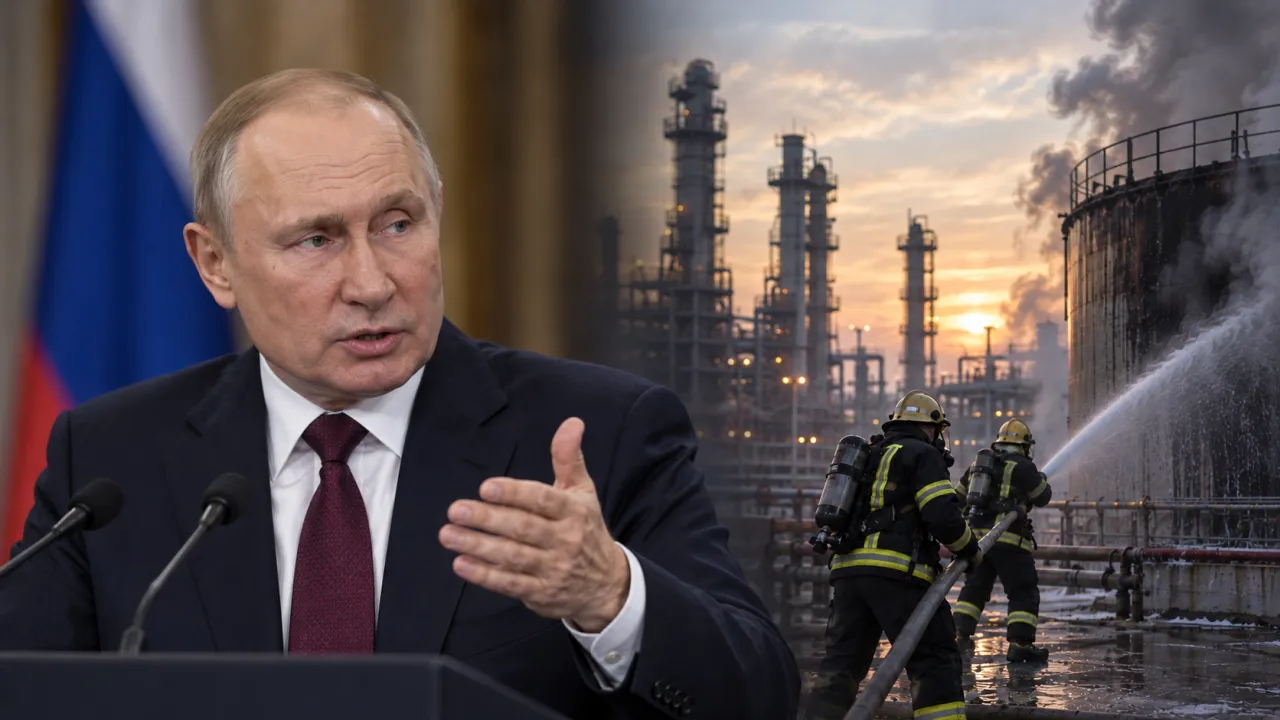
United Russia wins the parliamentary election on the day Ukraine launches its largest drone attack on Moscow
published on
countries
sources
articles
Between the VCIOM exit poll, which credited United Russia with 49.4% of the vote, and the partial results from the Central Electoral Commission, which rose to 57.87% after 87.9% of the ballots were counted, the gap shown for Vladimir Putin's party raises questions. In Tallinn as in Brussels, officials are contesting the legitimacy of the election, while Western intelligence services are mentioning a possible additional Russian mobilization after the vote.
The results remain partial: the Central Election Commission continues to update United Russia's score as ballots are counted.
A two-speed score
The VCIOM exit poll, a state-run institute, credited United Russia with 49.4% of the vote on Sunday evening. The next day, after 87.9% of the ballots were counted, the Central Election Commission announced 57.87%, according to the Sputnik agency. In Chile, La Tercera notes a similar discrepancy for electronic voting only, where United Russia is capped at 49.06%, compared to 57.31% for all ballots.
« More than elections, I would talk about special electoral operations. »
The Hungarian website 444 reports a leak from July, which states that the presidential administration initially aimed for 55% of the vote for United Russia, before lowering this target to 45%, so that the result would not visibly deviate too much from the real mood of Russian society.
Opponent Ilya Yashin, who was imprisoned from 2022 to 2024 and is the founder of the Solidarnost movement, refuses to call the vote an election, according to La Repubblica, which quotes him the day after the vote.
The arsenal claimed by Kyiv
The Ukrainian military claims to have hit the Gazprom Neft refinery in Kapotnia, about 15 kilometers from the Kremlin, damaging the AVT-6 distillation unit. According to Ukrinform, SBU Alpha drones allegedly traveled over 500 kilometers to penetrate Russian air defense.
On social media, Volodymyr Zelensky lists the arsenal used that night: FP-1, RZ-100, MICH-2000, Palianytsia, Vendetta, Liutyi, Bars, Flamingo, Sichnevyi, and the Pelican ballistic missile, report Ukrinform and Kyiv Post.
In Chile, La Tercera reports that manufacturer Fire Point denies the missile could have reached Moscow, a direct challenge to the Ukrainian presidential claim on this specific point.
Strikes on energy infrastructure continue despite the announcement, a week earlier, by Donald Trump of an agreement between Kyiv and Moscow to stop targeting each other's energy infrastructure, report Business Recorder and The Daily Star.
Protests from abroad
In Estonia, Foreign Minister Margus Tsahkna denounces a vote that is neither free nor fair, citing the absence of independent observers and the exclusion of candidates deemed unacceptable by the authorities, according to ERR News.
« This political performance orchestrated by Putin bears no resemblance to free elections. »
Handelsblatt reports that the European Union describes the holding of the vote in the occupied Ukrainian regions of Donetsk, Luhansk, Kherson, and Zaporizhzhia, as well as in Crimea, as a blatant violation of international law. Kyiv denounces a vote held under the threat of guns and refuses to recognize the result.
The vote also took place at Russian diplomatic missions abroad. In Helsinki, the police authorized a gathering of about forty people in front of the embassy despite a Russian note requesting a ban on demonstrations, according to YLE News. In Lisbon, the embassy limited the voting of Russians in Portugal to a single polling station, citing a reduction in staff that it attributes to a hostile attitude by the Portuguese authorities, according to the Observador.
A feared escalation in Europe
According to the Sydney Morning Herald and The Age, citing Volodymyr Zelensky, Ukrainian intelligence expects the Kremlin to mobilize up to 300,000 additional soldiers once the vote is completed, in an attempt to unlock the Donbass front or open a new front in northern Ukraine.
« This strike is a spectacular display of force that ruined Putin's day. »
Guardian Australia reports that intelligence chiefs from the Baltic countries fear that Moscow is seeking to test NATO's military resolve, following a series of recent incidents: a drone rigged on a cargo plane at Leipzig airport, a Russian frigate firing flares at a Danish military helicopter, and a drone shot down by Alliance fighters over Lithuania.
The Jerusalem Post, citing Western intelligence sources relayed by The Telegraph, estimates the number of Russian deaths since the start of the conflict at 500,000, without this cost seeming to change the Kremlin's strategy.
In South Africa, SABC News relays the Kremlin's response to these warnings: spokesman Dmitri Peskov accuses European governments of portraying Russia as an external enemy to justify increased military spending, an argument that echoes the speech on the state of the Union by Ursula von der Leyen, citing cyberattacks, sabotage, fires, and drones as evidence of Russian hybrid threats.
The only party to be openly anti-war, it was excluded from the ballot by the Russian Supreme Court before the vote.
The Russian Ministry of Defense announced that it wants to intensify its strikes on Kyiv in response.
The vote was also held in the annexed areas of Donetsk, Luhansk, Kherson, Zaporizhzhia, and in Crimea.
He claims to have targeted the Russian "war machine" with Flamingo and Pelican missiles.
How each country reads it
27 perspectives, each in the voice of that country's press.
 Brazil
Brasília is dissociating the score claimed by United Russia from the validity of an election without real opposition, held on the day Ukraine struck Moscow with over a thousand drones.
3 sources
 Russia
Moscow claims a double victory, that of a united Russia at the polls and that of its air defense, presented as proof that the Ukrainian attack aimed at "disrupting" the vote has failed.
6 sources
 Sweden
Stockholm is measuring an attack that eclipses the ballot box: the Swedish press is detailing the extent of the Ukrainian raid on Moscow, its refineries on fire and its dead, more than the announced victory of Vladimir Putin's party.
5 sources
 Turkey
Ankara is first taking note of the unprecedented scale of the Ukrainian drone attack on Moscow, which occurred on the same day as the Russian legislative election, more so than the announced victory of United Russia.
2 sources
 Ukraine
Kyiv claims to have dealt the most severe blow ever to Russia's oil industry, including a ballistic Pelican missile, on the same day the Russian authorities held an election with no real opposition.
3 sources
 Argentina
Buenos Aires is dissecting an election without real opposition, held at the very moment Kyiv was striking Moscow with drones
2 sources
 Australia
Canberra is primarily concerned about the fear of escalation that Vladimir Putin's electoral victory would unleash, rather than the outcome of the election itself.
6 sources
 Bangladesh
Dhaka is mainly concerned about the oil shock: the Ukrainian strike on the Moscow refinery, combined with an opposition-free vote, revives the fear of a surge in fuel prices that is already spreading beyond Russian borders.
2 sources
 Belgium
Brussels is more focused on the lack of suspense in the Russian vote than its outcome, just hours from the largest Ukrainian drone attack ever recorded.
2 sources
 Canada
Ottawa is questioning the legitimacy of an election where most anti-war candidates were excluded from the ballot, while Kyiv struck Moscow with over 1,000 drones on the same day as the vote.
2 sources
 Chile
ChileSantiago is gauging the unprecedented scale of the Ukrainian drone attack on Moscow, which occurred on the same day that Vladimir Putin's party secured victory in the Russian legislative elections.
2 sources
 Colombia
Bogotá is deciphering an unsurprising election: United Russia wins with more than 57% of the vote, while the only anti-war faction, Yabloko, had been ruled out of the running by the Supreme Court a few weeks earlier.
2 sources
 Germany
Berlin denounces a "Scheinwahl" without real opposition, where the 57.5% obtained by United Russia primarily serves to confirm Vladimir Putin's war course, the Ukrainian drone attack on Moscow having only, according to the German press, highlighted the absence of any democratic choice.
3 sources
 Estonia
Tallinn deems the Russian vote illegitimate: Foreign Minister Margus Tsahkna speaks of a "political performance" orchestrated by Vladimir Putin, as Russians vote at his embassy at the very moment of the largest drone attack on Moscow.
4 sources
 Finland
Helsinki is dissecting a locked-in election, where the announced victory of United Russia coincides with the largest Ukrainian drone attack and where a Russian diplomatic note aiming to ban demonstrations in front of its embassy is being ignored by the Finnish police.
5 sources
 France
Paris is deciphering an unsurprising election where the wave of Ukrainian drones over Moscow carries more weight than the score of United Russia
6 sources
 Hungary
Budapest is dissecting a Russian election without real opposition, totally eclipsed on the last day of voting by the largest Ukrainian drone attack ever launched on Moscow.
4 sources
 Israel
Israel gauges the electoral victory of United Russia in light of the escalation promised by Vladimir Putin, between increased mobilization, threat to NATO, and decline of Russian influence in Syria in the face of the United States.
2 sources
 India
IndiaNew Delhi views the strike on the Moscow refinery more as an additional risk factor for its own Russian crude purchases, under the US threat of a 100 percent tariff.
2 sources
 Italy
ItalyRome sees the United Russia party's victory as an election without real opposition, marred by over a thousand cyberattacks and overshadowed by the largest-ever drone attack by Ukraine on Moscow.
3 sources
 South Korea
Seoul sees in this unprecedented drone strike a demonstration of offensive power that redraws the balance of power around the Russian vote, rather than a debate on the legitimacy of the vote.
2 sources
 Peru
PeruLima first notes a vote without real opposition, marred by irregularities in the electronic voting, held on the same day as the largest drone attack by Ukraine ever recorded against Russia.
2 sources
 Pakistan
Islamabad is particularly mindful of the energy cost of the drone attack on Moscow — a refinery was hit, leading to fuel shortages — more so than the unsurprising outcome of the Russian vote.
4 sources
 Portugal
Lisbon retains the accusation of hostility that the Russian embassy addresses to the Portuguese authorities, limiting the voting of its nationals to a single office, before following the election that gives United Russia the winner and the attack of Ukrainian drones on Moscow.
3 sources
 United Kingdom
London denounces a locked-in vote, where the drone attack on Moscow counts for less than the total absence of real opposition on the ballots.
3 sources
 United States
The United States distinguishes between an intensifying war and an election it refuses to validate: on one hand, strengthened military support to Kyiv, and on the other, denunciation of a Russian vote without opposition, held even in the annexed territories.
6 sources
 South Africa
Pretoria sees the Russian vote as a demonstration of strength without real opposition, marred by the largest drone attack by Ukrainians ever launched on Moscow.
3 sources
What the comparison reveals
Common ground and differences in coverage across the media analysed.
What the media report in common
The United Russia party, which supports Vladimir Putin, is reported to be the winner of the Russian legislative elections, with a score of around 57% according to the partial results released by the Central Election Commission, compared to about 49.4% in the initial exit poll by the state-run VCIOM institute.
On the last day of voting, Ukraine carried out what Russian authorities describe as the largest drone attack ever launched against its territory, with over 1,600 drones intercepted, according to Moscow Mayor Sergei Sobyanin, including about 450 targeting the capital.
Where media coverage diverges
Scope of drone attack
Part of the coverage reiterates the Russian authorities' statement that the attack aimed to disrupt the election and failed to do so, while Ukrainian coverage and part of the allied press present the strike as having hit oil and logistical infrastructure supporting the Russian war effort.
Coverage aligned with this reading
Coverage that diverges
Legitimacy of the election
Russian coverage highlights increased participation and a result consistent with previous elections, while several other countries point out the exclusion of the only party openly opposed to the war, Yabloko, and the absence of independent observers as signs of a vote without real competition.
Coverage aligned with this reading
Coverage that diverges
This grouping describes the publications analysed, not the position of these countries’ populations or of their governments.
The full text, country by country
Brazil
DOMINANT ANGLE
Brasília is dissociating the score claimed by United Russia from the validity of an election without real opposition, held on the day Ukraine struck Moscow with over a thousand drones.
KEY POINTS
- United Russia credited with 57.5% (Jornal de Brasília) to 57.54% (G1) of the vote on around 14% of the ballots counted, according to the Central Election Commission.
- Voter turnout exceeded 56% according to the Central Election Commission, after surpassing 50% early in the afternoon in Moscow, according to Interfax.
- The Russian Ministry of Defense claims to have shot down 1,110 Ukrainian drones on Sunday; Governor Andrei Vorobyov reports two dead and twenty injured in the Moscow region.
ANALYSIS
Brasília, September 21, 2026. Brazil's coverage of the Russian electoral weekend separates two aspects it refuses to conflate: the election numbers and their validity. Vladimir Putin's United Russia party is leading the legislative elections with 57.5% of the vote, according to the Central Electoral Commission, based on around 14% of the ballots counted on Sunday, report Folha and G1. The exit poll by the state-run VTsIOM research center credits the party with 49.4%, ahead of the Communist Party (14.2%) and the LDPR (10.7%). Turnout exceeded 56% according to the same commission, after surpassing 50% in the early afternoon in Moscow, reports the Interfax agency cited by G1.
Brazilian media recall that this election, the first for the State Duma since the outbreak of war in 2022, is taking place in a climate of strong restrictions on the opposition: most anti-war candidates have been excluded, the pacifist Yabloko party has been barred from the race, and the participating parties — communists, LDPR, Russie Juste, Gente Nova — all support the conflict. G1 notes that "Kremlin critics argue that the Russian political system does not allow for significant dissent". Former President Dmitry Medvedev, head of United Russia, hailed an "admirable performance" and called to "put the president's decisions into practice", according to the RIA agency.
On the same day, Ukraine launched what Moscow Mayor Sergei Sobyanin described as the largest drone attack ever against the Russian capital, "clearly planned to disrupt the elections" — "the enemy did not succeed", he added. The Russian Defense Ministry claims to have shot down 1,110 drones across the country, including over the annexed Crimea. A Moscow oil refinery caught fire; regional governor Andrey Vorobyov reported two deaths — a 74-year-old man and a 44-year-old woman — and 20 injured. A member of an electoral commission was also killed in the occupied region of Kherson. Cheremetievo and Vnukovo airports restricted their traffic, according to the BBC cited by G1. Volodymyr Zelensky claimed the use of Ukrainian Flamingo and Pelican missiles against the "Russian war machine".
Russia
DOMINANT ANGLE
Moscow claims a double victory, that of a united Russia at the polls and that of its air defense, presented as proof that the Ukrainian attack aimed at "disrupting" the vote has failed.
KEY POINTS
- According to the CEC, United Russia obtains 57.19% of the vote after 36.87% of the protocols have been counted, a score that rises to 57.87% after 87.91% of the ballots have been counted (Sputnik).
- Turnout stands at 56.66%, a level the CEC presents as higher than in 1993, 2003, 2016, and 2021.
- Moscow Mayor Sergei Sobyanin reports that over 1,600 drones have been intercepted since Saturday, including 450 targeting Moscow, and the Investigative Committee has opened a terrorism case (Article 205) after the fire at the Kapotnya refinery.
ANALYSIS
Moscow, September 21, 2026. The legislative election ended on Sunday evening with a double announcement that the authorities present as a joint success: that of the polls and that of the air defense. According to the Central Election Commission (CEC), United Russia collected 57.19% of the votes after counting 36.87% of the protocols, a score increased to 57.87% on Monday morning after 87.91% of the ballots were counted, according to Sputnik. The KPRF follows with 13.85%, the LDPR with 9.16%, New People with 8.01%. Turnout reached 56.66%, a level that the CEC presents as higher than that of 1993 (54.7%), 2003 (55.75%), 2016 (47.88%) and 2021 (51.72%).
This three-day vote, the first since the start of the "special military operation" in Ukraine, took place under a drone attack that Moscow Mayor Sergei Sobyanin described as "the most massive" ever launched against the capital: more than 1,600 devices intercepted since Saturday, including 450 "on approach to Moscow". "This unprecedented attack was clearly planned to disrupt the elections. The adversary failed," he said. The Ministry of Defense mentions 1,951 drones and eight Flamingo cruise missiles destroyed. Drones reached the Moscow refinery in Kapotnya, which processed 11.6 million tons of oil in 2024, and a residential building was hit. In the Moscow region, two people died, in Sofyino and Orekhovo-Zuyevo, according to Governor Andrey Vorobyov, and 400 residents of a building in Ramenskoye, including 70 children, were evacuated. The Investigative Committee opened a terrorism case based on Article 205 of the Criminal Code.
Deputy Foreign Minister Evgeny Ivanov assures that "all attempts" to disrupt voting abroad, including in the embassies of Paris, Delhi or Tallinn, have "failed", despite cyberattacks that CEC Chairwoman Ella Pamfilova says were recorded against electronic voting systems. More than 5.8 million voters voted online. In Paris, the Kommersant correspondent describes a calm atmosphere at the consulate, between international observers and dual nationals. Kyiv has not commented on the strikes; both sides claim not to be targeting civilians.
Sweden
DOMINANT ANGLE
Stockholm is measuring an attack that eclipses the ballot box: the Swedish press is detailing the extent of the Ukrainian raid on Moscow, its refineries on fire and its dead, more than the announced victory of Vladimir Putin's party.
KEY POINTS
- According to Moscow Mayor Sergei Sobyanin, 1,600 drones have been sent since Saturday, including 450 targeting the capital, and 249 were shot down between 3am and 5am in 17 districts.
- The Kapotnya refinery, which supplies 40% of the Moscow region's fuel and processes around eleven million tonnes of crude oil per year, according to Kyiv Independent, caught fire 560 km from the Ukrainian border.
- Regional Governor Andrei Vorobyov reported two deaths and the evacuation of 400 people, including 70 children, from a 21-story building in Ramenskoye; Sveriges Radio also reported a cyberattack that briefly paralyzed voting in some polling stations.
ANALYSIS
Stockholm, September 21, 2026. The Swedish press opens its Monday edition with the flames of the Kapotnya refinery rather than the ballot box. According to Moscow Mayor Sergei Sobyanin, cited by Dagens Nyheter and Aftonbladet, Ukraine has launched 1,600 drones over Russian territory since Saturday, including 450 targeting the capital alone; 249 are said to have been shot down between 3 and 5 am in 17 districts. Sobyanin sees this as an attempt to "disrupt" the last day of the Russian legislative election, which ended on Sunday, and Sveriges Radio describes the episode as the largest drone and missile attack ever directed against Moscow since the large-scale invasion.
Sveriges Radio correspondents, including Fredrik Wadström, describe columns of smoke visible in several neighborhoods and a strike targeting "mainly power plants, heating installations, and refineries". The Kapotnya refinery, in southeastern Moscow, is said to have a capacity of eleven million tons of crude oil per year, according to Kyiv Independent, cited by Svenska Dagbladet; it provides 40% of the fuel for the Moscow region and is located 560 kilometers from the Ukrainian border. Dagens Nyheter recalls that repeated strikes against Russian refineries have already reduced the country's refining capacity, causing fuel shortages, high prices, and long lines in several regions.
The human toll varies from one title to another: Dagens Nyheter mentions one death in the village of Sofyino, south of Moscow, while Aftonbladet cites regional governor Andrei Vorobyov, who reports two deaths in two separate locations, as well as the evacuation of 400 people, including 70 children, from a 21-story building in Ramenskoye. Expressen, more subdued, reports 76 drones shot down over the capital and a fire at a large warehouse filmed by witnesses.
Sveriges Radio also reports a cyberattack that briefly paralyzed voting in some polling stations; Russia attributes the responsibility to Kiev, while ensuring that it did not affect the outcome of the election. The announced victory of United Russia, meanwhile, occupies only a secondary place in the Swedish accounts of this electoral weekend, which took place under fire and smoke.
Turkey
DOMINANT ANGLE
Ankara is first taking note of the unprecedented scale of the Ukrainian drone attack on Moscow, which occurred on the same day as the Russian legislative election, more so than the announced victory of United Russia.
KEY POINTS
- According to Daily Sabah, at least two people were killed in Moscow and two others in the Russian-held Kherson region, including an election official.
- Moscow Mayor Sergei Sobyanin, quoted by Cumhuriyet, reported that more than 1,600 drones were shot down in all regions since the previous day, including 450 approaching Moscow.
- Regional Governor Andrei Vorobyev reported that a drone killed a 44-year-old woman in Sofyino and that a fire caused by another drone in Ramenskoye led to the evacuation of 400 people, including 70 children.
ANALYSIS
Ankara, September 21, 2026. Turkish media are devoting most of their coverage to the Ukrainian drone attack on Moscow, which occurred on Sunday, the last day of the Russian legislative election. According to Daily Sabah, at least two people were killed in Moscow and two others in the part of the Kherson region held by Russia, including an election official. A facility at Moscow's oil refinery, which had been targeted in the past, was damaged again.
The Mayor of Moscow, Sergei Sobyanin, quoted by Cumhuriyet, mentions "the largest enemy drone attack ever repelled" and claims that "more than 1,600 drones have been shot down since yesterday in all regions, including 450 approaching Moscow." He adds: "This unprecedented attack was clearly planned to disrupt the elections. The enemy did not succeed."
The Governor of the Moscow region, Andrei Vorobyev, quoted by the same newspaper, specifies that air defenses destroyed or neutralized 249 drones in 17 districts between 3 and 5 am local time. In the Ramenskoye district, a drone caused a fire on the roof of a 21-story building, leading to the evacuation of 400 people, including 70 children. In the Sofyino district, a drone hit a three-story building: a 44-year-old woman died, and five people were injured, including two children.
Daily Sabah puts this offensive in the context of the first legislative election since the outbreak of war in February 2022. The ruling United Russia party is expected to easily retain its majority in a system that critics consider impervious to any real opposition. Turnout exceeded 45% on Sunday morning, according to Ella Pamfilova, the chairwoman of the Central Election Commission. Most anti-war candidates were excluded from the ballots; those from the liberal Yabloko party, who hoped to capitalize on the weariness with the conflict, say they fear for their freedom after two party leaders were sentenced to long prison terms before the vote.
The two Turkish titles treat the electoral sequence as a backdrop to the military event, the scale of which - unprecedented according to the Russian authorities themselves - dominates their respective reports.
Ukraine
DOMINANT ANGLE
Kyiv claims to have dealt the most severe blow ever to Russia's oil industry, including a ballistic Pelican missile, on the same day the Russian authorities held an election with no real opposition.
KEY POINTS
- The military claims to have hit the Gazprom Neft refinery in Kapotnya, about 15 km from the Kremlin, damaging the AVT-6 unit and causing a fire.
- Moscow Mayor Sergei Sobyanin says over 1,600 drones have been intercepted since September 19, including 450 targeting the capital.
- The Central Election Commission credits United Russia with 57.5% of the vote after counting 13.88% of the ballots, in an election where the liberal party Yabloko was excluded from the ballot.
ANALYSIS
Kyiv, September 21, 2026. In the night of September 19-20, Ukrainian forces carried out what President Volodymyr Zelensky presents as their most severe strike against the Russian oil apparatus since the start of the war. On social media, he lists the arsenal used: FP-1, RZ-100, MICH-2000, Palianytsia, Vendetta, Liutyi, Bars, Flamingo, Sichnevyi, and, publicly cited, the Pelican ballistic missile. "Our long-range responses had a very clear effect in the Moscow region tonight," he writes, adding that the targeted facilities "represent billions of dollars that fuel the Russian war machine."
The Ukrainian General Staff specifies that it hit the Gazprom Neft refinery in Moscow, Kapotnya district, about 15 kilometers from the Kremlin — three damaged units, including the primary distillation unit AVT-6, causing a large fire. The plant, with a capacity of nearly 12 million tons per year, would supply 40% of Moscow's fuel and 70% of the regional demand for gasoline and kerosene. Alpha drones from the SBU would have traveled over 500 kilometers to pierce the Russian air defense. Zelensky thanks the SBU, the unmanned system forces, the special operations forces, the HUR, and the SZRU for this joint operation, and calls on Moscow to "choose peace" rather than strengthening its air defenses at the expense of other regions.
The Mayor of Moscow, Sergei Sobyanin, claims to have intercepted over 1,600 drones since September 19, including 450 targeting the capital — a figure he presents, without proof according to Ukrainian media, as an attempt to disrupt the vote. The Russian Ministry of Defense announces in response that it wants to intensify its strikes on targets in Kyiv, which has already been targeted almost daily this autumn.
This strike comes on the last day of a vote in the Duma that Ukrainian media describes as an election without real opposition: United Russia is credited with 57.5% of the vote by the Central Election Commission, with polling stations open even in the occupied territories of Donetsk, Luhansk, Zaporizhzhia, Kherson, and Crimea. In occupied Kherson, a local journalist describes a "handful" of voters in front of improvised backdrops. The head of the Russian Central Election Commission, Ella Pamfilova, mentions a "massive and intense" cyberattack against electronic voting, without any established link to Kyiv.
Argentina
DOMINANT ANGLE
Buenos Aires is dissecting an election without real opposition, held at the very moment Kyiv was striking Moscow with drones
KEY POINTS
- United Russia gets 57.86% of the list votes with over 90% of ballots counted, enough to secure a constitutional majority of 450 seats, according to the Central Electoral Commission cited by Infobae.
- Over 1,600 Ukrainian drones were intercepted on the last night of voting, including around 450 targeting Moscow, according to Mayor Sergei Sobyanin cited by La Nación.
- The only party opposed to the war, Yabloko, was excluded from the vote, according to Infobae.
ANALYSIS
Buenos Aires, September 21, 2026. The Argentine press reports on a dual Russian event: the announced victory of United Russia in the legislative elections and the largest-ever Ukrainian drone attack on Moscow, which occurred on the last day of voting. La Nación headlines "elections without surprise", noting that the opposition "practically did not participate" in the vote. According to the Central Electoral Commission cited by Infobae, with over 90% of ballots counted, United Russia obtains 57.86% of the party list votes, which would secure it around 130 seats out of the 225 allocated by proportional representation and the lead in 208 of the 225 single-member constituencies, more than enough to exceed the 301 seats needed for a constitutional majority in the 450-seat Duma.
Infobae recalls that this majority allowed for the reform of the Constitution in 2020 and the lifting of the limit preventing Vladimir Putin from running again in 2024, paving the way for him until 2036. Far behind, the Communist Party obtains 13.84%, the ultra-nationalists of the Liberal Democratic Party 8.9%, and New People 7.94%; Fair Russia, at 4.95%, would remain below the parliamentary threshold by party list. The only party opposed to the war, Yabloko, was excluded from the vote, notes Infobae without detailing the reasons.
On the military front, La Nación relays the Russian report: over 1,600 drones intercepted during the last night of voting, including around 450 targeting the capital, according to Mayor Sergei Sobyanin, who describes the assault as the "largest attack in history" against Moscow. The Ministry of Defense puts the total at 1,951 drones and eight cruise missiles shot down across the territory in 24 hours. The newspaper cites a toll of at least two dead and around twenty injured, including three children, as well as a residential building hit near Moscow, which forced the evacuation of around 400 inhabitants; the Moscow oil refinery is among the sites struck.
For the Argentine press, the coincidence of the two events — a vote sealed in advance and the war invading the Russian capital — illustrates above all the absence of real political competition in Russia, more than the military outcome of the assault itself.
Australia
DOMINANT ANGLE
Canberra is primarily concerned about the fear of escalation that Vladimir Putin's electoral victory would unleash, rather than the outcome of the election itself.
KEY POINTS
- Moscow Mayor Sergei Sobyanin mentions around 450 drones shot down while approaching the capital, out of a total of more than 1,600 intercepted since Saturday, according to PerthNow.
- Volodymyr Zelensky warned that Ukrainian intelligence expects a Russian mobilization of 300,000 additional soldiers after the vote, report the Sydney Morning Herald and The Age.
- Intelligence chiefs from the Baltic countries warn that Moscow is preparing to test NATO's resolve, according to Guardian Australia.
ANALYSIS
Canberra, Monday, September 21, 2026. The Australian press is viewing the Russian legislative election through the prism of potential military escalation. The Sydney Morning Herald and The Age, under the same title, summarize the mood in European capitals: the fear that the Russian president, having completed his "electoral charade", will feel "sufficiently emboldened to escalate his campaign in Ukraine, his undeclared war against Europe, or perhaps both". According to these headlines, Volodymyr Zelensky has warned that Ukrainian intelligence expects the Kremlin to mobilize up to 300,000 additional soldiers once the vote is completed, in an attempt to break the deadlock in the Donbass or open a new front in northern Ukraine.
The drone attack that occurred on the last day of the election is dominating the coverage. ABC News Australia reports that the Russian Ministry of Defense claims to have shot down 1,100 Ukrainian drones on Sunday, while Moscow Mayor Sergei Sobyanin mentions around 450 devices destroyed while approaching the capital, where a refinery and a residential building were hit. PerthNow notes a broader toll: over 1,600 drones intercepted since Saturday and three deaths in the Moscow region, with a quote from the mayor stating that the attack "was clearly planned with the aim of disrupting the elections", adding that "the adversary failed to achieve this". SBS News Australia specifies that twenty people were injured and that Kyiv is trying to make the war felt by the Russian population to push Vladimir Putin towards negotiations.
In the background, Guardian Australia reports that intelligence chiefs from the Baltic countries are warning that Moscow is preparing to test NATO's resolve, following a series of recent incidents: a rigged drone on a cargo plane at Leipzig airport, a Russian frigate firing flares at a Danish military helicopter, and a drone shot down by Alliance fighters over Lithuania.
The actual outcome of the election, won by United Russia, remains secondary in this coverage: no Australian article details the official score, with the focus on what the vote could trigger rather than its legitimacy. For Australia, a partner in Western coalitions imposing sanctions on Moscow, the perceived stake is not the Duma but the risk of a transatlantic flare-up in the weeks following the election.
Bangladesh
DOMINANT ANGLE
Dhaka is mainly concerned about the oil shock: the Ukrainian strike on the Moscow refinery, combined with an opposition-free vote, revives the fear of a surge in fuel prices that is already spreading beyond Russian borders.
KEY POINTS
- More than 1,600 Ukrainian drones have been intercepted since Saturday, including around 450 targeting Moscow, according to Mayor Sergei Sobyanin.
- Two people have died in the Moscow region after drone strikes that notably hit the capital's refinery.
- Ukrainian attacks have already put a significant part of Russian refining capacity out of service, causing shortages of petroleum products and higher fuel prices, according to TBS News.
ANALYSIS
Dhaka, September 21, 2026. For the Bangladeshi press, the news that grabs attention behind the announced victory of United Russia is less about the vote tally than the smoke rising on Sunday, September 20, 2026, above the Moscow refinery. The Daily Star and TBS News, citing the same figures from Mayor Sergei Sobyanin, report that over 1,600 Ukrainian drones have been intercepted since the previous day, including about 450 targeting the Russian capital, in what Moscow describes as the largest drone attack ever carried out on its soil. Several devices reached the perimeter of the Moscow refinery, damaging a facility already targeted several times; an apartment was also hit. Sobyanin claims that "the unprecedented attack was clearly planned to disrupt the elections" and that "the adversary did not succeed." Two deaths are reported in the Moscow region.
What the Dhaka press highlights is the economic scope of these repeated strikes on Russian energy infrastructure. TBS recalls that Ukrainian attacks have already put a significant part of the country's refining capacity out of service, causing shortages of petroleum products, rising fuel prices, and long lines at gas stations across the eleven Russian time zones. The Moscow refinery targeted on Sunday alone processed several million tons of crude oil per year. Both articles emphasize that these strikes continue despite the announcement, the previous day, by US President Donald Trump that Moscow and Kyiv had agreed to stop targeting each other's energy infrastructure - an agreement immediately contradicted by the facts.
On the election itself, the Bangladeshi coverage remains subdued: United Russia is expected to retain its dominance in the Duma, in a vote presented by Vladimir Putin as a test of support for the war. None of the articles in the pool mention any credible opposition on the ballots. For a net fuel-importing country like Bangladesh, it is the issue of Russian oil supply and its impact on global prices, rather than the electoral outcome, that structures the narrative.
Belgium
DOMINANT ANGLE
Brussels is more focused on the lack of suspense in the Russian vote than its outcome, just hours from the largest Ukrainian drone attack ever recorded.
KEY POINTS
- United Russia is credited with 49.4% of the vote according to the VCIOM exit poll, a state institute, a score close to that of 2021.
- The Communist Party (KPRF) and the nationalist LDPR collect 14.2% and 10.7% of the vote, respectively, among the only formations authorized to compete against United Russia, while Yabloko was excluded.
- The last day of voting was marked by a Ukrainian drone attack: DH mentions '1,600 drones shot down' on the Russian side, La Libre more than a thousand drones having hit a refinery and residential areas.
ANALYSIS
Brussels, September 21, 2026. Belgium is more focused on the lack of suspense in the Russian election than its outcome itself. United Russia, Vladimir Putin's party, is expected to win the legislative election with 49.4% of the vote, according to the exit poll by VCIOM, a state institute, "around the same score as in 2021", report DH and La Libre. The Communist Party (KPRF) garnered 14.2% and the nationalist LDPR 10.7%, the only formations allowed to compete against the Kremlin's party, alongside the conservatives of Fair Russia and the liberals of New People. Yabloko, the only party openly opposed to the war, was excluded from the election.
The Belgian press emphasizes that this vote, the first for the Duma since the start of the large-scale offensive in 2022, took place "without suspense in a country where the expression of dissent is severely repressed". The 450 seats in the lower house were also renewed in the Ukrainian territories occupied and annexed by Moscow, a detail that DH and La Libre mention without developing it further.
Another notable fact noted in Brussels is the coincidence of the calendar between the vote and the war itself. The last day of voting, Sunday, was marked from the morning by a Ukrainian drone attack, which DH estimates at "1,600 drones shot down" on the Russian side, while La Libre mentions more than a thousand devices that hit a refinery and residential areas. The two titles include this episode in a conflict marked, in recent months, by an intensification of strikes on both sides of the front, without taking up the language elements of one or the other party.
What Belgium is highlighting is the mechanics of an election without real choice rather than a political victory: United Russia's score is presented as the expected confirmation of a system where frontal opposition to the war was excluded even before the vote count, rather than as a renewed mandate. The two newspapers also note the continuity of the result with that of 2021, as if to emphasize that two and a half years of war have not changed the balance of power displayed at the polls or the physiognomy of the State Duma, despite the unprecedented scale of the Ukrainian attack that occurred on the day of the vote.
Canada
DOMINANT ANGLE
Ottawa is questioning the legitimacy of an election where most anti-war candidates were excluded from the ballot, while Kyiv struck Moscow with over 1,000 drones on the same day as the vote.
KEY POINTS
- United Russia gathers 57.5% of the vote according to the Central Election Commission's partial results, in the first legislative election since February 2022.
- Most anti-war candidates were excluded from the ballot; two Yabloko party officials were sentenced to lengthy prison terms before the vote for comments on the conflict.
- Ukraine has launched over 1,000 drones at Russia, with around 450 targeting Moscow, according to Mayor Sergei Sobyanin, damaging the Moscow refinery and a residential building.
ANALYSIS
Ottawa, Monday, September 21, 2026. The vote that was supposed to establish Vladimir Putin's legitimacy took place under the drones. According to the partial results published by the Central Electoral Commission, the United Russia party garnered 57.5% of the votes in the elections to the State Duma, the first legislative vote since the outbreak of war in February 2022. The opposition communist, LDPR, New People, and Fair Russia parties, which vote like the majority on key issues, shared the remaining seats without threatening its dominance. Dmitry Medvedev, vice-president of the Security Council, hailed a "worthy" performance, which he said was a sign that Russians trusted the party to continue its power.
Most of the candidates opposed to the war were excluded from the ballot, reports the Globe and Mail. Those from the liberal Yabloko party said they feared for their freedom after courts handed down long prison sentences to two of their leaders for comments on the conflict, even before the polls opened. Cyberattacks on the voting system were reported as early as Saturday; voting also took place in four annexed Ukrainian regions and in Crimea, a move Kyiv calls illegal. Turnout exceeded 50% in the early afternoon in Moscow, according to Interfax citing the Electoral Commission.
On the last day of voting, Ukraine launched over 1,000 drones at Russia, including about 450 targeting Moscow, according to Mayor Sergei Sobyanin, who called it the "largest" attack ever carried out against the capital and presented it as a failed attempt to disrupt the vote. The Russian Ministry of Defense claims to have shot down 1,100 drones across the country, including in annexed Crimea and over the Black Sea. The Moscow refinery and a residential building were damaged. The toll varies from one source to another: CBC News reports three dead in the Moscow region and two others in the occupied part of Kherson, including an election official; the Globe and Mail reports two dead on the Moscow side. Regional Governor Andrei Vorobyov mentions two dead - a 74-year-old man and a 44-year-old woman - and twenty injured.
For the Canadian press, the dominant image is not one of an electoral victory, but of a power that is locking down its Parliament while the war it chose is hitting its own capital.
Chile
DOMINANT ANGLE
Santiago is gauging the unprecedented scale of the Ukrainian drone attack on Moscow, which occurred on the same day that Vladimir Putin's party secured victory in the Russian legislative elections.
KEY POINTS
- United Russia collects 57.31% of the vote according to the CEC's initial official results (17.05% of the ballots counted), compared to 49.4% given by a VCIOM exit poll.
- Over 1,600 Ukrainian drones have targeted Russia, including around 450 in Moscow, according to Mayor Sergei Sobyanin; the Gazpromneft-Moscow refinery, which supplies 40% of the city's fuel, caught fire.
- Regional Governor Andrey Vorobyov reports at least two dead and 400 people evacuated after a drone hit a residential building on the outskirts of Moscow.
ANALYSIS
Santiago, September 21, 2026. Chilean media first took note of the unprecedented scale of the Ukrainian drone offensive against Moscow, which occurred on the last day of a legislative election that the Kremlin is already claiming as a victory. According to the initial official results published on Sunday by the Central Election Commission (CEC), with 17.05% of the votes counted, United Russia, Vladimir Putin's party, garnered 57.31% of the vote — a score that a VCIOM exit poll had estimated at 49.4%. The Communist Party followed with 13.89%, ahead of the ultranationalist LDPR (9.29%), the liberal New People (7.97%), and Fair Russia (5.09%). Turnout exceeded 56%, a level higher than the 2016 and 2021 elections, according to BioBioChile; for electronic voting, which the opposition considers an "instrument of fraud" according to the same media outlet, United Russia obtained 49.06% of the vote. Dmitry Medvedev, the party's leader, hailed the citizens' unwavering trust; Foreign Minister Sergey Lavrov assured that the country's diplomatic line would not change and that Moscow had rejected Western attempts to present the vote as undemocratic.
On the same day, Kiev launched what Russian authorities describe as the largest drone attack ever carried out against the capital: over 1,600 devices, including around 450 targeting Moscow, according to Mayor Sergey Sobyanin, who spoke of an "unprecedented attack". The Gazpromneft-Moscow refinery, which processes 12 million tons of oil per year and supplies 40% of the city's fuel, caught fire; a residential building was hit on the outskirts, forcing the evacuation of 400 people. Regional Governor Andrey Vorobyov reported at least two fatalities. Volodymyr Zelensky claimed a "very significant impact" on the Moscow region and mentioned the use of a recently designed Ukrainian ballistic missile, which the manufacturer Fire Point denied could have reached Moscow. The Russian Ministry of Defense accused Kiev of trying to disrupt the democratic will of the voters and announced an intensification of its bombing of Kyiv. In the Kherson region, another drone targeted a bus, killing two people, including an employee of the election commission.
Colombia
DOMINANT ANGLE
Bogotá is deciphering an unsurprising election: United Russia wins with more than 57% of the vote, while the only anti-war faction, Yabloko, had been ruled out of the running by the Supreme Court a few weeks earlier.
KEY POINTS
- United Russia gets more than 57% of the vote according to the Central Election Commission's initial official results, with turnout exceeding 56%.
- The sole anti-war party, Yabloko, was excluded from the election race a few weeks before the vote by a decision of the Supreme Court.
- Over 1,600 Ukrainian drones were intercepted on Sunday, including 450 targeting Moscow, according to Mayor Sergei Sobyanin, resulting in at least five deaths between the Moscow region and Kherson.
ANALYSIS
Bogotá, September 21, 2026. The Colombian press is looking at the Russian legislative elections as a foregone conclusion. According to La República, the Kremlin's party, United Russia, led by Vladimir Putin's campaign, is ahead in the elections to the State Duma with more than 57% of the vote according to the first official results, with a participation rate of over 56% announced by the Central Electoral Commission. El Colombiano emphasizes that the party has won all legislative elections since 2003, a fact that none of the three articles presents as surprising.
The two newspapers stress the lack of a genuine alternative: the four other parties in the running support the bulk of Putin's policies and the offensive in Ukraine, while the only formation opposed to the war, Yabloko, was excluded from the race a few weeks earlier by the Supreme Court. La República notes that sectors of the opposition have denounced irregularities during the vote. El Colombiano recalls that this election is the first since the start of the military campaign in Ukraine in 2022 and that it can offer clues about public opinion in the face of the worst conflict in Europe since World War II, without either participation or results leaving any doubt about the outcome.
The last day of voting coincided with what Moscow described as the largest drone attack ever carried out against its capital: more than 1,600 drones intercepted, including 450 targeting Moscow, according to Mayor Sergei Sobyanin, cited by the three Colombian articles. La República details the damage to the Moscow oil refinery, already targeted in the past, and reports five deaths in total between the Moscow region and the occupied Kherson area, where an election official is among the victims. Sobyanin, on Telegram, called the attack "unprecedented, clearly planned to disrupt the elections," adding that "the enemy did not succeed."
For the Bogotá press, the message that the Kremlin wants to draw from the election — proof of popular support for the war, which it intends to brandish as such, according to El Colombiano — runs up against an electoral system that observers cited by the same newspaper judge incapable of tolerating dissent, in a country where the war is already entering its fifth year without a announced end in sight.
Germany
DOMINANT ANGLE
Berlin denounces a "Scheinwahl" without real opposition, where the 57.5% obtained by United Russia primarily serves to confirm Vladimir Putin's war course, the Ukrainian drone attack on Moscow having only, according to the German press, highlighted the absence of any democratic choice.
KEY POINTS
- United Russia credited with 57.5% of the vote according to the Central Election Commission's partial results after counting 14% of the ballots (Handelsblatt)
- The vote was held for the first time in the occupied Ukrainian regions of Donetsk, Luhansk, Kherson, and Zaporizhzhia, which the EU describes as a "flagrant violation of international law" (Handelsblatt)
- Over 1,600 drones intercepted since Saturday, according to Moscow Mayor Sergei Sobyanin, including 450 targeting the capital, and a refinery hit in Moscow (Tagesschau)
ANALYSIS
Berlin, September 21, 2026. For the German press, the Russian legislative election that ended on Sunday was never an open election. The FAZ speaks of a "Scheinwahl", a sham election according to "a script written by the Kremlin", where the ruling party United Russia wins "as always". According to the partial results of the Central Electoral Commission, cited by Handelsblatt after counting 14% of the ballots, United Russia obtains 57.5% of the votes. The Communists would follow with 13.6%, the nationalist LDPR with 9.2%, New People with nearly 8% and Fair Russia with 5.1%, according to the projections relayed by Tagesschau. The five parties already present in the Duma all support, the public channel emphasizes, "the war of aggression against Ukraine". The chairwoman of the electoral commission, Ella Pamfilova, announced that the final results would not be known until September 25 at the earliest. Tagesschau recalls that candidates in favor of a peace settlement were excluded from the ballots, and that observers reported "attempts at manipulation and other violations of the rules".
A unprecedented fact noted by the FAZ and Handelsblatt: the vote was held for the first time in the occupied Ukrainian regions of Donetsk, Luhansk, Kherson and Zaporizhzhia, as well as in Crimea, annexed in 2014. The European Union sees this, according to Handelsblatt, as "a blatant violation of international law"; Kyiv denounces a vote "under the threat of guns" and refuses to recognize the result.
The last day of the election coincided with what Moscow calls its largest attack by Ukrainian drones: more than 1,600 devices intercepted since Saturday, according to Mayor Sergei Sobyanin, including 450 targeting the capital, and a refinery that was hit which had processed 11.6 million tons of oil in 2024. In Ramenskoye, 400 people, including 70 children, were evacuated from a 21-story building. Two deaths are reported in the Moscow region, two others in occupied Kherson, including an election observer. Sobyanin sees this as "a failed attempt to disrupt the elections", while Volodymyr Zelensky claims on X to have targeted infrastructure representing "billions of dollars that fuel the war machine".
Estonia
DOMINANT ANGLE
Tallinn deems the Russian vote illegitimate: Foreign Minister Margus Tsahkna speaks of a "political performance" orchestrated by Vladimir Putin, as Russians vote at his embassy at the very moment of the largest drone attack on Moscow.
KEY POINTS
- Estonian Foreign Minister Margus Tsahkna describes the State Duma elections as a "political performance orchestrated by Putin", neither free nor fair
- Yabloko, the only registered party with a pacifist platform, was banned from the election by the Russian Supreme Court the previous month, and no OSCE observer was invited
- Russian citizens voted at the Russian Embassy in Tallinn this weekend while a protest denouncing illegal elections was held in front of the building
ANALYSIS
Tallinn, September 21, 2026. As the Russian Central Election Commission announces the victory of United Russia with 57.5% of the vote, Estonian Foreign Minister Margus Tsahkna states: "this political performance orchestrated by Putin bears no resemblance to free elections." For Tallinn, the assessment of this legislative election — the first since the outbreak of the war against Ukraine — remains unchanged since the beginning of the process.
Tsahkna lists the reasons for this judgment: severe restrictions imposed on the opposition and its supporters, exclusion of candidates deemed unacceptable by the authorities, biased registration conditions, and criminal prosecutions. He cites the ban on Yabloko, the only registered party to advocate a pacifist platform, as "a revealing example of the Kremlin's determination to preserve its power monopoly." No independent international observers were allowed, with the OSCE not being invited. The minister also condemns the holding of the election in occupied Ukrainian territories — Crimea, Donetsk, Luhansk, Zaporizhzhia, and Kherson — which he describes as a violation of international law and Ukrainian sovereignty.
The vote also took place at the Russian embassy in Tallinn, where Russian citizens residing in Estonia cast their ballots over the weekend, despite the lack of real democratic choice. "I don't trust the results, but I think it's important not to lose the habit," says Anna, a voter. Nina, on the other hand, says she mainly voted against United Russia. A demonstration was held in front of the embassy; a participant, Daniil, recounts that Russian retirees called them "fascists."
The last day of the election coincided with what Moscow presents as its largest drone attack: according to Mayor Sergei Sobyanin, over 1,600 drones were shot down across the front since the previous day, including 450 near Moscow, where a refinery was hit. Two people died in the Moscow oblast, and two others in Sumy. Washington, on its part, has signed a law strengthening sanctions against Russia and approved a $2.68 billion sale of anti-aircraft armaments to Ukraine.
Finland
DOMINANT ANGLE
Helsinki is dissecting a locked-in election, where the announced victory of United Russia coincides with the largest Ukrainian drone attack and where a Russian diplomatic note aiming to ban demonstrations in front of its embassy is being ignored by the Finnish police.
KEY POINTS
- United Russia gathers 57.70% of the vote according to partial results cited by Tass, ahead of the KPRF (13.87%) and the LDPR (8.65%) (Helsingin Sanomat).
- Over 1,600 Ukrainian drones targeted Russia in two days, including around 450 towards Moscow, according to Mayor Sergei Sobyanin (MTV Uutiset).
- A Russian diplomatic note called for a ban on demonstrations in front of the embassy in Helsinki; however, the police authorized a gathering of about forty people (YLE News EN).
ANALYSIS
Helsinki, September 21, 2026. For the Finnish press, the victory of United Russia in the Russian legislative elections is no surprise: according to the partial results cited by the Tass agency and reported by Helsingin Sanomat, Vladimir Putin's party won 57.70% of the vote, far ahead of the Communist Party (13.87%) and the LDPR (8.65%). The newspaper recalls that the Parliamentary Assembly of the Council of Europe judged that this election, the first since the start of the war, does not meet international democratic standards, and that the vote was held for the first time in the annexed regions of Donetsk, Luhansk, Kherson, and Zaporizhzhia, where participation would have reached 81%.
MTV Uutiset documents concrete irregularities: in St. Petersburg, a polling station president "would have trampled and torn up ballots" transferred from the ballot box to bags; an observer counted 387 voters when the official minutes recorded 936. The independent site Meduza reports observers being prevented from entering several polling stations, officially due to lack of space.
The election ended on Sunday against a backdrop of massive Ukrainian drone strikes: over 1,600 devices launched in two days, including around 450 towards Moscow, according to Mayor Sergei Sobyanin. Governor Andrei Vorobyov mentions 249 drones shot down, while Tass cites 338. A Moscow refinery caught fire and two civilians would have been killed, according to unconfirmed Russian sources not confirmed by Kyiv. Professor Markku Kangaspuro, from the Aleksanteri Institute at the University of Helsinki, sees a Ukrainian message: the strikes show that "the Russian leadership is unable to counter Ukrainian attacks" and to keep its promise of security on the very day of the vote.
This locked-in election resonates all the way to Finland. The Russian Embassy in Helsinki also served as a polling station for Russians living in the country. A Russian diplomatic note requested that no demonstrations be held there on the day of the vote; however, the police authorized a gathering of about forty people in front of the building. Irina Vesikko, president of the Democratic Community of Russian-speakers in Finland, sees this as a necessary gesture, as "no real alternative" was on the ballots except for parties close to Putin. She also notes that the anti-war party Yabloko saw its registration revoked by the Supreme Court after only twelve days of campaigning.
France
DOMINANT ANGLE
Paris is deciphering an unsurprising election where the wave of Ukrainian drones over Moscow carries more weight than the score of United Russia
KEY POINTS
- United Russia gathers 57.5% of the votes after counting three quarters of the ballots, versus 14% for the communists and 8.7% for the LDPR, up from 49.8% in 2021 (Le Monde, HuffPost France, 20 Minutes)
- Sergey Sobyanin reports over 1,600 drones intercepted since Saturday, including 450 targeting Moscow, with a refinery damaged in Kapotnya and two deaths in the region (RFI, BFMTV, Le Monde, La Tribune)
- Ella Pamfilova, head of the electoral commission, denounces "over a thousand" cyberattacks against electronic voting, described as "signs of Ukrainian interference" (Le Monde)
ANALYSIS
Paris, September 21, 2026. For the French press, the election that just designated the deputies of the State Duma was more of a formality than an electoral test. According to the official results relayed by Russian agencies and reported by Le Monde, HuffPost France, and 20 Minutes, United Russia, Vladimir Putin's party, garnered 57.5% of the vote after counting three-quarters of the ballots, compared to 14% for the communists and 8.7% for the LDPR, a score that shows significant progress compared to 49.8% in 2021. HuffPost France summed up the atmosphere by headlining that "the winner of these elections was already known; all that remained was to see what their score would be." Le Monde recalled that "no party opposed to the conflict was allowed to run" and that the only party openly anti-war, Yabloko, was disqualified by the Supreme Court.
But it is the developments of the last day of the election, Sunday, September 20, that occupy a large part of the French coverage. According to Sergei Sobyanin, cited by RFI, BFMTV, and Le Monde, the Russian air defense intercepted more than 1,600 drones since Saturday, including 450 targeting Moscow; a refinery in Kapotnya was damaged and two people were killed in the region. The mayor denounced an "unprecedented" attack "planned to disrupt the elections." The head of the electoral commission, Ella Pamfilova, cited by Le Monde, mentioned "more than a thousand" cyberattacks against electronic voting, "signs of Ukrainian interference." The Russian Ministry of Defense promised to "intensify" its strikes on Kyiv.
Le Monde also highlights what the official Russian narrative omits: the strikes that killed at least four people, including three children, near Kiev on the eve of the election. RFI and Le Monde also reported on the gatherings of exiled Russian opponents in front of embassies, from Berlin to Helsinki, to denounce repression and vote against United Russia. For the French press, the combination of a vote without real opposition, cyberattacks invoked by the Russians, and a drone war opened on the eve of the election confirms above all the lack of democratic scope of this election, presented by Vladimir Putin himself as a barometer of support for the war.
Hungary
DOMINANT ANGLE
Budapest is dissecting a Russian election without real opposition, totally eclipsed on the last day of voting by the largest Ukrainian drone attack ever launched on Moscow.
KEY POINTS
- According to the VCIOM exit poll cited by Index.hu, United Russia collects 49.4% of the vote, ahead of the Communist Party (14.2%), the LDPR (10.7%), New People (9.7%) and Fair Russia (6.6%), with a turnout of 56.6%
- 444 reports a July leak according to which the presidential administration initially aimed for 55% of the vote for United Russia before lowering the target to 45% to not stray too far from the real mood of society
- Sergei Sobyanin indicates that 1,600 drones targeted Russia on Sunday, including 450 in Moscow, causing two deaths in the Moscow region and damaging a refinery in the Kapotnya district
ANALYSIS
Budapest, September 21, 2026. The Hungarian press reports a Russian election Sunday completely overshadowed by the drone chaos. Index.hu leads with the exit poll published by the VCIOM, the public institute: United Russia, the party supporting Vladimir Putin, collects 49.4% of the votes, far ahead of the Communist Party (14.2%), the LDPR (10.7%), New People (9.7%), and Fair Russia (6.6%); turnout stands at 56.6%, and more than 5.8 million Russians voted online, a record according to the authorities.
But Telex and 444 immediately recall the limits of the vote: the first legislative election since the invasion of Ukraine in February 2022, it "is not, in the strict sense, a real election," writes 444, since the main opponents of the ruling party are excluded from the lists and dissident figures are imprisoned. The media cites a July leak according to which the presidential administration initially aimed for 55% of the votes for United Russia, before lowering the target to 45% so that the result does not visibly deviate too much from the real mood of Russian society.
The last day of voting, Sunday, was marked by what Moscow Mayor Sergei Sobyanin called the largest drone attack ever carried out against the Russian capital: 1,600 drones launched against Russia, according to him, including 450 targeting Moscow. A refinery in the Kapotnya district caught fire, two people died in the Moscow region, and a house was hit in Kotelniki without causing any casualties. Sobyanin wrote on Telegram that "the largest attack ever carried out by enemy drones has been repelled" and that the goal of "disrupting the elections" had failed.
Volodymyr Zelensky claimed responsibility for targeting "one of Russia's most important oil facilities," mentioning the use of the long-range Flamingo drone and a weapon called Pelican, initially mistaken for a ballistic missile. Index.hu relays the analysis of British historian Mark Galeotti, who believes the attack, timed to coincide with the last day of voting, aimed for a "spectacular demonstration of force" that "ruined Putin's day" by setting the Moscow sky ablaze as the polling stations closed.
At the bottom of the page, HVG's news summary slips in a scene that closes the internal loop: at the market, a candidate from the Hungarian party Mi Hazánk selling T-shirts with Putin's image got upset that "not everyone appreciates his merchandise" - a reminder, by implication, that the Russian divide also runs through the Hungarian political debate.
Israel
DOMINANT ANGLE
Israel gauges the electoral victory of United Russia in light of the escalation promised by Vladimir Putin, between increased mobilization, threat to NATO, and decline of Russian influence in Syria in the face of the United States.
KEY POINTS
- According to Western intelligence sources cited by The Telegraph and relayed by the Jerusalem Post, Vladimir Putin is preparing to intensify the war after the Duma election, through increased mobilization and heightened strikes on Ukraine and its European allies.
- The toll of Russian losses is estimated at 500,000 dead since the start of the conflict, according to the same intelligence sources cited by the Jerusalem Post.
- On the night of the last day of the election, Ukraine carried out a large-scale attack on Moscow, damaging an oil refinery, according to local information relayed by Arutz Sheva.
ANALYSIS
Jérusalem, September 21, 2026. For the Israeli press, the announced victory of United Russia in the State Duma is overshadowed by a broader picture: that of a Kremlin choosing escalation over the negotiating table. The Jerusalem Post, citing Western intelligence sources relayed by The Telegraph, reports that Vladimir Putin "is preparing to intensify the war with Ukraine" following the election, through an acceleration of mobilization, an increase in the volume of conscripts, and reinforced strikes against Ukraine and its European allies. The newspaper emphasizes the cost already paid by Moscow: an estimated 500,000 Russian deaths since the start of the conflict, a figure that the government nonetheless refuses to make its strategy waver.
On the ground, Arutz Sheva confirms that Ukraine carried out, on the night preceding the closing of the vote, a large-scale attack against Moscow, damaging an oil refinery according to local information. The episode, which occurred on the last day of the legislative vote, illustrates for the Israeli press the simultaneity of the two files: internal political legitimation on one hand, energy vulnerability on the other.
The Jerusalem Post broadens the scope to Europe: defense officials fear "a concentrated incursion into NATO territory" after CIA Director John Ratcliffe's visit to the Kremlin last month to warn Moscow against any attack targeting a member country. German Foreign Minister Johann Wadephul mentions a "broader pattern of Russian hybrid operations in Europe," while his Interior Ministry colleague, Alexander Dobrindt, asserts: "We are not at war, but we are the daily target of a hybrid war."
In the background, a third article from the pool sheds light on another front: Syria, where four Russian ships supplied the Tartous facilities at the beginning of September, under an agreement redefining the Russian military presence, while representatives of about fifty American companies discussed investment and energy in Damascus. For Israel, which borders this disputed area of influence, this overlap between Russian military pressure and American economic penetration directly affects the regional security equation, much more so than the result of the Russian legislative election itself, which is never quantified in this corpus.
India
DOMINANT ANGLE
New Delhi views the strike on the Moscow refinery more as an additional risk factor for its own Russian crude purchases, under the US threat of a 100 percent tariff.
KEY POINTS
- United Russia gathers 57.5% of the votes based on the partial results from the Central Election Commission, with a turnout of 56.66%
- Ukraine launched over 1,000 drones at Russia on Sunday, with around 450 intercepted while approaching Moscow according to Mayor Sergei Sobyanin, hitting a Moscow refinery
- The Times of India links the attack on Russian oil infrastructure to the sanctions law signed by Donald Trump and the risk of a 100% tariff targeting buyers of Russian crude, including India
ANALYSIS
New Delhi, September 21, 2026. Indian newspapers are reporting side by side the two news stories from Sunday, September 20, 2026: the landslide victory of the United Russia party, which supports Vladimir Putin, in the elections to the State Duma, and the largest drone attack ever launched by Ukraine against Moscow. But their reading is distinguished by a thread they draw to New Delhi itself: the fate of Indian imports of Russian oil, now under threat of a 100% American tariff.
According to the Central Electoral Commission, United Russia garnered 57.5% of the vote in the partial results of the election, the first since the invasion of Ukraine in February 2022, with a turnout of 56.66%. The only registered anti-war party, Yabloko, was excluded after a decision by the Russian Supreme Court last month. The vote was also held in the annexed territories of Donetsk, Luhansk, Kherson, and Zaporizhzhia, as well as in Crimea.
On the same day, Ukraine launched over 1,000 drones against Russia, including hundreds towards Moscow. Mayor Sergei Sobyanin described the attack as "unprecedented", stating that 450 drones had been destroyed near the capital. A Moscow refinery and a residential building were hit; regional governor Andrey Vorobyov reported two deaths and twenty injuries. The Russian Ministry of Defense claims 1,100 drones were shot down, including over annexed Crimea. Volodymyr Zelensky assumed responsibility for targeting Russian oil and logistics sites, writing on X: "These are billions of dollars that fuel the war machine", referring to the use of Flamingo and Pelican missiles developed in Ukraine.
It is this targeting of refineries that the Indian press is linking to its own dossier: an article in the Times of India directly references the Russian sanctions law signed by Donald Trump and the question of whether India, the largest buyer of discounted Russian crude, will itself face a 100% tariff. The attack on Russia's energy supply is thus read less as a military episode than as an additional factor of tension on refining margins and the prices India pays for its imported oil.
Italy
DOMINANT ANGLE
Rome sees the United Russia party's victory as an election without real opposition, marred by over a thousand cyberattacks and overshadowed by the largest-ever drone attack by Ukraine on Moscow.
KEY POINTS
- La Repubblica puts Russia united at over 57% of the votes after an initial exit poll of 49.4% relayed by Ansa and Adnkronos, a score "practically identical to that of 2021"
- The Central Electoral Commission, headed by Ella Pamfilova, denounces over a thousand DDoS attacks against electoral infrastructure
- The Russian Ministry of Defense reports 1,110 drones launched over 19 regions, and Moscow Mayor Sergei Sobyanin mentions 1,600 drones intercepted, including 450 targeting the capital
ANALYSIS
Rome, September 21, 2026. The Italian press is reporting on a dual event that occurred over the same weekend: the re-election of United Russia to the State Duma and the largest drone offensive ever launched by Ukraine against Russian territory. According to La Repubblica, Vladimir Putin's party exceeded "over 57% of the votes" after three days of voting, consolidating its constitutional majority in the lower house - a result that the newspaper believes will be presented by "the tsar" as confirmation of support for his government and the war in Ukraine. The first exit polls, relayed by Ansa and Adnkronos, initially gave 49.4% of the votes, a score "almost identical to that of 2021", far ahead of the Communist Party (14.2%) and the nationalist LDPR party (10.7%).
The Central Electoral Commission, chaired by Ella Pamfilova, denounced "over a thousand DDoS attacks" targeting electoral infrastructure from Friday night to Saturday, without preventing, according to La Repubblica, the functioning of the vote. On the same day, the newspaper mentioned an "American turn" with Washington giving the green light to missile sales to Kiev. Adnkronos also noted an increase in participation, with 52.6% in the middle of Sunday afternoon compared to 51.7% in 2021. For opposition figure Ilya Yashin, who was imprisoned from 2022 to 2024 and is the founder of the Solidarnost movement, this is not an election but "special electoral operations" that, in his opinion, prolong the war and announce a new mobilization.
The last day of voting coincided with what the Russian Ministry of Defense presents as the largest Ukrainian drone attack ever carried out: 1,110 devices launched against 19 regions, according to Moscow, with 1,600 drones intercepted in total, including 450 targeting the capital, according to Mayor Sergei Sobyanin, who denounced an unprecedented attempt to "disrupt" the vote. The Kapotnya refinery was hit, resulting in two deaths and around twenty injuries, including three children. On the Ukrainian side, Ansa also reported the death of a 71-year-old priest in Kherson, killed by a Russian drone that targeted a monastery. Kiev, through the voice of Minister Andrii Sybiha, hailed a "burning day". In the evening, Volodymyr Zelensky announced an upcoming meeting with Donald Trump in New York, citing a "favorable diplomatic moment".
South Korea
DOMINANT ANGLE
Seoul sees in this unprecedented drone strike a demonstration of offensive power that redraws the balance of power around the Russian vote, rather than a debate on the legitimacy of the vote.
KEY POINTS
- Moscow Mayor Sergei Sobyanin reported that over 1,600 drones have been shot down since Saturday, including around 450 targeting the capital.
- The United Russia party is credited with 57.5% of the vote according to the partial results from the Central Election Commission, the first legislative election since the start of the war.
- Volodymyr Zelensky claimed the use of Ukrainian Flamingo and Pelican missiles and drones against Russian oil and logistics facilities.
ANALYSIS
Seoul, September 21, 2026. The South Korean press is covering the double Russian event of the weekend — the closing of the legislative election and the Ukrainian drone strike on Moscow — through the lens of military figures. The Korea Times and the Korea Herald, which are picking up Reuters dispatches, are leading their articles with the scope of the attack rather than the political controversy over the result.
According to Moscow Mayor Sergei Sobyanin, cited by the Korea Times, "more than 1,600 drones have been shot down on all fronts since Saturday. Among them, 450 were approaching Moscow." The capital's oil refinery, which supplies part of its fuel needs, was hit; columns of smoke were observed by Reuters witnesses. The human toll differs according to the articles: two deaths are mentioned in the Moscow region by the Korea Times and a first article by the Korea Herald, while a second article by the Korea Herald cites Governor Andrei Vorobyov reporting two killed and twenty injured, a 44-year-old woman and a 74-year-old man.
Volodymyr Zelensky justifies the operation by targeting, in his words, the "Russian war machine" with Ukrainian-designed missiles and drones, Flamingo and Pelican, directed against oil and logistics facilities. "These are billions of dollars that finance the war," he wrote, cited by the Korea Herald.
On the election side, the United Russia party is credited with 57.5% of the vote according to partial results, in what the Korea Herald describes as a "tightly controlled" political system where, according to critics cited in the article, no real dissent is tolerated. The communist, LDPR, New People, and Fair Russia parties, which systematically vote like United Russia on major texts, would obtain seats in the Duma despite a considerable gap. Dmitry Medvedev hailed a performance deemed worthy of the party. Russian electoral authorities also reported a cyberattack targeting the online voting system in Moscow on Saturday.
For the South Korean press, the technological scope of the raid, with over 1,000 drones fired in one night, combined with long-range missiles, is holding as much attention as the verdict of the polls, in a country itself engaged in a race for anti-drone capabilities against North Korea.
Peru
DOMINANT ANGLE
Lima first notes a vote without real opposition, marred by irregularities in the electronic voting, held on the same day as the largest drone attack by Ukraine ever recorded against Russia.
KEY POINTS
- United Russia gets 57.31% of the vote according to the Central Electoral Commission, after counting 17.05% of the ballots (Diario Correo).
- Over 1,000 Ukrainian drones targeted Russia, including hundreds in Moscow; the attack killed two people and injured twenty others in the Moscow region (Gestión).
- The electronic vote, contested by the Yabloko party for its irregularities, gives 49.06% to United Russia, 15.42% to New People, and 12.26% to the Communist Party.
ANALYSIS
Lima, September 21, 2026. The Peruvian press is highlighting a dual event that occurred the same weekend in Russia: the announced victory of the Kremlin's party in the legislative elections and the largest Ukrainian drone attack ever recorded on its soil. According to Diario Correo, United Russia, the party linked to Vladimir Putin, is in the lead with 57.31% of the votes after counting 17.05% of the ballots, far ahead of the Russian Communist Party (13.89%), the Liberal Democratic Party (9.29%), New People (7.97%), and Fair Russia (5.09%). The leader of United Russia, Dmitri Medvedev, welcomed this score: "The citizens of our country maintain their trust in the main political force." The Central Electoral Commission reported a participation rate of over 56%, an increase compared to the 2016 and 2021 elections. However, the media notes that the opposition has denounced the electronic vote, where United Russia received 49.06% of the votes: the pacifist party Yabloko reported irregularities and difficulties in accessing paper ballots in certain polling stations.
Gestión links this election, held without real opposition to Vladimir Putin's policies, to the Ukrainian attack that occurred on the third and final day of voting, Sunday, September 20, 2026: over 1,000 drones were launched against Russia, including hundreds targeting Moscow. The regional governor, Andrei Vorobyov, reported two deaths and twenty injuries in the Moscow region — a 74-year-old man and a 44-year-old woman. Volodymyr Zelensky claimed the use of Flamingo and Pelican missiles, of Ukrainian manufacture, against oil and logistics facilities, stating that he was targeting the Russian "war machine." The media also recalls the Russian strikes on Saturday, September 19, 2026, on a monastery in the Kherson region, where a member of the clergy was killed and four people were injured, as well as a strike on Kyiv that killed two children and their mother. In an occupied area of Kherson, a member of the local electoral committee was killed in a Ukrainian attack, according to the Russian Central Electoral Commission.
Pakistan
DOMINANT ANGLE
Islamabad is particularly mindful of the energy cost of the drone attack on Moscow — a refinery was hit, leading to fuel shortages — more so than the unsurprising outcome of the Russian vote.
KEY POINTS
- Moscow Mayor Sergei Sobyanin reported over 1,600 drones shot down since Saturday, including 450 targeting the capital
- The Moscow refinery processed 11.6 million tonnes of oil in 2024, producing 2.9 million tonnes of gasoline and 3.2 million tonnes of diesel (Business Recorder)
- Around 400 people, including 70 children, were evacuated from a damaged building in the Moscow region, according to Daily Times
ANALYSIS
Islamabad, September 21, 2026. For the Pakistani press, which largely reproduces Reuters dispatches, Sunday's event is first and foremost read through its energy cost rather than its electoral outcome. The United Russia party is expected to maintain its dominance in the Russian Parliament, the first election since the outbreak of war in February 2022, in a climate where "most anti-war candidates have been excluded from the ballot," according to ARY News, which recalls that two figures from the liberal Iabloko party have received lengthy prison sentences. Turnout exceeded 50% in the early afternoon, according to the Central Election Commission cited by Interfax.
But it's the Ukrainian strike, presented as the largest ever launched on Moscow, that structures the Pakistani narrative. Mayor Sergei Sobyanin reported over 1,600 drones shot down since Saturday, including 450 targeting the capital. "The unprecedented attack had clearly been planned to disrupt the elections. The adversary did not succeed," he said, a phrase almost verbatim repeated by several Pakistani titles. Two deaths were recorded in the Moscow region — a 74-year-old man and a 44-year-old woman, according to Daily Times — and around 400 people, including 70 children, were evacuated from a damaged building.
The angle retained by Islamabad remains economic: the Moscow refinery, which processed 11.6 million tons of oil in 2024 and produced 2.9 million tons of gasoline and 3.2 million tons of diesel, has been hit again. Business Recorder emphasizes that Ukrainian strikes have "put a significant part of Russia's refining capacity out of service, causing fuel shortages, price hikes, and long lines in several regions." President Volodymyr Zelensky claims to have targeted sites that finance the Russian "war machine" using Flamingo and Pelican missiles produced in Ukraine.
Notable fact reported by ARY News: these strikes on energy infrastructure continue despite the announcement, last Monday, by Donald Trump of an agreement between Kyiv and Moscow to put an end to them — an agreement whose content remains vague and which both sides have apparently ignored.
Portugal
DOMINANT ANGLE
Lisbon retains the accusation of hostility that the Russian embassy addresses to the Portuguese authorities, limiting the voting of its nationals to a single office, before following the election that gives United Russia the winner and the attack of Ukrainian drones on Moscow.
KEY POINTS
- United Russia credited with 57.54% of the vote according to the initial official results from the Central Electoral Commission, out of 111 million voters called to the polls over three days.
- The Russian embassy in Lisbon limited voting for Russians in Portugal to a single polling station, citing a reduction in personnel due to an allegedly "hostile" attitude from the Portuguese authorities.
- Over 1,000 Ukrainian drones launched overnight on Sunday, including 450 targeting Moscow according to Mayor Sergei Sobyanin, and 1,100 claimed shot down by the Russian Defense Ministry nationwide.
ANALYSIS
Lisbon, Monday, September 21, 2026. Russian residents registered in Portugal, forced to vote at the sole location of their embassy and nowhere else: this detail, reported by Observador at dawn, anchors the Portuguese reading of the Russian legislative election in Lisbon. The Russian embassy announced on Wednesday that Russian citizens established in Portugal would not be able to vote "on the move" and would be confined to a single office, open from 8am to 8pm in Lisbon. The diplomatic mission attributes this restriction to the reduction of its personnel, a consequence, according to it, of a "hostile attitude" from the Portuguese authorities — an accusation that the Portuguese press relays without further comment.
The rest of the coverage, a replay of international dispatches by Sapo and Jornal Económico, follows the thread of the election itself: Rússia Unida, the Kremlin's party, claims 57.54% of the votes according to the first official results from the Central Electoral Commission (CEC), out of 111 million voters called to the polls over three days. The Russian Communist Party follows with 13.67%, ahead of the LDPR (9.27%), Novye Lyudi (7.96%), and Rússia Justa (5.16%) — whose leader Dmitri Medvedev asserts that "the country's citizens keep their trust in the main political force". Yabloko, the only registered pacifist party, was excluded from the lists by the Russian Supreme Court; the opposition in exile denounces the mandatory electronic vote, which it describes as an "instrument of fraud". The CEC reported a "very powerful cyberattack" on Saturday that targeted the electronic voting system all day.
The last day of the election coincided with what the mayor of Moscow, Sergei Sobyanin, described as the "largest attack" ever suffered by the capital: over 1,000 Ukrainian drones launched at night, 450 shot down approaching Moscow, a refinery hit, two deaths recorded. The Russian Ministry of Defense claims 1,100 drones intercepted across the country. Foreign Minister Sergei Lavrov assures that Russia's diplomatic course will not change after this first legislative election since the invasion of Ukraine.
United Kingdom
DOMINANT ANGLE
London denounces a locked-in vote, where the drone attack on Moscow counts for less than the total absence of real opposition on the ballots.
KEY POINTS
- United Russia claims 57.5% of the vote according to the first results published Monday, versus around 14% for the Communist Party (The Independent, Daily Mail).
- The Russian Ministry of Defense says it has shot down 1,110 Ukrainian drones across the territory, including 450 targeting Moscow according to Mayor Sergei Sobyanin (BBC, The Independent).
- Independent European observers were turned away and the real opposition excluded from the vote, The Independent notes.
ANALYSIS
London, 21 September 2026. For the British press, Sunday's shock is not only military, but also electoral. At the end of a three-day vote for the State Duma, United Russia, the party supporting Vladimir Putin, claims 57.5% of the vote according to the first results published on Monday, far ahead of the Communist Party, credited with around 14%. The Daily Mail does not mince its words: this vote, the first since the start of the war, remains "widely regarded as a 'sham'", a simulation, recalls the tabloid, which notes an official turnout of 56% for an electorate of 111 million registered voters. Vladimir Putin was not on the ballot - he left the presidency of United Russia in 2012 - but his ally Dmitry Medvedev, the current head of the party, has already promised to apply its line to the future Parliament.
The Independent emphasizes the lack of credible opponents: independent European observers were rejected, and the few parties called to sit in the Duma all publicly support the government. The newspaper notes that the Kremlin wanted to present this vote as a test of support for the war, "even as critics say there are few available avenues for genuine dissent".
The vote ended in the chaos of a Ukrainian drone offensive, which Moscow describes as the largest of the war. The Russian Ministry of Defense says it shot down 1,110 devices across the entire territory, including Crimea and the Black Sea; Moscow Mayor Sergei Sobyanin mentions 450 drones targeting the capital alone, a figure he calls "unprecedented". The BBC reports two deaths and six injuries in the Moscow region according to Governor Andrei Vorobyov, a warehouse on fire and a refinery damaged near Moscow; Cheremetievo and Vnukovo airports have suspended part of their traffic. However, the channel specifies that the images circulating on social media have not been independently verified.
In retaliation, the Kremlin promises to "intensify" its strikes on Kyiv. The Independent notes that Russian strikes had already killed four people, including three children, in the Kyiv region on Saturday. For the British press, the coincidence of the two events is of interest mainly for what it reveals about the Russian electoral lock, rather than for an outcome that was never in doubt.
United States
DOMINANT ANGLE
The United States distinguishes between an intensifying war and an election it refuses to validate: on one hand, strengthened military support to Kyiv, and on the other, denunciation of a Russian vote without opposition, held even in the annexed territories.
KEY POINTS
- More than 1,600 drones shot down since Saturday, including around 450 targeting Moscow, according to Mayor Sergei Sobyanin (NBC News)
- The US State Department approved the sale of $2.68 billion in air defense equipment to Ukraine on September 18, and President Trump signed a sanctions text (CBS News)
- Turnout of 56.66% announced by the Russian Central Election Commission at the close of voting, for 111 million registered voters, including voting in annexed territories deemed illegal by Kyiv and a "flagrant violation of international law" by the EU (ABC News)
ANALYSIS
Washington, September 21, 2026. For the American press, the weekend of September 20 overlaps two shows of force: the drone attack that Kyiv launches on Russian territory, and the legislative election that the Kremlin organizes without real opposition. NBC News and Fox News report on the operation that Moscow Mayor Sergei Sobyanin describes as "unprecedented", with more than 1,600 devices shot down since Saturday, including about 450 targeting the Russian capital; he sees it as an action "clearly planned to disrupt the elections", adding that "the enemy did not succeed". Two civilians were killed in the Moscow region, in Orekhovo-Zuyevo and Ramenskoye, and fifteen people were hospitalized, including two adolescents.
Volodymyr Zelensky, quoted by CBS News and NPR, claims to have targeted "one of the key enterprises of the Russian oil industry and a logistical installation of the aggressor", including Ukrainian Flamingo and Pelican missiles: "These are billions of dollars that support the war machine." He demands that Washington, Europe, and the G7 impose "new sanctions", recalling that Russia fired more than 2,000 drones, 1,700 air bombs, and 19 missiles at Ukraine this week.
The American coverage links these strikes to the action of its own government: CBS News reports that the State Department approved the sale of $2.68 billion in anti-aircraft defense equipment to Kyiv on Friday, and that President Trump signed a text introducing new sanctions.
On the election itself, ABC News and Bloomberg highlight the absence of real opposition to Vladimir Putin on the ballots and a turnout of 56.66% announced by the Central Election Commission, for 111 million registered voters since Friday. The vote also took place in the four Ukrainian regions annexed by Russia and in Crimea, which Kyiv considers illegal and which the European Union describes as a "flagrant violation of international law", according to ABC News. The vote was also extended in Russian consulates and embassies, including in the United States. The Russian Ministry of Defense claims to have shot down 1,100 Ukrainian drones over the entire territory, including over annexed Crimea and the Black Sea.
South Africa
DOMINANT ANGLE
Pretoria sees the Russian vote as a demonstration of strength without real opposition, marred by the largest drone attack by Ukrainians ever launched on Moscow.
KEY POINTS
- Turnout exceeded 50% by early afternoon in Moscow, according to the Interfax agency citing the Central Election Commission, despite reported cyberattacks on Saturday.
- Drone strikes killed two people in the Moscow region and two others in the occupied part of Kherson, including an election official, according to Mayor Sergei Sobyanin.
- Kremlin spokesman Dmitry Peskov accuses European governments of portraying Russia as an "external enemy" to justify increased military spending, according to SABC News.
ANALYSIS
Pretoria, September 21, 2026. The South African press reports that Sunday, September 20, 2026, was the day when two Russian narratives collided: one of an unsurprising electoral victory for United Russia, the party supporting Vladimir Putin, and another of a Ukrainian drone attack presented by Moscow as the largest ever suffered by the Russian capital.
According to the dispatch reported by TimesLIVE and Business Day, the vote for the State Duma - the first since the large-scale invasion of Ukraine began in February 2022 - took place in a landscape where "most anti-war candidates have been excluded from the ballot". The Yabloko party, the only liberal formation still in the running and credited with single-digit scores in recent years, had hoped to capture a war fatigue, but its candidates fear the consequences of their presence on the lists. Turnout exceeded 50% in the early afternoon in Moscow, according to the Interfax agency citing the Central Electoral Commission; electoral authorities claim that the three days of voting took place without a hitch, despite reported cyberattacks on Saturday.
The Mayor of Moscow, Sergei Sobyanin, described the Sunday drone attack on Telegram as the "largest ever repelled", stating that it had been "manifestly planned to disrupt the elections" and that "the enemy did not succeed". The strikes killed two people in the Moscow region and two others in the occupied part of Ukraine's Kherson region, including an election official; a facility at the Moscow refinery, already targeted in the past, was damaged.
In the background, SABC News relays diplomatic tensions: Vladimir Putin accuses European leaders of fueling tensions and criticizes NATO expansion, while Kremlin spokesman Dmitry Peskov reproaches European governments for presenting Russia as an "external enemy" to justify increased military spending - echoing the speech on the state of the Union by Ursula von der Leyen, who cited cyberattacks, sabotage, fires, and drones as evidence of Russian hybrid threats.
For the South African press, the Kremlin is likely to present this result as proof of popular support for the war, in a system that its critics deem intolerant to dissent.
Explore every perspective on this subject across 27 countries.
Compare viewpoints and see where they diverge.