France: half a million march against the cost of living as Limoges city hall is set on fire
published on
countries
sources
articles
More divergent than 37% of recent comparable stories (reference: 90 recent stories measured with the same method).
The tallies for October 17 changed by the hour, and sources did not retain the same information, this article follows these discrepancies, then the affected buildings, the high school origin of the movement, and the political readings of the officials.
The toll is not stabilized: the Minister of the Interior reported 400 arrests on Saturday, the Prime Minister at least 1,200 the following day.
Evolving counts
At noon, the Ministry of the Interior reported 140 actions and 32,800 participants outside of Paris, according to TimesLIVE and Business Recorder. Tagesschau and Handelsblatt add 166 arrests to this total. Later in the afternoon, NPR, Fox News, and Geo News report at least 272 arrests. Laurent Nuñez then announces around 400 arrests, which he says are provisional, according to Observador and PressAfrik.
Participation followed the same logic of stages. According to Yle, the police expected 200,000 people in the country; Observador writes that the authorities anticipated 150,000 the day before. The same media outlet indicates that the CGT had initially estimated 500,000 before adopting the figure of 800,000 given by youth organizations and the yellow vests' website. In Toulouse, Vedomosti reports 32,000 protesters according to the prefecture and 80,000 according to the CGT.
Regarding the injured, RIA Novosti and the BBC report that Laurent Nuñez counts 60 members of the security forces injured, including two who were hospitalized unconscious. The next day, RIA Novosti quotes Sébastien Lecornu as saying 150 police officers and gendarmes were injured. The Straits Times mentions more than 900 police officers injured since the beginning of the movement, a figure attributed to the Prime Minister.
El Deber reports that Laurent Nuñez emphasized that the "immense majority" of those arrested are adults. He draws the conclusion, according to the Bolivian daily, that there were several thousand people who came to engage in violent acts.
The affected buildings
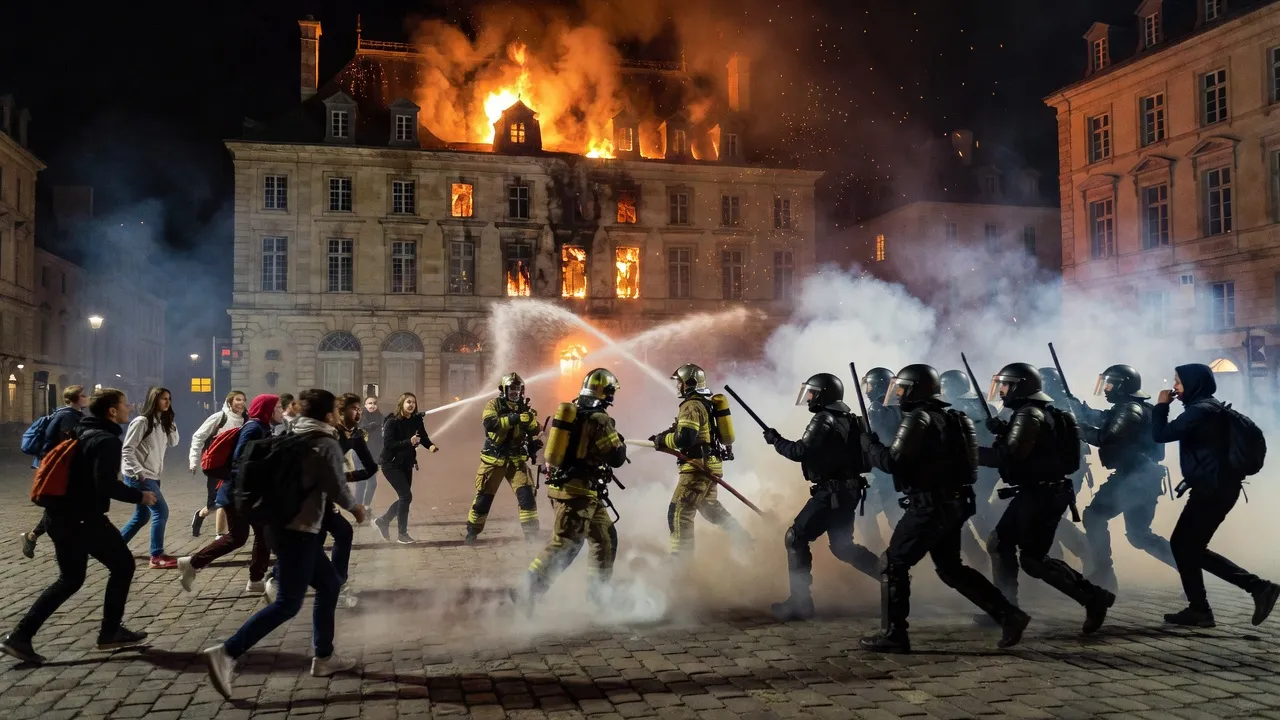
The FAZ leads with Limoges, citing Prefect Maurice Barate, as reported by the AFP: the 143-year-old city hall is "largely lost", the roof collapsed onto the lower floors, and two-thirds of the facade have disappeared. The prefect views this as a "premeditated act" and a "catastrophe for cultural heritage". Mediafax specifies that the building, inaugurated in 1883, is a classified historic monument. According to this media outlet, a municipal police car was burned before the attack, and firefighters were only able to intervene after the protesters were evacuated. RT reports no injuries.
« largely lost »
In Marseille, La Libre Belgique describes a forced entry into the city hall of the Old Port and an attack on the central police station on the Canebière. Mayor Benoît Payan claims to have requested in writing that the police prefecture secure the station the day before. CBS reports that he speaks of "limited damage" in the hall; Expressen quotes him calling the intruders "vandals" and "thugs". Digi24 mentions a bust of Marianne thrown to the ground and broken televisions.
In Lyon, the BBC cites Mayor Grégory Doucet, who speaks of a "tragedy" for a historic building after the tourism office fire. Observador reports in Bordeaux that the prefect's residence was sacked and the RAID intervened. Deutsche Welle adds broken windows at the offices of CNews and Europe 1, as well as a looted Apple Store.
On the law enforcement side, the BBC notes that the police charged with batons in the center of Paris, using tear gas and water cannons. In Saint-Étienne, Vedomosti writes that a young man of around 20 years old was injured in the hand, allegedly by a stun grenade he had picked up, a detail not reported by other sources in the corpus.
From high schools to yellow vests
Sources date the start of the movement differently. VRT NWS places it at the end of August, NRC at the end of September, Estadão and HuffPost in mid-September, The Independent in September in Créteil, and the Globe and Mail "last month". NRC writes that thousands of high school students and university students have been marching in Paris since October 6 and that almost all universities in the capital have been closed for over a week, some for the first time since 1968.
« By the end of the month I have nothing left, prices are rising but not salaries »
Svenska Dagbladet reports that a 15-year-old boy had his left hand torn off by a police grenade in front of his high school in Lens the previous week. The newspaper adds that Education Minister Édouard Geffrey promised 3,000 additional teachers for the most fragile establishments, a response that the high school movement deems insufficient. The Independent writes that hundreds of schools had to close.
According to SRF, the call originated on social networks and not from the major unions; the CGT joined the movement afterwards. La Razón cites the title of the call, "Jaunes et Jeunes", and VRT the Dutch equivalent "jong en geel". Estadão specifies that the CGT is demanding better salaries and pensions, lower prices, and protection of public services.
Political readings and echoes
The BBC and The Independent report the Interior Ministry's reading: a "very strong mobilization of far-left elements". Fox News quotes spokesperson Maud Bregeon, who says the concerns of young people are "legitimate" but "exploited for political purposes". The same media outlet reports that Sébastien Lecornu judges the student movement "instrumentalized" by the allies of La France insoumise. Daily Times writes that the party rejects this accusation, and HuffPost España notes that participants and organizations contest the government's reading.
« Violence may play into Marine Le Pen's hands »
Infobae, according to the EFE agency, relays Jordan Bardella, who denounces "professionals of chaos" and refers the demands to the polls, the first round being set for April 18. The same article quotes Jean-Luc Mélenchon, who says there are "two worlds, two realities" between the images of violence and peaceful gatherings. Jornal Económico reports that Sébastien Lecornu wants to see the law project through, which would require vandals to pay for damages.
Out of 26 national corpora analyzed, 16 open with the violence and arrests, 7 with the cost of living and the state of schools, 3 with the electoral or financial reading. This count measures the order in which the collected articles present the facts; it says nothing about the gravity of the events or the opinion of the inhabitants of these countries.
Outside of France, Handelsblatt notes that tens of thousands of people marched in Lisbon, notably against the housing crisis, that police fired tear gas in Milan and used water cannons in Bologna. Svenska Dagbladet and Aftonbladet report the slogan "Vi gör som i Frankrike" in high schools in Turin, Rome, Naples, and Genoa. SABC News and Daily Times add that the French state's borrowing costs are at their highest level in over twenty years.
A protester had his hand torn off by a police grenade, according to a police source cited by AFP.
Sébastien Lecornu says the government will not be "intimidated" ; Emmanuel Macron promises to prosecute the perpetrators.
The mobilization comes six months ahead of the presidential election; Bardella and Mélenchon comment on the violence in opposing ways.
Key figures
- 550,000Protesters in France on October 17, according to the Ministry of the Interior
What the comparison reveals
Common ground and differences in coverage across the media analysed.
What the media report in common
The national participation count on Saturday, October 17, is disputed: around 550,000 protesters according to the Ministry of the Interior, up to 800,000 according to the CGT or the organizers.
The day ended with several hundred arrests (around 400 according to the Minister of the Interior, 272 or 166 in partial counts for the day).
Public buildings were targeted: the city hall of Limoges was set on fire, intrusions into those of Marseille and Lille, the tourist office of Lyon was set on fire, looting of businesses.
Where media coverage diverges
Place of violence in the narrative
When asked what structured the day of October 17, some of the press began with the fires, looting, and arrests, while others first addressed the social and school-related anger, with the violence coming afterwards.
Number of people arrested
Regarding the arrest tally on Saturday, October 17, several sources reported around 400 arrests announced by the Interior Minister, while the BBC and Russian media cited at least 1,200 people, a figure attributed to the Prime Minister.
This grouping describes the publications analysed, not the position of these countries’ populations or of their governments.
Blind spots
What the coverage of each country leaves aside, while others put it forward.
 Germany
- Mélenchon's reading highlighting the peaceful nature of most processions
 United States
- the national participation figure (550,000 according to the Interior Ministry, 800,000 according to the CGT)
Understand the context
- OCT 6, 2026Previous large day of mobilization, according to Meduza
- OCT 17, 2026National day against the high cost of living; fire at the city hall of Limoges
- OCT 18, 2026Sébastien Lecornu announces at least 1,200 arrests
How each country reads it
Preview: 3 of 26 media perspectives. Syntheses of the media analysed — not direct quotations. Method & limitations
- Germany
Berlin is first focusing on the Limoges riots and the violence toll, relaying the Interior Ministry's reading on the far left, while the social anger born in high schools takes a back seat.
4 sources · View sources
 Argentina
Buenos Aires is witnessing a "social explosion" where anger over the high cost of living is bringing together yellow vests, high school students, and unions, with rioting adding to the picture of a deep-seated malaise.
4 sources · View sources
 Australia
Canberra focuses first on the flames: the Australian press highlights the town hall of Limoges on fire, the looting and the arrests, more than the social unrest at the origin of the movement.
4 sources · View sources
The full text, country by country
Germany
DOMINANT ANGLE
Berlin is first focusing on the Limoges riots and the violence toll, relaying the Interior Ministry's reading on the far left, while the social anger born in high schools takes a back seat.
KEY POINTS
- The 143-year-old Limoges city hall is "largely lost" according to prefect Maurice Barate (FAZ).
- 550,000 protesters according to Minister Laurent Nuñez, around 800,000 according to the organizers, and around 400 arrests.
- Demonstrations also took place in Lisbon, Milan, and Bologna on the same day (Handelsblatt).
ANALYSIS
Berlin, October 17, 2026. The German press first reports on a day of riots, then a social movement. The FAZ leads with the fire at the 143-year-old city hall of Limoges, which is "largely lost" according to Prefect Maurice Barate, cited by AFP: the roof collapsed onto the lower floors and two-thirds of the facade disappeared. The prefect sees this as a "premeditated" act by rioters and a "catastrophe for France's cultural heritage".
The numbers are attributed: 550,000 demonstrators according to Interior Minister Laurent Nuñez, around 800,000 according to the organizers, and nearly 400 arrests. Deutsche Welle adds that 60 police officers were injured, according to the ministry, dozens of stores were looted in Paris, Marseille, Nice, Bordeaux, and Lille, including an Apple Store that was cleared out, windows were broken at the headquarters of CNews and Europe 1, and the Lyon tourist office was set on fire.
The Handelsblatt speaks of "one of the most serious riots in years", with cars set on fire in Paris and at least 272 arrests in an initial tally. It broadens the focus: in Lisbon, tens of thousands of people marched, including against the housing crisis; in Milan, the police used tear gas, and in Bologna, they used water cannons.
Tagesschau and Handelsblatt, in their initial afternoon reports, relay the version of the Interior Ministry: a "very strong mobilization of the ultra-left movement", organized in black blocks in Paris, Marseille, Rennes, Toulouse, and Angers, which seeks "only to sow trouble". They report 140 actions and 32,800 participants at noon, 166 arrests, including around 100 in Paris for carrying weapons and prohibited objects. DW reports the same accusation targeting the "hard-left".
The social aspect remains in the background. DW recalls that the movement was born last month in high schools, where students denounced the lack of teachers and dilapidated facilities, before expanding to prices and inequalities, against a backdrop of "increasing social polarization". Emmanuel Macron, who had called for calm the day before, declares that there is "no place for violence" in the Republic and promises to prosecute the rioters.
Argentina
DOMINANT ANGLE
Buenos Aires is witnessing a "social explosion" where anger over the high cost of living is bringing together yellow vests, high school students, and unions, with rioting adding to the picture of a deep-seated malaise.
KEY POINTS
- The Interior Minister reports 400 arrests and 60 injured police officers (La Nación).
- According to Le Monde, as cited by Ámbito, the rally drew between 550,000 and 800,000 people.
- Bardella (RN) denounces "professionals of chaos" while Mélenchon highlights the peaceful nature of most of the marches (Infobae/EFE).
ANALYSIS
Buenos Aires, October 18, 2026. The Argentine press is treating the day of Saturday, October 17, in France as a "social explosion": La Nación sees an "eclectic" protest where yellow vests, high school students, university students, farmers, and unionists are mixed against the cost of living. The newspaper recalls that seven years after the 2018 revolt, France is finding itself in "a scenario it knew by heart": smoking barricades in Rennes, blockages of the RN 12 near Saint-Brieuc, occupied roundabouts.
Social unrest is taking center stage. Clarín mentions an inflation "that has grown by 20 percent" and disillusioned high school students facing abandoned institutions. La Nación quotes Florine Pigny, a 36-year-old tattoo artist: "Today there is a point of convergence of many legitimate angers." She links the rise in fuel prices to the war in the Middle East since February 28, and gives the floor to Franck, a civil servant in Guéret: "At the end of the month, I have nothing left, prices are rising but not salaries."
Violence is described in detail. According to La Nación, town halls have been stormed in Marseille, Lille, and Limoges, the Lyon tourism office has been set on fire, and a spontaneous demonstration approached to about 150 meters from the Élysée. Ámbito reports the looting of luxury stores like Louis Vuitton and Hermès. Clarín, from the Republic Square, contrasts a festive southern side, with orchestras and "Samba de Janeiro", to a northern side flooded with tear gas, facing black bloc groups; 40 riot control companies are deployed in Paris.
Figures are reported as is: 400 arrests according to the Interior Minister, 60 members of the police forces injured, and, citing Le Monde, between 550,000 and 800,000 protesters. La Nación reports Emmanuel Macron's promise that the perpetrators of vandalism will be "pursued and punished".
The electoral prism is present: Ámbito situates the mobilization in the last phase of Macron's term, in the second economy of the euro zone. Infobae (EFE) relays Jordan Bardella, who accuses "professionals of chaos" and refers the demands to the polls, the first round being set for April 18, while Jean-Luc Mélenchon opposes "two worlds, two realities" between images of violence and peaceful gatherings.
Australia
DOMINANT ANGLE
Canberra focuses first on the flames: the Australian press highlights the town hall of Limoges on fire, the looting and the arrests, more than the social unrest at the origin of the movement.
KEY POINTS
- Around 550,000 protesters according to Laurent Nuñez, 800,000 according to the CGT; about 400 people arrested.
- The city hall of Limoges was set on fire and the roof collapsed; Marseille and Lille affected, the tourism office of Lyon set on fire.
- Sébastien Lecornu says the government will not be "intimidated" and blames the far left a few months ahead of the presidential election.
ANALYSIS
Canberra, 18 October 2026. The Australian press opens with images: protests against the high cost of living and the state of schools, on Saturday, 17 October, which "turned" into riots. SBS talks about "some of the most destructive unrest in years", The Age and the Sydney Morning Herald about a "new flare-up of violence" that will weigh on the national election scheduled in a few months.
The figures are presented from the start: around 550,000 protesters according to Interior Minister Laurent Nuñez, 800,000 according to the CGT, including 110,000 in Paris, a procession deemed "largely peaceful". Nuñez announces around 400 arrests; SBS cites a previous tally of 272 arrests from the ministry.
The account details the damage. In Limoges, the city hall was set on fire, the roof collapsing onto the lower floors; the local administration says it is "largely lost". In Marseille, protesters in black entered the city hall shouting "We're taking the Bastille" and tagged the anarchist symbol; in Lyon, the tourist office was set on fire. ABC also reports broken windows at the headquarters of CNews and Europe 1, luxury stores and supermarkets looted, tear gas and a water cannon on the Place de la République.
On the political side, the quotes come from officials. Emmanuel Macron: "There is no place for violence in our Republic", the perpetrators will be "pursued and punished". Prime Minister Sébastien Lecornu asserts that the government will not be "intimidated" and targets those who want to make these violent acts a "warm-up" before the presidential election. Nuñez describes extreme left-wing groups as "extremely violent and radical", joined by looters.
The voice of the protesters is brief. SBS reports that they attribute the violence to troublemakers and cite the price of fuel and violence against high school students. PerthNow notes the return of the yellow vests. The European context is mentioned in one sentence: more modest marches in Belgium, Portugal, and Italy, and in Albania, rallies against corruption.
The electoral calendar (presidential election in April) serves as a backdrop: ABC concludes on the risk of a campaign dominated by law and order.
 Belgium
DOMINANT ANGLE
Brussels is eyeing French anger from an electoral angle: who can capitalize on it six months ahead of the presidential election, and what does the handling of law and order in Marseille say.
KEY POINTS
- VRT NWS (October 16) cites 70,000 to 140,000 expected protesters and more than 1,400 announced actions by the yellow vests and the high school movement.
- Frederik Dhondt, a France specialist, warns: "Violence can play into Marine Le Pen's hands," about six months from the presidential election.
- In Marseille, Mayor Benoît Payan (DVG) "demanded answers" after vandals broke into the city hall and attacked the central police station of the municipal police.
ANALYSIS
Brussels, 18 October 2026. The Belgian press is covering the French day of mobilization as a political test for Emmanuel Macron, just a few months ahead of the presidential election, rather than simply as a street episode.
The VRT NWS, in an article published on 16 October, asks the question ahead of the day: is France heading towards a "perfect storm" of protest? It describes the connection between the yellow vests and the high school movement, summed up by the slogan "young and yellow" ("jong en geel"). The scope was announced as large: more than 1,400 actions across the country, roadblocks and refinery blockades planned, and an estimated 70,000 to 140,000 protesters, far below the tally given later by the authorities and unions. The cited demands are fuel prices, loss of purchasing power, and the decline of public services.
The VRT recalls that the yellow vests of 2018-2019 had shaken Macron's position and obtained a shift in policy, but that "veel van wat toen is beloofd" has not been realized. The high school movement, born at the end of August against the "wantoestanden" in education, is presented as the support of a more general "anger" against the government, which is "geen goed nieuws" for the presidential camp. France specialist Frederik Dhondt wonders who will be able to recover this discontent and warns: "Geweld kan in de kaart spelen van Marine Le Pen".
La Libre Belgique, in its live coverage on Saturday, 17 October, focuses on the incidents. In Marseille, protesters forcibly entered the city hall of the Vieux-Port, and the central police station on the Canebière was attacked. The mayor, Benoît Payan (DVG), "demanded explanations" about the organization of law and order: he claims to have requested in writing from the police prefecture that the police station be secured the day before, to no effect. He distinguishes between "casseurs" who came "to fight" without any demands and protesters, and mentions the use of tear gas by a line of CRS in front of the city hall.
The Belgian perspective thus combines two levels: the analysis of the political risk, fed by an expert, and the field account of a local elected official questioning the state. The two texts do not dwell on the detailed economic causes or the government's responses.
 Bolivia
DOMINANT ANGLE
La Paz remembers the French day for its outcry against the high cost of living, driven by wages that are not keeping pace with prices, more than the riots that followed.
KEY POINTS
- Between 550,000 and 800,000 people demonstrated in France on Saturday, October 17, according to the authorities and organizers respectively (La Razón).
- About 400 people were arrested; Laurent Nuñez speaks of "several thousand rioters", including ultra-left groups and "opportunistic delinquents" (El Deber).
- The mobilization was mainly about the cost of living, particularly the rise in fuel prices since the start of the war in the Middle East (La Razón).
ANALYSIS
La Paz, October 18, 2026. The Bolivian press is covering the French mobilization day of Saturday, October 17, from the angle of purchasing power. La Razón headlines with the slogan "Tomamos la Bastilla" and summarizes: protests against the rising cost of living shook France, as Emmanuel Macron faces a convulsive end to his term, six months before the presidential election that will designate his successor.
The daily newspaper recalls the origin of the gathering: a call launched on social networks, entitled "Jaunes et Jeunes", inviting people to demonstrate alongside the yellow vests, Generation Z, farmers, teachers, climate activists, and retirees. The slogans cited are "À bas le système" and "Macron démission". The newspaper estimates the participation at between 550,000 and 800,000 people, according to the authorities and organizers respectively.
La Razón acknowledges that most of the processions were peaceful, but estimates that they were overshadowed by clashes between police and protesters, looting of businesses, and unauthorized marches that sowed chaos in the centers of large cities, with invasions of town halls. The authorities announced an initial toll of around 400 arrests. Macron wrote on X that those who destroyed, attacked prefectures and businesses, and looted town halls "will be pursued and punished".
The account emphasizes the economic dimension: if the protesters also criticized the police action against student protests since late September, the mobilization was primarily about the rise in the cost of living, particularly that of fuel since the start of the war in the Middle East. The newspaper gives the floor to Franck, a civil servant who came to demonstrate in Guéret with around 300 people: "At the end of the month, I have nothing left, prices are rising but not salaries."
El Deber, on the other hand, focuses on the police aspect. It reports that the Minister of the Interior, Laurent Nuñez, emphasized that the "immense majority" of those arrested are adults, which proves, according to him, that there were "several thousand rioters", among whom he identified ultra-left groups and "opportunistic delinquents". The two media outlets converge on the figure of 400 arrests, but the first gives voice to the protesters while the second takes up that of the minister.
 Brazil
DOMINANT ANGLE
Brasília is first to grasp the outbreak: the Brazilian press highlights tear gas, invaded city halls and arrests at the forefront of a mobilization against the high cost of living.
KEY POINTS
- Around 550,000 people demonstrated and at least 400 were arrested in France on Saturday, October 17 (Veja).
- In Marseille and Lille, protesters invaded city halls; in Marseille, a bust of Marianne was toppled (Veja).
- The movement emerged in mid-September in high schools in poor suburbs north of Paris, with over three weeks of blockages, before expanding to the cost of living (G1, Estadão).
ANALYSIS
Brasília, October 18, 2026. Brazilian headlines covered Saturday, October 17, in France from the angle of public order. G1 (Globo) reported on the police using "gás lacrimogêneo" and clashing with protesters in several cities, in acts that were among the "most violent" in the country in recent years. According to cited authorities, 140 demonstrations had brought together 32,800 people by noon, outside of Paris.
Veja highlighted the most striking figure: around 550,000 people in the streets and at least 400 arrests. The weekly magazine described scenes of chaos: in Marseille and Lille, protesters invaded city halls; in Marseille, they overturned a bust of Marianne, a symbol of the Republic. In Paris, the Place de la République, the starting point of the processions, saw clashes, with police responding with tear gas and water jets to objects thrown by masked protesters. The Champs-Élysées had been closed to demonstrations.
The account traced the origin of the movement. Estadão recalled that the mobilization began in mid-September in high schools, with more than three weeks of blockages, before joining a broader protest against the rising cost of living. G1 specified that students from the poor northern suburbs of Paris initially demanded more teachers and better buildings, and then added criticism of inequalities, public spending, and purchasing power. The 2018 yellow vests were cited as a reference; Estadão mentioned calls on social media to "revive" them.
The voices of protesters gave a social face to this anger. Florine Pigny, a 36-year-old tattoo artist, spoke of a "point of convergence of many revolts, all legitimate". Franck, a civil servant in Guéret, said that "nothing is left at the end of the month: prices are rising, but not salaries". Estadão quoted the CGT, which demanded higher salaries and pensions, lower prices, and protection of public services.
On the government side, Emmanuel Macron had called on Friday for calm and respect for people and property, recalling the constitutional right to demonstrate, and then promised on X to punish "those who committed acts of vandalism". Interior Minister Laurent Nuñez had announced hundreds of actions and more than 80 marches. G1 noted that the government attributed the violence to groups of "ultragauche".
 Canada
DOMINANT ANGLE
Ottawa is witnessing an unprecedented social convergence: high school students demanding repaired heaters, joined by unions and yellow vests, against a backdrop of division over the French state's budget priorities.
KEY POINTS
- According to CBC, a minister estimated 400 arrests, with 110,000 protesters in Paris alone.
- The Globe and Mail reports that the protests began last month in high schools in poor suburbs north of Paris, due to teacher absences and rundown facilities.
- According to the National Post, protesters forced their way into Marseille's city hall, ransacked Lille's town hall and set fire to a tourist office in Lyon.
ANALYSIS
Ottawa, October 17, 2026. Canadian media are treating Saturday as a deep social malaise rather than a simple flare-up of violence. CBC News analysis speaks of a France "shaken" by processions bringing together high school students, unions, and yellow vests. The movement, it writes, began weeks ago when high school students demanded the repair of their classroom heaters, before becoming "an existential battle" over the definition of the Republic. It quotes Bally Bagayoko, the left-wing mayor of Saint-Denis: "France is reaching a major turning point." CBC's correspondent in Paris, Chris Brown, highlights a "convergence" of several movements that support each other, with the goal of wresting significant budget concessions from the Macron government.
The Globe and Mail situates the origin in the high schools of the poor suburbs of northern Paris, where anger over teacher absences and dilapidated facilities turned into a movement against inequality and the weakness of public spending. It relays the words of Lola, 19 years old: "The cost of living is too harsh, the price of fuel too high." It also reports that the authorities have attributed the troubles to the "ultra-left".
The clashes occupy an important place. According to the National Post, masked youths set fire to a tourist office in Lyon, protesters entered the city hall of Marseille and the town hall of Lille, and the premises of CNews and Europe 1 had their windows broken. More than 130 people were arrested in the capital. CBC mentions Paris neighborhoods resembling "a war zone" and a minister citing 400 arrests, with 110,000 protesters in Paris. Global News, via the Associated Press, reports tear gas on the Republic Square and the support of the CGT, which demands higher wages and pensions, lower prices, and protection of public services.
The maple leaf country is also projecting itself into the event: Global News shows Montrealers gathered in Phillips Square in solidarity with French high school students. They say they fear a drift to the right and more repression in Quebec, and judge that "the system is not working" for young people. The Canadian press finally puts the crisis into perspective in the last months of Macron's term at the Élysée, after a decade of protest movements that have eroded his popularity.
 Switzerland
DOMINANT ANGLE
Bern interprets the day of October 17 as the expression of a deep social malaise, where anger over the high cost of living and run-down schools outweighs the rioting.
KEY POINTS
- Interior Minister Laurent Nuñez counted 550,000 protesters, including 110,000 in Paris, compared to 800,000 according to the CGT (SRF).
- More than 400 people were arrested in the country during the day (SRF).
- The slogan "On en a marre!" was born on social media, not from the major unions (SRF).
ANALYSIS
Berne, October 17, 2026. The Swiss press, from SRF to Le Temps, reports on a day of mobilization under the slogan "On en a marre!" ("Wir haben die Schnauze voll"), which brought together hundreds of thousands of people in France on Saturday, October 17, 2026, to protest against the rising cost of living and inequalities. SRF speaks of the most serious troubles in years. The Minister of the Interior, Laurent Nuñez, counted 550,000 demonstrators, including 110,000 in Paris; the CGT claims 800,000. More than 400 people were arrested in the country.
The Alemannic account first focuses on the causes. SRF lists the increase in fuel, food, and energy prices, the distress of schools, the difficulties of agriculture after a summer of drought, as well as the discontent with the fate of disadvantaged neighborhoods and climate action. The calls originated on social media, not from the major unions, before the CGT joined the movement. High school students, students, parents, teachers, civil servants, La France insoumise, communists, and former yellow vests marched together. The demands concern better salaries and working conditions, particularly in healthcare.
On the ground, SRF's correspondent in Paris, Zoe Geissler, describes a smoky Republic Square, objects on fire, fireworks, and clashes between hooded protesters and law enforcement, who used tear gas. A few meters away, protesters peacefully held up signs and danced. She specifies that many actions took place calmly, but some people came to cause damage. SRF also reports tear gas in Lyon and Strasbourg, and looted shops in Marseille, where protesters tried to enter a police station. The Ministry of the Interior had ordered the police to intervene firmly; 166 arrests had already been recorded during the day.
Le Temps chooses the angle of testimony. It gives the floor to Frédéric, 51, a "historic" yellow vest present since 2018, who judges that "this violence is not gratuitous" and speaks of a "frustration that can no longer be expressed otherwise". His daughter, a 23-year-old social worker in the Paris suburbs, demands more resources for the National Education system. The Romandy daily headlines a youth responding to the call of the yellow vests, on a day marked by extreme violence.
SRF finally notes that rallies also took place in Italy, Portugal, and Belgium, which inscribes French anger in a broader European malaise.
 Colombia
DOMINANT ANGLE
Bogotá is particularly holding onto images of disorder: the Colombian press is headlining a France that is "burning" and highlighting Macron's warning against violence.
KEY POINTS
- More than 270 people were arrested on Saturday, October 17, according to the Interior Ministry cited by El Colombiano.
- The participation is estimated at 800,000 by the organizers, around 550,000 by the authorities and nearly 500,000 by the CGT (El Colombiano).
- Macron promised that the perpetrators of destruction and looting, including town halls, will be prosecuted and punished; Lecornu set up an interministerial crisis unit (Semana).
ANALYSIS
Bogotá, October 18, 2026. Colombian media outlets are reporting on the October 17 mobilization day in France as a series of disorders. El Colombiano leads with "Francia arde en nueva jornada de disturbios por el costo de vida" and reports that over 270 people were arrested, according to the Ministry of the Interior. The Medellín daily describes a mobilization launched by a call spread on social media under the slogan "Amarillos y Jóvenes", which brought together students, workers, farmers, teachers, and retirees against Emmanuel Macron's government.
Regarding participation, El Colombiano notes divergent estimates: 800,000 people according to the organizers, around 550,000 according to the authorities, and nearly 500,000 according to the CGT union. The cited slogans, "Abajo el sistema", "Tomamos la Bastilla", and "Macron dimisión", set the tone. The newspaper links the movement to the 2018-2019 yellow vests and the rise in fuel prices in the context of the Middle East war. It quotes Franck, a civil servant in Guéret: "At the end of the month, I have nothing left; prices are rising, but salaries are not."
La República, an economic daily, published an article ahead of the day of mobilization, in which the Ministry of the Interior announced hundreds of actions, including toll and gas station blockades, and 90 marches. Minister Laurent Nuñez said he expected "a fairly significant mobilization" and a police force prepared for possible violence from extremist elements. Forty people had been arrested in the Paris region before 9:30 am, mostly for carrying prohibited weapons or equipment. The article places France in a European wave, along with Spain, Italy, Albania, and Belgium, where affordable housing and the cost of living are among the demands.
Semana emphasizes the executive's response. Macron wrote on social media: "No hay lugar para la violencia en nuestra República", promising that those responsible for destruction, attacks on prefectures and businesses, and looting of town halls would be prosecuted and punished. He assured the security forces of the Nation's support and denounced those who "siembran el caos". Prime Minister Sébastien Lecornu convened an interministerial crisis cell at the Ministry of the Interior, with Gérald Darmanin and Laurent Nuñez. The site also relays videos, including one of the looting of a Christian Dior boutique on Rue Saint-Honoré in Paris.
 Spain
Spain
DOMINANT ANGLE
Madrid is first grappling with the social unrest that originated in high schools: the Spanish press describes a student anger that has turned into a protest against the high cost of living, which the fires and looting do not erase.
KEY POINTS
- Total participation is estimated at around 500,000 people by AP and El País, according to HuffPost España; the Ministry of the Interior counted 32,800 protesters outside of Paris at mid-day.
- The French Ministry of the Interior reported 400 arrests across the country and serious incidents in Marseille, Lyon, and Nantes, according to ElDiario.es (provisional data).
- Lecornu accused "far-left groups" and "delinquents"; Macron promised that those responsible for destruction and looting would be "pursued and punished".
ANALYSIS
Madrid, October 18, 2026. For the Spanish press, Saturday, October 17, in France, was first and foremost the culmination of a social movement. HuffPost España, which picks up the EFE agency, recalls that everything started "weeks ago" as a mobilization of students against the lack of teachers, overcrowding in classes, and the deterioration of educational facilities. It then joined forces with yellow vests, unions, farmers, civil servants, and other collectives dissatisfied with the cost of living and public services.
The figures cited are those of the agencies. The call to action had planned for around 500 actions and more than 90 demonstrations. By mid-day, the Ministry of the Interior counted 32,800 participants outside of Paris, and then AP and El País put the total participation at around 500,000 people. HuffPost España emphasizes that a large part of the processions took place calmly, along authorized routes.
Violence, however, occupies a central place. HuffPost España dedicates an article to Limoges, whose city hall was "severely damaged" by a fire, presented as one of the most striking images of the day. Citing AP and Reuters, the site mentions clashes, looting, and attacks on public buildings in Paris, Lyon, Marseille, Bordeaux, Lille, Toulouse, and Angers, and talks about some of the worst unrest in recent years in France. In Paris, charges, tear gas, burning containers, and damaged businesses were reported.
ElDiario.es emphasizes the youth: tens of thousands of high school students and university students marched in Paris, in a march "riddled with tensions" with the police. The newspaper reports the Ministry of the Interior's tally, 400 arrests across the country, and serious incidents in Marseille, Lyon, or Nantes, according to still provisional data.
The executive's reactions are extensively quoted. Prime Minister Sébastien Lecornu accused "far-left groups" joined by "delinquents", stating that "peaceful protesters have their place in our Republic. Fires, looting, and aggression, none". Emmanuel Macron promised that the perpetrators of destruction would be "pursued and punished" and called for a "united front" against "those who sow chaos". HuffPost España notes that participants and organizations contest this government reading.
 Finland
DOMINANT ANGLE
Helsinki is particularly concerned about the street disorder and its concrete consequences: town hall fires, looting, tear gas, embassy warnings, and testimonies from Finns caught up in the riots in Marseille.
KEY POINTS
- According to HS citing AFP, more than half a million people demonstrated on Saturday in France and the city hall of Limoges was destroyed by a fire.
- The Ministry of the Interior reports around 400 arrests, mostly adults according to Le Monde cited by HS.
- The Embassy of Finland in Paris has warned about X, recommending to avoid crowds and to expect delays in local transportation (Yle).
ANALYSIS
Helsinki, October 17, 2026. The Finnish press is following Saturday, October 17, in France from the angle of disorder and its concrete effects, including for Finns present on the scene. Helsingin Sanomat opens with the figure: "more than half a million people" have demonstrated, according to AFP, in a wave of protest that has been going on for weeks. The newspaper lists the highlights: the town hall of Limoges, in the center of the country, "destroyed and unusable" after being set on fire, intrusions into those of Lille and Marseille, the tourist office of Lyon in flames, and looted shops. It cites the Ministry of the Interior, which reports around 400 arrests, mostly adults, according to Le Monde.
Helsingin Sanomat also recalls the origin of the movement: in September, in the Paris suburbs, high school students protested against overcrowded classes, the lack of teachers, and the poor condition of buildings. Unionists and yellow vests, who became famous in 2018 for denouncing the rising cost of living, joined them. Its journalist Petja Pelli, present in Paris, describes improvised barricades made with shared bicycles and trash cans, one of which is on fire, and apparent support from residents: motorists honk their horns in approval.
Yle provides live coverage of the morning. The police expected 200,000 participants in the country and 40,000 in Paris. Citing the BBC, the channel reports tear gas in Paris and Marseille and at least 160 arrests during the day. It notes that many are demonstrating peacefully and that many participants suspect outside troublemakers. It relays the warning from the Finnish embassy in Paris, which advises avoiding crowds and expecting delays in local transportation. Emmanuel Macron has called on protesters to stop the violence.
MTV Uutiset talks about "one of the most violent days of protest in years" and links the national appeal, focused on the cost of living and fuel prices, to the yellow vest movement of 2019. It specifies that masked protesters forced a door of the town hall of Marseille and one of them painted an anarchist symbol before the police arrived.
Iltalehti collects the testimony of Finns in Marseille. Rickard, seated at a restaurant, sees a crowd advancing to the sound of drums with smoke bombs, then the police firing tear gas: "It started to cough," he says, his eyes red. He then describes burning barricades, broken shops, and "the entire street completely destroyed".
 France
DOMINANT ANGLE
Paris is first remembering the chaos: a massive mobilisation against the high cost of living, eclipsed by looting and fires of a rare intensity.
KEY POINTS
- Between 550,000 and 800,000 protesters on Saturday, October 17, according to the police and organizers, and around 400 arrests (France 24).
- In Lyon, the tourist office was set on fire; in Saint-Étienne, a protester had their hand torn off by a police grenade (Le Monde, France 24).
- Macron promises that the perpetrators of violence will be "prosecuted and punished"; Lecornu denounces "violence of extreme intensity" (France 24).
ANALYSIS
Paris, October 18, 2026. The day of mobilization on Saturday, October 17, against the "high cost of living" brought together between 550,000 and 800,000 people in France, according to the police and organizers, reports France 24. Former yellow vests, high school students, students, climate activists, and farmers had converged, according to RFI, against the rise in prices and the deterioration of public services. The HuffPost recalls that the call was born on social networks in mid-September, before the high school movement carried the convergence of struggles. According to BFMTV, nearly seven out of ten French people approved of the mobilization.
But the French press is highlighting the drift of the day. France 24 talks about "clashes and scenes of chaos of rare intensity": stores looted in Paris around the Place de la République, windows broken in Marseille and Lille, cars set on fire. Le Monde's live coverage describes the tourism office in Lyon ravaged by flames on Place Bellecour. In Saint-Étienne, a protester had his hand torn off by a police grenade, according to a police source quoted by AFP; a 15-year-old high school student had already lost his hand on October 5 in Lens.
On the executive side, Emmanuel Macron promised that those who "smashed" and "looted" will be "pursued and punished". Prime Minister Sébastien Lecornu denounced "violence of extreme intensity" and chaired an interministerial crisis cell. Interior Minister Laurent Nuñez had reauthorized stun grenades in case of "extremely serious urban violence" and mentioned "opportunistic delinquents"; around 400 arrests were recorded. Jean-Luc Mélenchon stated that "those who share our fight have nothing to do with looting".
The police prefecture, quoted by Le Monde, emphasizes that "the vast majority of individuals are demonstrating without incident", and France 24 describes a festive atmosphere on one side, violence on the other. The media also note the tense vigil: ban on demonstrating around the Élysée, Matignon, and the Champs-Élysées, and Macron's call for "calm" from Brussels. The commander of the CRS-8 confides to BFMTV that he fears an extremely serious injury on both sides.
 Italy
Italy
DOMINANT ANGLE
Rome is scrutinizing the day of October 17 from the angle of public order: tear gas, arrests, town halls invaded and shops looted dominate the story of anger against the cost of living.
KEY POINTS
- Adnkronos: at least 166 people arrested during the day, according to Le Parisien, including around a hundred in Paris.
- Marseille: protesters stormed the city hall lobby; in Lyon, a branch of the tourism office was looted and set on fire (Adnkronos).
- Libero: Laurent Nuñez warned that police could use stun grenades in the event of serious violence.
ANALYSIS
Rome, October 17, 2026. The Italian press has been covering the day of mobilization on Saturday, October 17, since its early hours, and its account is dominated by public order. ANSA speaks of a "giornata di fuoco" and Adnkronos of a France that "esplode contro il caro vita", with tear gas and assaults "from Paris to Marseille".
The context is quickly set: according to Adnkronos, students, unions, militants, and supporters of the Gilets jaunes are protesting against the rise in the cost of living, fuel prices, and the deterioration of public services. Libero, quoting the askanews agency, mentions around 1,500 announced initiatives on a dedicated website, while recalling that these figures do not allow us to predict how many people will actually take to the streets. ANSA, citing the same website, counts more than 1,750. La Repubblica, through the pen of its correspondent Anaïs Ginori, situates the day "six months from the presidential election" and reports the slogan "Prendiamo la Bastiglia".
The details of the incidents occupy the bulk of the dispatches. In Paris, the police used tear gas in the Place de la République; Repubblica already counts over 100 arrests in the capital, Adnkronos at least 166 on the territory according to Le Parisien. In Marseille, protesters burst into the city hall lobby; in Lyon, a branch of the tourism office was looted and set on fire. ANSA relays Le Figaro on the blockade of CNews premises by about a hundred people, media designated as "enemy propaganda channels" in the discussion groups of the protesters.
The official word is mostly that of Interior Minister Laurent Nuñez. Libero reports that he feared "uncontrollable actions", that he had warned that blockages of strategic axes would not be tolerated and that the police could use stun grenades in case of serious violence. Adnkronos signals a meeting of the crisis unit at Place Beauvau at 6 pm, with the offices of Prime Minister Sébastien Lecornu and Justice Minister Gérald Darmanin.
Shopkeepers provide the recurring image: Parisian storefronts protected by wooden panels, painful memories of the previous Gilets jaunes. ANSA nuances the morning picture, however: the blockages recorded remained lower than what was announced the day before, with limited dispersals in Lyon, Rennes, and Marseille.
 Mexico
DOMINANT ANGLE
Mexico City retains the image of a France in flames: the Mexican press puts fires, looting, and arrests in the spotlight, ahead of the cost of living claims.
KEY POINTS
- Interior Minister Laurent Nuñez reported 400 temporary arrests and 550,000 protesters, compared to 800,000 according to the organizers (El Informador).
- The city hall of Limoges was set on fire and its bell tower collapsed during the emergency response (Vanguardia MX, Reforma).
- Emmanuel Macron promised that those responsible for attacks on public buildings and businesses would be prosecuted and sanctioned (Vanguardia MX).
ANALYSIS
Mexico, October 18, 2026. The Mexican press describes Saturday, October 17, as a day of unrest. El Financiero reports that France is "ablaze" over the cost of living, citing fires, looting, and 272 arrests by 3 pm (1 pm GMT), according to the Ministry of the Interior. The newspaper describes hundreds of people facing off against law enforcement in the Place de la République in Paris, burned cars, a group attempting to reach the Élysée, a restricted area for demonstrations, and the deployment of CRS 8.
Vanguardia MX dedicates an article to Limoges: protesters set the city hall on fire, and firefighters and security forces cordoned off the area. Reforma, as reported by El Norte, adds that the bell tower collapsed while emergency services fought the flames. Both publications also relay images of a tourist office looted and set on fire in Lyon's Place Bellecour, as well as tear gas, water cannons, and police vehicles being targeted.
Regarding the numbers, the newspapers present conflicting versions. El Financiero cites 500,000 protesters according to the CGT, compared to an official estimate of up to 150,000 outside the Paris region. El Informador reports the balance sheet from Minister Laurent Nuñez at 8 pm: 400 arrests, still provisional, and 550,000 protesters, while his services had anticipated a maximum of 150,000; the organizers claim 800,000. Nuñez mentioned "several thousand troublemakers," including far-left groups and "opportunistic delinquents," and emphasized that "the vast majority" of those arrested are adults, and therefore not comparable to the high school students of recent weeks.
On the executive side, Vanguardia relays Emmanuel Macron's statement: there is no place for violence, and those responsible for attacks on public buildings and businesses will be prosecuted and sanctioned, with total support for law enforcement.
The demands — inflation, fuel prices, loss of purchasing power — are mentioned, as well as the convergence of high school students, healthcare workers, farmers, truckers, and civil servants in a message from La France insoumise reproduced by El Norte. However, they remain in the background: El Financiero notes that, while many marches took place normally, the violent incidents concentrated the attention of the day.
 Netherlands
DOMINANT ANGLE
Amsterdam looks back on the day of October 17 from the high schools and universities, and presents the violence as a deviation from a social movement born out of fear for the future.
KEY POINTS
- Around 550,000 protesters according to the Ministry of the Interior, up to 800,000 according to the unions, and about 400 arrests (NRC).
- Since Tuesday, October 6, thousands of high school students and university students have been protesting in Paris; almost all the universities in the capital have been closed for over a week (NRC).
- Protesters set fire to the city hall of Limoges; the fire spread to the roof (De Telegraaf).
ANALYSIS
Amsterdam, October 18, 2026. The Dutch press has been following the French mobilization since its inception in schools. As early as Friday, October 16, NRC published a report on young people who are "afraid of the future, angry at the government": since Tuesday, October 6, thousands of Parisian high school students and students have been protesting against an educational system they deem failing and are demanding better facilities, more teachers, and a transparent selection procedure. The movement, which originated in late September among frustrated high school students, has spread to universities and unions; almost all universities in the capital have been closed for over a week following attempts to block them, some for the first time since 1968.
The newspaper gives a voice to Ulysse Bel, a student in urban planning in Paris, who notes the paradox of passing by the motto "liberty, equality, fraternity" every morning without feeling its effects. With the presidential election in sight, young people see this as the moment to impose change. A protester quoted says: "Maybe the Earth will be on fire in twenty years, so we have nothing to lose."
On Saturday, October 17, NRC reported on a day of protest, riots, and looting. Hundreds of thousands of people demonstrated against the cost of living: around 550,000 according to the Ministry of the Interior, up to 800,000 according to the unions. By noon, the ministry had counted 140 actions. Protesters launched fireworks and smoke bombs, public buildings were damaged or stormed, and around 400 people were arrested. In Paris, on the Place de la République, a car and a kiosk were set on fire, according to France 24; the police used tear gas several times. The official procession remained relatively calm, but in the evening, militants entered the town hall of the 10th arrondissement.
De Telegraaf, for its part, broadcast images of the city hall of Limoges in flames: the fire had spread to the roof and thick black smoke was escaping from the building. The daily newspaper recalls that the protest initially targeted the government and the school system.
NRC headlines Emmanuel Macron's reaction: "We will form a bloc against those who sow chaos." Yellow vests and unions had announced they would join the students on this national day set by collectives. The Dutch account remains focused on youth and social unrest, with violence presented as a deviation from a initially peaceful movement.
 Pakistan
DOMINANT ANGLE
Islamabad is first focusing on the clashes: the Pakistani press, which reprints AFP and Reuters dispatches, highlights tear gas, targeted town halls, and arrests more than social demands.
KEY POINTS
- According to Geo News, citing the Interior Ministry, 272 people had been arrested by mid-afternoon in Paris, Marseille, Rennes, Toulouse, and Angers, among other places.
- Protesters stormed the city hall in Marseille before being pushed back by police, and a tourist office was set on fire in Lyon (ARY News, Geo News).
- The movement originated in high schools in the poor suburbs of northern Paris over a lack of teachers before expanding to inequalities and public spending (Business Recorder, Daily Times).
ANALYSIS
Islamabad, October 18, 2026. Pakistani media is treating Saturday, October 17, in France as a public order issue, largely relying on agency dispatches. ARY News headlines with protesters "clashing with police" during national rallies against the high cost of living, ahead of the presidential election. Geo News talks about "some of the most violent protests in years" against price hikes and the deterioration of public services.
The reported facts are first those of violence. In Marseille, protesters forced their way into the city hall before being removed by police; one of them shouted "We're taking the Bastille". In Paris, police used water cannons and tear gas against hundreds of masked individuals, some of whom were throwing fireworks; windows of CNews and Europe 1 offices were broken. In Lyon, a tourist office was set on fire. According to Geo, citing the Interior Ministry, 272 people had been arrested by mid-afternoon; ARY mentions over 160 detentions, according to a ministerial source, earlier in the day.
The participation figures remain modest in these accounts: 32,800 people in around 140 actions outside of Paris by mid-day, according to the authorities cited by Business Recorder. These texts do not mention the estimates of half a million protesters.
The origin of the movement is recalled in one sentence: it was born last month in the high schools of the poor suburbs of northern Paris, around the lack of teachers and dilapidated facilities, then expanded to inequalities and public spending. The social voice is represented by Lola, 19 years old: "We're fighting because the cost of living is too tough, because the price of fuel is too high." The yellow vests, called to a "yellow and youth" day, are presented as a reminder of the Macron precedent.
On the political level, ARY notes public criticism of a police response deemed disproportionate. According to Daily Times, Prime Minister Sébastien Lecornu feared trouble, and the government accuses La France insoumise of encouraging the movement, which the party denies. The Interior Ministry attributes the excesses to the "ultra-left". Daily Times adds a financial aspect: investors have sold French bonds, bringing borrowing costs to their highest level in over twenty years, without debt reduction efforts reassuring.
 Portugal
DOMINANT ANGLE
Lisbon is assessing the outcome of a day of public order: arrests, public buildings targeted and accusations against the far left dominate the Portuguese account of the French mobilization.
KEY POINTS
- Nuñez estimates 550,000 protesters, compared to 800,000 according to the organizers; 150,000 were expected by the authorities (Observador).
- Nuñez announces around 400 arrests, the Prime Minister speaks of at least 1,200 detainees on BFMTV (Observador).
- In Paris, 61 arrests and 589 preventive checks by 11 am, according to the police cited by the EFE agency (SAPO, Jornal Económico).
ANALYSIS
Lisbon, October 18, 2026. The Portuguese press treats the day of Saturday, October 17, in France, first and foremost as a public order assessment. Observador reports that Interior Minister Laurent Nuñez estimated the number of protesters at 550,000, far above the 150,000 anticipated by the authorities the day before; the organizers claim 800,000. The CGT had initially reported 500,000 by 5 pm local time before joining the 800,000 figure given by youth organizations and the yellow vests' website.
The arrests structure the narrative. Observador cites Nuñez for around 400 arrests, a figure he says is provisional, and then the Prime Minister announcing "at least 1,200" detainees on BFMTV with the promise: "Será feita justiça." Nuñez attributes the violence to "several thousand agitators," including far-left groups and "opportunistic delinquents," who targeted the city halls of Marseille and Limoges, where a fire broke out, as well as the Lyon tourist office, destroyed by flames. In Bordeaux, the prefect's residence was ransacked, triggering the intervention of the RAID.
SAPO Notícias and Jornal Económico detail the Parisian morning: 61 arrests and 589 preventive checks by 11 am, tear gas against high school students and a union procession, about a hundred hooded individuals attacking the headquarters of CNews and Europe 1, properties of Vincent Bolloré. SAPO headlines "the largest wave of protests since 2018" and describes a France "blocked," with a head of state at the end of his term, a "cornered" government, and rising interest rates after the failure of efforts to reduce debt.
On the political level, Jornal Económico relays Sébastien Lecornu: "Não nos deixaremos intimidar," addressed to those who would like to make these violent acts a "warm-up" before next year's presidential election. He accuses far-left groups and promises to see through the bill requiring vandals to pay for damages. An Observador section shows, in parallel, Portugal: Luís Montenegro warns against importing "conflictuality" experienced in other countries, after a video where a housing movement protester threatens his home. SAPO also notes that the high school protest has reached Italy, where a student says: "Fomos inspirados por França."
 Romania
DOMINANT ANGLE
Bucharest is particularly mindful of the day's violence: town halls invaded or set on fire, hundreds of arrests, and a warning to Romanian travelers in France.
KEY POINTS
- According to French authorities, around 550,000 people demonstrated on Saturday, October 17, versus 800,000 according to the organizers (Mediafax).
- Masked individuals set fire to the city hall of Limoges, inaugurated in 1883; part of the roof collapsed (Mediafax).
- The Ministry of Foreign Affairs notes possible disruptions to transportation and an air strike from October 17 to 21 (G4Media).
ANALYSIS
Bucharest, October 18, 2026. The Romanian press recounts Saturday, October 17, primarily through images of disorder. Digi24 headlines with "Haos și tensiune maximă" and describes a mobilization of pupils, students, unionists, and members of the "Gilets jaunes" against the rising cost of living, inequalities, and the degradation of public services. Citing BFM TV, the site mentions a police estimate of around 170,000 participants and over 160 arrests, with clashes in several cities.
The account advances with hourly updates. In Marseille, individuals entered the city hall of the Vieux-Port: a bust of Marianne was thrown to the ground, an anarchist slogan was tagged, and televisions were smashed; the intruders, blocked in the hall, eventually fled without injuring anyone. In Lyon, on the Bellecour square, young people launched fireworks at the police, who responded with tear gas. In Paris, on the Republic square, Mediafax reports, according to France 24, that the police searched bags and confiscated masks and physiological serum; around 166 people had been arrested by mid-day.
Mediafax dedicates an article to Limoges: masked individuals set the city hall on fire, which was inaugurated in 1883 and classified as a historic monument, with part of the roof collapsing. A municipal police car was burned before the attack, and businesses in the city center were looted. The firefighters were only able to intervene after the evacuation of the protesters.
The final tally is taken from French sources: the government counts 550,000 protesters, the organizers 800,000. Interior Minister Laurent Nuñez reports around 400 arrests, according to The Independent. Emmanuel Macron promises that those who attacked prefectures and businesses and looted city halls will be "pursued and punished". The slogan "C'est la Révolution – on prend la Bastille!" is cited from Le Monde, and the origin of the movement, in the high schools of the northern suburbs of Paris, is summarized in one phrase.
G4Media, relaying Mediafax, adopts the traveler's angle: the Romanian Ministry of Foreign Affairs warns its citizens of protests in several cities, possible blockages of intersections, gas stations, railway nodes, and oil depots, and a strike in the air transport sector from October 17 to 21. It recalls the phone numbers of the Romanian general consulate in Paris.
 Russia
DOMINANT ANGLE
Moscow is particularly focused on the "pogroms" and looting of a day of social unrest, and is counting the injured, arrests, and occupied town halls more than the demands.
KEY POINTS
- According to Interfax, 800,000 protesters as per the organizers and 550,000 as per the Ministry of the Interior, including 110,000 in Paris.
- According to RIA Novosti, Laurent Nuñez reports 60 law enforcement officers injured; on October 18, Sébastien Lecornu announces 1,200 arrests and 150 police and gendarmes injured.
- RT and RIA Novosti report the fire at the Limoges city hall, whose belfry collapsed, and the entry of radicals into the city halls of Marseille and Lille.
ANALYSIS
Moscow, October 18, 2026. Interfax headlines: "France is plagued by pogroms and looting". The agency reports 800,000 demonstrators according to the organizers and 550,000 according to the Ministry of the Interior, including 110,000 in Paris. It specifies that the coalition of left-wing unions, parties, student and high school organizations, and "yellow vests" initially had a peaceful character. The Ministry of the Interior attributes the violence to ultra-left anarchists and the radical wing of the "yellow vests", joined by "black blocs". The demands are listed: fuel prices and essential goods, high school funding, rejection of Emmanuel Macron's policy, and an investigation into police action.
RIA Novosti focuses on the human and material toll. According to Interior Minister Laurent Nuñez, 60 law enforcement officers were injured, including two who were hospitalized unconscious. He sees this as proof of the "cruelty" of the attackers. Radicals entered the town halls of Limoges, Marseille, and Lille. In Limoges, a fire broke out on the ground floor and spread to the roof. In Lyon, the tourist office was looted and set on fire. The police used tear gas, stun grenades, and water cannons. The next day, October 18, the agency quotes Prime Minister Sébastien Lecornu: 1,200 arrests and 150 police and gendarmes injured. TASS reports the "at least 400" arrests announced by Nuñez, who promises to punish looters and vandals.
RT in English lingers on the image of the Limoges town hall, built 143 years ago, whose belfry collapsed. Prefect Maurice Barate indicates that the roof collapsed onto the lower floors and that two-thirds of the facade disappeared. No injuries are reported. RT links the movement to teacher shortages in Créteil and opposition to the 2027 budget.
Vedomosti, which relays the CGT (over 500,000 people, 1,750 gatherings), provides nuances that others omit: in Toulouse, 32,000 demonstrators according to the prefecture versus 80,000 according to the CGT; in Saint-Étienne, a young man of around 20 years old had his hand torn off, apparently by a stun grenade he had picked up. Meduza, a media outlet in exile, talks about the fourth week of mobilization, after the October 6 march (several hundred thousand people), and the fire at the Limoges town hall.
 Sweden
DOMINANT ANGLE
Stockholm is deciphering a movement that originated in high schools, which is spreading across Europe and whose Saturday saw a descent into urban chaos, with slogans being repeated as far as Italian schools.
KEY POINTS
- High school students are occupying schools in Turin, Rome, Naples, and Genoa under the slogan "Vi gör som i Frankrike" (Svenska Dagbladet, Aftonbladet).
- A 15-year-old boy had his left hand torn off by a police grenade in Lens; Minister Édouard Geffrey promised 3,000 additional teachers.
- According to the Interior Ministry cited by the BBC, 272 people were arrested on Saturday; student associations count 800,000 protesters.
ANALYSIS
Stockholm, October 17, 2026. For the Swedish press, France is the starting point of a protest that goes beyond its borders. Svenska Dagbladet and Aftonbladet headline with the slogan "Vi gör som i Frankrike" ("we do as in France"), heard in the high schools of Turin, Rome, Naples, and Genoa, where students are occupying the schools and chanting "money for schools, not for war". Students from Turin, quoted by Corriere della sera, believe that the French prove that collective struggle can force a "deaf" political class to listen to their demands.
The two dailies recall the school origin of the movement. In France, the protests have been going on for weeks, and the perceived police brutality only serves to galvanize the young people. A 15-year-old boy in Lens had his left hand torn off by a police grenade in front of his high school the previous week. Education Minister Édouard Geffrey promised 3,000 additional teachers for the most fragile schools, a response that the high school movement considers insufficient. Svenska Dagbladet, citing Le Monde, notes that the "yellow vests" of 2018 are being resurrected under the names "youth vests" and "young and yellow", and that the two movements are merging their demands against "the high cost of living".
On Saturday, the tone changed. Expressen talks about "chaos" in several major cities, with students, yellow vests, railway workers, and farmers clashing with the police in Paris, Marseille, and Lyon. In Marseille, protesters entered the city hall; its mayor, Benoît Payan, calls them "vandals" and "thugs" and says he has called Emmanuel Macron and Laurent Nuñez for reinforcements. In Lyon, the tourist office was set on fire, with more than 20,000 protesters according to the authorities. Aftonbladet adds the looting of luxury stores (Hermès in Marseille, Louis Vuitton and Apple in Bordeaux) and the takeover of the city halls of Marseille and Lille.
The figures remain attributed. Aftonbladet reports 800,000 participants, according to student associations. The Ministry of the Interior reported 272 arrests during the day, including 191 in Paris, according to Le Parisien, to the BBC. Paris Mayor Emmanuel Grégoire condemns the damage while emphasizing that the majority of protesters are peaceful, and estimates that they harm the demands of the high school students. Jean-Luc Mélenchon opposes the images of violence with tens of thousands of people marching calmly. Svenska Dagbladet finally notes that Belgium is also experiencing widespread protests, and that a teachers' strike is open in Spain for an indefinite period.
 Singapore
DOMINANT ANGLE
Singapore first takes note of the outbreak: the city-state's press headlines the worst riots in years in France and frames the day with burned buildings and the government's firm response.
KEY POINTS
- Around 550,000 protesters according to Interior Minister Laurent Nuñez, 800,000 according to the CGT, and about 400 arrests.
- The city hall of Limoges was set on fire, that of Marseille was invaded, and the tourism office of Lyon was set on fire.
- Lecornu: the government will not be "intimidated" and blames the far left six months before the presidential election.
ANALYSIS
Singapour, 18 October 2026. The Straits Times and Channel News Asia, which report the same account, headline the "worst riots in years" in France. On Saturday, 17 October, protests against the rising cost of living and the deterioration of public services degenerated into violence in several cities, according to them among the most severe that the country has experienced in decades.
The account clearly distinguishes between the peaceful majority and the violent fringe. Hundreds of thousands of people marched peacefully in dozens of cities, but violent groups targeted public buildings, looted luxury stores and supermarkets, and attacked vehicles and police officers. In Limoges, the city hall was set on fire; in Marseille, protesters dressed in black entered and covered it with anarchist graffiti; in Lyon, the tourist office was set on fire.
The figures are given with their sources: approximately 550,000 participants according to Interior Minister Laurent Nuñez, 800,000 according to the CGT cited by Reuters, and around 400 arrests, mostly adults. Prime Minister Sébastien Lecornu assured that the government would not be "intimidated", accusing the "far left" and criminals of wanting to use violence as a "warm-up" before the presidential election. Emmanuel Macron promised to prosecute the perpetrators and denounced the "sowers of chaos".
The articles put the movement back in its origin: high schools in the poor suburbs of northern Paris, where anger against teacher absences and the dilapidation of facilities turned into a protest against inequalities, weak public spending, and the standard of living. Students, unionists, and remnants of the yellow vests joined in. The Straits Times, in its pre-day article, recalls that the government implicates La France insoumise, which the party denies, and that Jordan Bardella feared "a day of chaos for France".
A reading of financial stability also emerges: Macron is entering the final stretch of his term facing a polarized electorate, while investors are shying away from French debt, pushing borrowing costs to their highest level in over twenty years. The same text notes that Lecornu mentions more than 900 police officers injured since the beginning of the movement. Protests also took place in Belgium, Portugal, and Italy.
 Senegal
DOMINANT ANGLE
Dakar is first focusing on the chaos: the Senegalese press is highlighting the looting, the official buildings attacked and the 400 arrests more than the claims about the high cost of living.
KEY POINTS
- 550,000 protesters according to Interior Minister Laurent Nuñez, 800,000 according to the organizers, in 110 demonstrations including 110,000 in Paris.
- Around 400 arrests; the Lyon tourist office set on fire, intrusion into the Marseille city hall, Limoges city hall on fire according to the minister.
- Emmanuel Macron promises that the rioters will be "prosecuted and punished"; Sébastien Lecornu denounces "violence of extreme intensity".
ANALYSIS
Dakar, October 18, 2026. Sénégal's online media is following the French mobilization of Saturday, October 17, through the prism of public order. Senego headlines "looting and violence after protests" and describes a day of protest against the "high cost of living" that "ended with clashes and scenes of chaos of rare intensity".
The site reports that the procession brought together 550,000 people according to Interior Minister Laurent Nuñez and 800,000 according to the organizers, a mix of "yellow vests", high school students, students, employees, climate activists, and anti-fascists. It describes smashed windows, burned cars, and attacked government buildings, and compares the day to certain Saturdays of the yellow vests in 2018-2019. In Paris, the festive atmosphere of the Place de Clichy contrasts with the clashes around the Place de la République, where tensions began in the early afternoon.
PressAfrik sticks to the official toll. The article gives 550,000 participants in 110 protests, including 110,000 in Paris, and "about 400 arrests", figures that the minister says are provisional. The newspaper repeats the attribution of violence to the far left and radical left according to Mr. Nuñez, the convening of an interministerial crisis cell at Beauvau, the tourism office in Lyon set on fire, the intrusion into the town hall of Marseille, attempts in Lille, Calais, and Limoges, and the town hall of Limoges "on fire" at the time of the minister's intervention.
On the executive side, Senego quotes Emmanuel Macron on X: "We will all stand together against the sowers of chaos", there is "no place for violence in our Republic", and the perpetrators will be "pursued and punished". Prime Minister Sébastien Lecornu denounces "violence of extreme intensity" and assures the police of his support.
The two articles place the event six months before the presidential election, but do not detail the high school origin of the movement or the details of the demands for public services. The narrative remains focused on the response of the authorities and the damage, with few voices from protesters.
 Turkey
DOMINANT ANGLE
Ankara sees the Saturday, October 17, as an uprising against the cost of living: fuel, wages, and public services, with the return of the yellow vests in the background.
KEY POINTS
- According to the French Ministry of the Interior, cited by BBC Türkçe, around 33,000 people took part in 140 actions and 166 people were arrested; Cumhuriyet later reported 272 arrests.
- In Marseille, protesters entered the city hall shouting "The revolution has begun, we're taking the Bastille" and overturned the bust of Marianne (Cumhuriyet).
- The Ministry of the Interior attributes the violence to "far-left elements" whose sole aim would be to provoke chaos (BBC Türkçe).
ANALYSIS
Ankara, October 18, 2026. The Turkish press is addressing the French mobilization of Saturday, October 17, through the issue of purchasing power. Daily Sabah headlines with a France "shaken" by demonstrations against price hikes, where "the yellow vests are back". The pro-government daily describes clashes in Paris and other cities: tear gas and water cannons on the Republic Square, fireworks launched at police, metro stations closed, broken windows at the Paris headquarters of CNews and Europe 1. It sees increased pressure on Emmanuel Macron's government ahead of the presidential election and recalls that several teenagers were seriously injured in clashes with the CRS.
BBC Türkçe sticks to the Interior Ministry's report: around 33,000 people in 140 recorded actions, 166 arrests, after three weeks of high school mobilization. The Turkish service of the BBC also relays the ministry's reading, which attributes the violence to "far-left elements" whose "only goal is to sow chaos", and reports a fire at the Lyon tourist office. It notes that protesters were chanting slogans calling for Macron's resignation.
Cumhuriyet, an opposition newspaper, emphasizes the social aspect. Its account mentions the rise in the cost of living, fuel and energy prices, wages, and the lack of resources for schools. The newspaper reports on protesters entering the city hall of Marseille, in the Old Port, shouting "The revolution has begun, we're taking the Bastille", as well as the toppling of the bust of Marianne. It puts the number of arrests at 272 and quotes Sophie Binet, general secretary of the CGT, who believes that the economic burden should fall on large companies and high incomes rather than on employees.
The three titles put the episode in the context of the 2018-2019 movement against fuel taxes. None of the provided texts give the national total of participants or mention the fire at the city hall of Limoges; the Turkish coverage remains focused on Paris, Marseille, and Lyon, and on the mid-day figures.
 United Kingdom
DOMINANT ANGLE
London is first focusing on the unrest: the British press is highlighting the fires, the looting and the number of arrests, before the academic and social causes of the movement.
KEY POINTS
- According to the BBC, around 550,000 people demonstrated and at least 1,200 were arrested on Saturday, October 17.
- In Limoges, a large fire at the city hall partially collapsed the roof; sixty police officers and gendarmes were injured, according to Laurent Nuñez.
- The Independent dates the start of the movement to September, in a high school in Créteil, over staff shortages and run-down facilities.
ANALYSIS
London, 18 October 2026. The British press is recounting Saturday, 17 October as a day of nationwide disorder. The BBC is reporting on "violence, looting and buildings on fire" and estimates the mobilization at around 550,000 people, with at least 1,200 arrests according to its count, which the French government associates with an "escalation of violence". The Independent, reporting live in the afternoon, had already counted over 270 arrests, including dozens in Paris even before the start of the marches.
The retained images are those of the town hall of Limoges, where a large fire partially collapsed the roof, the tourist office of Lyon set on fire, looted shops and burned-out vehicles on the Place de la République. The Minister of the Interior, Laurent Nuñez, reports that sixty members of the security forces were injured, including two hospitalized unconscious. The Mayor of Lyon, Grégory Doucet, speaks of "a tragedy" for a historic building, cited by the BBC.
The two media outlets nonetheless emphasize that the Parisian march remained largely peaceful during the afternoon. The BBC quotes young protesters saying they are "pacifists" and "just trying to make things change, but nothing is moving". It also notes that the police charged with batons in the center of Paris, with tear gas and water cannons.
On the origin of the movement, The Independent dates back to September: high school students from Créteil, then from poor suburbs in the north of Paris, protested against the lack of teachers and dilapidated facilities, rats, collapsed ceilings, and leaks. The anger turned into national protest over inequalities, the weakness of public spending, and the cost of living. Hundreds of schools had to close due to damage or attacks on staff.
The account relays the version of the Interior Ministry, which denounces "a very strong mobilization of far-left elements" and claims that the security forces reacted "quickly and firmly". The daily presents the episode as a new test for Emmanuel Macron, who called for "calm" and "respect for people and property", while France faces internal and external difficulties. It also mentions a risk of contagion to other European countries.
United States
DOMINANT ANGLE
The United States retains above all the images of clashes and fires, and reports the mobilization against the high cost of living through the balance sheet of the police forces and the accusation made by the government against La France insoumise.
KEY POINTS
- The Ministry of the Interior reported at least 272 arrests in France on Saturday, October 17 (NPR, Fox News).
- In Lyon, around 20,000 protesters marched and a fire broke out in a tourist office (NPR).
- Lecornu claims that the student movement is being "instrumentalized" by LFI's allies "for electoral reasons" (Fox News).
ANALYSIS
Washington, October 18, 2026. The American media describe clashes in Paris and several major cities on Saturday, October 17, on the sidelines of national protests against the rising cost of living and in support of high school students. NPR reports that a car and a newspaper kiosk were set on fire in Paris, while the police used tear gas and water cannons against masked groups launching fireworks in the Place de la République.
The office of Interior Minister Laurent Nuñez mentions "a growing number of violent incidents": assaults on police officers, looting or attempted looting, and damage to public buildings. Fox News and NPR report a toll of at least 272 arrests. In Lyon, where around 20,000 people marched, a fire broke out in a tourist office. In Marseille, according to CBS, protesters briefly forced their way into the city hall; Mayor Benoît Payan speaks of "limited damage" in the hall.
The channels also insist on the largely peaceful nature of the processions. NPR notes that the Parisian crowd sang La Marseillaise, to the sound of trumpets and violins, and that most protesters followed the march towards the northwest of the capital. CBS and ABC recall the origin of the movement: high school blockages since mid-September, then calls on social networks to revive the yellow vests of 2018, relayed by the CGT, which demands "better salaries and pensions, lower prices, and protection of public services".
The political aspect is mainly developed by Fox News. Emmanuel Macron, who is starting his last six months at the Élysée, judges through his spokesperson Maud Bregeon that the concerns of young people are "legitimate" but "exploited for political purposes" and transformed into urban violence; he asks his ministers for "concrete responses" within a few weeks. Prime Minister Sébastien Lecornu goes further and asserts that the student movement is "instrumentalized" by the allies of La France insoumise "for electoral reasons". Jean-Luc Mélenchon, LFI candidate, participated in a Parisian demonstration this week, and the presidential election is set for April and May.
ABC reports the day before Macron's call, from Brussels, for respect for people and property: the right to demonstrate is constitutional, but it is "unacceptable" that people come "solely to cause damage". Several gatherings were banned in the center of Paris and many metro stations were closed at the request of the police.
 South Africa
DOMINANT ANGLE
Pretoria is particularly concerned about the security situation: tear gas and police charges in French cities, with the public debt and the end of Macron's term in the background.
KEY POINTS
- According to French authorities cited by TimesLIVE, 140 demonstrations and 32,800 people were recorded outside of Paris by mid-day.
- The movement was born last month in high schools in poor suburbs north of Paris, around the lack of teachers and rundown facilities.
- SABC News notes that the French state's borrowing costs are at their highest level in over twenty years.
ANALYSIS
Pretoria, October 18, 2026. The South African press is treating Saturday, October 17, in France as an agency dispatch on urban violence, with an economic thread in the background. TimesLIVE headlines about tear gas and clashes in French cities; SABC News talks about a police charge against protesters in Paris.
The two media outlets use the same phrase: it's about "some of the most violent protests in years," born out of anger over the cost of living and the state of public services. They recall the origin of the movement, which appeared last month in high schools in the poor suburbs of northern Paris, where the lack of teachers and the dilapidation of facilities have fueled a broader claim about inequalities, public spending, and the standard of living.
TimesLIVE details the situation: according to French authorities, 140 demonstrations gathering 32,800 people had been recorded outside of Paris by mid-day. The Ministry of the Interior reports violence in several cities, including damage in Marseille and attacks targeting the police, media, and public buildings. The authorities attribute the unrest to what they describe as the "ultra-left." In Marseille, the mayor indicates that the city hall has been vandalized and that police reinforcements are being sent after exchanges with the Prime Minister and the Minister of the Interior.
In Paris, the police presence is massive around the Champs-Élysées and the Arc de Triomphe, which are excluded from the routes of the two authorized marches. Protesters in high-visibility vests block streets, reminiscent of the Yellow Vests movement from Emmanuel Macron's previous term. TimesLIVE gives the floor to a protester, Lola: "We're fighting because the cost of living is too tough, because the price of fuel is too high."
SABC News adds an economic layer: Emmanuel Macron, who called for calm on Friday, is entering the final stretch of his term in a fragmented political landscape and under increasing economic pressure. The efforts to reduce public debt have not reassured investors, and the state's borrowing costs are at their highest level in over twenty years.
Neither of the two articles provides a national total of participants nor mentions a city hall fire; the narrative remains focused on public order and the budgetary context.
Explore every perspective on this subject across 26 countries.
Compare viewpoints and see where they diverge.