
DOMINANT ANGLE
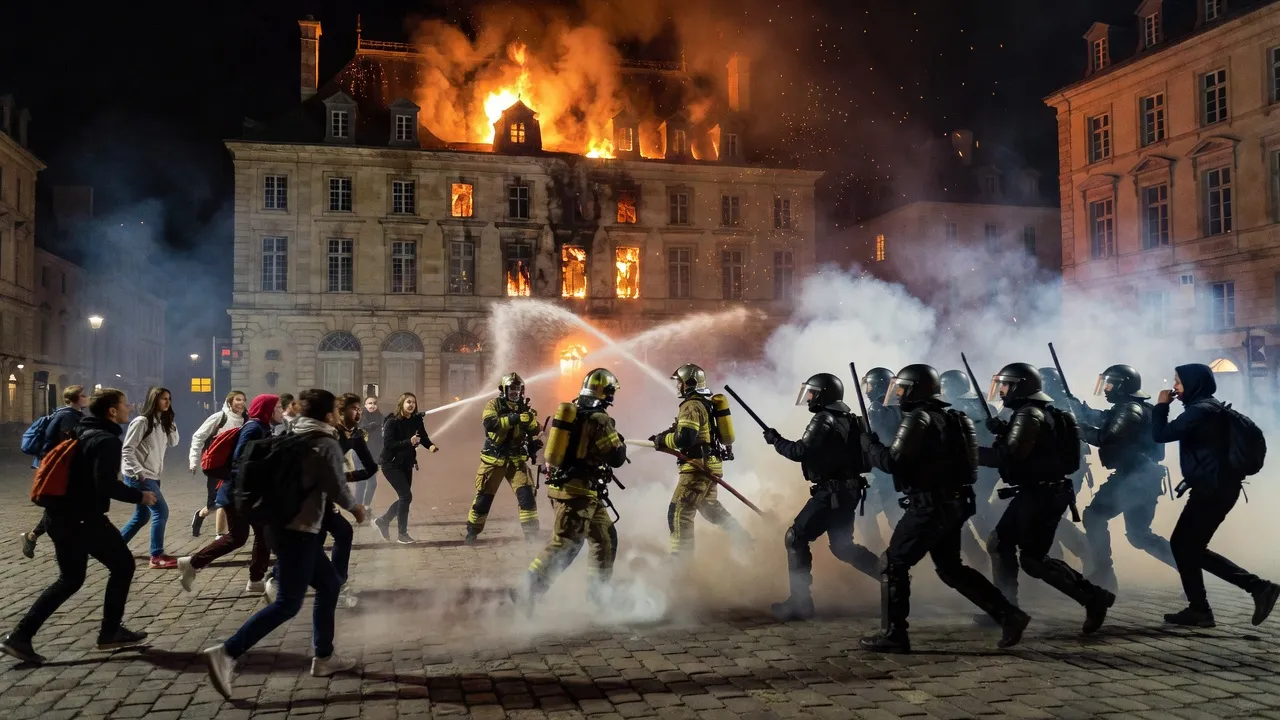
Lisbon is assessing the outcome of a day of public order: arrests, public buildings targeted and accusations against the far left dominate the Portuguese account of the French mobilization.
Dominant angle identified — does not reflect unanimity of this country’s media
KEY POINTS
- 01
Nuñez estimates 550,000 protesters, compared to 800,000 according to the organizers; 150,000 were expected by the authorities (Observador).
- 02
Nuñez announces around 400 arrests, the Prime Minister speaks of at least 1,200 detainees on BFMTV (Observador).
- 03
In Paris, 61 arrests and 589 preventive checks by 11 am, according to the police cited by the EFE agency (SAPO, Jornal Económico).
ANALYSIS
Lisbon, October 18, 2026. The Portuguese press treats the day of Saturday, October 17, in France, first and foremost as a public order assessment. Observador reports that Interior Minister Laurent Nuñez estimated the number of protesters at 550,000, far above the 150,000 anticipated by the authorities the day before; the organizers claim 800,000. The CGT had initially reported 500,000 by 5 pm local time before joining the 800,000 figure given by youth organizations and the yellow vests' website.
The arrests structure the narrative. Observador cites Nuñez for around 400 arrests, a figure he says is provisional, and then the Prime Minister announcing "at least 1,200" detainees on BFMTV with the promise: "Será feita justiça." Nuñez attributes the violence to "several thousand agitators," including far-left groups and "opportunistic delinquents," who targeted the city halls of Marseille and Limoges, where a fire broke out, as well as the Lyon tourist office, destroyed by flames. In Bordeaux, the prefect's residence was ransacked, triggering the intervention of the RAID.
SAPO Notícias and Jornal Económico detail the Parisian morning: 61 arrests and 589 preventive checks by 11 am, tear gas against high school students and a union procession, about a hundred hooded individuals attacking the headquarters of CNews and Europe 1, properties of Vincent Bolloré. SAPO headlines "the largest wave of protests since 2018" and describes a France "blocked," with a head of state at the end of his term, a "cornered" government, and rising interest rates after the failure of efforts to reduce debt.
On the political level, Jornal Económico relays Sébastien Lecornu: "Não nos deixaremos intimidar," addressed to those who would like to make these violent acts a "warm-up" before next year's presidential election. He accuses far-left groups and promises to see through the bill requiring vandals to pay for damages. An Observador section shows, in parallel, Portugal: Luís Montenegro warns against importing "conflictuality" experienced in other countries, after a video where a housing movement protester threatens his home. SAPO also notes that the high school protest has reached Italy, where a student says: "Fomos inspirados por França."
SOURCES (3)
- ObservadorMEDIUM
- SAPO NotíciasMEDIUM
- Jornal EconómicoMEDIUM