
DOMINANT ANGLE
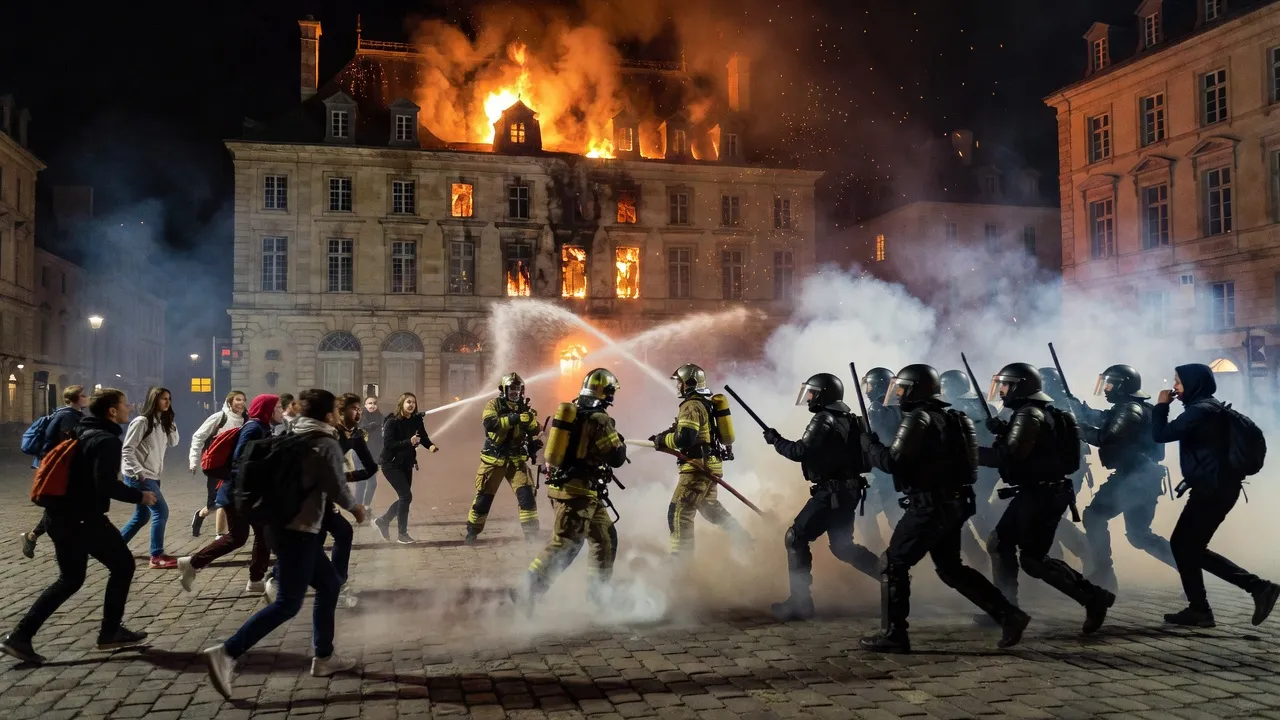
Singapore first takes note of the outbreak: the city-state's press headlines the worst riots in years in France and frames the day with burned buildings and the government's firm response.
Dominant angle identified — does not reflect unanimity of this country’s media
KEY POINTS
- 01
Around 550,000 protesters according to Interior Minister Laurent Nuñez, 800,000 according to the CGT, and about 400 arrests.
- 02
The city hall of Limoges was set on fire, that of Marseille was invaded, and the tourism office of Lyon was set on fire.
- 03
Lecornu: the government will not be "intimidated" and blames the far left six months before the presidential election.
ANALYSIS
Singapour, 18 October 2026. The Straits Times and Channel News Asia, which report the same account, headline the "worst riots in years" in France. On Saturday, 17 October, protests against the rising cost of living and the deterioration of public services degenerated into violence in several cities, according to them among the most severe that the country has experienced in decades.
The account clearly distinguishes between the peaceful majority and the violent fringe. Hundreds of thousands of people marched peacefully in dozens of cities, but violent groups targeted public buildings, looted luxury stores and supermarkets, and attacked vehicles and police officers. In Limoges, the city hall was set on fire; in Marseille, protesters dressed in black entered and covered it with anarchist graffiti; in Lyon, the tourist office was set on fire.
The figures are given with their sources: approximately 550,000 participants according to Interior Minister Laurent Nuñez, 800,000 according to the CGT cited by Reuters, and around 400 arrests, mostly adults. Prime Minister Sébastien Lecornu assured that the government would not be "intimidated", accusing the "far left" and criminals of wanting to use violence as a "warm-up" before the presidential election. Emmanuel Macron promised to prosecute the perpetrators and denounced the "sowers of chaos".
The articles put the movement back in its origin: high schools in the poor suburbs of northern Paris, where anger against teacher absences and the dilapidation of facilities turned into a protest against inequalities, weak public spending, and the standard of living. Students, unionists, and remnants of the yellow vests joined in. The Straits Times, in its pre-day article, recalls that the government implicates La France insoumise, which the party denies, and that Jordan Bardella feared "a day of chaos for France".
A reading of financial stability also emerges: Macron is entering the final stretch of his term facing a polarized electorate, while investors are shying away from French debt, pushing borrowing costs to their highest level in over twenty years. The same text notes that Lecornu mentions more than 900 police officers injured since the beginning of the movement. Protests also took place in Belgium, Portugal, and Italy.