
DOMINANT ANGLE
London is first focusing on the unrest: the British press is highlighting the fires, the looting and the number of arrests, before the academic and social causes of the movement.
Dominant angle identified — does not reflect unanimity of this country’s media
KEY POINTS
- 01
According to the BBC, around 550,000 people demonstrated and at least 1,200 were arrested on Saturday, October 17.
- 02
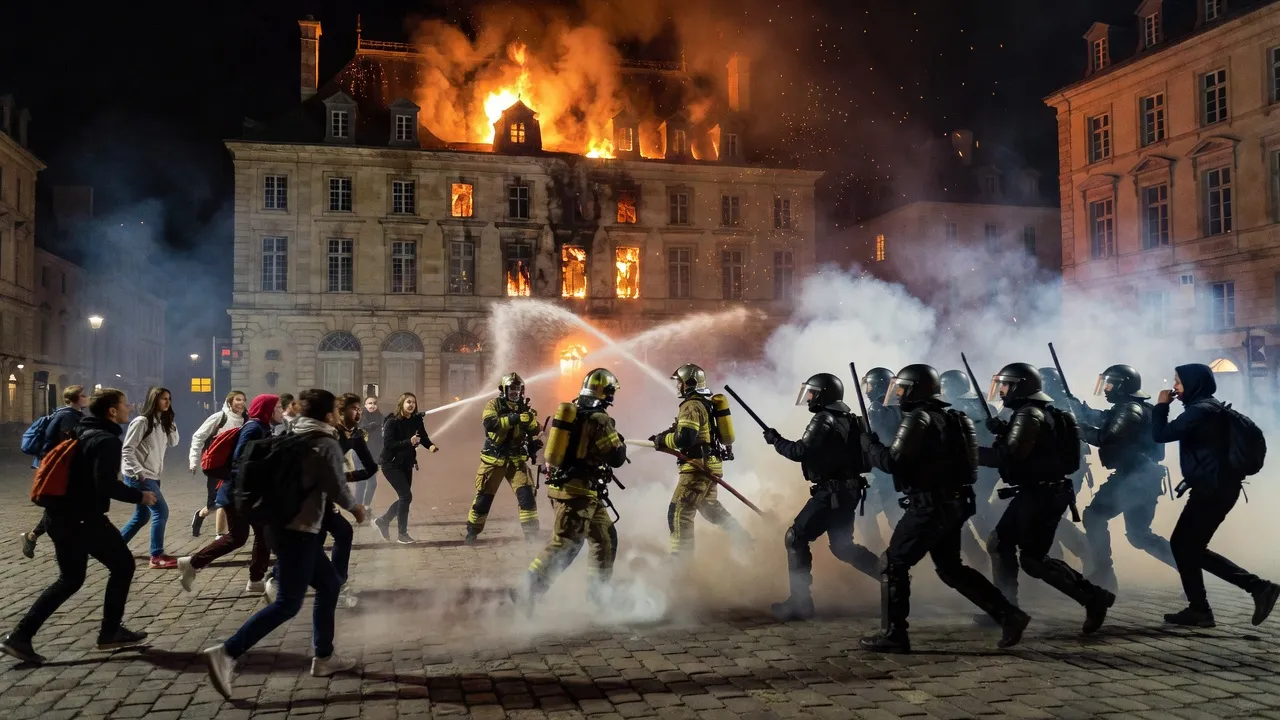
In Limoges, a large fire at the city hall partially collapsed the roof; sixty police officers and gendarmes were injured, according to Laurent Nuñez.
- 03
The Independent dates the start of the movement to September, in a high school in Créteil, over staff shortages and run-down facilities.
ANALYSIS
London, 18 October 2026. The British press is recounting Saturday, 17 October as a day of nationwide disorder. The BBC is reporting on "violence, looting and buildings on fire" and estimates the mobilization at around 550,000 people, with at least 1,200 arrests according to its count, which the French government associates with an "escalation of violence". The Independent, reporting live in the afternoon, had already counted over 270 arrests, including dozens in Paris even before the start of the marches.
The retained images are those of the town hall of Limoges, where a large fire partially collapsed the roof, the tourist office of Lyon set on fire, looted shops and burned-out vehicles on the Place de la République. The Minister of the Interior, Laurent Nuñez, reports that sixty members of the security forces were injured, including two hospitalized unconscious. The Mayor of Lyon, Grégory Doucet, speaks of "a tragedy" for a historic building, cited by the BBC.
The two media outlets nonetheless emphasize that the Parisian march remained largely peaceful during the afternoon. The BBC quotes young protesters saying they are "pacifists" and "just trying to make things change, but nothing is moving". It also notes that the police charged with batons in the center of Paris, with tear gas and water cannons.
On the origin of the movement, The Independent dates back to September: high school students from Créteil, then from poor suburbs in the north of Paris, protested against the lack of teachers and dilapidated facilities, rats, collapsed ceilings, and leaks. The anger turned into national protest over inequalities, the weakness of public spending, and the cost of living. Hundreds of schools had to close due to damage or attacks on staff.
The account relays the version of the Interior Ministry, which denounces "a very strong mobilization of far-left elements" and claims that the security forces reacted "quickly and firmly". The daily presents the episode as a new test for Emmanuel Macron, who called for "calm" and "respect for people and property", while France faces internal and external difficulties. It also mentions a risk of contagion to other European countries.
SOURCES (2)
- The IndependentMEDIUM