
DOMINANT ANGLE
Berlin is first focusing on the Limoges riots and the violence toll, relaying the Interior Ministry's reading on the far left, while the social anger born in high schools takes a back seat.
Dominant angle identified — does not reflect unanimity of this country’s media
KEY POINTS
- 01
The 143-year-old Limoges city hall is "largely lost" according to prefect Maurice Barate (FAZ).
- 02
550,000 protesters according to Minister Laurent Nuñez, around 800,000 according to the organizers, and around 400 arrests.
- 03
Demonstrations also took place in Lisbon, Milan, and Bologna on the same day (Handelsblatt).
ANALYSIS
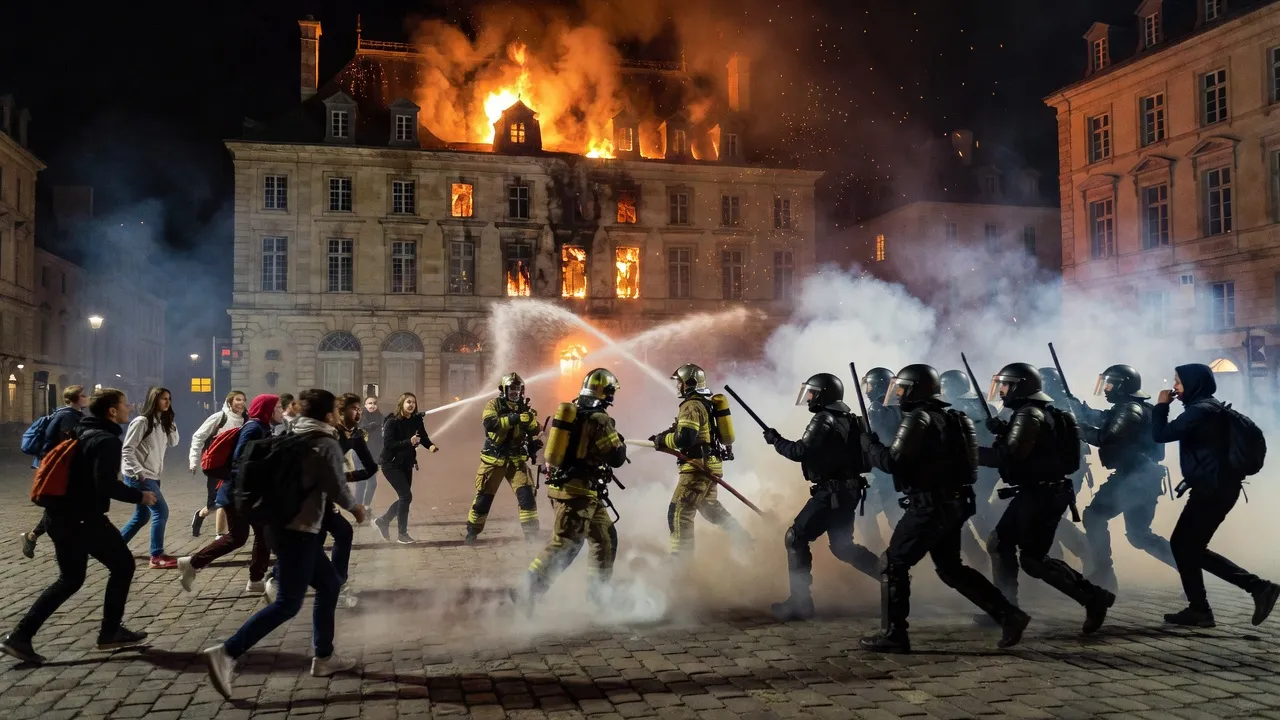
Berlin, October 17, 2026. The German press first reports on a day of riots, then a social movement. The FAZ leads with the fire at the 143-year-old city hall of Limoges, which is "largely lost" according to Prefect Maurice Barate, cited by AFP: the roof collapsed onto the lower floors and two-thirds of the facade disappeared. The prefect sees this as a "premeditated" act by rioters and a "catastrophe for France's cultural heritage".
The numbers are attributed: 550,000 demonstrators according to Interior Minister Laurent Nuñez, around 800,000 according to the organizers, and nearly 400 arrests. Deutsche Welle adds that 60 police officers were injured, according to the ministry, dozens of stores were looted in Paris, Marseille, Nice, Bordeaux, and Lille, including an Apple Store that was cleared out, windows were broken at the headquarters of CNews and Europe 1, and the Lyon tourist office was set on fire.
The Handelsblatt speaks of "one of the most serious riots in years", with cars set on fire in Paris and at least 272 arrests in an initial tally. It broadens the focus: in Lisbon, tens of thousands of people marched, including against the housing crisis; in Milan, the police used tear gas, and in Bologna, they used water cannons.
Tagesschau and Handelsblatt, in their initial afternoon reports, relay the version of the Interior Ministry: a "very strong mobilization of the ultra-left movement", organized in black blocks in Paris, Marseille, Rennes, Toulouse, and Angers, which seeks "only to sow trouble". They report 140 actions and 32,800 participants at noon, 166 arrests, including around 100 in Paris for carrying weapons and prohibited objects. DW reports the same accusation targeting the "hard-left".
The social aspect remains in the background. DW recalls that the movement was born last month in high schools, where students denounced the lack of teachers and dilapidated facilities, before expanding to prices and inequalities, against a backdrop of "increasing social polarization". Emmanuel Macron, who had called for calm the day before, declares that there is "no place for violence" in the Republic and promises to prosecute the rioters.
SOURCES (4)
- FAZMEDIUM
- HandelsblattMEDIUM