
DOMINANT ANGLE
Amsterdam looks back on the day of October 17 from the high schools and universities, and presents the violence as a deviation from a social movement born out of fear for the future.
Dominant angle identified — does not reflect unanimity of this country’s media
KEY POINTS
- 01
Around 550,000 protesters according to the Ministry of the Interior, up to 800,000 according to the unions, and about 400 arrests (NRC).
- 02
Since Tuesday, October 6, thousands of high school students and university students have been protesting in Paris; almost all the universities in the capital have been closed for over a week (NRC).
- 03
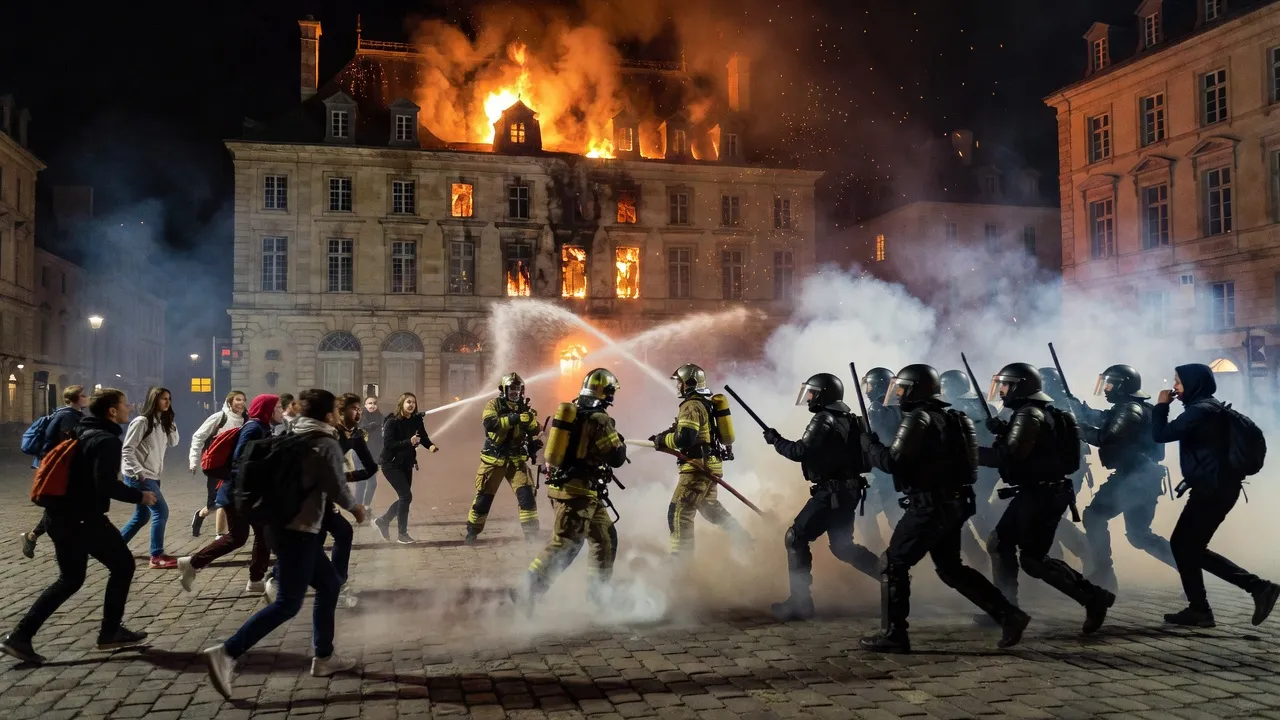
Protesters set fire to the city hall of Limoges; the fire spread to the roof (De Telegraaf).
ANALYSIS
Amsterdam, October 18, 2026. The Dutch press has been following the French mobilization since its inception in schools. As early as Friday, October 16, NRC published a report on young people who are "afraid of the future, angry at the government": since Tuesday, October 6, thousands of Parisian high school students and students have been protesting against an educational system they deem failing and are demanding better facilities, more teachers, and a transparent selection procedure. The movement, which originated in late September among frustrated high school students, has spread to universities and unions; almost all universities in the capital have been closed for over a week following attempts to block them, some for the first time since 1968.
The newspaper gives a voice to Ulysse Bel, a student in urban planning in Paris, who notes the paradox of passing by the motto "liberty, equality, fraternity" every morning without feeling its effects. With the presidential election in sight, young people see this as the moment to impose change. A protester quoted says: "Maybe the Earth will be on fire in twenty years, so we have nothing to lose."
On Saturday, October 17, NRC reported on a day of protest, riots, and looting. Hundreds of thousands of people demonstrated against the cost of living: around 550,000 according to the Ministry of the Interior, up to 800,000 according to the unions. By noon, the ministry had counted 140 actions. Protesters launched fireworks and smoke bombs, public buildings were damaged or stormed, and around 400 people were arrested. In Paris, on the Place de la République, a car and a kiosk were set on fire, according to France 24; the police used tear gas several times. The official procession remained relatively calm, but in the evening, militants entered the town hall of the 10th arrondissement.
De Telegraaf, for its part, broadcast images of the city hall of Limoges in flames: the fire had spread to the roof and thick black smoke was escaping from the building. The daily newspaper recalls that the protest initially targeted the government and the school system.
NRC headlines Emmanuel Macron's reaction: "We will form a bloc against those who sow chaos." Yellow vests and unions had announced they would join the students on this national day set by collectives. The Dutch account remains focused on youth and social unrest, with violence presented as a deviation from a initially peaceful movement.
SOURCES (2)
- De TelegraafMEDIUM
- NRCMEDIUM