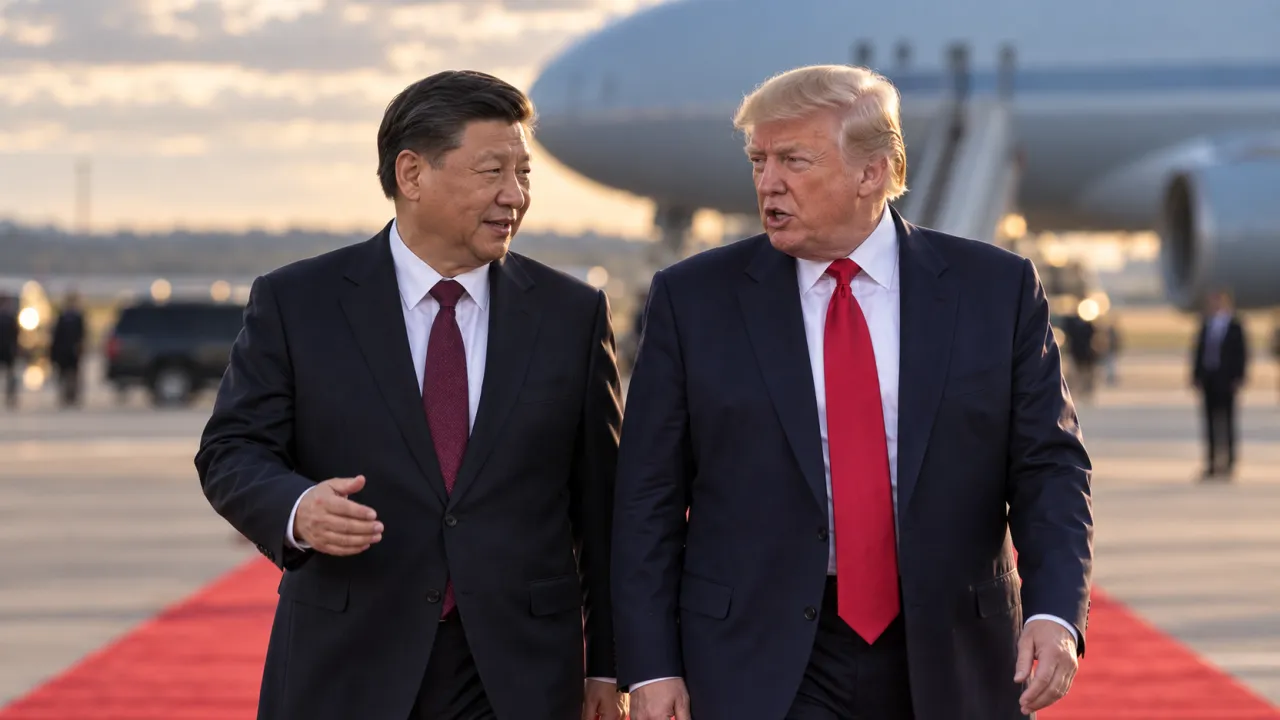
Xi Jinping arrives in Washington for a state visit as Beijing sets Taiwan and human rights as "red lines"
published on
countries
sources
articles
Thirteen newsrooms, from Buenos Aires to Seoul, are covering Xi Jinping's arrival in Washington: this figure measures the subject's place in global news, not an agreement on its meaning. Beijing sees it as a milestone of "strategic stability", former US diplomats as a mere spectacle, and several mid-sized powers as a fear of arbitration that will bypass them.
No agreement has been announced yet on trade or Taiwan: the Busán tariff truce expires in November and the summit itself is still to come on Thursday.
Two accounts of the same summit
On the Chinese side, the official apparatus locked in a narrative even before Xi Jinping's landing. The People's Daily called on the two countries to build on the "constructive strategic stability" sealed in Beijing in May, according to CGTN and the South China Morning Post. The spokesperson for the Ministry of Foreign Affairs, Guo Jiakun, described the exchange of visits in six months as a "historic milestone", also according to CGTN.
« Can China and the United States overcome the Thucydidean trap and build a new paradigm for relations between major powers? The Pacific is large enough to accommodate China and the United States. »
On the American side, former high-ranking officials judge the exercise to be largely devoid of substance. Kurt Campbell, former Deputy Secretary of State under Joe Biden, sums it up, quoted by the Australian press: "This is less a summit than a spectacle." His former colleague Evan Medeiros, long in charge of the Chinese file at the National Security Council, adds that "no serious preparation" took place and that expectations are "incredibly low", according to The Age and the Sydney Morning Herald.
The director of the Berlin-based think tank MERICS, Mikko Huotari, quoted by Deutsche Welle, speaks of a "strategic deadlock" shared by the two capitals: according to him, Xi Jinping needs neither a breakthrough in Washington nor a failure, but time. The Italian press shares this reading: according to Adnkronos, few concessions are expected from Xi Jinping, a caution that, for the cited observers, measures the summit as much as what will be announced afterwards.
An unbalanced trade delegation
Washington confirmed the presence, Thursday evening, of the leaders of several American tech and industrial giants at the state dinner: Satya Nadella (Microsoft), Jensen Huang (Nvidia), Sam Altman (OpenAI), Sundar Pichai (Google), Elon Musk, Jane Fraser (Citigroup), Jeff Bezos, Tim Cook (Apple), and Michael Dell, according to CNBC.
Beijing, on its part, struggled to gather an equivalent contingent. The South China Morning Post reports that disagreements over cross-investments between the two countries have weakened the participation of a delegation of Chinese companies in Xi Jinping's trip: the leaders of DeepSeek and Moonshot AI, two Chinese artificial intelligence companies, were not on the reported list.
The same Hong Kong newspaper notes additional friction over rare earths: Washington accuses Beijing of creating "uncertainty" about the extension of the Busán trade agreement, due to insufficient exports of this strategic mineral.
Artificial intelligence lying in wait
According to El País, artificial intelligence will be among the central topics of discussion on Thursday, between the two countries that have made the most progress in this technology. The Spanish daily notes a contrast in mindset: a majority of Americans say they are concerned about the risk that AI poses to humanity, while the Chinese population approaches it with enthusiasm.
The industrial models also differ, El País writes: Silicon Valley prioritizes closed systems whose training remains an industrial secret, while Beijing is betting on open source, a strategy perceived in Washington as a threat to its competitiveness. The head of Anthropic, Dario Amodei, linked his call to slow down the development of the most powerful models to a blockade of Beijing's access to advanced semiconductors. Former Trump advisor Steve Bannon, on the other hand, called for "quarantining the entire artificial intelligence ecosystem out of reach of the Chinese Communist Party", during a symposium shared with Senator Bernie Sanders, also according to El País.
According to Expansión, Treasury Secretary Scott Bessent and Chinese Vice Premier He Lifeng held preparatory negotiations in New York that resulted in a project for a shared alert system in the event of a serious AI-related incident, after autonomous hacking attributed to models such as those developed by OpenAI. Swedish daily Dagens Nyheter reports that Beijing has described the call by US officials to restrict technology transfers to China as "fear propaganda".
Mid-level powers left out
Several regional partners fear being left out of arbitrations that directly concern them. The Indian daily Deccan Chronicle describes the reciprocal visits over six months as a sign of a shift towards a bilateral Sino-American "duopoly", to the detriment of traditional multilateral alliances like the Quad, a pillar of New Delhi's foreign policy.
The Indian press also notes the exclusion of General Zhang Youxia's party and army, who was in charge of China's border strategy during the 2020 Galwan clash and the military buildup in Ladakh and Tibet, according to the Free Press Journal. This sidelining leaves uncertainty over who will now steer China's posture on the Himalayan border.
In Germany, diplomacy itself is absent from the main stage: Chancellor Friedrich Merz is missing the UN General Assembly this week, held back by a series of regional election defeats, and is being represented by his Foreign Minister Johann Wadephul, according to Deutsche Welle. In Seoul, President Lee Jae Myung has ruled out sending troops to the Strait of Hormuz while separately negotiating an investment package with Washington, according to Korea Pro — two issues being handled on separate tracks that illustrate, for the South Korean press, the risk of South Korea being absent from the arbitrations of the Xi-Trump summit while still suffering the effects.
Xi is expected to invoke the 3rd joint communiqué of 1982 to call for an end to arms sales to Taiwan.
Mary Barra (GM) attends Thursday's state dinner; Beijing has not confirmed a comparable business delegation.
The Shanghai Stock Exchange fell by 0.3% and the CSI 300 by 0.4% on the eve of the summit, according to Handelsblatt.
The wife of seismologist Youlin Chen, detained since late 2024, hopes Trump will plead for his release to Xi.
How each country reads it
13 perspectives, each in the voice of that country's press.
 Argentina
Buenos Aires is mainly gauging the commercial impact of the Trump-Xi summit, fearing that an agreement on soybeans and Boeing aircraft could erode Argentine market outlets in China.
5 sources
 Australia
Canberra fears that artificial intelligence and Taiwan's security will be settled bilaterally in Washington, without the involvement of mid-sized powers that will suffer the consequences.
5 sources
 China
ChinaBeijing is positing Taiwan and human rights as non-negotiable "red lines" even before Xi Jinping's landing in Washington, claiming the state visit as a historic milestone of "constructive strategic stability".
4 sources
 Germany
Berlin fears that Europe will be relegated to the role of a mere adjustment variable in the negotiations between Washington and Beijing, without having a say in the arbitrations being negotiated.
2 sources
 Spain
SpainMadrid sees the Trump-Xi summit as a technological and commercial battle more than a simple diplomatic ritual, the tariff truce threatening to expire while artificial intelligence takes center stage in the discussions.
2 sources
 India
IndiaNew Delhi sees Xi Jinping's state visit to Washington as a symptom of an emerging Sino-American duopoly, where India and its Quad partners risk being reduced to spectators in the decisions that affect them.
3 sources
 Italy
ItalyRome is gauging the Trump-Xi summit in light of the US electoral calendar and the November expiration of the trade truce, rather than a spectacular deal on Taiwan.
2 sources
 Japan
JapanTokyo is locking in its alliance with Washington ahead of the Xi-Trump summit, fearing that Taiwan and regional economic security may be negotiated without Japan having a say.
2 sources
 South Korea
Seoul gauges the risk of being the major absentee from the Xi-Trump summit, between American silence on North Korea and its own showdown over $350 billion in investments
2 sources
 Nepal
NepalKathmandu sees Xi Jinping's state visit to Washington as a showdown over arms sales to Taiwan rather than a simple resumption of dialogue
2 sources
 Sweden
Stockholm fears that a closed-door race for artificial intelligence between Washington and Beijing will dictate, without its input, the technological rules that apply to the rest of the democratic world.
3 sources
 Singapore
Singapore sees the pomp and protocol of the Trump-Xi summit as a staged display primarily for domestic use, rather than a signal of actual thawing between the two powers.
3 sources
 United States
The United States is measuring this summit less by the protocol than by the unfulfilled trade commitments and the November electoral deadline.
5 sources
What the comparison reveals
Common ground and differences in coverage across the media analysed.
What the media report in common
Xi Jinping arrived in Washington on Wednesday, September 23, 2026, for a three-day state visit, with an official summit with Donald Trump and a state dinner on Thursday, September 24, in an American capital he had not visited in several years.
The summit is taking place in a context of unresolved economic and technological rivalry between Washington and Beijing — the Busan tariff truce is nearing its end, export controls and artificial intelligence rivalry — which most perspectives put back at the heart of their reading of the meeting.
Where media coverage diverges
Actual scope of the summit
Regarding the question of whether the meeting marks a substantial diplomatic breakthrough, Chinese and Nepalese media reiterate the official framing of a 'constructive strategic stability' and a historic milestone in bilateral relations, while several other perspectives (Australian, Singaporean, South Korean, Italian, American) describe a meeting with significant protocolary fanfare but whose concrete results remain uncertain.
Coverage that diverges
Thematic priority of the agenda
On the question of the dominant subject of the summit, some media (Spanish, Swedish, Australian, Japanese) place artificial intelligence at the top of the agenda, while others (Argentine, Italian, American) first retain the trade truce and ongoing tariff deadlines.
This grouping describes the publications analysed, not the position of these countries’ populations or of their governments.
The full text, country by country
Argentina
DOMINANT ANGLE
Buenos Aires is mainly gauging the commercial impact of the Trump-Xi summit, fearing that an agreement on soybeans and Boeing aircraft could erode Argentine market outlets in China.
KEY POINTS
- Xi Jinping arrived Wednesday in Washington for a three-day state visit, the first by a Chinese leader in the US capital in eleven years, greeted by Trump on the tarmac of Joint Base Andrews (Infobae, Clarín).
- El Cronista reports that Xi will seek to extend the Busán trade truce and could offer to buy American soybeans and Boeing planes in exchange for a shift on arms sales to Taiwan.
- According to Ambito, analysts Martín Mejía (Cohen Aliados Financieros) and Honorio Zabaleta (Eco Go) deem a strong impact on markets unlikely, recommending to monitor the trade truce and restrictions on artificial intelligence.
ANALYSIS
Buenos Aires, Wednesday, September 23, 2026. Xi Jinping arrived on Wednesday in Washington for a three-day state visit, the first by a Chinese leader in the American capital in eleven years. Donald Trump welcomed him in person on the tarmac of Joint Base Andrews, alongside his wife Peng Liyuan, a protocol gesture deemed unprecedented by the Argentine press, which notes that the American president preferred this trip rather than waiting for his counterpart at the White House. The local press sees this as Trump's desire to return the tribute he received in Beijing in May, where he had benefited from a carefully planned protocol.
But it is mainly the commercial agenda that is drawing the attention of the Argentine media. According to El Cronista, Xi will prioritize extending the trade truce sealed in Busan last October, and could propose purchases of American soybeans and Boeing aircraft, while addressing AI security and the end of the war in Iran. In exchange for a shift in Washington's stance on arms sales to Taiwan, Beijing would offer increased cooperation to pressure Tehran — a dossier that La Nación describes as the "most delicate" of the summit, with Beijing also demanding an end to deliveries already ordered by Taipei, which rejects any Chinese sovereignty claims.
A potential agreement on soybeans directly concerns Argentina, the world's second-largest supplier of this oilseed after the United States and Brazil, and for which China remains the main market. Ambito reports that local markets "do not expect significant progress": analyst Martín Mejía (Cohen Aliados Financieros) considers the summit "fundamental for current geopolitical relations" without anticipating a strong impact on markets, while Honorio Zabaleta (Eco Go) recommends closely monitoring technological restrictions on artificial intelligence. Clarín and Infobae detail the planned pomp — a state dinner on Thursday at the White House, repeated praise from Trump for Xi, whom he describes as a "great leader" and "friend" — while noting that tensions over trade, AI, the war in Iran, and Taiwan remain intact beneath the diplomatic fanfare.
Australia
DOMINANT ANGLE
Canberra fears that artificial intelligence and Taiwan's security will be settled bilaterally in Washington, without the involvement of mid-sized powers that will suffer the consequences.
KEY POINTS
- More than twenty countries, including Australia, have signed a statement calling for international safeguards on AI (mandatory security tests, independent assessments, supervision of "frontier" models) ahead of the Trump-Xi meeting.
- Chinese Ambassador Xie Feng wrote in the People's Daily that Taiwan and human rights are two of the four Chinese "red lines" that cannot be crossed.
- Trump holds a package of arms for Taiwan worth around $14 billion "in waiting", which he described as a "very good negotiating chip" after the May summit in Beijing.
ANALYSIS
Canberra, Wednesday, September 23, 2026. Xi Jinping has arrived in Washington for a three-day state visit, with a personal welcome from Donald Trump on the Joint Base Andrews tarmac on Thursday, a rare protocol gesture that the Australian press describes as a "spectacle" rather than a substantive summit. Kurt Campbell, former deputy to the State Department under Joe Biden, sums it up: "This is less a summit and more a spectacle." His former colleague Evan Medeiros, long in charge of the Chinese file at the National Security Council, adds: "There's been no serious preparation - expectations are incredibly low."
On substance, three issues dominate according to Crikey: trade, technology, and Taiwan. The tariff truce concluded last year in Busan must be renewed, and Beijing could agree to buy more American soybeans. But it's on artificial intelligence that Canberra is focusing its attention: more than twenty countries, including Australia, have signed a statement calling for international safeguards - mandatory security tests, independent evaluations, and enhanced supervision of so-called "frontier" AI models - just before the meeting between the two presidents.
Beijing, for its part, has set the tone before the summit. In the Party's daily newspaper, Ambassador Xie Feng warned that Taiwan and human rights are among four "red lines" that Washington cannot cross, alongside China's development paths and rights. Trump still holds a package of arms for Taiwan worth around $14 billion, which he himself described as a "very good negotiating chip" after the May summit in Beijing. A Taiwanese security official estimates that any delay in these deliveries directly slows down the island's military modernization.
For Canberra, the concern goes beyond Taiwan: it's the fear of seeing AI rules and Indo-Pacific security balance being negotiated in a tête-à-tête between Washington and Beijing, without the medium powers that would suffer the consequences. Engaged the same week at the UN General Assembly, Australian diplomacy is counting on the coalition of twenty signatories to weigh in despite its absence from the Washington table.
China
DOMINANT ANGLE
Beijing is positing Taiwan and human rights as non-negotiable "red lines" even before Xi Jinping's landing in Washington, claiming the state visit as a historic milestone of "constructive strategic stability".
KEY POINTS
- Xi Jinping is making a state visit to the United States from September 23 to 25, his first to Washington in over ten years, at the invitation of Donald Trump
- The People's Daily published the "red lines" of Beijing (Taiwan, human rights) on its front page before Thursday's summit, calling for building "constructive strategic stability"
- China added two chemical precursors of fentanyl to its export control list, bringing the total to 18, on the eve of Xi's departure for Washington
ANALYSIS
Beijing, Wednesday, September 23, 2026. China's official press has set the narrative even before Xi Jinping's landing in Washington for a three-day state visit, from September 23 to 25, his first to Washington in over ten years. On the front page, the Communist Party's organ laid out Beijing's "red lines": Taiwan and human rights are non-negotiable, with the rest of the relationship to be guided by a "constructive strategic stability" sealed during Trump's visit to Beijing in May. The Ministry of Foreign Affairs described the exchange of visits over six months as a "historic milestone," with spokesperson Guo Jiakun emphasizing that head-of-state diplomacy "plays an irreplaceable strategic role" in stabilizing the relationship.
In substance, Beijing is making calculated gestures. Two additional chemical precursors were added, on the eve of Xi's departure, to the list of substances subject to export licenses to North America, bringing to 18 the number of fentanyl-related products under control. However, trade tensions are emerging: Washington accuses Beijing of creating "uncertainty" about the extension of the 2025 Busan agreement due to insufficient exports of rare earths, and disagreements over cross-investments have weakened the participation of a Chinese business delegation in the trip, with the leaders of DeepSeek and Moonshot AI absent from the reported list.
On Taiwan, Chinese diplomacy is pressing Washington to slow down, or even delay, arms sales to the island, while the Taiwanese opposition is concerned about restrictions imposed on official visits to Washington. Beijing is also calling on Berlin to prevent the European Union from waging a trade war against China, with Wang Yi asking his German counterpart to defend "free trade".
The tone deployed elsewhere remains that of people-to-people friendship: Xi responded by letter to American students who came to China through the Future Makers 2026 program, praising a youth that "shares one planet". Beijing recalls that it reached, as early as May, the goal of hosting 50,000 American young people in five years, two and a half years ahead of the deadline announced by Xi in 2023 in San Francisco.
Germany
DOMINANT ANGLE
Berlin fears that Europe will be relegated to the role of a mere adjustment variable in the negotiations between Washington and Beijing, without having a say in the arbitrations being negotiated.
KEY POINTS
- In Düsseldorf, German and Chinese business leaders held an economic dialogue where the Sino-American rivalry loomed over the debates, according to Deutsche Welle.
- Mikko Huotari, director of the Berlin-based think tank MERICS, believes Xi and Trump are experiencing a "strategic stalemate" where neither is seeking an immediate breakthrough.
- Chancellor Friedrich Merz is absent from the UN General Assembly this week, held back by regional election defeats in Saxony-Anhalt, Berlin, and Mecklenburg-Western Pomerania, and is being represented by Minister Johann Wadephul.
ANALYSIS
Berlin, September 23, 2026. For the German press, the arrival of Xi Jinping in Washington is not primarily a duel between two capitals: it's a summit where Europe could pay the price without being invited. Deutsche Welle recalls that German and Chinese business leaders met last week in Düsseldorf for an economic dialogue where the Sino-American rivalry loomed over the debates. Mikko Huotari, director of the Berlin-based think tank MERICS, summarizes Beijing's calculation: "Xi really doesn't need a breakthrough in Washington. He needs more time." He describes a situation of "strategic stalemate" shared, in his view, by both capitals.
The first meeting between the two presidents, in May in Beijing, had not yielded any tangible results, DW recalls. This time, domestic pressure is bearing down on Donald Trump: political analyst Wang Hung-Jen, cited by Deutsche Welle, estimates that the American president needs visible results before the November midterm elections - tariffs, agricultural products, Boeing aircraft, rare earths, investments. A trade agreement would also be an electoral success for the Republicans, without certainty that it will materialize.
From an economic perspective, Handelsblatt notes that Chinese investors remain cautious on the eve of Xi's arrival in Washington: the Shanghai Stock Exchange fell by 0.3%, the CSI 300 by 0.4%, while Asian markets outside China benefited from the enthusiasm for artificial intelligence. The newspaper mentions the hypothesis of a prolongation of the trade de-escalation and a cooperation agreement on AI, a field where Washington is already restricting the export of advanced semiconductors and where Beijing is responding by limiting the rare earths necessary for their production.
In the background, German diplomacy finds itself absent from the main stage: Chancellor Friedrich Merz is missing the UN General Assembly this week, entangled in a series of regional election defeats in Saxony-Anhalt, Berlin, and Mecklenburg-Vorpommern, and it's his Foreign Minister Johann Wadephul who represents him. For Deutsche Welle, the conclusion is clear: while Washington and Beijing negotiate the terms of their rivalry, it's the medium powers - Europe first and foremost - that will have to adjust to an agreement they had no part in writing.
Spain
DOMINANT ANGLE
Madrid sees the Trump-Xi summit as a technological and commercial battle more than a simple diplomatic ritual, the tariff truce threatening to expire while artificial intelligence takes center stage in the discussions.
KEY POINTS
- AI will be a central topic at Thursday's summit at the White House, according to El País, between the two countries most advanced in this technology
- Expansión reports that the tariff truce between Washington and Beijing is about to expire, alongside the Taiwan and Iran files
- Treasury Secretary Scott Bessent and Chinese Vice Premier He Lifeng negotiated a shared alert system in New York for serious AI-related incidents, according to Expansión
ANALYSIS
Madrid, September 23, 2026. For the Spanish press, the summit between Donald Trump and Xi Jinping opening this week in Washington is less about protocol than about artificial intelligence and trade. El País emphasizes that AI will be one of the central topics of discussion on Thursday at the White House, between the two countries that have made the most progress in this technology. The newspaper notes a contrast in mindset: a majority of Americans say they are concerned about the risk that AI poses to humanity, while the Chinese population approaches it with enthusiasm. The industrial models also differ: Silicon Valley prioritizes closed systems whose training remains an industrial secret, while Beijing is betting on open source, a strategy perceived in Washington as a threat to American competitiveness, against a backdrop of accusations of industrial espionage. El País quotes the head of Anthropic, Dario Amodei, who linked his call to slow down the development of the most powerful models to a blockade of Beijing's access to advanced semiconductors. Former Trump advisor Steve Bannon, on the other hand, called for "quarantining the entire AI ecosystem out of reach of the Chinese Communist Party" during a symposium shared with progressive Senator Bernie Sanders.
Expansión places Xi's three-day state visit in a tight schedule: the Chinese president arrives in Washington as the UN General Assembly brings together a large part of the world's leaders in New York. Trump is to return to the White House after his intervention at the UN to receive Xi the next day, while Chinese Vice President Han Zheng represents him in New York. The newspaper notes that Beijing only officially announced the visit the day before. According to Expansión, the meeting will be marked by a commercial, military, and technological showdown, with the risks of the AI race, a tariff truce about to expire, the evolution of the war in Iran and its energy and commercial impact, as well as the status of Taiwan on the agenda. The newspaper reports that Treasury Secretary Scott Bessent and Chinese Vice Premier He Lifeng held preparatory negotiations in New York, resulting in a draft shared alert system between Washington and Beijing in the event of a serious AI-related incident, after autonomous hacking suffered by third-party companies attributed to models like those developed by OpenAI.
India
DOMINANT ANGLE
New Delhi sees Xi Jinping's state visit to Washington as a symptom of an emerging Sino-American duopoly, where India and its Quad partners risk being reduced to spectators in the decisions that affect them.
KEY POINTS
- Donald Trump goes in person to Joint Base Andrews to welcome Xi Jinping, a protocol gesture so far reserved for papal visits under Obama and Bush (Times of India).
- The Deccan Chronicle describes the reciprocal visits in six months as a "milestone" and sees a shift towards a bilateral Sino-American "duopoly" sidelining traditional multilateral alliances.
- The Free Press Journal reports the exclusion of General Zhang Youxia, who was in charge of China's border strategy during the 2020 Galwan clash and the military buildup in Ladakh and Tibet, from the Party and the army.
ANALYSIS
New Delhi, Wednesday, September 23, 2026. New Delhi is deciphering Xi Jinping's state visit to Washington as a sign of a strategic shift that could leave India and its partners on the sidelines of Sino-American arbitration. The Times of India notes that Donald Trump will personally go to Joint Base Andrews to welcome the Chinese president, a protocol gesture previously reserved for papal visits under Obama and Bush. The planned ceremony at the Rose Garden - a 479-military honor guard, a flyover by a B-2 bomber escorted by four F-22s - contrasts with the reception given to Trump in Beijing in May: Xi did not come to the airport, had delegated his vice-president Han Zheng, and no flyover had marked the occasion. Former National Security Council official Rush Doshi sees it as a symbol: "the asymmetry of pomp reflects a broader asymmetry in the relationship: Beijing thinks that rare earths have tamed Washington, and Washington sometimes seems to agree."
The Deccan Chronicle describes these reciprocal visits over six months as a "milestone" on the Chinese side, and reads Washington's shift towards a bilateral "duopoly" with Beijing, to the detriment of traditional multilateral alliances - an interpretation that worries New Delhi, where the Quad remains a pillar of foreign policy. The trade deadline is approaching: the truce concluded in Busan is due to expire in the coming weeks, while the US Congress has just authorized Trump to impose up to 100% customs duties on any country trading with Russia or Iran - China being the largest trading partner of both.
The Free Press Journal highlights, in parallel, the exclusion of General Zhang Youxia from the Party and the army, alongside Liu Zhenli. As Vice-President of the Central Military Commission, Zhang had led China's border strategy during the 2020 Galwan confrontation and the military buildup along the Line of Actual Control in Ladakh and Tibet. For the Indian press, this purge recalls that the architect of border tensions with India is disappearing from command at the very moment when Xi is negotiating in Washington, leaving uncertainty over who will now pilot China's posture in the Himalayas while Beijing and Washington redraw their balance of power without consulting New Delhi.
Italy
DOMINANT ANGLE
Rome is gauging the Trump-Xi summit in light of the US electoral calendar and the November expiration of the trade truce, rather than a spectacular deal on Taiwan.
KEY POINTS
- The summit is being held on Thursday, September 24 in Washington: third Trump-Xi face-to-face in less than a year, according to Adnkronos, which does not expect concessions from Xi Jinping
- The trade truce concluded last October expires in November; Chinese Vice Premier He Lifeng and Treasury Secretary Scott Bessent met in New York just before the summit
- In Busan in October 2025, Washington had postponed for a year the extension of its blacklist of Chinese companies and reduced its tariffs on fentanyl, while Beijing resumed its soybean purchases; in Beijing in May, China had promised $17 billion in agricultural purchases and 200 Boeing aircraft
ANALYSIS
Rome, September 23, 2026. The Italian press is approaching the Trump-Xi summit on Thursday, September 24, in Washington more as a stage in a suspended trade negotiation tied to the American electoral clock than as a spectacular diplomatic meeting. For Adnkronos, this is the third face-to-face between the two leaders in less than a year, after the meeting in Beijing in mid-May and more than nine years after their first summit — but, according to observers, few concessions are expected from Xi Jinping. The talks are taking place as, in the words of the daily, "the Midterm vote is approaching" for the American president, a deadline considered central by Italian commentators to understand Washington's caution.
Attention is focused on a possible extension of the trade truce concluded last October, which expires in November, discussed a few days earlier in New York between Chinese Vice Premier He Lifeng and Treasury Secretary Scott Bessent. A new trade war and counter-measures on critical minerals, highlights the New York Times analysis relayed by Adnkronos, would penalize American consumers ahead of the elections — a risk Trump cannot afford —, while a status quo would give Xi time to relaunch the Chinese economy and "recompose" his staff after the anti-corruption purges.
Internazionale places the meeting in the continuity of Busan, South Korea, in October 2025: Washington had agreed to postpone for a year the extension of its blacklist of Chinese companies, Beijing was pushing back its new regime on exports of critical minerals and batteries, obtained a reduction in tariffs related to fentanyl, and resumed its purchases of American soybeans. In Beijing in May, the results had been more modest: China had promised $17 billion in additional agricultural purchases and two hundred Boeing planes, on condition of also obtaining spare parts.
According to American media cited by Adnkronos, artificial intelligence is at the top of Thursday's agenda, alongside the Iranian dossier and the Boeing dossier, but expectations remain low on AI security and trade imbalances. For the Italian press, this shared caution — no revolutionary agreement is expected — measures the summit: what has not happened before counts more than what will be announced after.
Japan
DOMINANT ANGLE
Tokyo is locking in its alliance with Washington ahead of the Xi-Trump summit, fearing that Taiwan and regional economic security may be negotiated without Japan having a say.
KEY POINTS
- Sanae Takaichi met with Donald Trump on Tuesday, September 22, in New York, for a meeting of about 35 to 40 minutes, on the eve of Xi Jinping's arrival in Washington for his first state visit in eleven years.
- Scott Bessent indicated that Washington has asked Beijing to create a "notification mechanism" for national security-related artificial intelligence issues.
- Tokyo and Beijing have been in a diplomatic freeze since Takaichi suggested in November that an attack on Taiwan could justify a Japanese military response.
ANALYSIS
Tokyo, September 23, 2026. On the eve of Xi Jinping's arrival in Washington for his first state visit in eleven years, Japanese diplomacy has taken the lead. On Tuesday, September 22, Prime Minister Sanae Takaichi met with Donald Trump in New York, on the sidelines of the United Nations General Assembly, for a tête-à-tête of approximately thirty-five to forty minutes. According to the Japanese government, the two leaders discussed "various issues concerning China, including economic security," and agreed to strengthen the deterrent and response capabilities of the Japan-US alliance.
Takaichi justified the move by citing the deterioration of the regional security climate, stating that she wants to show the world "how robust our alliance is" by multiplying meetings. She praised the progress of bilateral cooperation in economic security - artificial intelligence, semiconductors, critical minerals - "thanks to Donald's leadership" and hers. Trump paid her a strong tribute, praising "a Japanese industry that is doing very well" and calling Takaichi a future "great Prime Minister".
The context is heavy: Tokyo and Beijing have been experiencing a diplomatic chill since Takaichi suggested in November that an attack on Taiwan could constitute an existential threat to Japan and justify a military response - a statement that provoked China's anger, which claims the island as part of its territory.
Another thread being followed by the Japanese press is the place of artificial intelligence in the Xi-Trump discussions. US Treasury Secretary Scott Bessent indicated on Sunday that Washington has asked Beijing to create a "notification mechanism" for AI issues related to national security, calling for more transparency between the two powers. Xi Jinping himself emphasized in July, during a conference in Shanghai, the need for technology to remain "always under human control".
For Tokyo, these two issues - military deterrence against China and AI governance - set the terms of a summit where Japan has no seat but will directly suffer the repercussions.
South Korea
DOMINANT ANGLE
Seoul gauges the risk of being the major absentee from the Xi-Trump summit, between American silence on North Korea and its own showdown over $350 billion in investments
KEY POINTS
- Trump made no mention of North Korea in his speech to the UN General Assembly on Tuesday, instead referencing Iran, Russia-Ukraine, AI, Cuba, and Venezuela, while saying he hopes to meet Kim Jong-un later this year (Korea Times).
- Xi Jinping is set to be greeted by Trump on the tarmac at Joint Base Andrews on Wednesday for his first state visit to the US in over a decade, with a state dinner on Thursday and a private tea/meet at the National Archives on Friday; Senator Roger Wicker has criticized the pomp (Korea Times).
- President Lee Jae Myung is refusing to send troops or military assets to the Strait of Hormuz while separately negotiating a $350 billion investment package with Washington (Korea Pro).
ANALYSIS
Seoul, September 23, 2026. On the eve of Xi Jinping's arrival in Washington, South Korean diplomacy is initially silent: on Tuesday, during his second speech to the UN General Assembly since his return to the White House, Donald Trump made no mention of North Korea, according to Korea Times, instead discussing Iran, the war in Ukraine, artificial intelligence, Cuba, and Venezuela. The US President, however, reaffirmed his intention to meet Kim Jong-un later this year, a path that Seoul is following closely, as it has so far set the tone for the personal diplomacy between the two men, since their first summit in Singapore in 2018.
Xi Jinping is set to arrive on Wednesday at Joint Base Andrews, where Trump will greet him in person on the tarmac rather than waiting for his arrival at the White House, a rare protocol gesture that Korea Times describes as the first Chinese state visit to the United States in over a decade. Xi and his wife Peng Liyuan are expected to attend a state dinner on Thursday, followed by a private tea and a visit to the National Archives on Friday. Washington has provided little detail on the program, but Senator Roger Wicker has publicly criticized the pomp, judging that Trump should not have invited Xi given the persistent bilateral differences.
For Seoul, this diplomatic display is not neutral: it is taking place while the country is separately negotiating with Washington a $350 billion investment package. According to Korea Pro, President Lee Jae Myung has ruled out any deployment of troops or military assets to the Strait of Hormuz, while reserving the possibility of measures to protect maritime transport, energy supplies, and Korean nationals. The two governments are handling economic and security issues on separate tracks, in the same climate where Washington is demanding more support from Seoul.
South Korea's concern is less about the content of the Xi-Trump summit than about what it could lead to behind the scenes: an arbitration between major powers on Taiwan, arms sales, or the Iranian dossier, while North Korea remains off the official agenda and Seoul's own negotiating leverage continues to be measured in the shadow of the summit.
Nepal
DOMINANT ANGLE
Kathmandu sees Xi Jinping's state visit to Washington as a showdown over arms sales to Taiwan rather than a simple resumption of dialogue
KEY POINTS
- Xi Jinping is making a three-day state visit to Washington from September 23 to 25, at the invitation of Donald Trump, six months after hosting the latter in Beijing
- According to three sources cited by Reuters via the Kathmandu Post, Xi is expected to press Trump to end arms sales to Taiwan, citing the 1982 third joint communiqué, possibly at the US National Archives
- The memo from Ronald Reagan accompanying this communiqué conditioned the reduction of arms sales on "China's continued commitment to a peaceful solution", and China has intensified its military activities around Taiwan over the past five years
ANALYSIS
Katmandou, 23 September 2026. Nepal's press is primarily scrutinizing the military aspect of the three-day state visit that Xi Jinping is starting this Wednesday in Washington, at the invitation of Donald Trump, from 23 to 25 September — an exchange of visits completed just six months after Trump's reception in Beijing in May. The Kathmandu Post, citing three sources close to the preparatory discussions reported by Reuters, asserts that Xi Jinping should press his host to put an end to American arms sales to Taiwan, relying on the third of the three "joint communiqués" signed in 1982 — a text that Beijing could invoke even within the symbolic premises of the US National Archives. The newspaper recalls the terms of this communiqué, by which Washington then stated its intention to gradually reduce its arms sales to Taiwan and not to seek to prolong them indefinitely. But a memo accompanying this text, written by President Ronald Reagan, conditioned this reduction "absolutely" to "China's continued commitment to a peaceful solution" to the differences with Taiwan — a clause that the daily highlights in its reading of the file. The Kathmandu Post also notes that China has significantly intensified its military activity around the island over the past five years, with maneuvers including real missile launches, and that its armed forces now operate there almost daily, while Taipei continues to reject Beijing's sovereignty claims. The Rising Nepal, quoting an Xinhua dispatch, prefers the register of strategic stability: it cites Xi Jinping wondering about the ability of the two powers to "overcome the Thucydides trap" and build "a new paradigm for relations between great powers", the Chinese leader estimating that the Pacific is "large enough to accommodate China and the United States". Between these two readings, Nepal's press retains above all that Washington remains, by law, bound to provide Taiwan with the means to defend itself, despite the absence of formal diplomatic relations — the point on which, according to it, the concrete outcome of the summit will be played out.
Sweden
DOMINANT ANGLE
Stockholm fears that a closed-door race for artificial intelligence between Washington and Beijing will dictate, without its input, the technological rules that apply to the rest of the democratic world.
KEY POINTS
- Donald Trump is to personally welcome Xi Jinping on Wednesday at Joint Base Andrews, a move deemed unusual for an American president, ahead of a summit scheduled for Thursday.
- Anthropic CEO Dario Amodei wrote in an open letter that it is crucial for democratic countries to lead the development of artificial intelligence.
- Beijing, one of Tehran's main economic and diplomatic partners, seeks to avoid American sanctions targeting countries trading with Iran, while the threat of a confrontation over Taiwan continues to weigh on the summit.
ANALYSIS
Stockholm, September 23, 2026. The Swedish press is covering Xi Jinping's arrival in Washington, focusing less on protocol and more on a dossier that has taken a backseat in previous summits: artificial intelligence. The Chinese leader is expected to arrive on Wednesday at Joint Base Andrews, where Donald Trump is set to personally greet him, a gesture that Svenska Dagbladet and Aftonbladet describe as an unusual welcome from an American president. Trump has warned that he will "discuss almost everything" with his counterpart.
According to these two newspapers, the trade war remains on the agenda without a guaranteed long-term agreement, and the war in Iran also weighs on the discussions: Beijing, one of Tehran's main economic and diplomatic partners, is seeking to avoid American sanctions targeting countries that trade with Iran. The threat of a military confrontation over Taiwan also looms over the summit: the island has been functioning de facto as an independent state since 1949, but Beijing regularly threatens to conquer it by force. Taiwan has long relied on Washington's support, but under Trump, the American position is seen as increasingly open to interpretation.
However, it is artificial intelligence that, according to Svenska Dagbladet, is set to dominate the summit scheduled for Thursday, following Xi's arrival. The two countries are competing to lead the technological race; Trump has repeated that whoever wins AI wins everything, while Beijing accuses Washington of seeking a monopoly through restrictions on the export of advanced semiconductors. Dagens Nyheter talks about a new area of conflict: American tech giants, worried about an uncontrolled race, are calling for restrictions on technology transfers to China. The head of Anthropic, Dario Amodei, wrote in a highly commented open letter that it is "decisive that democratic countries lead the development" of AI.
Experts cited by Svenska Dagbladet consider the chances of broad cooperation on AI to be limited, even though Washington has proposed a joint alert mechanism for AI-related incidents before the meeting. For the Swedish press, the stakes go beyond the bilateral duel: Amodei's appeal implicitly includes countries like Sweden, spectators of a summit where technological rules that will apply to all are being negotiated between two capitals only.
Singapore
DOMINANT ANGLE
Singapore sees the pomp and protocol of the Trump-Xi summit as a staged display primarily for domestic use, rather than a signal of actual thawing between the two powers.
KEY POINTS
- Trump is to greet Xi in person on the tarmac at Joint Base Andrews on September 23, a "rare departure from protocol" according to the Straits Times, whereas in May 2026 in Beijing, Trump was received by Vice President Han Zheng and not by Xi himself
- The wife of American seismologist Youlin Chen, detained in China since late 2024, claims she was assured by the White House that Trump would ask Xi for his release, as well as that of researcher Min Zin arrested in June
- General Motors CEO Mary Barra is to attend the state dinner on September 24, as American automakers warn against opening the market to Chinese manufacturers, which Trump does not rule out
ANALYSIS
Singapour, Wednesday, September 23, 2026. The local press is covering Xi Jinping's arrival in Washington more as a staged event with a dual audience than as a diplomatic breakthrough. The Straits Times notes that Donald Trump is to personally greet the Chinese leader on the tarmac of Joint Base Andrews, a gesture described as a "rare departure from protocol": American presidents almost always receive visiting heads of state at the White House, not at a military airbase. Mothership points out the asymmetry in the reciprocal treatment: during Trump's visit to Beijing in May 2026, it was not Xi but Vice President Han Zheng, eighth in the party hierarchy, who had greeted the American presidential plane.
For the Singaporean press, this pomp - a summit at the White House on September 24, a state dinner attended by leaders such as Mark Zuckerberg, Albert Bourla, Jeff Bezos, Sundar Pichai, or Jamie Dimon - primarily serves domestic agendas. The Straits Times notes that Trump is seeking to make an impression before the midterm elections, while Xi is preparing for the Communist Party's deadlines and a fourth term; the underlying strategic competition, particularly over Taiwan and trade, would remain unchanged behind the display of cooperation.
Two concrete issues are drawing more attention from Singapore than the protocol. First, the fate of Americans detained in China: the wife of seismologist Youlin Chen, imprisoned since late 2024 and accused of espionage based on openly published research, says she was assured by the White House that Trump would plead for his release, as well as that of researcher Min Zin, arrested in June. Then, the automobile industry: Channel News Asia notes that General Motors CEO Mary Barra will attend the state dinner while American manufacturers are warning against opening the market to Chinese manufacturers, an option that Trump is not ruling out.
For Singapore, a small open economy caught between the two poles, this summit illustrates less of a thaw than a cautious management of a persistent rivalry - where protocol symbols mask, without resolving, the tensions over Taiwan, trade, and detained citizens.
United States
DOMINANT ANGLE
The United States is measuring this summit less by the protocol than by the unfulfilled trade commitments and the November electoral deadline.
KEY POINTS
- Treasury Secretary Scott Bessent acknowledged on CNBC that "some commitments have not been fully met" by Beijing in the agreement reached in Busan.
- The summit comes less than six weeks before the midterm elections, as Trump's popularity rating on the cost of living has fallen to a low.
- Thursday's state dinner is set to bring together leaders from Microsoft, Nvidia, OpenAI, Google, Tesla/SpaceX, Citigroup, Amazon, Apple, and Dell on the American side, with no comparable Chinese business delegation, according to Bloomberg.
ANALYSIS
The United States, September 23, 2026. On the eve of Xi Jinping's arrival, the American press is framing the summit less as a protocol event than as a test of the solvency of the trade agreement forged in Busan nearly a year ago. Treasury Secretary Scott Bessent acknowledged on CNBC that "certain commitments have not been fully met" by Beijing, while assuring that the "great respect" between the two presidents is driving the negotiation. The tariff truce, which has suspended Chinese controls on rare earths and American surtaxes since Busan, expires in November; its extension, and its duration, are at the top of American expectations, according to the CNBC China Connection newsletter.
The electoral calendar is explicitly weighing on the reading in Washington: with less than six weeks to go before the midterm elections, and as Trump's rating on the cost of living has fallen, the White House has an immediate political interest in emerging from the summit with a tangible economic announcement. Artificial intelligence is emerging as a second major issue: Republican Representative Nicole Malliotakis considers China to be "both an ally and an adversary" in this area, while a cooperation framework remains, according to Bloomberg, an open question about the trust to be given to Beijing.
Thursday's state dinner illustrates the imbalance of the delegations: Washington has confirmed the presence of Satya Nadella, Jensen Huang, Sam Altman, Sundar Pichai, Elon Musk, Jane Fraser, Jeff Bezos, Tim Cook, and Michael Dell, while Beijing has not assembled, according to Bloomberg, any comparable business delegation — an asymmetry that fuels doubt about the summit's ability to produce concrete trade agreements.
The visit is not a consensus in Congress: Republican Senator Roger Wicker stated from the Senate floor that he would have advised Trump not to invite Xi Jinping for such a summit. Meanwhile, Fox News reports that a network of pro-Beijing organizations funded by activist Neville Roy Singham has organized a week of anti-American demonstrations from Austin to New York, a movement that lawmakers suspect serves China's desire to project an image of chaos in the United States. On the Taiwan front, the American press recalls that Trump had, in May in Beijing, delayed a $14 billion arms contract, calling future sales "very good currency" with Beijing.
Explore every perspective on this subject across 13 countries.
Compare viewpoints and see where they diverge.