
DOMINANT ANGLE
Buenos Aires is mainly gauging the commercial impact of the Trump-Xi summit, fearing that an agreement on soybeans and Boeing aircraft could erode Argentine market outlets in China.
Dominant angle identified — does not reflect unanimity of this country’s media
KEY POINTS
- 01
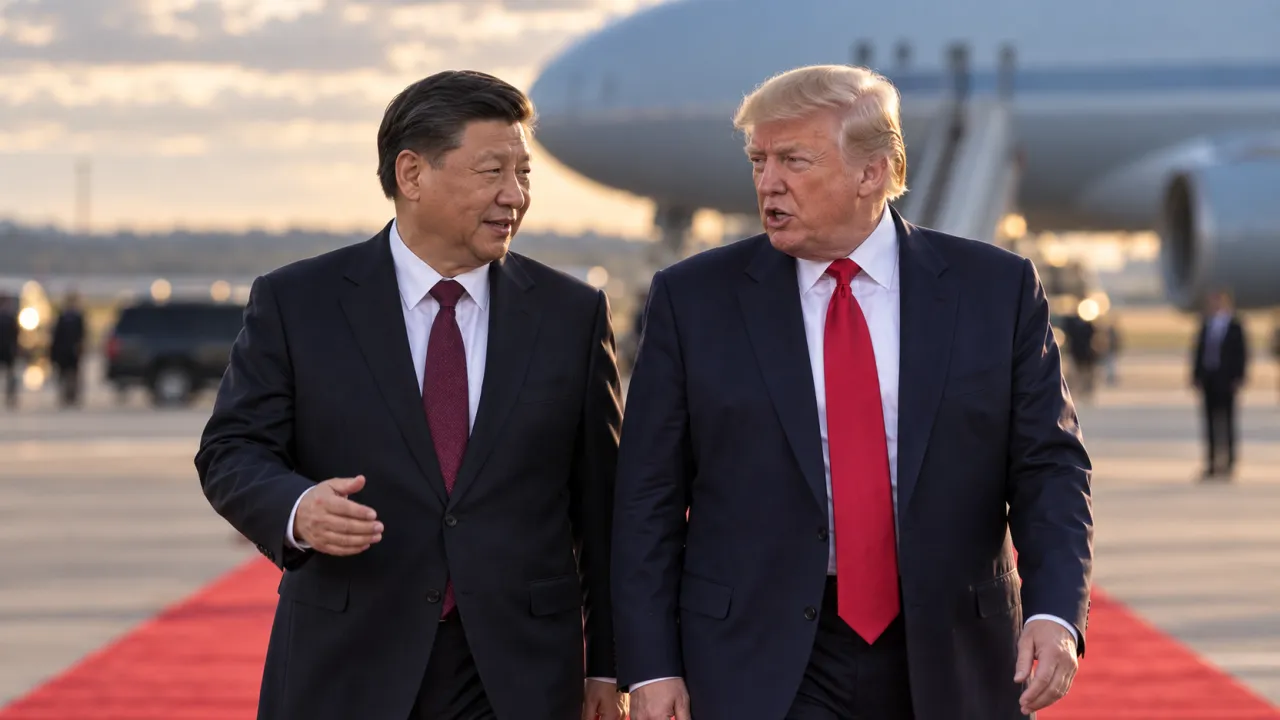
Xi Jinping arrived Wednesday in Washington for a three-day state visit, the first by a Chinese leader in the US capital in eleven years, greeted by Trump on the tarmac of Joint Base Andrews (Infobae, Clarín).
- 02
El Cronista reports that Xi will seek to extend the Busán trade truce and could offer to buy American soybeans and Boeing planes in exchange for a shift on arms sales to Taiwan.
- 03
According to Ambito, analysts Martín Mejía (Cohen Aliados Financieros) and Honorio Zabaleta (Eco Go) deem a strong impact on markets unlikely, recommending to monitor the trade truce and restrictions on artificial intelligence.
ANALYSIS
Buenos Aires, Wednesday, September 23, 2026. Xi Jinping arrived on Wednesday in Washington for a three-day state visit, the first by a Chinese leader in the American capital in eleven years. Donald Trump welcomed him in person on the tarmac of Joint Base Andrews, alongside his wife Peng Liyuan, a protocol gesture deemed unprecedented by the Argentine press, which notes that the American president preferred this trip rather than waiting for his counterpart at the White House. The local press sees this as Trump's desire to return the tribute he received in Beijing in May, where he had benefited from a carefully planned protocol.
But it is mainly the commercial agenda that is drawing the attention of the Argentine media. According to El Cronista, Xi will prioritize extending the trade truce sealed in Busan last October, and could propose purchases of American soybeans and Boeing aircraft, while addressing AI security and the end of the war in Iran. In exchange for a shift in Washington's stance on arms sales to Taiwan, Beijing would offer increased cooperation to pressure Tehran — a dossier that La Nación describes as the "most delicate" of the summit, with Beijing also demanding an end to deliveries already ordered by Taipei, which rejects any Chinese sovereignty claims.
A potential agreement on soybeans directly concerns Argentina, the world's second-largest supplier of this oilseed after the United States and Brazil, and for which China remains the main market. Ambito reports that local markets "do not expect significant progress": analyst Martín Mejía (Cohen Aliados Financieros) considers the summit "fundamental for current geopolitical relations" without anticipating a strong impact on markets, while Honorio Zabaleta (Eco Go) recommends closely monitoring technological restrictions on artificial intelligence. Clarín and Infobae detail the planned pomp — a state dinner on Thursday at the White House, repeated praise from Trump for Xi, whom he describes as a "great leader" and "friend" — while noting that tensions over trade, AI, the war in Iran, and Taiwan remain intact beneath the diplomatic fanfare.