
DOMINANT ANGLE
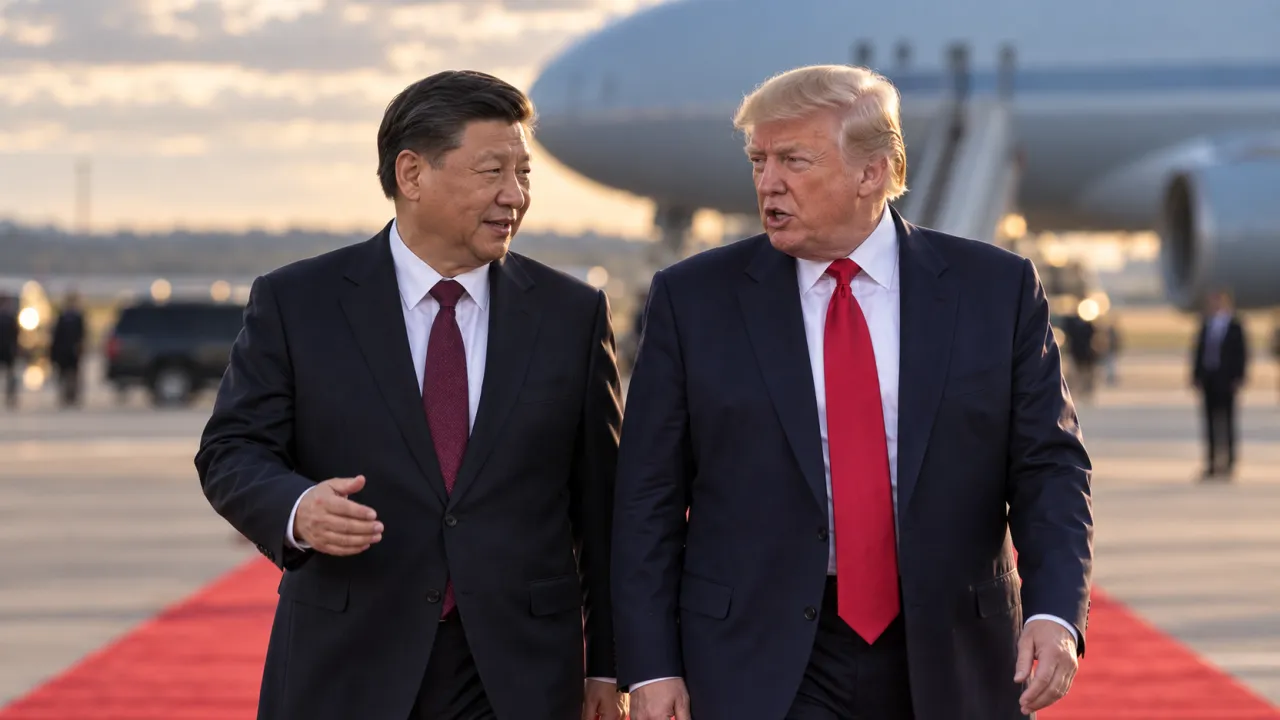
The United States is measuring this summit less by the protocol than by the unfulfilled trade commitments and the November electoral deadline.
Dominant angle identified — does not reflect unanimity of this country’s media
KEY POINTS
- 01
Treasury Secretary Scott Bessent acknowledged on CNBC that "some commitments have not been fully met" by Beijing in the agreement reached in Busan.
- 02
The summit comes less than six weeks before the midterm elections, as Trump's popularity rating on the cost of living has fallen to a low.
- 03
Thursday's state dinner is set to bring together leaders from Microsoft, Nvidia, OpenAI, Google, Tesla/SpaceX, Citigroup, Amazon, Apple, and Dell on the American side, with no comparable Chinese business delegation, according to Bloomberg.
ANALYSIS
The United States, September 23, 2026. On the eve of Xi Jinping's arrival, the American press is framing the summit less as a protocol event than as a test of the solvency of the trade agreement forged in Busan nearly a year ago. Treasury Secretary Scott Bessent acknowledged on CNBC that "certain commitments have not been fully met" by Beijing, while assuring that the "great respect" between the two presidents is driving the negotiation. The tariff truce, which has suspended Chinese controls on rare earths and American surtaxes since Busan, expires in November; its extension, and its duration, are at the top of American expectations, according to the CNBC China Connection newsletter.
The electoral calendar is explicitly weighing on the reading in Washington: with less than six weeks to go before the midterm elections, and as Trump's rating on the cost of living has fallen, the White House has an immediate political interest in emerging from the summit with a tangible economic announcement. Artificial intelligence is emerging as a second major issue: Republican Representative Nicole Malliotakis considers China to be "both an ally and an adversary" in this area, while a cooperation framework remains, according to Bloomberg, an open question about the trust to be given to Beijing.
Thursday's state dinner illustrates the imbalance of the delegations: Washington has confirmed the presence of Satya Nadella, Jensen Huang, Sam Altman, Sundar Pichai, Elon Musk, Jane Fraser, Jeff Bezos, Tim Cook, and Michael Dell, while Beijing has not assembled, according to Bloomberg, any comparable business delegation — an asymmetry that fuels doubt about the summit's ability to produce concrete trade agreements.
The visit is not a consensus in Congress: Republican Senator Roger Wicker stated from the Senate floor that he would have advised Trump not to invite Xi Jinping for such a summit. Meanwhile, Fox News reports that a network of pro-Beijing organizations funded by activist Neville Roy Singham has organized a week of anti-American demonstrations from Austin to New York, a movement that lawmakers suspect serves China's desire to project an image of chaos in the United States. On the Taiwan front, the American press recalls that Trump had, in May in Beijing, delayed a $14 billion arms contract, calling future sales "very good currency" with Beijing.
SOURCES (5)
- CNBCMEDIUM
- TimeMEDIUM
- Bloomberg PoliticsMEDIUM
- The HillMEDIUM