
DOMINANT ANGLE
Berlin fears that Europe will be relegated to the role of a mere adjustment variable in the negotiations between Washington and Beijing, without having a say in the arbitrations being negotiated.
Dominant angle identified — does not reflect unanimity of this country’s media
KEY POINTS
- 01
In Düsseldorf, German and Chinese business leaders held an economic dialogue where the Sino-American rivalry loomed over the debates, according to Deutsche Welle.
- 02
Mikko Huotari, director of the Berlin-based think tank MERICS, believes Xi and Trump are experiencing a "strategic stalemate" where neither is seeking an immediate breakthrough.
- 03
Chancellor Friedrich Merz is absent from the UN General Assembly this week, held back by regional election defeats in Saxony-Anhalt, Berlin, and Mecklenburg-Western Pomerania, and is being represented by Minister Johann Wadephul.
ANALYSIS
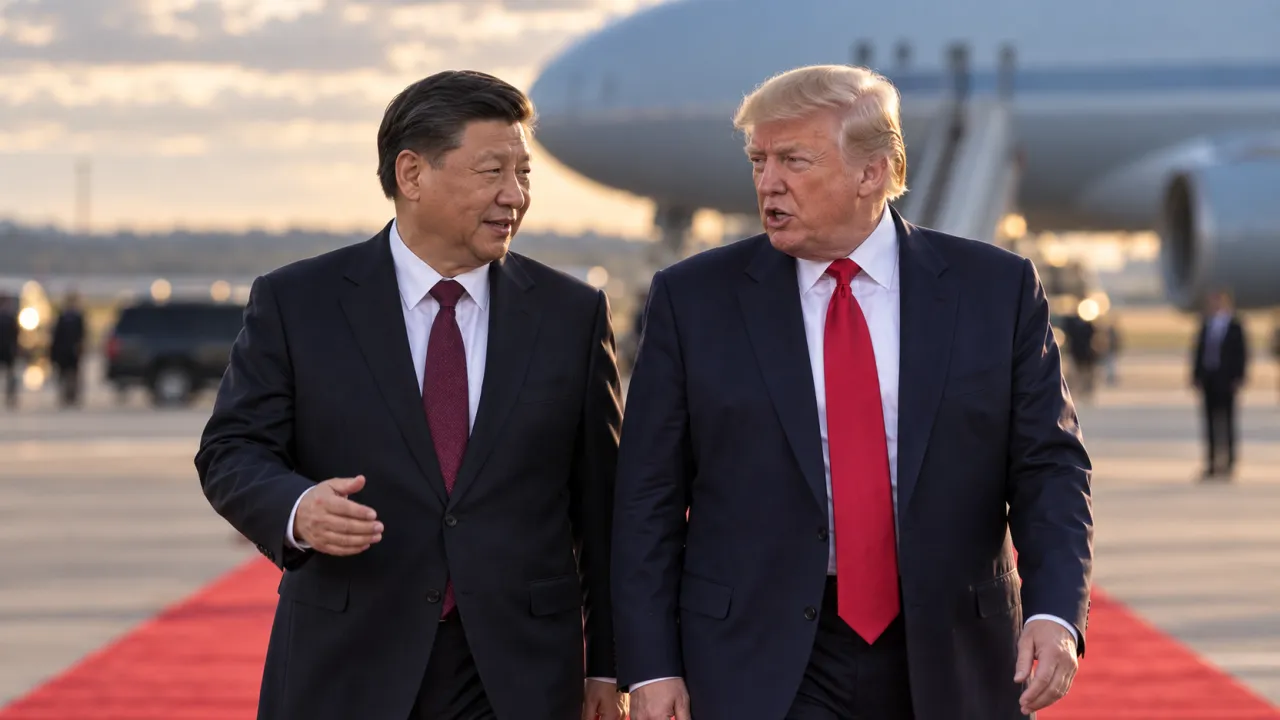
Berlin, September 23, 2026. For the German press, the arrival of Xi Jinping in Washington is not primarily a duel between two capitals: it's a summit where Europe could pay the price without being invited. Deutsche Welle recalls that German and Chinese business leaders met last week in Düsseldorf for an economic dialogue where the Sino-American rivalry loomed over the debates. Mikko Huotari, director of the Berlin-based think tank MERICS, summarizes Beijing's calculation: "Xi really doesn't need a breakthrough in Washington. He needs more time." He describes a situation of "strategic stalemate" shared, in his view, by both capitals.
The first meeting between the two presidents, in May in Beijing, had not yielded any tangible results, DW recalls. This time, domestic pressure is bearing down on Donald Trump: political analyst Wang Hung-Jen, cited by Deutsche Welle, estimates that the American president needs visible results before the November midterm elections - tariffs, agricultural products, Boeing aircraft, rare earths, investments. A trade agreement would also be an electoral success for the Republicans, without certainty that it will materialize.
From an economic perspective, Handelsblatt notes that Chinese investors remain cautious on the eve of Xi's arrival in Washington: the Shanghai Stock Exchange fell by 0.3%, the CSI 300 by 0.4%, while Asian markets outside China benefited from the enthusiasm for artificial intelligence. The newspaper mentions the hypothesis of a prolongation of the trade de-escalation and a cooperation agreement on AI, a field where Washington is already restricting the export of advanced semiconductors and where Beijing is responding by limiting the rare earths necessary for their production.
In the background, German diplomacy finds itself absent from the main stage: Chancellor Friedrich Merz is missing the UN General Assembly this week, entangled in a series of regional election defeats in Saxony-Anhalt, Berlin, and Mecklenburg-Vorpommern, and it's his Foreign Minister Johann Wadephul who represents him. For Deutsche Welle, the conclusion is clear: while Washington and Beijing negotiate the terms of their rivalry, it's the medium powers - Europe first and foremost - that will have to adjust to an agreement they had no part in writing.
SOURCES (2)
- HandelsblattMEDIUM