After the Trump–Xi summit, Washington and Beijing announce an AI incident channel and tariff cuts on $30 billion of goods
published on
countries
sources
articles
The reports published on Saturday, September 26, by Washington and Beijing do not describe the same summit. The White House fact sheet details tariffs and "super intelligence"; the Chinese statement, in eight points, frames the agreement in terms of "respect, equity, and reciprocity", without using this term or mentioning the coal purchase announced by the American side.
The Chinese statement does not confirm the coal purchases announced by Washington, and the Taiwan, Iran, and rare earth files remain unresolved.
Two accounts of the same summit
The fact sheet released Friday by the White House highlights the tariff cuts, American coal, and the new "super intelligence" vocabulary, wanted by Donald Trump, according to CBS News and Axios.
The Chinese statement, published Saturday by the Ministry of Foreign Affairs and relayed by the ECNS agency, talks about a "consensus on eight results" and places the agreement in a relationship of "respect, equity and reciprocity", without using the term "super intelligence".
This same text recalls that China and the United States were "allies during World War II", and adds two clauses absent from the American fact sheet: Iran's commitment to respect its nuclear non-proliferation, and the principle that no country or institution should collect passage fees in international waters, according to ECNS.
The formalities before the substance
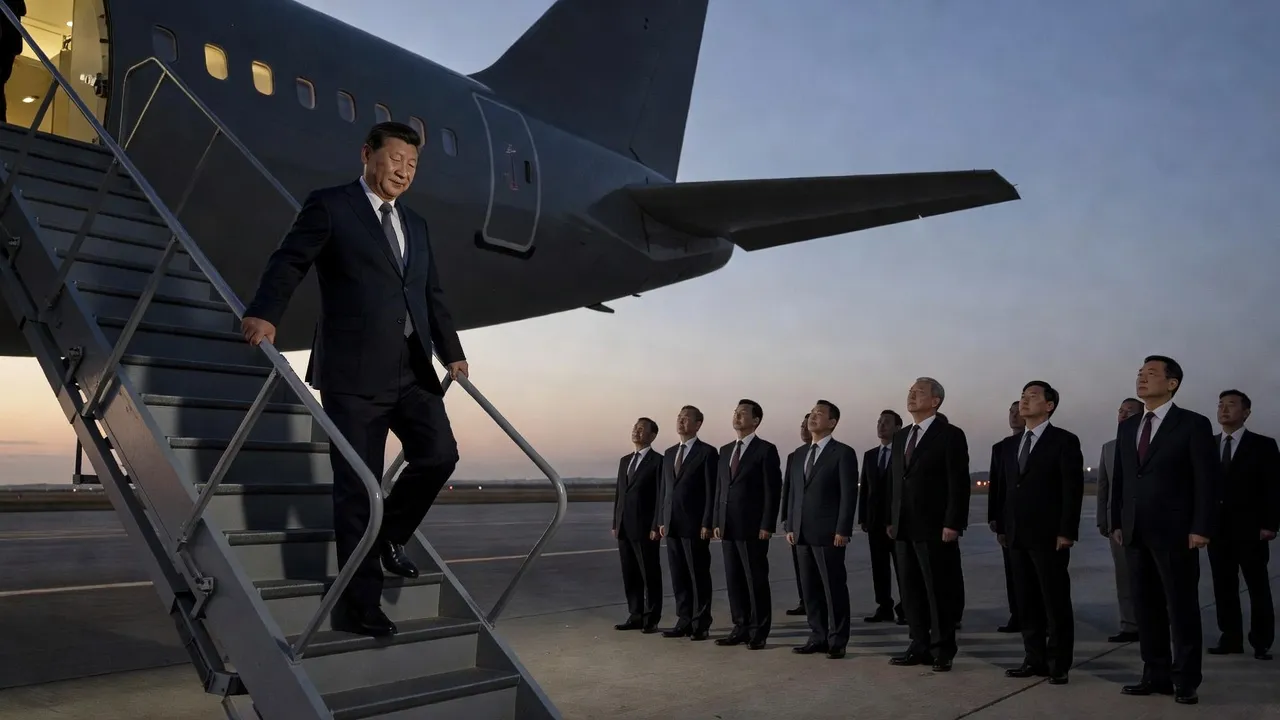
On Thursday, September 24, the White House hosted a ceremony of honor for Xi Jinping. The Chinese president extended his congratulations for the 250th anniversary of American independence "on behalf of more than 1.4 billion Chinese," according to El Ciudadano, before calling for "frank, deep, and continuous" dialogue and avoiding the "Thucydides trap," the thesis of an inevitable confrontation between a rising power and an established power.
« I call it SI because it's a much better name »
Donald Trump reserved an unusual welcome for his counterpart: a personal reception at Andrews military base, a visit to the White House's new granite heliport, and a presentation of the construction site of a reception hall adjacent to the official residence, reports El Informador, which recalls that the American president had long accused Beijing of unfair trade practices and intellectual property theft.
On Friday, following the meeting, Donald Trump described the conversation as "very productive," promising on social media that "extraordinary things are going to happen," according to La Tercera.
The less commented-on clauses
The two countries have also signed a memorandum of understanding to strengthen crisis communication between their armies, a text that the Globe and Mail and the Serbian agency Beta both deem lacking in details from the Chinese side.
The Board of Trade and the Board of Investment, established during a previous summit in Beijing in May, are said to have already begun their work this week, according to the White House as cited by the Korea Times and ABC News Australia. Additionally, two Chinese pandas are set to join the Atlanta zoo, and China will host more American students, according to L'Express.
On Saturday, at the UN podium, Chinese Vice President Han Zheng called for respect for the sovereignty of Gulf countries and the lifting of the blockade against Cuba, in a speech that Folha Mundo deemed cautious on the war in Ukraine.
According to L'Express, no concrete agreement was found on artificial intelligence, Taiwan, or the war in Iran; Bloomberg makes the same observation, judging that the major differences between the two countries remain intact behind the display of good relations.
What each press outlet retains
Of the seventeen perspectives gathered, six view the summit through its technical mechanics alone — customs tariffs, trade council, IA channel — relying on official communiqués: Australia, Canada, Germany, Finland, Singapore, and the United States. This count measures the diversity of angles retained by the global press, not the validity of one or the other.
Seven other pools downplay the scope of the agreement: Bangladesh and Brazil focus on delayed Chinese agricultural purchases, South Korea on the silence regarding North Korean denuclearization, Pakistan and France on the unresolved war in Iran. Three pools — Argentina, Chile, Mexico — first consider the summit's decorum before the details of the announced measures.
On the summit's outcome itself, two readings respond to the same question without converging: Handelsblatt, Ilta-Sanomat, and the Beta agency conclude that "no major breakthrough" was announced, while the South China Morning Post and ABC News Australia deem these same mechanisms useful for avoiding future disputes' escalation, even in the absence of a major breakthrough.
Beijing is still behind on the 25 Mt of soybeans and the 200 Boeing planes promised in May.
The American statement remains vague on rare earths, at the heart of the trade dispute.
The White House fact sheet does not detail the exchanges on North Korean denuclearization.
Trump announced two new meetings with Xi: in China in November, then at the G20 in Miami in December.
How each country reads it
17 perspectives, each in the voice of that country's press.
 Argentina
Buenos Aires is scrutinizing the new Washington-Beijing channel on AI incidents, deemed more concrete than the commercial announcements of the Trump-Xi summit, while Trump refuses to slow down the American advance on "superintelligence".
2 sources
 Australia
Canberra is gauging the true scope of the Sino-American trade truce, exercising caution in the face of tariff reductions that only apply to "non-sensitive" goods.
2 sources
 Bangladesh
Dhaka is gauging the actual impact of the $30 billion in reduced tariffs between Washington and Beijing, between cautious trade relief and analyst skepticism over the duration of the truce.
2 sources
 Brazil
Brasília is weighing the risk that Chinese purchases of American soy and beef, revived by the Sino-American trade truce, will encroach on its own export markets more than the new channel opened between Washington and Beijing on artificial intelligence.
6 sources
 Canada
Ottawa is dissecting a summit that is more technological than commercial: the channel for AI incidents and the military memorandum carry more weight than the $30 billion in reduced tariffs.
3 sources
 Chile
ChileSantiago distinguishes two narratives from the same summit: the "superintelligence" promised by Trump versus Xi's warning against the Thucydide trap.
2 sources
 China
ChinaBeijing retains a "consensus on eight outcomes" based on respect and reciprocity, rather than the sole trade fact sheet released by Washington after Xi Jinping's state visit.
2 sources
 Germany
Berlin coolly details the Sino-American trade agreement, noting that "no major breakthrough" has been announced despite $30 billion in reduced tariffs on each side.
2 sources
 Finland
Helsinki takes away from the Trump-Xi summit mainly the unprecedented mechanism put in place for artificial intelligence: a joint alert channel and a scheduled dialogue in November, more than the actual scope of the trade truce.
2 sources
 France
Paris sees the technical breakthrough of the Trump-Xi summit as a narrow compromise on managing AI risks, with no progress on the most sensitive diplomatic issues.
4 sources
 India
IndiaNew Delhi is measuring the actual scope of the Sino-American trade agreement, between $30 billion in reduced tariffs and a mere two-month truce, seeing in it a fragile armistice rather than a strategic reconciliation.
2 sources
 South Korea
Seoul is scrutinizing the White House's silence on North Korean denuclearization, which has been left without details despite the trade and technological agreements announced at the end of the Trump-Xi summit.
2 sources
 Mexico
Mexico City views the Trump-Xi summit as two parallel narratives: the carefully choreographed protocol in Washington and the unusual silence of Donald Trump in the face of Xi Jinping's conciliatory gestures.
2 sources
 Pakistan
Islamabad is particularly mindful of what the Trump-Xi summit did not resolve: the stalled Iranian war and regional military rivalry, overshadowed by the tariff gains touted by Washington and Beijing.
2 sources
 Serbia
Belgrade is measuring the actual scope of the US-China trade agreement, cautious in the face of a summit that local press deems lacking in major breakthroughs despite the announcement of $30 billion in tariff cuts.
2 sources
 Singapore
Singapore is eyeing the new IA channel opened between Washington and Beijing, seeing it more as a cautious and distant management of technological rivalry than a diplomatic breakthrough.
2 sources
 United States
The United States claims a vocabulary and technological advance specific to AI, while locking down a security channel to avoid any incident with Beijing.
5 sources
What the comparison reveals
Common ground and differences in coverage across the media analysed.
What the media report in common
After Xi Jinping's state visit to Washington, completed on Friday, September 25, Washington and Beijing reduce tariffs on $30 billion worth of non-sensitive goods in each direction — American agricultural products, wood, and cosmetics in exchange for Chinese small appliances, toys, and decorations — according to 15 of the 17 perspectives (all except Argentina and Chile).
Washington and Beijing establish a communication channel for artificial intelligence-related incidents, with a first dialogue session scheduled for November.
Where media coverage diverges
Confirmed Chinese purchase of coal?
The Chinese commitment to import at least 10 million tonnes of American coal in 2027 and 2028 is reported as a fact, sourced to the White House, by several titles, when the Mexican press notes that the official Chinese statement on Saturday does not explicitly mention it.
Coverage aligned with this reading
Coverage that diverges
Wealth of Chinese report
Several titles note that the official Chinese statement, spanning a single page, remains sparse in details compared to the White House fact sheet, when the Chinese report itself frames the same text in a context of "respect, equity and reciprocity" rather than in the detail of mechanisms.
Summit outcome: breakthrough or not
Some of the press note the absence of a major breakthrough from the summit despite the announced measures, when other titles highlight experts judging the steps towards cooperation as important or present the agreement as a significant evolution.
This grouping describes the publications analysed, not the position of these countries’ populations or of their governments.
The full text, country by country
Argentina
DOMINANT ANGLE
Buenos Aires is scrutinizing the new Washington-Beijing channel on AI incidents, deemed more concrete than the commercial announcements of the Trump-Xi summit, while Trump refuses to slow down the American advance on "superintelligence".
KEY POINTS
- Washington and Beijing have created a "bilateral communication channel" for incidents related to artificial intelligence, according to Clarín and Ámbito.
- The two countries have adopted the term "superintelligence (SI)" instead of AI; the next session of the dialogue is scheduled for November, in China.
- China has committed to importing at least 10 million tonnes of American coal in 2027 and 2028, according to Clarín.
ANALYSIS
Buenos Aires, September 27, 2026. Following the Trump-Xi summit, which the White House summarized, the Argentine press first retains the technical channel more than the commercial promises. Clarín and Ámbito report that Washington and Beijing have agreed to open a "bilateral communication channel" for incidents related to artificial intelligence, complemented by a "US-China Dialogue on Superintelligence (SI)" aimed at exchanging on the risks and benefits of the technology. According to the White House, cited by Clarín, the two leaders have agreed to use the term "SI" rather than AI; the next session is set for November, on Chinese territory according to Ámbito.
Argentine media highlight the contrast between the postures displayed before and during the meeting. On Truth Social, before the summit, Trump had announced wanting to "leave superintelligence exactly where it is", adding: "This is also China's position." On Thursday, at the White House, Xi Jinping requested that AI development "remain under human control" and "serve the well-being of populations". The three-day state visit ended on Friday; Chinese state media confirmed the creation of the direct line on AI on Saturday.
On the commercial front, more concrete than declarative, Clarín retains a Chinese commitment to import at least 10 million tonnes of American coal in 2027 and 2028, and already announces a third and then a fourth Trump-Xi meeting this year, in China and then in the United States. But the same article tempers the political scope of the visit, judging it marked "more by pomp and ostentation than by substance".
For Buenos Aires, engaged in a commercial rapprochement with Washington under the presidency of Javier Milei, the underlying question remains the place left for third parties in a technological rivalry now institutionalized by a bilateral channel. The two available articles do not detail the reduction of customs duties on $30 billion worth of goods announced elsewhere, a sign that the Argentine thread prioritizes the technological angle of the summit over its tariff aspect.
Australia
DOMINANT ANGLE
Canberra is gauging the true scope of the Sino-American trade truce, exercising caution in the face of tariff reductions that only apply to "non-sensitive" goods.
KEY POINTS
- Tariffs are reduced on $30 billion worth of "non-sensitive" goods in each direction: American agriculture, wood, and cosmetics for Chinese small appliances, toys, and decorations.
- China has committed to importing at least 10 million tons of American coal in 2027 and 2028, according to the White House.
- The announced trade council is reportedly already operational this week, according to Washington, while the official Chinese account fit on a single page.
ANALYSIS
Canberra, September 27, 2026. In the aftermath of Xi Jinping's state visit to Washington, which ended on Friday, September 25, the Australian press is measuring the real scope of the agreements announced between the two largest economies in the world. The tariff reductions, estimated at $30 billion, approximately AU$42 to AU$43 billion, in each direction, only concern "non-sensitive" goods: American agricultural products, wood, and cosmetics on one hand, and Chinese small appliances, toys, and decorations on the other. The White House specifies that "the two countries have reached a consensus on recommendations for more favorable tariff treatment." The announced trade council would have already begun operating this week, according to Washington, while the Chinese statement, described by the Australian press as a one-page summary, is deemed brief. This asymmetry in communication is fueling Canberra's caution, which is itself engaged in a close and sometimes tense economic relationship with Beijing. A sensitive point for the Australian economy, which exports coal: China has committed to importing at least 10 million tons of American coal in 2027 and 2028, a commercial gesture that could weigh on Australian market shares in this sector. On the technological front, the two countries are opening a dialogue on the risks and benefits of artificial intelligence, with the next session scheduled for November, and creating a communication channel for AI-related incidents, as well as a memorandum on crisis prevention between the two armies. Experts cited anonymously consider these mechanisms important, capable of preventing the escalation of future disputes, even in the absence of a major breakthrough during this three-day summit. Chinese Foreign Minister Wang Yi hailed a historic visit, which would have opened a new chapter in bilateral relations. Xi Jinping returned to Beijing on Saturday, according to the Xinhua agency. This development comes after the two-month extension of a trade truce that was set to expire on November 10, confirmed on Wednesday by Treasury Secretary Scott Bessent. For Australia, an ally of Washington but Beijing's largest trading partner, every gesture of appeasement between the two giants has direct repercussions on its own trade.
Bangladesh
DOMINANT ANGLE
Dhaka is gauging the actual impact of the $30 billion in reduced tariffs between Washington and Beijing, between cautious trade relief and analyst skepticism over the duration of the truce.
KEY POINTS
- China and the United States have agreed to a reciprocal tariff reduction of $30 billion and to establish a trade council, according to an eight-point agreement announced Saturday by the Chinese Ministry of Foreign Affairs.
- The trade truce, which was set to expire on November 10, has been extended until January 10, confirmed US Treasury Secretary Scott Bessent on Wednesday.
- The two countries will open a dialogue on the risks and benefits of artificial intelligence, with the next session scheduled for November, and a dedicated communication channel for AI-related incidents.
ANALYSIS
Dacca, September 27, 2026. In the aftermath of the three-day summit between Donald Trump and Xi Jinping in Washington, which ended on Friday, the Bangladeshi press first notes the economic scope of the eight-point agreement announced on Saturday by Beijing. According to the Chinese Ministry of Foreign Affairs, cited by TBS News, the two countries have agreed on a reciprocal tariff reduction affecting $30 billion worth of goods, as well as the creation of a trade council extending the results of discussions held in Kuala Lumpur. For an economy like Bangladesh, whose textile exports depend on the stability of trade between the two leading world powers, this agreement confirms that the tariff truce is holding, for now.
The Daily Star reports that Washington and Beijing have bought time with this extended truce, without resolving their strategic rivalry. Treasury Secretary Scott Bessent confirmed on Wednesday that the agreement, which was set to expire on November 10, has been postponed to January 10. Daniel Russel, of the Asia Society Policy Institute, recalls that the two countries "remain engaged in a fierce competition on trade, technology, Taiwan, defense, rare earths, and industrial policy". Daniel Kritenbrink, of The Asia Group, adds that tangible results will be needed for the truce to last, with some US officials estimating that Beijing "has largely failed to fulfill its commitments" made during previous meetings.
US Trade Representative Jamieson Greer has described these extensions as "compliance periods" rather than definitive agreements, a nuance that Dacca notes, accustomed to seeing Washington's tariff fluctuations weigh on its own negotiations. On artificial intelligence, the two sides have agreed on a dialogue on the risks and benefits of the technology, with the next session scheduled for November, and a communication channel for AI-related incidents. Beijing also assures that the two leaders have agreed to mutually support the APEC and G20 summits.
Beijing finally indicates that the two leaders have agreed that Iran must respect its non-proliferation commitment. For the Bangladeshi press, this summit, marked by personal diplomacy more than public breakthroughs, illustrates how third-party economies remain suspended on the arbitrations of Washington and Beijing.
Brazil
DOMINANT ANGLE
Brasília is weighing the risk that Chinese purchases of American soy and beef, revived by the Sino-American trade truce, will encroach on its own export markets more than the new channel opened between Washington and Beijing on artificial intelligence.
KEY POINTS
- Washington and Beijing will reduce tariffs on $30 billion worth of "non-sensitive" goods and extend the trade truce set to expire on November 10 by two months, according to G1 and Folha de S.Paulo.
- China remains behind on the $17 billion in agricultural purchases promised in May and has not finalized the 25 million tonnes of American soybeans agreed upon in Busan, or the order for 200 Boeing aircraft, according to an editorial in the Estadão.
- The two countries will use the term "superintelligence" rather than AI, open a communication channel for incidents related to this technology, and hold their next dialogue session in November, according to Veja and the Estadão.
ANALYSIS
Brasília, September 27, 2026. The three-day summit between Donald Trump and Xi Jinping in Washington, which ended on Friday, September 25, resulted in a trade and technology agreement that the Brazilian press is interpreting primarily in terms of its own agricultural markets. According to the Chinese report relayed by G1 and Folha de S.Paulo, Washington and Beijing will reduce tariffs on $30 billion worth of "non-sensitive" goods — wood, cosmetics, and American agricultural products, toys, and small Chinese appliances — as part of an eight-point consensus. The two capitals will also create a trade council and extend the tariff truce, which was set to expire on November 10, by two months, with Treasury Secretary Scott Bessent seeing this as a gain in time for a broader agreement.
But it's the editorial in Estadão that provides the Brazilian measure of the summit: Beijing is still lagging behind on the $17 billion in additional agricultural purchases promised in May and has not completed the 25 million tons of American soybeans agreed upon in Busan in October, nor the order for 200 Boeing aircraft. For editorialist Lourival Santanna, these purchases weigh on electorally decisive American states — an implicit reminder, for the Brazilian press, that every ton of soybeans or beef purchased from American producers is a ton that does not pass through Mato Grosso or Paraná.
On artificial intelligence, Veja and Estadão note that the two countries have adopted the term "superintelligence" rather than AI, established a "US-China Superintelligence Dialogue," and will open a communication channel for incidents, with a next session in November. Trump, however, specified on Saturday that he prefers to leave the technology "exactly where it is" rather than cooperate with Beijing, while Xi advocated for a relationship "without conflict or confrontation" and human control of AI.
Chinese Foreign Minister Wang Yi described the visit as "historic," having "enriched the constructive and stable relationship between China and the United States." Folha Mundo also reports that Chinese Vice President Han Zheng, speaking at the UN on Saturday, called for respect for the sovereignty of Gulf countries without naming Washington, in a speech deemed cautious towards Russia on Ukraine.
Canada
DOMINANT ANGLE
Ottawa is dissecting a summit that is more technological than commercial: the channel for AI incidents and the military memorandum carry more weight than the $30 billion in reduced tariffs.
KEY POINTS
- Washington and Beijing create a channel for AI-related incidents and set a specific AI dialogue for November.
- Tariffs are reduced on $30 billion worth of non-sensitive goods in each direction (agricultural, wood, cosmetics from the US side; small appliances, toys, decorations from the Chinese side).
- China commits to importing at least 10 million metric tons of US coal in 2027 and 2028, according to the White House.
ANALYSIS
Ottawa, September 27, 2026. The three-day summit between Donald Trump and Xi Jinping, concluded on Friday, September 25, in Washington, did not produce a "major public breakthrough," Canadian press reports summarize, but several concrete mechanisms emerged from it. The most commented on here is not primarily commercial: Washington and Beijing agreed to create a dedicated channel for incidents related to artificial intelligence, with a specific dialogue scheduled for November to discuss the "risks and benefits" of the technology. The two capitals also signed a memorandum of understanding to strengthen crisis communications between their armies, a point confirmed by the Chinese Ministry of Foreign Affairs in a statement described as "one page" and not very detailed on Saturday, September 26.
On the commercial front, the two countries will reduce tariffs on $30 billion worth of goods considered "non-sensitive" in each direction: American agricultural products, wood, and cosmetics in exchange for Chinese small appliances, toys, and decorations. A Trade Council, which has already taken office this week according to the White House, will oversee these exchanges. China has also committed to importing at least 10 million metric tons of American coal in 2027 and 2028. These gestures extend the two-month trade truce announced on Wednesday, September 23, by Treasury Secretary Scott Bessent, which was initially set to expire on November 10.
On Saturday, back in Beijing according to the Xinhua agency, Xi Jinping let Donald Trump comment alone on the scope of the AI dialogue. The American president ruled out any slowdown: "The United States is not going to put the brakes on," he told journalists in front of the White House, adding that he prefers not to share the technology with Beijing "because we are leading widely." Chinese Foreign Minister Wang Yi, for his part, hailed a visit that "opens a new chapter" in bilateral relations.
For the Canadian press, the essence of the summit lies less in the tariff figures than in these technical and military channels: modest devices capable, according to several analysts cited, of preventing differences from escalating between the two largest economies in the world.
Chile
DOMINANT ANGLE
Santiago distinguishes two narratives from the same summit: the "superintelligence" promised by Trump versus Xi's warning against the Thucydide trap.
KEY POINTS
- Xi Jinping made a two-day state visit to Washington, culminating on Friday, September 25, 2026, with a meeting with Trump.
- Trump announced two upcoming meetings with Xi: one in China in November 2026, and another at the G20 summit in Miami in December 2026.
- Xi Jinping invoked the "Thucydides trap" and called on both countries to respect a limit of non-conflict and non-confrontation.
ANALYSIS
Santiago, September 27, 2026. Chile is viewing the Trump-Xi summit through two intersecting yet non-overlapping narratives. On Thursday, September 24, the White House hosted a ceremony of honor to welcome Xi Jinping, who was on a two-day state visit to Washington, according to El Ciudadano. Military music and national anthems played alternately: the displayed protocol contrasts with years of trade friction between the two powers.
In his speech, Xi Jinping greeted the American people and extended his congratulations on the 250th anniversary of US independence, "on behalf of over 1.4 billion Chinese." He called for "frank, profound, and continuous" dialogue, inviting both countries to seek common ground while setting aside their differences. On artificial intelligence, the Chinese president stated that Beijing and Washington, leaders in this technological race, have the capacity and responsibility to develop it for the better, under human control. He urged both powers to respect a limit of non-conflict and non-confrontation in order to avoid the "Thucydides trap," the theory that a rising power and an established power almost always end up clashing.
On Friday, September 25, following the meeting, Donald Trump offered a radically different interpretation on social media, describing the conversation as "very productive" and promising that "extraordinary things will happen." The US president also praised his counterpart's choice of vocabulary, who he claimed preferred the term "superintelligence" to the allegedly imprecise term "artificial intelligence." Xi Jinping and his wife, Peng Liyuan, then left the United States for China.
Trump announced two new meetings: one in China in November, and another at the G20 summit in Miami in December. Neither of the two articles available in Santiago provides details on the tariff cuts on $30 billion or the dedicated channel for AI incidents mentioned by Washington; the Chilean press primarily retains the protocol staging and two parallel speeches, one focused on the technological future, the other on the shared historical memory against fascism.
China
DOMINANT ANGLE
Beijing retains a "consensus on eight outcomes" based on respect and reciprocity, rather than the sole trade fact sheet released by Washington after Xi Jinping's state visit.
KEY POINTS
- The Chinese statement relayed by ECNS announces a "consensus on eight outcomes", including a reciprocal tariff reduction arrangement of $30 billion and the creation of a trade council.
- The two leaders agreed that Iran must honor its commitment not to develop nuclear weapons, and that no country should charge for passage through international waters, according to ECNS.
- The White House fact sheet, cited by the South China Morning Post, announces the establishment of a dialogue on "super intelligence", described by analysts as a potentially more decisive channel than immediate trade gains.
ANALYSIS
Beijing, September 27, 2026. Three days after the end of Xi Jinping's state visit to Washington, on Friday, September 25, the Chinese presentation of the summit clearly diverges from the technical sheet released the same day by the White House. The statement relayed by the ECNS agency speaks of a "consensus on eight results", and not first of a commercial gesture: the two leaders would have agreed to build "a constructive China-US relationship of strategic stability based on respect, equity, and reciprocity".
This framework encompasses the commercial aspect without placing it first. The statement mentions the outcome of economic and trade consultations held in New York before the summit: the establishment of a trade council, a "reciprocal tariff reduction arrangement of $30 billion" and the extension of the gains from the Kuala Lumpur consultation. According to the South China Morning Post, this amount covers "non-sensitive" goods traded in both directions, with China also committing to buy American coal.
The same statement places diplomatic and security issues on an equal footing: mutual support for the organization of the APEC summit by China in November and the G20 by the United States in December, Iran's commitment not to develop nuclear weapons, and a principle that "no country or institution" should levy passage rights in international waters. The text even recalls that China and the United States were "allies during World War II".
On artificial intelligence, the White House's technical sheet, cited by the SCMP, mentions the establishment of a dialogue on "super intelligence"; analysts consider this channel potentially more decisive for stabilizing the bilateral relationship than the immediate commercial results. Washington also wants to continue discussions on China's control of rare earths, and is pressing Beijing to increase its production of refined petroleum products and limit fentanyl precursors.
This dual reading illustrates a difference in emphasis rather than a factual contradiction: whereas Washington details tariff concessions, the Chinese narrative relayed by ECNS inserts the commercial agreement into a broader framework of mutual recognition.
Germany
DOMINANT ANGLE
Berlin coolly details the Sino-American trade agreement, noting that "no major breakthrough" has been announced despite $30 billion in reduced tariffs on each side.
KEY POINTS
- According to Xinhua, China and the US are reducing to zero or very low rates tariffs on "non-sensitive" products worth $30 billion in each direction.
- The Board of Trade, a bilateral trade council, began its work this week, the White House indicated.
- Scott Bessent mentioned a two-month extension of the tariff moratorium, while China had hoped for a year or more, according to several media outlets cited by Handelsblatt.
ANALYSIS
Berlin, September 27, 2026. Following Xi Jinping's state visit to Washington, the German economic press is dissecting less the diplomatic gesture than its tariff mechanism. Handelsblatt reports that China and the United States agreed, as part of the summit between Donald Trump and Xi Jinping, on the exchange of "non-sensitive" products worth $30 billion, without customs duties or at very reduced rates, in each direction. The Chinese agency Xinhua communicated the information on Saturday afternoon, without immediately detailing the list of products concerned. The American trade representative, Jamieson Greer, had already mentioned the agreement on Friday on CNBC, citing American agricultural products and medical equipment, as well as Chinese consumer goods, promising additional clarification on Monday.
The newspaper also highlights the extension of the tariff moratorium, which includes rare earth exports, without Beijing specifying the exact duration. US Treasury Secretary Scott Bessent had, at the beginning of Xi's visit, spoken of a two-month extension, while several media outlets, according to Handelsblatt, indicated that China was hoping for a year or more. This duration gap remains, for the German press, an indicator of the fragility of the truce.
On the institutional level, a joint statement announces an agreement in principle to strengthen crisis communication and prevent military incidents, as well as the launch this week of the Board of Trade, which will handle current trade files. Handelsblatt notes that no major breakthrough was announced during this summit, with some experts seeing it as a signal of strengthened dialogue rather than a concrete result.
The dialogue on artificial intelligence, whose next session is scheduled for November, and the emergency channel for AI-related incidents, are treated as a separate, almost ancillary section to the commercial aspect. Deutsche Welle recalls that UN Secretary-General António Guterres had called on Washington and Beijing to engage in this dialogue, citing the communication channels between the USA and the USSR during the Cold War to avoid misunderstandings and escalation.
Finland
DOMINANT ANGLE
Helsinki takes away from the Trump-Xi summit mainly the unprecedented mechanism put in place for artificial intelligence: a joint alert channel and a scheduled dialogue in November, more than the actual scope of the trade truce.
KEY POINTS
- Reciprocal reduction of tariffs on $30 billion worth of goods on each side, according to China's Ministry of Foreign Affairs as cited by Ilta-Sanomat.
- Creation of a bilateral communication channel for artificial intelligence-related incidents, with a next dialogue session scheduled for November.
- Agreement to use the term "superintelligence" instead of "artificial intelligence", according to the White House statement as cited by MTV Uutiset.
ANALYSIS
Helsinki, September 27, 2026. The Finnish press has taken away from the Trump-Xi summit less the extent of the trade détente than the technical mechanism put in place around artificial intelligence. Ilta-Sanomat reports that the state visit of Chinese President Xi Jinping to Washington, which ended on Friday, September 25, does not seem to have produced a "major breakthrough" in bilateral relations: concrete results had remained "rather meager" until Saturday, when the Chinese Ministry of Foreign Affairs released a statement detailing an "eight-point agreement".
This text provides for a reciprocal reduction in customs duties on $30 billion worth of goods on each side, as well as the opening of a dialogue on the risks and benefits of artificial intelligence. According to Beijing, the next session of this dialogue is scheduled for November, and a communication channel will be created to manage incidents related to AI. MTV Uutiset, citing a White House statement, confirms the creation of this bilateral channel and specifies that Xi and Donald Trump also agreed to use the term "superintelligence" rather than artificial intelligence - a phrase launched by Trump earlier in the week.
On Iran, Ilta-Sanomat notes a vaguer agreement: the two leaders would have agreed that Tehran must keep its commitment not to develop nuclear weapons, and that no country or actor should perceive passage rights on international navigable waters. The two capitals have also planned to attend their respective summits later in the year: Trump will attend the APEC summit organized by China in November, Xi the G20 hosted by the United States in December. These announcements add to the already known extension of the trade truce until next January.
For the Finnish press, the interest of the summit lies less in a overhaul of Sino-American relations than in the establishment, point by point, of risk management instruments: an alert channel for AI, a scheduled dialogue and a common vocabulary around "superintelligence", in a context where details remain largely to be specified.
France
DOMINANT ANGLE
Paris sees the technical breakthrough of the Trump-Xi summit as a narrow compromise on managing AI risks, with no progress on the most sensitive diplomatic issues.
KEY POINTS
- Creation of a "US-China Super-Intelligence Dialogue" and a bilateral communication channel for AI-related incidents, with a next session scheduled by November (Le Monde, Sud Ouest).
- Reduction of tariffs on $30 billion worth of "non-sensitive goods" in each direction; Beijing has not immediately reacted to the US announcement (Sud Ouest).
- L'Express notes that no concrete agreement was reached on AI, Taiwan, or the war in Iran, with only the extension of the trade truce, the sending of two pandas to Atlanta, and the hosting of more American students in China being achieved.
ANALYSIS
Paris, September 27, 2026. The French press has taken away from the Washington summit, which ended on Friday, September 25, after Xi Jinping's state visit, a precise technical advance and a vague diplomatic packaging. The standout fact, reported by Le Monde and Sud Ouest, is the creation of a "US-China Dialogue on Super-Intelligence to exchange views on the risks and benefits" of artificial intelligence, complemented by a "bilateral communication channel" dedicated to incidents. The next session is to be held "by November," the White House specifies in its information sheet.
This mechanism comes as the two capitals display opposing philosophies on regulation. Xi Jinping recalled that the two leading countries have the "responsibility to develop and manage AI for the common good, and to ensure that its development remains always under human control," according to Le Monde. Donald Trump, for his part, stated that he wants to stay "exactly at the current stage" of regulation — a divergence that the emergency channel does not close, it merely frames.
The semantic aspect does not escape the newspapers: Beijing indicated that it is "considering" the American renaming of AI as "super-intelligence," without confirming or denying Trump's account that Xi Jinping appreciated the formula. On the commercial front, the two countries are reducing their customs duties on $30 billion worth of "non-sensitive goods" in each direction; Beijing has not immediately reacted to this American announcement.
L'Express, reviewing the international readings of the summit, retains a minimal balance: no concrete agreement on AI, Taiwan, or the war in Iran, only the extension of the trade truce, the sending of two pandas to Atlanta, and the hosting of more American students in China having been concluded. La Tribune, on the other hand, sees "the first foundations of global governance" of AI, against the backdrop of rivalry between American giants (Microsoft, Google, Meta, Amazon, Apple, Nvidia, OpenAI) and Chinese giants (Baidu, Alibaba, Tencent, Huawei, ByteDance). Between these two readings, the French press retains above all that the technical channel already exists, while political governance remains to be built.
India
DOMINANT ANGLE
New Delhi is measuring the actual scope of the Sino-American trade agreement, between $30 billion in reduced tariffs and a mere two-month truce, seeing in it a fragile armistice rather than a strategic reconciliation.
KEY POINTS
- The eight-point consensus provides for a reciprocal reduction in tariffs on $30 billion worth of goods, announced by the Chinese Ministry of Foreign Affairs.
- The trade truce, which was set to expire on November 10, has been extended by two months, according to an announcement by Treasury Secretary Scott Bessent on Wednesday, September 23.
- The leaders agreed that Iran will honor its commitment not to acquire nuclear weapons and that no country will impose transit tolls on international waterways.
ANALYSIS
New Delhi, September 27, 2026. The Indian economic press reports, via the minutes released by the Chinese Ministry of Foreign Affairs, the content of an eight-point consensus sealed at the end of Xi Jinping's state visit to Washington, which ended on Friday, September 25. Beijing announces a reciprocal reduction in tariffs on $30 billion worth of goods, the creation of a trade council, and the opening of a dialogue on the risks and benefits of artificial intelligence, with the next round scheduled for November. A communication channel for AI-related incidents is also to be established. The Chinese Ministry appreciates Washington's use of the term "super intelligence" instead of "artificial intelligence".
For Indian media, this set of announcements extends, without transforming, the existing trade truce: US Treasury Secretary Scott Bessent had indicated on Wednesday, September 23, that this truce, which was due to expire on November 10, was being extended by two months to allow time for negotiating a broader agreement. The three-day summit between Xi Jinping and Donald Trump, according to Swarajya, was marked "more by personal diplomacy than by major public breakthroughs". Xi Jinping returned to Beijing on Saturday, September 26, reported the Xinhua agency.
Chinese Foreign Minister Wang Yi described the visit as a moment that "opened a new chapter" in bilateral relations, promising a lasting impact "on global peace and development". The two countries have also committed to supporting each other in organizing the APEC and G20 summits, with each leader attending the event hosted by the other.
Noted on the sidelines of the commercial aspect: the two sides reportedly agreed that Iran must honor its commitment not to acquire nuclear weapons, and that no country should impose transit tolls on international shipping lanes - a clause that directly affects the security of the energy routes used by India. The two delegations finally recalled their World War II alliance.
For New Delhi, the overall outcome remains a calibrated gesture rather than a strategic reconciliation: a two-month commercial reprieve, a technological dialogue that only begins in November, and a report that came almost exclusively from Beijing.
South Korea
DOMINANT ANGLE
Seoul is scrutinizing the White House's silence on North Korean denuclearization, which has been left without details despite the trade and technological agreements announced at the end of the Trump-Xi summit.
KEY POINTS
- The White House fact sheet indicates the summit covered North Korea, Russia, and Iran, without detailing the exchanges on North Korean denuclearization.
- The Board of Trade and the Board of Investment, chartered in Beijing in May, have been operationalized with more favorable tariff treatment for $30 billion in non-sensitive goods in each direction; China has committed to importing at least 10 million tons of American coal in 2027 and 2028.
- A bilateral communication channel for incidents related to "super intelligence" has been created, with a next exchange planned before November 2026, likely on the sidelines of the APEC summit in Shenzhen.
ANALYSIS
Seoul, September 27, 2026. In the aftermath of the Trump-Xi summit concluded on Thursday, September 24, in Washington, the South Korean press first notes what the White House left in the shadows. According to the results sheet released on Thursday by the White House and reported by Yonhap and the Korea Times, the two leaders mentioned North Korea alongside Russia and Iran, but did not detail their discussions on this issue, leaving uncertainty about a reaffirmation of their joint commitment to the denuclearization of the North. For Seoul, this silence carries more weight than the commercial and technological announcements highlighted in Washington.
On the economic front, Trump and Xi operationalized the Board of Trade and the Board of Investment, created during the Beijing summit in May, by agreeing on more favorable tariff treatment for $30 billion worth of non-sensitive goods in each direction, including American agricultural products, wood, and cosmetics in exchange for Chinese small appliances, toys, and decorations. Beijing has also committed to importing at least 10 million tons of American coal in 2027 and 2028.
On artificial intelligence, the two capitals announced the creation of a bilateral communication channel for incidents related to what Washington now prefers to call super intelligence rather than AI, a term that Trump considers more accurate, as the adjective "artificial" gives a false image of the technology. The next exchange on the risks and benefits of super intelligence is scheduled to take place before November 2026, likely on the sidelines of the APEC summit that China will host in Shenzhen.
The two leaders also agreed that no country can impose tolls on international shipping lanes, as Iran asserts its control over the Strait of Hormuz, a crucial route for oil and gas, and that Iran will never be able to possess nuclear weapons.
For South Korean diplomacy, the lack of detail on North Korea contrasts with the precision of the commercial and technological announcements: an indicator that Pyongyang was not among the concrete priorities of the summit, despite its direct geographical proximity to the two powers negotiating its future without it.
Mexico
DOMINANT ANGLE
Mexico City views the Trump-Xi summit as two parallel narratives: the carefully choreographed protocol in Washington and the unusual silence of Donald Trump in the face of Xi Jinping's conciliatory gestures.
KEY POINTS
- Beijing has committed to importing at least 10 million metric tonnes of US coal in 2027 and then in 2028, according to the White House.
- The two countries are negotiating more favourable tariffs on $30 billion worth of "non-sensitive" goods, including US agricultural products, wood and cosmetics in exchange for Chinese small appliances and toys.
- The official Chinese statement on Saturday did not explicitly mention coal purchases, but confirmed discussions on the $30 billion in tariffs and the extension of the trade truce.
ANALYSIS
Mexico, September 27, 2026. Following Xi Jinping's state visit to Washington, which ended on Friday, September 25, the Mexican press is focusing less on the content of the announced agreements and more on the contrast between the protocolary pomp deployed by Donald Trump and his political silence towards his Chinese counterpart. El Informador headlines that "China and Iran are unmasking" the American president, recalling that Trump had long been offensive towards Beijing — accusations of unfair trade practices, intellectual property theft, and disagreements over Taiwan — before rolling out an exceptional welcome this week: a personal reception at Andrews military base, a visit to the new granite heliport at the White House, and a presentation of the controversial project for a reception hall adjacent to the official residence. The newspaper notes that once on the political terrain, Trump was discreet, playing the role of a tourist guide, while Xi Jinping responded with measure: "We must cooperate with sincerity. The interests of China and the United States are deeply intertwined, and there is much room for common work between the two countries," he said, calling for "maintaining a relationship without conflict or confrontation" and for the armies of the two countries to "maintain regular dialogue and improve communication mechanisms."
On the commercial front, El Financiero details the concrete gestures: China has committed to importing at least 10 million metric tons of American coal in 2027 and 2028, according to the White House, a gesture that serves Trump's priority for the coal industry. The two countries will also seek more favorable tariffs on $30 billion worth of "non-sensitive" goods: American agricultural products, seafood, wood, cosmetics, and medical devices in exchange for Chinese small appliances, toys, and Christmas decorations, through a new trade council. The official Chinese statement on Saturday, the newspaper highlights, did not explicitly mention coal purchases but confirmed discussions on the $30 billion and the extension of the trade truce. In the background, the rise in electricity costs — driven by the demand from data centers related to artificial intelligence and the war with Iran — is fueling concern about the cost of living among American voters, two months ahead of the November midterm elections. The Mexican press finally notes the presence, at the UN podium the same weekend, of the Iranian president, a sign for them that Washington's staging does not close any of the underlying files.
Pakistan
DOMINANT ANGLE
Islamabad is particularly mindful of what the Trump-Xi summit did not resolve: the stalled Iranian war and regional military rivalry, overshadowed by the tariff gains touted by Washington and Beijing.
KEY POINTS
- Washington and Beijing are reducing tariffs on $30 billion worth of "non-sensitive" goods in each direction, according to an eight-point consensus relayed by Xinhua (Business Recorder).
- The two countries are opening a communication channel for AI-related incidents, confirmed by the White House on Friday and Chinese state media on Saturday, with a dialogue planned for November (Geo News).
- Trump and Xi discussed the stalled Iranian war without announcing a resolution, and confirmed two new meetings this year in China and the United States (Geo News).
ANALYSIS
Islamabad, September 27, 2026. Pakistan is primarily focused on what the Trump-Xi summit did not resolve. According to Geo News, the September 25 meeting in Washington, described as "short on breakthroughs," discussed topics "ranging from AI and trade to the stalled Iranian war," without any outcome being announced on this issue. For Islamabad, which shares a border with Iran and is a direct neighbor of China via the CPEC economic corridor, this omission carries more weight than the tariff concessions highlighted by the two capitals.
These concessions are real: Washington and Beijing will reduce tariffs on $30 billion worth of "non-sensitive" goods in each direction, according to an eight-point consensus relayed by the Xinhua agency and reported by Business Recorder. China has also committed to importing at least 10 million tons of American coal in 2027 and 2028, while two Chinese pandas are set to join an American zoo, a gesture cited by Geo News on the same level as the trade clauses.
On artificial intelligence, the two countries will open a communication channel for incidents, confirmed by the White House on Friday and by Chinese state media on Saturday, with a dialogue scheduled for November. Donald Trump dismissed concerns about an existential risk related to AI, while Xi Jinping took a more measured tone, emphasizing development under human control. The two leaders confirmed they will meet for a third and fourth time this year, during international summits in China and then in the United States.
Trump described the meeting as a moment of "friendship, strength, and success for China and the United States," assuring that he had made "great progress, very positive for both countries." But for the Pakistani press, this joint statement says nothing about the fate of the war in Iran, or the regional military rivalry that Washington and Beijing preferred not to detail publicly. As a long-time ally of Beijing, Pakistan notes that the extended trade truce stabilizes the Chinese economy, on which the CPEC corridor partly depends, without lifting the security uncertainty on its western border.
Serbia
DOMINANT ANGLE
Belgrade is measuring the actual scope of the US-China trade agreement, cautious in the face of a summit that local press deems lacking in major breakthroughs despite the announcement of $30 billion in tariff cuts.
KEY POINTS
- Reduction of customs duties on $30 billion worth of "non-sensitive" goods in each direction: US agricultural products, wood, and cosmetics in exchange for small Chinese appliances, toys, and decorations
- China has committed, according to the White House, to importing at least 10 million metric tons of US coal in 2027 and 2028
- A communication channel for AI-related incidents has been established, with a dedicated dialogue on this technology scheduled for November, while the Chinese statement on the military memorandum is only one page long
ANALYSIS
Belgrade, September 27, 2026. Following Xi Jinping's return to Beijing, confirmed Friday by the Xinhua agency, the Serbian press cautiously summarizes the agreement concluded in Washington between the two leading world economic powers. According to Beta and Blic, citing separate statements from the White House and the Chinese Ministry of Foreign Affairs, the two countries will reduce their customs duties on "non-sensitive" goods worth $30 billion, in each direction: American agricultural products, wood, and cosmetics in exchange for Chinese small appliances, toys, and decorations.
The trade council mentioned by the two capitals has already begun its work this week, the White House specifies, as reported by Beta. Belgrade also notes that the trade truce, which was set to expire on November 10, has been extended by two months, an additional deadline for negotiations, according to US Treasury Secretary Scott Besent, quoted by Blic.
On the military and technological front, the two parties have agreed to sign a memorandum of understanding strengthening crisis communication between their armies and establishing a dedicated channel for artificial intelligence-related incidents, with a dialogue exclusively devoted to this technology scheduled for November. But the Chinese statement, Beta notes, is only one page long and remains sparse on details.
The Serbian press points out a discrepancy between the scope of the diplomatic staging and the meagerness of the announced results: "the summit did not bring about significant advances," Beta writes, while emphasizing that some experts consider these steps towards increased cooperation important, as they allow the two powers to form working groups that can prevent escalation. Blic adds that the three days of summit, completed on Friday, mainly focused on personal diplomacy, without any major publicized breakthrough, according to Reuters.
Another element noted by Belgrade is China's commitment, announced by the White House, to import at least 10 million metric tons of American coal in 2027 and 2028, a concrete commercial gesture amidst more symbolic announcements. Chinese Foreign Minister Wang Yi, for his part, judged that Xi's visit had enriched constructive and stable relations and opened a new chapter, a positive assessment that the Serbian press reports without endorsing it.
Singapore
DOMINANT ANGLE
Singapore is eyeing the new IA channel opened between Washington and Beijing, seeing it more as a cautious and distant management of technological rivalry than a diplomatic breakthrough.
KEY POINTS
- Washington and Beijing are reducing tariffs on $30 billion worth of "non-sensitive" goods in each direction, including agricultural products and lumber from the US side, and small appliances and toys from the Chinese side
- The two countries are setting up a "bilateral communication channel" for AI-related incidents, confirmed by Chinese state media on September 26
- China has committed to importing at least 10 million tonnes of US coal in 2027 and 2028, according to the Straits Times
ANALYSIS
Singapour, 27 September 2026. In the aftermath of Xi Jinping's state visit to Washington, which ended on Friday, 25 September, the Singaporean press first noted the technological gesture of the summit: the opening of a "bilateral communication channel" for incidents related to artificial intelligence, confirmed on Saturday, 26 September, by Chinese state media. For Channel News Asia, the meeting between Donald Trump and Xi Jinping "showcased personal diplomacy rather than big public breakthroughs", the agreement on AI being the most concrete part of the summit.
Straits Times emphasized that the two leaders discussed topics "ranging from AI and trade to the stalled war in Iran" and confirmed two new meetings in 2026, in China and then in the United States. The newspaper noted a contrast in tone: Trump "repeatedly dismissed fears that AI could pose a threat to humanity", while Xi "took a more measured tone, noting the technology must develop under human control".
The change in vocabulary is particularly noteworthy: Washington has renamed artificial intelligence "super intelligence", a term that Beijing says it "respects". The Chinese Ministry of Foreign Affairs stated on Saturday that it "attaches importance" to this choice, without confirming or denying that Xi Jinping would have, according to Trump, appreciated the formula.
On the commercial front, the Singaporean press reported the reduction in customs duties on $30 billion worth of "non-sensitive" goods in both directions, the creation of a trade council, and the extension of the two-month truce, mentioned on Wednesday by Treasury Secretary Scott Bessent. Straits Times added a detail that remained in the background of official announcements: China has committed to importing at least 10 million tonnes of American coal in 2027 and 2028, and two pandas are to join an American zoo.
For Singapour, a small open economy caught between the two powers, this summit confirms that technological rivalry remains managed from a distance, through dialogue channels rather than in-depth cooperation: Trump repeated on Saturday that Washington would not slow down AI and preferred not to cooperate with Beijing on this technology, having, in his opinion, "a lot of advance".
United States
DOMINANT ANGLE
The United States claims a vocabulary and technological advance specific to AI, while locking down a security channel to avoid any incident with Beijing.
KEY POINTS
- The two countries are creating a bilateral communication channel for AI-related incidents and a dedicated dialogue, with the first session scheduled for November.
- Washington and Beijing have agreed to use the term "super intelligence" (SI): Trump stated "I call it SI because it's a much better name".
- Tariffs are being reduced on $30 billion worth of "non-sensitive" goods in each direction, and China has committed to importing 10 million tonnes of American coal in 2027 and 2028.
ANALYSIS
Washington, September 27, 2026. Three days after Xi Jinping's departure, the White House claims an eight-point agreement from the Chinese leader's state visit. The United States and Beijing are reducing their reciprocal tariffs on $30 billion worth of "non-sensitive" goods: agricultural products, wood, cosmetics, and Chinese medical devices on one side, small American household appliances, toys, party decorations, and car seats for children on the other. A Trade Council, already in operation this week according to the White House, will handle the remaining bilateral cases.
On artificial intelligence, the two administrations are setting up a communication mechanism for incidents related to the technology, which several commentators compare to the "red phone" of the Cold War. Treasury Secretary Scott Bessent had pushed this idea during the preparatory meetings the previous weekend. A dedicated dialogue, called the "U.S.-China Super Intelligence Dialogue," is scheduled to take place for the first time in November to examine the "risks and benefits" of the technology. The two sides have agreed to use the term "super intelligence," or SI, preferred by the American president: "I call it SI because it's a much better name," he explained on the South Lawn of the White House.
No major breakthrough is announced, several analysts cited by the American press acknowledge, but the establishment of working groups is considered useful to prevent differences from escalating. A protocol of agreement on crisis communications between the two armies has also been signed, in a Chinese account deemed sparse on details. China has also committed to importing 10 million tons of American coal in 2027 and 2028, after its purchases had collapsed in 2025 during the trade war. The fate of rare earths, at the heart of the trade dispute, remains unclear: the two parties only say they will "continue to work" on the supply chain shortages.
The American press notes the unusual warmth displayed by Donald Trump towards Xi Jinping, a year after he himself relaunched the trade war between the two countries. Xi Jinping returned to Beijing on Saturday, according to the Xinhua agency. For Bloomberg, the major differences - Taiwan, Iran, technology - remain intact behind the display of good understanding.
Explore every perspective on this subject across 17 countries.
Compare viewpoints and see where they diverge.