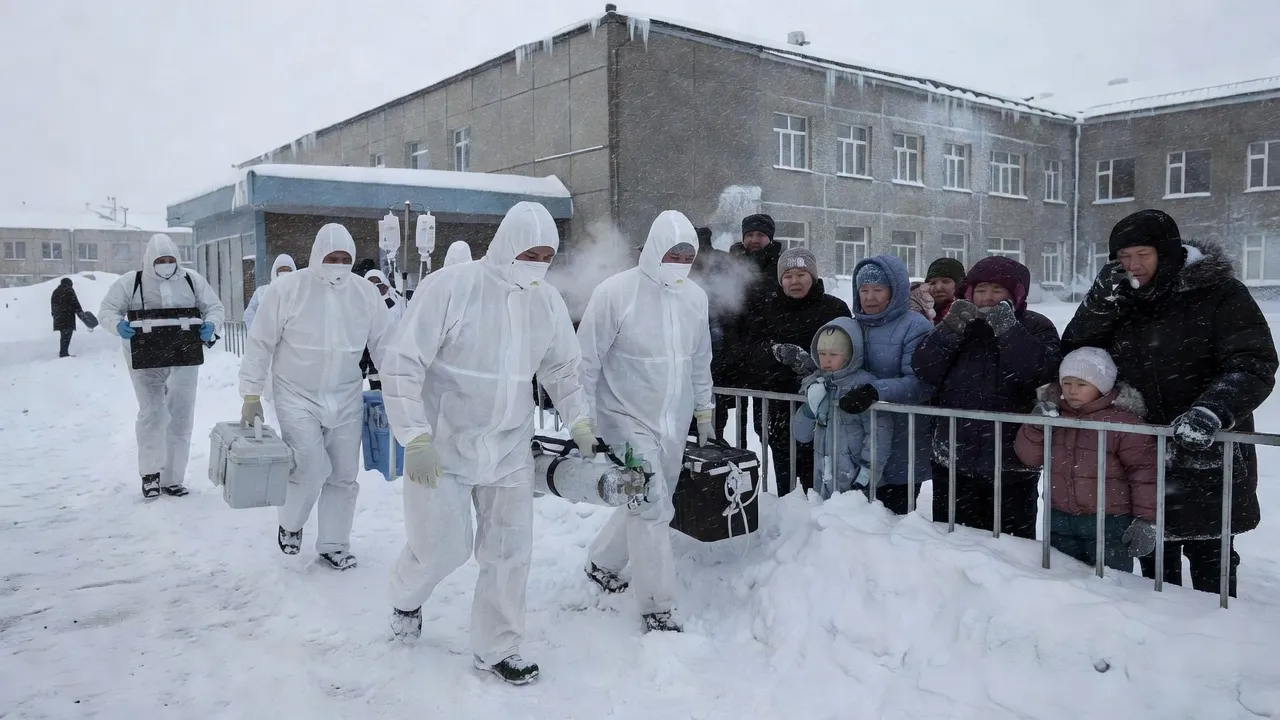
Suspected plague in Russia: the death of an Irkutsk lab technician worries the WHO and Washington
published on
countries
sources
articles
More divergent than 59% of recent comparable stories (reference: 90 recent stories measured with the same method).
The Irkutsk case is less about what has been established than about how the information has circulated, with local media, Russian authorities, the WHO, and foreign press having different sources, each reporting their own.
The cause of death remains officially undetermined: Moscow told the WHO that no cases of plague are recorded, and a Trump-Putin call was announced.
Successive versions
Meduza, which republishes the investigation by local media "Peoples of Baikal", writes that information about a lung plague initially circulated, then was removed from websites of media outlets close to the government, before the authorities spoke of pneumonia. The Russian media outlet specifies that the hypothesis of the plague is based on unnamed sources from several media outlets.
« But trust in the official version is low. »
Hypotheses about the origin of the disease vary according to the headlines. The Moscow Times mentions, according to unofficial sources, a trip to Buryatia or a broken test tube. TVNET in Latvia adds a stay in Thailand; RTP in Portugal reports the same lead, citing the local Russian press. According to Ukrainska Pravda, which cites Russian media, the test tube would have been broken on September 25; the Toronto Sun writes that she told her colleagues, without official confirmation.
Gulf Times notes that there is no public evidence to support these accounts. FAZ reports earlier versions, including a rat bite, and notes that it is still unknown where and how the young woman was infected.
What specialists are saying
Isaac Bogoch, an infectious disease specialist in Toronto, told the Globe and Mail that several pathogens are possible and that "we just don't know." According to him, ruling out the plague would be premature until the cause is established.
Experts cited by CBS and CNBC have expressed doubts. Amesh Adalja believes the health response does not match the plague, and Javier Pizarro-Cerda is surprised that a broken tube would be enough to contaminate someone wearing a full-body suit. In Latvia, TVNET+ interviewed Baiba Rozentāle, whose title, "It doesn't add up," expresses skepticism about certain versions.
DW, in its fact-checking on October 6, described the accident hypothesis as unproven. It noted that a Russian-language message on X, describing a broken vial and several hundred contaminated people, had over 320,000 views, and that two Rospotrebnadzor commissions found no evidence of an accident involving pathogenic microorganisms.
The WHO, Moscow, and the United States
Contrapunto, in Venezuela, reports that WHO spokesperson Christian Lindmeier stated that the organization had not received an official notification under the International Health Regulations. According to this media outlet, the WHO detected the case through its internal monitoring and contacted Russian authorities as early as October 3. Russia responded on October 6, according to the Free Press Journal.
« Be transparent and share more information with the world »
The Free Press Journal also details the WHO's requests: clarification on the cause of pneumonia, the agent that prompted public health measures, and press reports mentioning a second employee with pneumonia of undetermined cause. Director-General Tedros Adhanom Ghebreyesus demands, according to YLE and MTV Uutiset, an exchange of up-to-date, complete, and open information.
In Helsinki, THL's chief medical officer, Leif Lakoma, indicated on Monday, October 5, that no information had reached Finland through official channels, according to YLE. According to the Wall Street Journal, cited by France 24 and Al Jazeera, the State Department sent a confidential démarche to Moscow regarding its international health obligations.
From the Kremlin's side, Dmitri Peskov invites people to follow only the information from Rospotrebnadzor, according to the BBC and Meduza. According to the BBC, he also invited people not to listen to various rumors, in response to Donald Trump's offer of assistance.
On site and in laboratories
The ABC's report from Irkutsk states that Rospotrebnadzor denounced as false information a document allegedly announcing severe restrictions. Several residents say they do not trust the authorities; PerthNow notes that daily life has barely been disrupted.
According to The Moscow Times, a maternity hospital in Irkutsk distributed a plague screening form and restricted visits, according to a blogger cited by "Peoples of Baikal". Residents of the deceased woman's building describe to Meduza a disinfection carried out by agents who knew nothing else about the death of a young woman.
Outside of Russia, several newsrooms have linked the case to the debate on laboratory safety. Vox sees it as a scenario of a laboratory leak at the origin of a global epidemic, The Atlantic considers the case serious but not catastrophic, and Le Monde recalls China's lack of transparency at the start of Covid-19. The Ukrainian press goes further: TSN, which reprints The Sun, mentions a possible "new Wuhan" and a biological weapons program.
These angles address distinct questions: articles on laboratory safety concern the supervision of dangerous pathogens, those in the health press on the immediate risk to the population.
According to Elena Sofina, 60 % of those in quarantine have been released; two cases of Covid-19 and two of rhinovirus detected.
Marco Rubio is asking Russia to share more information; the State Department is following the situation.
Pulmonary plague, transmissible between humans, can be treated with antibiotics if care is provided early.
Key figures
- 200People in contact with the laboratory technician were placed under observation1 source · G1 Globo
What the comparison reveals
Common ground and differences in coverage across the media analysed.
What the media report in common
Rospotrebnadzor and regional authorities attribute the 28-year-old laboratory worker's condition to 'pneumonia of undetermined etiology' with no micro-organism linked to her professional activity, while local media suggest the possibility of pulmonary plague, which has not been officially confirmed.
The WHO considers the risk to be low to very low outside of Russia ('very low' for Europe), without the press in these countries presenting it as ruled out.
Where media coverage diverges
Credit of the official Russian version
Question asked: is the Russian version of undetermined pneumonia to be retained as such? Some coverage reports it with control elements (commissions, contact tests); others highlight the distrust it inspires or place it under the sign of a lack of transparency.
Coverage aligned with this reading
Coverage that diverges
Hypothesis of the broken tube
Question asked: what place to give to the hypothesis of a broken tube in the laboratory? Kyiv and Toronto put it forward citing Russian media, while Berlin, Warsaw and Paris describe it as unproven or unverified.
Biological safety and laboratories
Question asked: does the case refer to a biological laboratory safety issue? The Ukrainian press mentions a biological weapons program and a possible 'new Wuhan'; American, British, French and Indian media mention the Covid-19 precedent; Latvian, Mexican or Portuguese press mainly deals with the health risk.
Coverage aligned with this reading
This grouping describes the publications analysed, not the position of these countries’ populations or of their governments.
Understand the context
- SEP 30, 2026The technician fell ill at her workplace in Irkutsk
- OCT 2, 2026Death occurred at the hospital in Chelekhov
- OCT 5, 2026Governor Kobzev mentioned pneumonia of undetermined etiology
- OCT 6, 2026Russia informed the WHO that no cases of plague have been recorded
How each country reads it
Preview: 3 of 17 media perspectives. Syntheses of the media analysed — not direct quotations. Method & limitations
 Australia
Canberra is deciphering the Irkoutsk case as a health enigma: unknown pneumonia or lung plague, Australian media weigh what is established, what remains unknown and the risk deemed low by the WHO.
4 sources · View sources
 Brazil
Brasília is dissecting the conflicting versions of the death of the laboratory worker from Irkutsk and highlighting what is known, what is unknown, and the level of risk assessed by the WHO.
3 sources · View sources
 Canada
Ottawa is tempering the alert by raising the question of the risk to Canadians: Toronto experts, the WHO, and the Public Health Agency converge on a very low danger, while the cause of death remains to be established.
4 sources · View sources
The full text, country by country
Australia
DOMINANT ANGLE
Canberra is deciphering the Irkoutsk case as a health enigma: unknown pneumonia or lung plague, Australian media weigh what is established, what remains unknown and the risk deemed low by the WHO.
KEY POINTS
- Rospotrebnadzor attributes the 28-year-old woman's death to "pneumonia of undetermined etiology" and detected no micro-organism related to her work (PerthNow, ABC).
- According to the WHO, the risk to the general population "appears to be low" based on available information (SBS).
- Elena Sofina says 60% of people in quarantine have been released; contact tests revealed two cases of Covid-19 and two of rhinovirus (PerthNow).
ANALYSIS
Canberra, 7 October 2026. The Australian press is treating the Irkutsk case primarily as a public health issue: what is known, what is unknown, and what is the real risk. SBS and the ABC are publishing explanatory fact sheets on the plague, a disease caused by the Yersinia pestis bacterium, which is present in small wild mammals in Siberia and their fleas.
The reported facts are sparse. A 28-year-old laboratory worker at the Siberia and Far East Anti-Plague Institute died on Friday, 2 October. Local media have suggested a link to her work. Rospotrebnadzor, the Russian health agency, is talking about "pneumonia of undetermined etiology" and claims that thorough tests found no micro-organism related to her activity. PerthNow relayed its statement on Tuesday, 6 October: contacts, placed under hospital observation with daily tests, have presented two cases of Covid-19 and two cases of rhinovirus, but no other infectious agent. Elena Sofina, deputy head of the Chelekhov district, indicates that the "dangerous diagnosis" is not confirmed and that 60% of people quarantined have already been released; local press spoke of around 200 people.
The ABC explains that the pulmonary form is the most virulent, with an incubation period that can be as short as 24 hours and transmission through respiratory particles, which is fatal without treatment. SBS cites the WHO, which says that the risk to the general population "appears to be low" based on available information, with new assessments as soon as more elements are known.
The political aspect remains secondary. SBS reports that Donald Trump has called the death a "big problem for Russia" and offered his help, while Marco Rubio claims that Washington is closely following the situation.
The ABC's report from Irkutsk provides a local perspective. Rospotrebnadzor is denouncing a document circulating online, which allegedly announces severe restrictions, as false information: "No decision of this type has been made." Residents say they do not trust the authorities. A resident of 15 years claims that the authorities are downplaying the situation on instructions from Moscow. Others are downplaying the situation: PerthNow notes that daily life has been barely disrupted.
Brazil
DOMINANT ANGLE
Brasília is dissecting the conflicting versions of the death of the laboratory worker from Irkutsk and highlighting what is known, what is unknown, and the level of risk assessed by the WHO.
KEY POINTS
- Daria Shipilova, 28, from the Siberia and Far East Anti-Plague Institute, died in Shelekhov; nearly 200 people are said to have been placed under observation (G1).
- Rospotrebnadzor refers to a "pneumonia of undetermined etiology" and calls a document about health restrictions in Irkutsk false (Veja, Jornal de Brasília).
- Marco Rubio asks Russia to share more information; the WHO is verifying the death and estimates the risk as moderate to low for Irkutsk (G1, Jornal de Brasília).
ANALYSIS
Brasília, October 7, 2026. Brazilian media are covering the Irkutsk case from the angle of "what we know": a health file where versions clash. G1 Globo, which picks up a story from the BBC, reports that Daria Shipilova, 28, an employee of the Siberia and Far East Anti-Plague Institute, died in Shelekhov, near Irkutsk, after being hospitalized in late September. According to testimony, the death occurred on the night of October 2, but the BBC was unable to confirm this.
Veja highlights that the authorities' information is "contradictory". The Rospotrebnadzor agency talks about "pneumonia of undetermined etiology", while a representative of the neighboring Buryatia had mentioned the plague. The governor of the region, Igor Kobzev, claims that no micro-organism related to the patient's professional activity was found in her samples and that no other employee of the institute has been infected. The version of a broken test tube containing Yersinia pestis, put forward by the local press, is not confirmed by the Russian authorities, the magazine notes.
The Jornal de Brasília, via a dispatch, details the denials of Tuesday, October 6: Rospotrebnadzor qualifies as false a document circulating about a tightening of health restrictions, a document "not from official sources", and claims that the situation "remains stable". The same text explains the difference between pulmonary plague, transmitted by droplets, and bubonic plague, transmitted by fleas. During a press briefing in Geneva, the WHO says it is verifying the death with Moscow; its initial assessment speaks of a "moderate to low" risk for Irkutsk.
The diplomatic dimension comes into play: G1 reports that US Secretary of State Marco Rubio judged that it was up to Russia to "share more information with the world", adding that Washington is following the situation "hour by hour". The story also mentions, according to independent media, the quarantine of the hospital, the mandatory wearing of masks in a local aluminum plant, and the cancellation of a major public event in Irkutsk, and reports nearly 200 people under observation.
The tone remains cautious: the three titles repeat that the plague is not officially confirmed and avoid taking a stance between the laboratory accident and pneumonia. The emphasis is on educating about the disease and measuring the risk rather than on the geopolitical controversy.
Canada
DOMINANT ANGLE
Ottawa is tempering the alert by raising the question of the risk to Canadians: Toronto experts, the WHO, and the Public Health Agency converge on a very low danger, while the cause of death remains to be established.
KEY POINTS
- The WHO considers the risk "very low" outside of Russia (Global News, CBC).
- The Public Health Agency of Canada states that "no risk to Canada has been identified"; the last human case of plague in the country dates back to 1939 (Toronto Sun).
- Rospotrebnadzor says it found no micro-organisms related to the deceased's work, but two cases of COVID-19 and two of rhinovirus among contacts (Globe and Mail).
ANALYSIS
Ottawa, October 7, 2026. The Canadian press is treating the death of the laboratory worker from Irkutsk primarily from the angle of public health, with a central question: should Canadians be worried? The Globe and Mail reports on what is known and what is not. The 28-year-old woman, whom local media have named Darya Shipilova, worked at the Siberia and Far East Anti-Plague Institute. According to the newspaper, she reportedly died of severe pneumonia of unknown origin in a nearby hospital in Chelekhov, and the circumstances remain under investigation.
The Globe quotes Isaac Bogoch, a specialist in infectious diseases at Toronto General Hospital. When an employee of an "anti-plague institute" dies of severe pneumonia, he says, people inevitably think of the plague; but several pathogens are possible and "we simply don't know." Ruling out the plague would be premature until the cause of death is established.
Global News relays the WHO, which judges the risk "very low" outside of Russia, and recalls that pulmonary plague, the most virulent form, is transmitted between humans through respiratory particles, with an incubation period sometimes of 24 hours; recovery is frequent if treatment is early. The article links the case to the memory of the COVID-19 pandemic and the accusations of laboratory origin.
On the Russian side, The Globe reports that Rospotrebnadzor has detected no cases of plague among contacts, nor any micro-organism related to the deceased's work; tests have revealed two cases of COVID-19 and two of rhinovirus. A local official, Elena Sofina, indicates that 60% of people placed in quarantine have already been released.
The Toronto Sun takes a more vivid tone: the laboratory worker would have told her colleagues that she had broken a container of live bacteria on September 25, and more than 200 contacts are in quarantine. Ottawa wants to be reassuring: Federal Health Minister Marjorie Michel says she is following the situation with the WHO, and the Public Health Agency of Canada states that "no risk to Canada has been identified." The last human case of plague in the country dates back to 1939.
CBC adds a political dimension: Donald Trump has announced a call with Vladimir Putin "very soon," mentioning "very deep discussions" with the US intelligence, as the October 18 deadline approaches for potential sanctions against Russian entities.
 Germany
DOMINANT ANGLE
Berlin is dissecting the rumor mill: between Rospotrebnadzor's denials and distrust of the official Russian version, the German press is weighing what is proven and what is not.
KEY POINTS
- According to FAZ, Rospotrebnadzor attributes the death of the 28-year-old lab worker to a "Lungenentzündung unbekannter Herkunft", while the portal "Ljudi Bajkala" suggests pulmonary plague.
- DW deems the hypothesis of a broken tube "unproven": two Rospotrebnadzor commissions found "no evidence of an accident involving pathogenic microorganisms".
- A Russian-language message on X describing a laboratory accident has exceeded 320,000 views, according to DW Fact Check.
ANALYSIS
Berlin, October 7, 2026. In Germany, the Irkutsk case is first told as a duel between rumors and denials. The FAZ asks the question straightforwardly in its title: "Ist in Russland die Lungenpest ausgebrochen?" ("Has lung plague broken out in Russia?"). The daily newspaper recalls that Rospotrebnadzor, the Russian health protection authority, attributes the death of the laboratory worker, who died on Friday in a Siberian hospital, to a "Lungenentzündung unbekannter Herkunft" ("pneumonia of unknown origin"). Kremlin spokesman Dmitri Peskov calls for reliance on these statements and not on "rumors". But, the FAZ writes, "das Vertrauen in die offizielle Version ist gering" ("trust in the official version is low").
The newspaper mentions the name of the deceased, Daria Chipilova, 28, revealed by the exile portal "Ljudi Bajkala", which claims she died of pulmonary plague. It lists the successive stories circulating online: first a rat bite, then a tube containing the Yersinia pestis bacterium that she allegedly broke. Other media point out that bacteria are now stored in plastic tubes, which are not fragile. The FAZ concludes that it is still unknown where and how she was infected, and mentions the words of Donald Trump, who on Monday mentioned pathogens "like an army" and promised to help the Russians.
Deutsche Welle adopts a fact-checking register. Its "Fact check", dated October 6, notes that the case has become "the subject of intense speculation on social media", between fear and comparisons with Covid-19. A Russian-language message on X, claiming that a laboratory worker had broken a vial of plague and contaminated several hundred people, has exceeded 320,000 views. DW's verdict: "unproven". No independent evidence of a leak exists, and Rospotrebnadzor assures that two commissions found "no evidence of an accident involving pathogenic microorganisms". TASS, citing the agency, indicates that no microorganism related to the deceased's professional activity has been detected.
The two media thus place uncertainty at the center: the absence of evidence of an accident is not presented as proof of absence, and mistrust of Russian authorities fuels the circulation of stories. Geopolitical aspects, the announced call between Trump and Putin, or the WHO's assessment, remain in the background in the German articles in the corpus, which focus mainly on distinguishing verifiable information from noise.
 Finland
DOMINANT ANGLE
Helsinki is closely watching the pressure from Washington and the WHO on Moscow: the Finnish press is categorizing the case of the Siberian laboratory under the question of Russian transparency, up to the announced call between Trump and Putin.
KEY POINTS
- Marco Rubio, in Iceland, estimated that Russia has a duty to share more information and that Washington is monitoring the situation "very closely" (Ilta-Sanomat, YLE).
- The WHO Director-General, Tedros Adhanom Ghebreyesus, is calling on Russia for a complete, up-to-date, and open exchange of information (MTV Uutiset, YLE).
- According to the Chief Medical Officer of THL, Leif Lakoma, no official information about a possible death from the plague has been received (YLE).
ANALYSIS
Helsinki, October 7, 2026. In Finland, the death of a young laboratory worker at a plague research institute in Siberia is first and foremost being treated as a test of Moscow's transparency. Articles in Ilta-Sanomat, YLE, and MTV Uutiset focus more on international reactions than on the medical details.
Ilta-Sanomat recalls that the young employee died on Friday, October 2, in unclear circumstances. According to a Russian official, she succumbed to pneumonia of unknown cause. Media outlets are also mentioning a test tube containing live plague bacteria that allegedly broke at work, before her condition rapidly deteriorated: the newspaper specifies that "the matter has not been confirmed".
The daily puts the American statement at the forefront. Questioned on Tuesday, October 6, in front of the White House, Donald Trump stated that he had a call scheduled with Vladimir Putin, "very soon", without giving a date. He said that American intelligence services could provide more information the next day. Secretary of State Marco Rubio, visiting Iceland, judged that Russia had "a duty to share more information with the rest of the world". According to a Reuters dispatch relayed by YLE, Washington is monitoring the situation "hour by hour". Rubio added that the United States has the means to help Russia if the situation proves more serious than acknowledged, but that they first need more information.
MTV Uutiset and YLE are relaying the call from WHO Director-General Tedros Adhanom Ghebreyesus for an exchange of information that is "up-to-date, complete, and open". They note that the United States is also demanding openness.
The national aspect is limited to a few lines. The chief medical officer of the THL health institute, Leif Lakoma, indicated on Monday, October 5, that no information had reached Finland through official channels. YLE reports that, on the Russian side, the authorities consider the situation under control and that no infection has been detected among the deceased woman's contacts. It mentions dozens of people placed in quarantine and the concern expressed on social networks.
The three media outlets do not dwell on the safety of the laboratory or on the risk assessment outside of Russia. The common thread is that of a Russia being called upon to explain itself, as seen from a country that shares 1,300 km of border with it and has not been directly informed.
 France
DOMINANT ANGLE
Paris is scrutinizing Moscow's transparency more than the disease itself: between Russian denials, Washington's pressure, and memories of Covid, the French press finds the sanitary silence to be as unsettling as the risk.
KEY POINTS
- The governor of the Irkutsk region, Igor Kobzev, mentioned on Monday a "pneumonia of undetermined etiology", based on a commission of experts.
- Marco Rubio called on Russia to "be transparent" and Donald Trump announced a call "very soon" with Vladimir Putin.
- The WHO estimates the risk as low in Russia and very low for Europe, despite unverified rumors about a broken test tube.
ANALYSIS
Paris, October 7, 2026. The death of a 28-year-old laboratory worker from the Irkutsk Anti-Plague Institute, which occurred on Friday, October 2, is being treated in France as a test of transparency as much as a medical issue. The government notes that suspicions coming from Russia revive "a more recent traumatic memory" than the Black Death: China's lack of transparency in the early days of Covid-19. It is added that it is "difficult, at this stage, to draw any conclusion" about the cause of the death.
The official facts are stated without emphasis. On Monday, the governor of the Irkutsk region, Igor Kobzev, relying on a commission of experts, mentioned "pneumonia of undetermined etiology" and stated that "no micro-organism related to the young woman's professional activity has been detected in her biomaterials". The World Health Organization considers the risk to be low for the general population; it is specified that the risk is considered "very low" in Europe.
The diplomatic aspect is highlighted. Marco Rubio, on a trip to Iceland, called on Moscow to "be transparent and share more information with the world". Donald Trump announced, on Tuesday, a call "very soon" with Vladimir Putin. According to the Wall Street Journal, the State Department sent a confidential note to Russia reminding it of its international health obligations. The Russian authorities, for their part, deny any anti-plague measures and downplay the incident.
The "Truth or Fake" section of the media examines the circulation of rumors: a broken test tube, a trip to Thailand, a trip near the Mongolian border. It is emphasized that "no evidence" supports these theories, while misleading publications and videos taken out of context fuel fear online.
The educational aspect comes from an interview with infectiologist Emmanuel Piednoir. Pulmonary plague, which is transmissible from person to person, has a very high mortality rate without antibiotics, but remains rare and reappears occasionally in Africa, Asia, or South America. It is recalled that the disease "has not disappeared from the planet", according to the formula also used by the government.
In total, the French narrative combines three registers: uncertainty about the cause of death, assessment of the real risk, and demand for openness addressed to Moscow, with the memory of 2020 in the background.
 India
India
DOMINANT ANGLE
New Delhi is deciphering the Irkutsk case as a test of health transparency: between Moscow's denials, the WHO's requests, and the announced call from Trump to Putin, the Indian press is weighing what Russia says and does not say.
KEY POINTS
- According to the Times of India, there is no confirmation that the laboratory worker in Irkutsk died of the plague; Russian authorities cite pneumonia of unknown cause.
- Moscow responded to the WHO on October 6: no cases of plague in Irkutsk and contact tracing completed, with no high-risk pathogen detected (Free Press Journal).
- The WHO requested clarification on the cause of the pneumonia, the pathogen involved, and a possible second sick employee, and considers the risk outside of Russia "very low".
ANALYSIS
New Delhi, October 7, 2026. Indian media is covering the Irkutsk case with caution, first emphasizing what has not been established. The Times of India recalls that a woman employed at the Siberia and Far East Anti-Plague Research Institute died last week, that Russian authorities are talking about pneumonia of unknown cause, while Russian media and social networks are mentioning pulmonary plague. The newspaper states: "however, there is no confirmation" that the young woman died of the plague.
The newspaper focuses on the international dimension. Donald Trump said he wants to talk to Vladimir Putin about this case, while the World Health Organization (WHO) considers the risk outside of Russia "very low". The Times of India also explains why the episode is worrying: pulmonary plague, the rarest but most virulent form, is transmitted between humans through the respiratory route, but recovery is frequent if treated quickly.
The newspaper then links the case to a still vivid memory. The hypothesis of a respiratory disease coming from a laboratory, it writes, has revived the memory of Covid-19 and the debate over its origins. However, it quotes WHO spokesperson Christian Lindmeier, who says that nothing currently indicates a situation comparable to the pandemic.
The Free Press Journal relies mainly on the WHO statement. Moscow responded on October 6 to an information request under the International Health Regulations: no recent cases of plague have been recorded in the Irkutsk region, neither in the deceased nor in her contacts, who were placed under medical observation, tested, and then released from surveillance without any high-risk pathogens detected. According to the same source, the disease initially presented as a common acute viral respiratory infection.
The newspaper does not omit the areas of uncertainty highlighted by the WHO: it has offered technical support and requested clarification on the cause of the severe pneumonia, the agent that motivated public health measures, and press reports mentioning a second employee with pneumonia of undetermined cause. For the organization, "complete and transparent" information sharing is essential to resolve the contradictions.
In total, the Indian account is factual and without alarmism: it presents the Russian denial, the call from Washington, and the WHO's reservations side by side, without taking a stance on the real cause of the death.
 Latvia
DOMINANT ANGLE
Riga weighs the health risk over controversy: the Latvian disease prevention centre judges the danger of international spread to be very low and recalls that the plague can be treated.
KEY POINTS
- The risk of international spread of the plague, including to the country, is deemed "very low" even in the event of laboratory confirmation.
- According to BNN, The Moscow Times and Meduza report that nearly 200 people have been hospitalized for observation after contact with the patient.
- TVNET lists three versions of the contamination: a broken tube at work, a trip to Buryatia near Mongolia, or a stay in Thailand.
ANALYSIS
Riga, October 7, 2026. In Latvia, the Irkutsk case is first treated as a public health issue and a risk for the country. BNN reports that the Latvian Center for Disease Prevention and Control (SPKC) has responded to information about a possible case of pulmonary plague in Russia. According to it, the risk of international spread, including to Latvia, is "very low", even if the suspected case was confirmed in a laboratory.
The SPKC emphasizes that the potential death linked to pulmonary plague and the implementation of large-scale quarantines have not been officially confirmed by the World Health Organization or the European Center for Disease Prevention and Control (ECDC). It specifies that rapid diagnosis, patient isolation, contact tracing, and effective antibiotic treatment can now contain the disease and prevent more significant outbreaks. BNN relies on The Moscow Times and Meduza, which mentioned nearly 200 people hospitalized for observation after contact with the patient.
TVNET, on the other hand, details the informational confusion. Its article titled "The plague exists in Siberia and does not exist at the same time" recalls that local media first announced the death of a woman due to the plague, which Russian authorities immediately denied, citing pneumonia, and that Russian media mention quarantines in several hospitals, maternity wards, and an aluminum plant. The victim is identified as Daria Chipilova, an employee of the Irkutsk plague research institute.
The newspaper lists three versions: a broken test tube containing bacteria at the workplace, infection during a mission in Buryatia, near the Mongolian border, or contamination in Thailand. In a second article, TVNET+ interviews Baiba Rozentāle, a professor at the University of Stradiņš in Riga and the chief physician of the Latvian Infectology Center, about the credibility of the broken test tube hypothesis and the modes of contamination. The title, "It doesn't add up", expresses skepticism about certain versions, and the text notes that public reaction is strong, as the pulmonary form is the most dangerous because it is transmitted through the air.
The Latvian media does not focus on the announced call between Donald Trump and Vladimir Putin or the denials from the WHO or Moscow on October 6: the emphasis remains on useful information for the local reader, namely what is confirmed, what is not, and why there is no reason to alarm in Latvia.
 Mexico
DOMINANT ANGLE
Mexico City is deciphering the Irkutsk case as a health alert to be explained to the general public: symptoms, contagion, and real risk, with the WHO as the central reference.
KEY POINTS
- The 28-year-old technician died on October 2; according to El Informador, Rospotrebnadzor mentions pneumonia of unknown cause and no micro-organism linked to her work.
- According to El Financiero, the WHO considers the risk "muy bajo" outside of Russia and recalls more than three thousand cases of plague worldwide between 2010 and 2015, including 584 fatalities.
- Marco Rubio has asked Russia to share more information, with Washington being in contact with Russian authorities since October 2 (El Informador).
ANALYSIS
Mexico, October 7, 2026. Mexican media outlets El Informador and El Financiero have addressed the death of a 28-year-old technician from the Irkutsk anti-plague research institute from a public health and reader service perspective. Their articles, published on October 6, primarily explain what pulmonary plague is, how it is transmitted, and which symptoms should raise alarm.
El Informador recalls that the young woman was hospitalized at the end of September and died on October 2 after a severe case of pneumonia. It highlights that, until Tuesday, October 6, the authorities had not confirmed that the plague was the cause. Two hypotheses are circulating in the local press: an infection contracted during a recent trip to Thailand, or a laboratory accident related to the rupture of a tube containing pathogens. The newspaper specifies that Rospotrebnadzor diagnosed pneumonia of unknown cause, that the analyses did not detect any micro-organism related to her professional activity, and that no accident was recorded at the institute. Nearly 200 people have been placed under observation.
The international aspect is presented with sobriety. According to El Informador, Washington has been in contact with Russian authorities since October 2, and Secretary of State Marco Rubio has asked Moscow to share more information. The WHO, on its part, indicated that Russia reported no cases of plague in Irkutsk.
El Financiero emphasizes the WHO's message: the risk is "very low" outside of Russia. It quotes the organization on the lethality, ranging from 30 to 100% without treatment, and on the pulmonary form, "invariably fatal if not treated quickly". To avoid alarm, the newspaper adds that more than three thousand cases of plague, including 584 fatalities, were recorded worldwide between 2010 and 2015, and that the disease can be treated with antibiotics today. The incubation period ranges from one to seven days and can be as short as 24 hours for the pulmonary form.
The tone is more vivid in El Informador's style section, which mentions a global alert and an infection that can become fatal in 24 hours, while noting that Russian authorities had ruled out the presence of the bacteria in this specific case. The overall focus remains on practical information, with little room for controversy over the laboratory's transparency.
 Poland
DOMINANT ANGLE
Warsaw gauges the risk for Poland: between hypotheses from Irkutsk and the WHO's assessment, the Polish press first seeks to determine if Europe has reasons to be concerned.
KEY POINTS
- The WHO considers the risk "very low" for the European region, low for Russia, and moderate to low for Irkutsk (RMF24, spokesperson Christian Lindmeier).
- Around 200 people in contact with the lab worker have been placed under observation or isolation; Rospotrebnadzor mentions pneumonia of undetermined cause.
- The Chief Sanitary Inspector (GIS) notes that no official source confirms any human cases of plague in Russia.
ANALYSIS
Warsaw, October 7, 2026. The death of Daria Szypiłowa, a 28-year-old laboratory worker at the Siberia and Far East Anti-Plague Institute, is being covered by the Polish press from the angle of public health and geographical proximity: "Co z Polską?" asks Gazeta Prawna in its headline.
The reported facts are cautious. According to information gathered by Radio Wolna Europa, the young woman was hospitalized on September 29 and died during the night of October 1-2. About 200 people who came into contact with her have been placed under observation or isolation. The local independent media "Ludzie Bajkału" claims that she allegedly broke a tube containing a pathogen; RMF24, citing the American website Axios, mentions pulmonary plague and dates the incident to September 25. The Russian authorities do not confirm this version: Rospotrebnadzor talks about pneumonia of undetermined cause, without any micro-organism related to her work, and says that the institute has not recorded any accidents involving pathogens.
RMF24 highlights the opinion of the WHO. Its spokesperson, Christian Lindmeier, in Geneva, assesses the risk as "moderate to low" for Irkutsk, low for the whole of Russia, and "very low" for the European region. The organization has requested information from Moscow about the circumstances and analyses and offers its assistance.
The national aspect takes a clear place. On Monday, October 5, the Polish Chief Sanitary Inspector (GIS) indicated that no official Russian or international source confirmed any human cases of plague in Russia, recalling that the disease, caused by Yersinia pestis, is "highly contagious".
Gazeta Prawna also devotes a section to the speculations of former Ukrainian diplomat Roman Bezsmertny, interviewed by Kanał 24 on October 6. He considers three scenarios, including a link to work on biological weapons. The newspaper specifies, however, that he presented neither analysis results nor investigation elements. The general line remains one of restraint: an unexplained event, unverifiable Russian denials, and a risk considered low for Poland.
 Portugal
DOMINANT ANGLE
Lisbon interprets the Irkutsk case from a medical angle: it explains what pulmonary plague is, recalls that it can be treated if addressed early, and relays the "very low" risk for Europe according to the WHO.
KEY POINTS
- A 28-year-old Russian researcher from the Irkutsk anti-plague institute died early in October of pneumonia of unclear origin (SAPO Notícias).
- The WHO judged on Tuesday, October 6, the risk for Europe to be "very low" (SAPO Notícias).
- Beijing claims to be maintaining "close exchanges and cooperation" with Moscow, and Trump announces a call with Putin "very soon" (RTP Notícias).
ANALYSIS
Lisbon, October 7, 2026. Portugal is addressing the Irkutsk case through health education. SAPO Notícias has dedicated an article to pulmonary plague: how it is transmitted, what symptoms it causes, and what complications it leads to. The title poses the question that the reader is asking, and the text responds through medicine rather than geopolitics.
The reported facts are cautious. A 28-year-old Russian researcher died at the beginning of October after pneumonia whose origin "has not yet been clarified". She worked at the Irkutsk anti-plague research institute in Siberia, a structure specialized in the study of plague and other dangerous pathogens. Several people have been quarantined. SAPO notes that the Russian infectious disease surveillance authority has ruled out a possible link with the young woman's professional activity, and that the WHO judged the risk "very low" for Europe on Tuesday, October 6.
The Portuguese media then explains that pulmonary plague is a lung infection caused by the Yersinia pestis bacterium, the rarest and most severe form of the disease, transmissible between people. It emphasizes a reassuring point: antibiotics are effective if administered early, while the disease is almost always fatal without treatment. It distinguishes the bubonic form, the most frequent, transmitted by the bites of infected fleas.
RTP Notícias, on the other hand, shifts the focus to the chancelleries. The public channel reports that Beijing says it maintains "close exchanges and cooperation" with Moscow on the prevention of infectious diseases, according to spokesperson Guo Jiakun. It recalls that Washington issued an alert on Sunday, October 4, and that Donald Trump announced an upcoming call with Vladimir Putin "very soon".
RTP, citing the local Russian press, mentions two hypotheses under study: contamination in Thailand, where the young woman had recently returned from, or the accidental rupture of a test tube containing pathogens at her workplace. It specifies that the independent media Liudi Baikala reported the quarantine of several hospitals in Irkutsk.
In total, the Portuguese coverage remains factual and measured: it does not take up the laboratory leak thesis or the Russian denials without attributing them, and keeps the real risk for Europe as its guiding thread.
 Qatar
Qatar
DOMINANT ANGLE
Doha weighs what is known and what is unknown about the death of the laboratory worker in Irkutsk, aligning the assessments of the WHO and the CDC with the denials of Moscow.
KEY POINTS
- According to the WHO (Christian Lindmeier), the risk is "moderate to low" for Irkutsk, low for Russia, and very low for the European region.
- The autopsy cited by the institute detected no micro-organisms related to the victim's work, but two cases of COVID-19 and two of rhinovirus.
- Approximately 200 people were placed under observation and 60% of them have already been released, according to Elena Sofina.
ANALYSIS
Doha, October 7, 2026. Qatari media is treating the death of a laboratory worker at the Irkutsk anti-plague institute as an ongoing public health issue. Al Jazeera is headlining the story "Should we be worried?" and recalling that the plague remains endemic in Siberia. It identifies the victim, according to Russian media, as Darya Shipilova, 28, who fell ill at work on September 30 and died two days later in a hospital in Shelekhov.
Local media outlet People of Baikal has suggested that she may have contracted pneumonic plague after a test tube broke. Gulf Times lists three accounts circulating on social media (a broken tube, a trip to Thailand, a stay near the Mongolian border) and notes that "there is no public evidence" to support them, nor confirmation of a death from the plague. The newspaper specifies that a regional governor had said she "could" have died from it.
Al Jazeera details the version of the Russian authorities. Rospotrebnadzor claims that no cases of plague have been detected in people who came into contact with the young woman over ten days. The institute indicates that the autopsy revealed no micro-organisms related to her work, but two cases of COVID-19 and two of rhinovirus. Elena Sofina, head of the Shelekhov district, assures that no "dangerous diagnosis" has been confirmed and that 60% of the approximately 200 people under observation have been released. Moscow also denies any anti-plague measures, referring to an unofficial and "unfounded" document.
External arbitration occupies a significant place. Gulf Times reports the assessment of WHO spokesperson Christian Lindmeier: a "moderate to low" risk for Irkutsk, low for Russia, and "very low" for the European region. Al Jazeera cites the US CDC, which recalls that the plague can be treated with antibiotics if detected early.
Al Jazeera Arabic puts more emphasis on the diplomatic dimension: Washington is calling on Moscow to be "transparent" and, according to the Wall Street Journal, which it cites, has signaled that a refusal to provide details contravenes its obligations. Donald Trump announces a call to Vladimir Putin "very soon". Al Jazeera notes that Russian authorities have released few details about the circumstances of the death.
 Russia
DOMINANT ANGLE
Moscow, in its independent press, is deciphering a battle of versions: between the Rospotrebnadzor's denials, quarantines observed on site and rumors of plague, it is the reliability of official information that is at stake.
KEY POINTS
- Daria Shipilova, 28, an employee of the Irkutsk anti-plague institute, died on the night of October 1-2 in Chelekhov (Meduza).
- Rospotrebnadzor is citing "pneumonia of undetermined etiology"; around 200 contacts have been isolated (Meduza).
- Donald Trump announced an upcoming call with Vladimir Putin about the possible plague outbreak, while Dmitry Peskov calls for sticking to Rospotrebnadzor's information (Meduza).
ANALYSIS
Moscow, October 7, 2026. In the Russian independent press, the Irkutsk case is first and foremost an information crisis. Daria Shipilova, 28, an employee of the Siberia and Far East Anti-Plague Research Institute, died on the night of October 1-2 at the Chelekhov hospital, a satellite city of Irkutsk, according to Meduza, which republished the investigation by local media "Peoples of Baikal".
The story focuses on the chronology of versions. Information about a pulmonary plague contracted at the institute circulated in the media and on networks, then, according to Meduza, was removed from websites of media close to the authorities. The authorities then spoke of pneumonia. Rospotrebnadzor officially retained an "undetermined etiology pneumonia". Moscow Times reports that unofficial sources mention either a professional trip to Buryatia or a broken test tube in the laboratory, without any of these leads being confirmed.
The situation fuels doubt. About 200 people who came into contact with the young woman have been isolated, according to Meduza, and the Chelekhov hospital has been placed under quarantine. Residents of the deceased's building describe a disinfection with an "unbearable" smell by agents from Rospotrebnadzor, who "knew nothing" other than a young woman had died from a dangerous virus. In Irkutsk, a maternity ward, according to a blogger cited by "Peoples of Baikal", distributed a plague screening form, restricted visits, and prohibited the presence of spouses during childbirth.
The Kremlin responds with instructions. Dmitry Peskov called on Russians to only trust the official information from Rospotrebnadzor. Meduza notes that state agencies TASS and RIA Novosti announced an upcoming call between Donald Trump and Vladimir Putin without specifying its purpose, while the American president says he wants to discuss the "possible plague outbreak" in Russia.
The international dimension appears in the background: the WHO received assurances that no cases were recorded. But these articles do not specify what the laboratory was handling, and official confirmations are rare in the face of rumors that, according to Moscow Times, are already fueling fears of an epidemic.
 Ukraine
DOMINANT ANGLE
Kyiv is examining the Irkutsk case from a biological safety angle: the Ukrainian press sees it as a potential "new Wuhan" and questions Moscow's silence on the laboratory.
KEY POINTS
- According to Ukrainska Pravda, citing Russian media, Daria Shipilova allegedly broke a tube containing the pneumonic plague agent on September 25, before dying in the night of October 1-2; nearly 200 people have been quarantined.
- Marco Rubio urged Russia to "share more information with the world" while deeming it "irresponsible" to speculate about a modified strain (Kyiv Post).
- Trump announced a call "very soon" with Putin, and Dmitri Peskov welcomed the US offer of assistance (Kyiv Post, Ukrainska Pravda).
ANALYSIS
Kyiv, October 7, 2026. Ukrainian media are treating the death of Daria Shipilova, a 28-year-old laboratory worker at the Irkutsk anti-plague institute, as a test of Moscow's reliability regarding dangerous pathogens. According to Ukrainska Pravda, citing Russian media, she allegedly broke a tube containing the lung plague agent on September 25, was hospitalized on September 29, and died on the night of October 1-2. Nearly 200 people have been quarantined. Russian authorities are talking about a "pneumonia of undetermined etiology" and the plague has not been officially confirmed.
TSN, which picked up the story from the British tabloid The Sun, headlines "New Wuhan?" and claims that the Kremlin is "hiding" the extent of the incident. The site relays the opinion of Professor Simon Clark, who says that Russia may have restarted its biological weapons program, and raises the possibility of a leak of a modified strain. Marco Rubio, questioned about this in Reykjavik, refused to speculate: "It would be irresponsible to speculate, we don't have all the information." He called on Moscow to "share more information with the world".
The diplomatic aspect is being closely followed. Kyiv Post reports that Donald Trump spoke of a "big problem" on Monday, October 5, and then announced on Tuesday, October 6, a call "very soon" with Vladimir Putin. The media links this exchange to Washington's new sanction powers, as Russia continues its war against Ukraine. Ukrainska Pravda notes that Trump offered American assistance, and that Dmitry Peskov welcomed an offer of cooperation while saying he had not heard Trump mention a "major problem". The WHO considers the general risk to be low, and the European Commission says it is ready to coordinate a response.
The US Embassy in Moscow has issued a health alert and recalls its level 4 advisory, "do not travel". Ukrinform and TSN are reproducing this text.
There is also a domestic dimension: epidemiologist Natalia Vynohrad explains to TSN that in the absence of a direct link with Russia, a case could arrive in Ukraine through third countries. The incubation period lasts one to two days and the mobility of war complicates tracking. Another TSN article, citing the Lad Bible, recalls that the plague is bacterial, and therefore very different from Covid-19.
 United Kingdom
DOMINANT ANGLE
London weighs the real risk rather than the rumour: the British press explains the pulmonary plague, relays the "very low" judgment of the WHO and notes what Moscow has not yet established.
KEY POINTS
- The WHO considers the risk outside Russia to be "very low", according to The Independent on October 6.
- Rospotrebnadzor claims that the deceased's contacts are negative and that no micro-organism related to her work has been detected; the official cause remains pneumonia of unknown origin.
- Peskov called for not "listening to various rumors" and to only follow the information from the health service, according to the BBC.
ANALYSIS
London, 7 October 2026. The British media are addressing the death of a technician at the Siberia and Far East Anti-Plague Institute in Irkutsk from a health perspective. The Independent reports that the World Health Organization deems the risk outside of Russia to be "very low". According to the newspaper, the UN agency indicated on Tuesday, 6 October, that it was in contact with the Russian authorities, who are conducting the investigation into the death that occurred the previous week.
The BBC has dedicated an educational article to pulmonary plague, described as "the most virulent form" of the disease. It quotes Piero Olliaro, a professor at the University of Oxford: the Yersinia pestis bacterium persists in animal reservoirs, and sporadic cases continue to appear. The text places the global number of plague cases, in all forms, between 1,000 and 3,000 per year. It also specifies that the disease heals well if detected in time. The Independent cites the WHO: treatment must be administered within 24 hours of the onset of symptoms.
Regarding the facts, the articles distinguish between what is confirmed and what is reported. Rospotrebnadzor, the Russian health agency, claims that all individuals who came into contact with the deceased have tested negative and that no micro-organism related to her professional activity has been detected. Elena Sofina, deputy head of the Chelekhov district, states that a dangerous diagnosis has not been confirmed, and that 60% of the people placed in quarantine have been released. The Independent attributes to The Kyiv Independent the version of a broken test tube. The BBC notes that it is still unknown what made the young woman ill and that the media have fueled "a flood of speculation".
The political dimension appears in the background. The BBC questioned Kremlin spokesman Dmitri Peskov about Donald Trump's offer of assistance. Peskov invited people not to "listen to various rumors" and to only follow the information from the public health service. The Independent adds that the case revives the memory of Covid-19 and the suspicions of a Chinese laboratory origin, without a definitive answer from the WHO.
 United States
DOMINANT ANGLE
The United States is holding Moscow accountable: the American press is making Russian health transparency the central test, between the administration's caution and the reminder of the Covid precedent.
KEY POINTS
- Marco Rubio stated on Tuesday, October 6, that it was up to Russia to share more information with the world, according to CBS News.
- Donald Trump announced on Tuesday a call "very soon" with Vladimir Putin and had offered American assistance on Monday, according to NBC News and CNBC.
- The CDC claims to have no indication of a broader threat, according to Axios.
ANALYSIS
In America, the death of a technician at the Irkutsk anti-plague institute, identified by Russian media as 28-year-old Darya Shipilova, is initially treated as a matter of transparency. Secretary of State Marco Rubio stated on Tuesday, October 6, that it was "incumbent upon Russia to obviously share more information with the world." The day before, on Monday, October 5, he judged the situation to be "not cause for alarm, but cause for focus." A State Department spokesperson welcomed close monitoring with the CDC and called on Moscow for greater clarity, while the embassy in Moscow issued a health alert and Washington reaffirmed its warning against traveling to Russia.
The US government has been following the situation closely, with Donald Trump indicating on Tuesday that he had a call "scheduled" with Vladimir Putin, "very soon," after offering US assistance on Monday: "Anybody that has that kind of a problem, we're always willing to help." He mentioned "very deep discussions" with the intelligence community and promised a report "probably tomorrow."
On the medical front, the press is emphasizing uncertainty. Axios notes that two unknowns are blocking any decision: the pathogen in question and its level of containment, before considering border restrictions or travel advisories. The CDC says it sees "no indication of a broader threat to the United States." NBC points out that Rospotrebnadzor's statement on contacts, where two cases of Covid and one or two of rhinovirus were found, does not mention the word "plague." Experts cited by CBS and CNBC are expressing doubts: Amesh Adalja estimates that "the response doesn't fit plague," and Javier Pizarro-Cerda is surprised that a broken tube could be enough to contaminate someone wearing a full suit.
Editorials are broadening the discussion. The Atlantic judges the situation to be "bad, but not that bad" and recalls that pulmonary plague can be treated with antibiotics, but demands that Moscow tell the truth about the laboratory's work. Vox sees this as a warning signal: since Covid, laboratories handling dangerous pathogens are multiplying, while their supervision is struggling to keep up. The risk, according to the WHO, remains low outside of Russia, and very low for the European region.
 Venezuela
DOMINANT ANGLE
Caracas is particularly holding on to the requirement for transparency: the Venezuelan press is highlighting the WHO's demand to Moscow, due to the lack of official notification regarding the death of a laboratory worker in Irkutsk.
KEY POINTS
- On October 2, a laboratory worker studying dangerous pathogens died in the Irkutsk region, a possible case of pneumonic plague according to Contrapunto.
- The WHO, through Christian Lindmeier, states it has not received an official notification via the IHR, which requires a response within 24 hours.
- The WHO detected the case through its internal surveillance and contacted Russian authorities on October 3.
ANALYSIS
Caracas, October 7, 2026. The Venezuelan press first takes an institutional angle: the World Health Organization is demanding information from Russia after the death, on October 2, of an employee of a laboratory that studies dangerous pathogens in the Irkutsk region of Siberia. Contrapunto and El Nacional speak of a "possible fatal case of pneumonic plague", a phrase that puts the hypothesis in the conditional and does not settle on the cause of death.
Contrapunto reports the words of the spokesperson for the UN agency, Christian Lindmeier, during a press conference: "The WHO has not yet received an official notification in this regard" under the International Health Regulations (IHR). This text, the media specifies, obliges countries to respond within a 24-hour period. The account thus puts in the foreground an international legal obligation and its apparent non-compliance, rather than the clinical question.
The same article indicates that the WHO detected the case through its internal surveillance system and made contact with the Russian authorities as of October 3, under the IHR. Since then, according to the official source cited, the organization "maintains contact" with Moscow. The calendar is thus exposed in detail: death on October 2, detection and first contact on October 3, absence of formal notification as of the date of the press conference.
El Nacional, in a shorter text, takes up the same idea: the organization "noted that it still has not received an official notification" from the country about the death of a worker who was employed in a laboratory dedicated to dangerous pathogens. The title takes up the demand for information addressed to Russia, and the body of the text remains centered on this lack of notification.
In the two articles from the pool, the dominant voice is that of the WHO. The explanations of the Russian authorities, the evaluation of the risk outside of Russia, or the reaction of Washington are not mentioned. The Venezuelan reader therefore receives limited information: a UN agency is waiting for answers, a Siberian laboratory is at the center of the question, and the exact cause of death remains presented as not established in these texts.
Explore every perspective on this subject across 17 countries.
Compare viewpoints and see where they diverge.