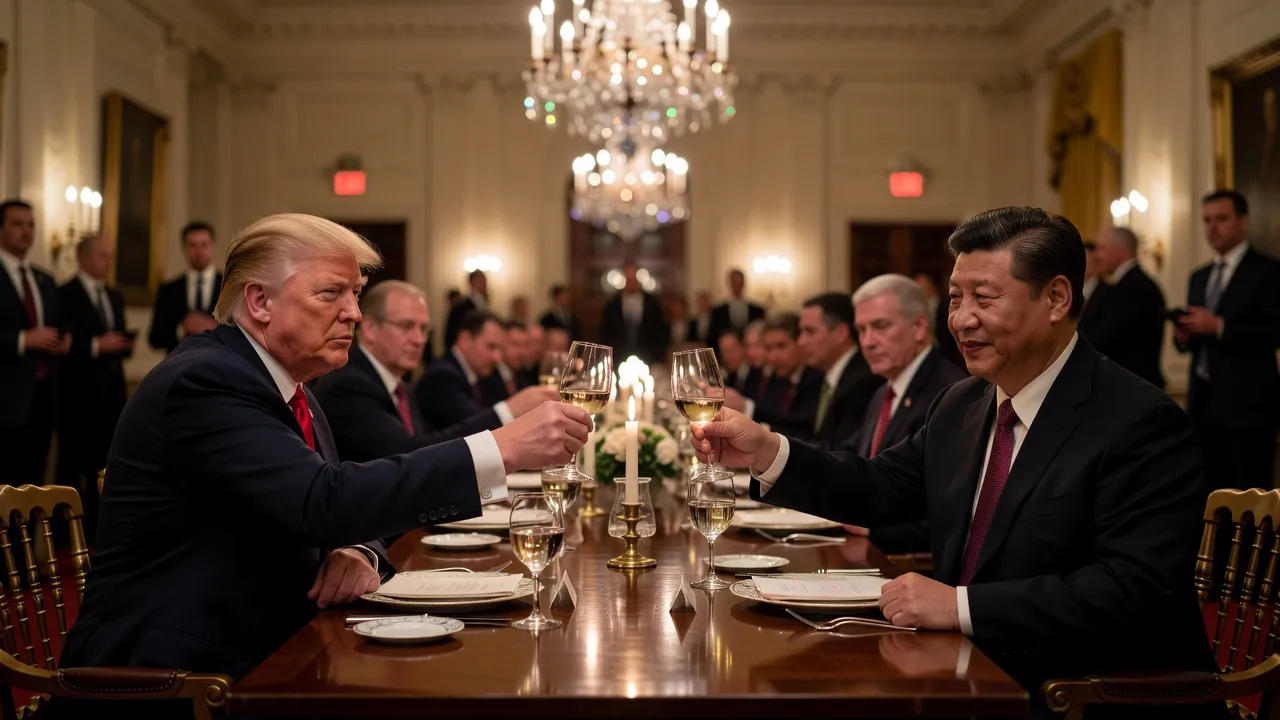
Trump and Xi display their "friendship" at the White House, with a state dinner and pandas but no progress on trade or Taiwan
published on
countries
sources
articles
In 2012, Donald Trump had criticized the red-carpet treatment that Barack Obama had given to Xi Jinping; in May in Beijing, it was the Chinese vice president, not Xi himself, who had received Trump at the airport. This week, Xi Jinping also preferred Washington to the United Nations General Assembly, where dozens of heads of state were gathering in New York.
No agreement was signed beyond the tariff extension; further meetings between the two leaders are planned during the APEC and G20 summits.
A protocol with variable geometry
The Guardian recalls that Donald Trump himself had judged the welcome on the tarmac that Obama had reserved for Xi Jinping in 2012 as "so bad". The reverse gesture, this time offered by Trump to his counterpart, also contrasts with last May: according to the Swedish press, it was the Chinese vice president, and not Xi Jinping, who had welcomed Trump at the airport during his visit to Beijing.
The state dinner revealed an asymmetry on the Chinese side. According to the South China Morning Post, a handful of Chinese business leaders had traveled to Washington at their own expense, hoping for an invitation that never came; no Chinese boss was among the guests, unlike the big names in American tech.
The place occupied by Ivanka Trump, seated in the front row in front of Secretaries of State Marco Rubio and Scott Bessent, has sparked criticism even within the Republican camp, according to The Guardian. The president's daughter wore, for the welcome ceremony, a dress by Chinese designer Guo Pei, notes the Free Press Journal.
The UN is being bypassed, markets are skeptical
The visit coincided with the week of the United Nations General Assembly in New York, where dozens of heads of state were meeting. The Kathmandu Post notes that Xi Jinping did not think it necessary to go there. Richard Gowan, of the International Crisis Group, quoted by the Nepalese daily, observes that it is notable that Xi comes to Washington the same week as the General Assembly without feeling embarrassed about not going to New York, and that many will wonder where the true center of decision-making is.
Financial markets did not follow the protocol enthusiasm. According to Business Recorder, the yuan retreated against the dollar on Thursday, the stock exchanges of Hong Kong and mainland China lost ground, and American tech stocks like Nvidia and Broadcom lost more than 1%, investors being skeptical about a breakthrough at the summit.
Gulf Times highlights a structural imbalance that the meeting did not resolve: the United States covers only 42% of their rare earth needs and will remain, according to data from Benchmark Mineral Intelligence cited by the Qatari daily, importers for nearly a quarter of their demand in five years.
Taiwan, Iran, and the Ukrainian lever
According to Sveriges Radio, Xi Jinping is expected to pressure Trump to secure the complete halt of the suspended arms package destined for Taiwan. The Wall Street Journal, cited by Expressen and Dagens Nyheter, meanwhile describes Chinese support for the Iranian military industry that would continue even as Beijing publicly presents itself as a facilitator between Washington and Tehran.
« If Trump also involves Xi, it could make a difference. Xi has influence over Putin. »
In Kyiv, the meeting is viewed through a single lens: the leverage Washington could exert against Moscow through Beijing. President Volodymyr Zelensky had advocated, on Tuesday, September 22, in New York, for Xi Jinping to be involved in discussions on the Russian war against Ukraine.
Kyiv Post notes that Trump now has a sanctions law allowing him to tax Russia's main trading partners, including China, but that he himself tempered its use in front of Zelensky. The same media outlet notes that Chinese refiners have recently increased their purchases of Russian crude oil.
Criticisms coming from several sides
In the United States, Democratic Senator Chuck Schumer accused Trump of being drawn to authoritarian leaders, according to the South Korean press, and several Democratic lawmakers criticized, according to the Straits Times, a summit deemed rich in pomp and poor in substance.
In Canada, CBC noted a contrast with Washington's trade policy towards its own partners: on the same day the truce with Beijing was extended, US officials continued to criticize Prime Minister Mark Carney for a much more modest agreement, concluded in January, opening the Canadian market to 49,000 Chinese electric vehicles.
In Mexico, the press noted a similar contrast with the language used by Trump towards his own neighbor: before the UN General Assembly, the US president had labeled Mexico the "epicenter of cartels", according to Vanguardia, just a few days before receiving Xi Jinping with the honors of a respected partner.
A judge had ordered the reinstatement of CNN, MS NOW, and Politico's credentials, which were restored around noon only.
The Age· outside the analysed corpusRepublican Thom Tillis described the visit as a "WTF moment", citing increased time spent with despots.
Xi proposed resuming US-Iranian negotiations on the 14-point memorandum concluded several months ago.
How each country reads it
39 perspectives, each in the voice of that country's press.
 Venezuela
Caracas is decoding the meeting between Trump and Xi through the prism of artificial intelligence, the only substantive issue mentioned by the local press beyond the protocol staging of the White House.
2 sources
 Argentina
Buenos Aires sees, behind the pomp of the Trump-Xi summit, what remains unresolved: a trade truce simply extended until January 10, with no agreement on rare earths, Taiwan, or artificial intelligence.
5 sources
 Australia
Canberra is particularly mindful of the lack of agreement on artificial intelligence, the only subject on which Xi Jinping publicly drew a red line in front of Donald Trump, despite the fanfare surrounding the summit.
5 sources
 Bangladesh
Dhaka is measuring the gap between the staging of the Trump-Xi summit and the lack of breakthrough on trade, rare earths or artificial intelligence, with only the trade truce having been extended by two months.
2 sources
 Belgium
Brussels sees this summit as a protocol staging rather than a diplomatic breakthrough: it is by breaking with tradition - a personal welcome at the airport, a red carpet, a state banquet - that Trump compensates for his political weakness, while the only concrete progress remains the extension of the trade truce until January 10.
3 sources
 Brazil
Brasília is measuring the trade repercussions of a highly symbolic but announcement-poor summit, particularly for soy and rare earths.
3 sources
 Canada
Ottawa is particularly mindful of the American double standard on trade: Washington is extending its own truce with Beijing while lecturing Canada over a far more modest agreement on Chinese electric vehicles.
3 sources
 China
ChinaBeijing takes away from this summit the personal relationship displayed far more than the unresolved issues, insisting on the red carpet protocol, the state dinner laden with symbols, and Xi Jinping's call for a relationship of "strategic stability" with Washington.
3 sources
 Colombia
Bogotá is particularly mindful of what the Trump-Xi summit failed to resolve: Taiwan, Iran, and artificial intelligence remain without progress, despite the diplomatic fanfare at the White House.
2 sources
 Germany
Berlin is interpreting the Trump-Xi summit as a demonstration of pomp without substance, where gestures and symbols - red carpet, eagle statue, pandas - took center stage while trade, Taiwan and artificial intelligence remained without agreement.
4 sources
 Denmark
Copenhagen sees the Trump-Xi summit as a diplomatic show masking a ruthless technological struggle between Washington and Beijing, artificial intelligence remaining the real unresolved issue.
3 sources
 Ecuador
Quito sees Xi Jinping's state visit to Washington as a protocolary staging exercise — red carpet, bombers and pandas offered to the Atlanta zoo —, while underlying tensions over trade, Taiwan or artificial intelligence are confined to a single agenda point.
4 sources
 Spain
SpainMadrid notes above all that the Trump-Xi summit did not result in any firm trade agreement, only a two-month extension of the tariff truce, leaving artificial intelligence, Taiwan and Iran up in the air.
4 sources
 Mali
MaliBamako sees the Trump-Xi summit as another round in the Sino-American technological race, rather than a diplomatic breakthrough.
2 sources
 Finland
Helsinki sees the Trump-Xi summit as a confrontation between artificial intelligence powers, where the protocolary pomp and the offered pandas mask the lack of agreement on the technology that will decide the global balance.
4 sources
 France
Paris is deciphering Xi Jinping's state visit as a diplomatic staging exercise where the pomp of protocol masks the lack of breakthrough on substance, from trade to Taiwan.
5 sources
 Indonesia
Jakarta is deciphering the protocolar fanfare deployed in Washington, where the red carpet, state dinner and gift exchange have garnered more attention from the Indonesian press than the commercial and security files left unanswered.
2 sources
 India
IndiaNew Delhi is scrutinizing the Trump-Xi summit through the prism of the "Thucydides trap" cited by Xi Jinping, a debate on the coexistence of rising and established powers that directly resonates with India's own ascent.
3 sources
 Italy
ItalyRome is deciphering Washington's show: beneath the red carpet and the pandas, a displayed friendship that, according to the Italian press, masks deep divergences over Taiwan, Iran, and trade.
5 sources
 Japan
JapanTokyo is mainly gauging what the Trump-Xi summit did not settle: neither on Taiwan, nor on artificial intelligence, nor on trade, despite the display of a "very great friendship".
2 sources
 South Korea
Seoul notes above all that the renewed trade truce extends its own "Busan agreement", while the Korean peninsula and a potential Trump-Kim meeting remain pending the outcome of the summit.
4 sources
 Mexico
Mexico City denounces the huge disparity: red carpet, state dinner and pandas for Xi Jinping, when Washington recently called its own neighbor the "epicenter of cartels" before the UN.
4 sources
 Malaysia
Kuala Lumpur views the extended trade truce between Washington and Beijing as a temporary reprieve, not a resolution, for a Malaysian economy heavily reliant on trade flows between its two largest partners.
2 sources
 Nigeria
Abuja downplays Washington's show: beyond the red carpet, the state dinner, and the pandas, the Nigerian press mainly notes a two-month extension of the trade truce and the lack of breakthrough on Taiwan, Iran, or artificial intelligence.
2 sources
 Nepal
NepalKathmandu is questioning the marginalization of the UN as Trump and Xi negotiate one-on-one in Washington, far from the General Assembly in New York.
4 sources
 Peru
PeruLima is separating the protocolary staging of the Trump-Xi summit from its concrete results, which have been reduced to a prolonged trade truce without Chinese confirmation and exchanges without an agreement on AI, Taiwan, or Iran.
3 sources
 Pakistan
Islamabad is gauging the Trump-Xi agreement by what was not signed: the trade truce has been extended by only two months, far from market expectations, while rare earths, chips, and Taiwan remain pending.
5 sources
 Poland
Warsaw is dissecting a "historic moment" proclaimed by Xi Jinping without any concrete agreement ever being mentioned, between diplomatic ritual and silence on substance.
2 sources
 Portugal
Lisbon retains from the summit less the protocolary staging of friendship than the direct warning from Xi Jinping to Trump about Taiwan, coupled with a snag over the freedom of the American press.
3 sources
 Qatar
QatarDoha is particularly mindful of what the Trump-Xi summit did not resolve: a trade truce extended by only two months and a US dependence on Chinese rare earths that stretches into the 2030s.
2 sources
 Romania
Bucharest is deciphering the Trump-Xi meeting through a technological lens: beyond the protocolary pomp, the Romanian press is mainly retaining the unprecedented convergence between Washington and Beijing against any regulation of artificial intelligence.
2 sources
 Russia
Moscow sees in the protocolar fanfare deployed in Washington a diplomatic ritual rich in symbols — red carpet, military flyovers, state dinner — but poor in concrete agreements, with expectations of a breakthrough remaining, according to local press, "modest".
3 sources
 Sweden
Stockholm is deciphering Washington's diplomatic display by comparing it to what it leaves in the shadows: the alleged Chinese support for Iran's military industry, Beijing's pressure on arms deliveries to Taiwan, and Xi's warning against the "Thucydide trap".
5 sources
 Singapore
Singapore sees the Trump-Xi summit as "diplotainment": beneath the pandas and state dinner, no progress on trade, Taiwan, rare earths or AI, and the trade truce is only extended until January 10.
2 sources
 Thailand
Bangkok is measuring the extended trade truce until January 10 and the pomp of Xi Jinping's state visit, with no progress on Taiwan, chips, or artificial intelligence.
2 sources
 Ukraine
Kyiv is watching this summit with one question in mind: will Trump use his new sanctions leverage to force Xi to drop Putin, or will the Trump-Xi relationship remain a matter of trade rather than peace?
3 sources
 United Kingdom
London is separating the ceremonial pomp displayed in Washington from the lack of any progress on trade, Taiwan or artificial intelligence.
4 sources
 United States
The United States is rolling out the red carpet for a leader it yesterday called a "global menace", a contrast its own press notes without progress on Taiwan, trade, or AI.
7 sources
 South Africa
Pretoria is particularly mindful of what the Washington summit failed to address: neither trade, nor Taiwan, nor artificial intelligence, with the tariff truce merely being extended by two months behind the ceremonial protocol.
5 sources
What the comparison reveals
Common ground and differences in coverage across the media analysed.
What the media report in common
The narrative of the summit is dominated, in most coverage, by the protocolary pomp of the reception (red carpet, personal welcome by Trump at Andrews base, state dinner) rather than the content of the discussions.
The Sino-American trade truce, which was due to expire on November 10, was only extended until January 10, an announcement made by Treasury Secretary Scott Bessent upon Xi Jinping's arrival.
No progress was announced at the end of the meeting on trade, Taiwan, rare earths, or artificial intelligence.
Where media coverage diverges
Portée du sommet
Une question commune traverse la couverture : le sommet marque-t-il une avancée substantielle dans la relation bilatérale ou une opération d'image sans contenu tranché ? La presse chinoise le présente comme un moment historique de partenariat retrouvé, tandis qu'une partie de la presse anglophone le lit comme une démonstration de faste sans percée, voire une incohérence de la politique commerciale américaine.
Coverage aligned with this reading
Coverage that diverges
Régulation de l'IA
Sur la question de savoir si Washington et Pékin convergent ou s'opposent sur la régulation de l'intelligence artificielle, une partie de la presse rapporte les propos de Trump affirmant que les deux pays s'accordent contre toute nouvelle règle, tandis qu'une autre partie rapporte l'appel explicite de Xi Jinping à un développement de l'IA maintenu « sous contrôle humain », que Trump qualifie par ailleurs de « canular ».
Coverage that diverges
Enjeu central du sommet
À la question de savoir quel dossier constitue l'enjeu le plus déterminant du sommet, une partie de la presse retient la rivalité technologique en intelligence artificielle comme l'axe véritable derrière le protocole, tandis qu'une autre partie retient prioritairement les répercussions commerciales et financières (marchés, terres rares, agro-industrie) du duel sino-américain.
This grouping describes the publications analysed, not the position of these countries’ populations or of their governments.
The full text, country by country
Venezuela
DOMINANT ANGLE
Caracas is decoding the meeting between Trump and Xi through the prism of artificial intelligence, the only substantive issue mentioned by the local press beyond the protocol staging of the White House.
KEY POINTS
- Trump called the meeting a "gran reunión" after more than three hours of closed-door talks on Thursday, September 24, 2026, according to Efecto Cocuyo
- This is Xi Jinping's first state visit to the White House since 2015 and his second face-to-face meeting with Trump this year, after Trump's trip to Beijing in May
- Trump claims that China and the US are opposing new regulations on artificial intelligence together, a subject that "will be a major theme", according to El Nacional
ANALYSIS
Caracas, Friday, September 25, 2026. From Caracas, the independent press details the cordial staging deployed by Donald Trump to receive Xi Jinping at the White House, Thursday, September 24, 2026, after more than three hours of closed-door talks in the Oval Office. "Gran reunión. Gracias," Trump said to the press as he greeted his Chinese counterpart around 1:30 p.m. local time on the steps of the West Wing, reports Efecto Cocuyo. Before parting ways, the American president gave Xi a tour of the presidential residence's gardens, showing him the new heliport and the construction of a large ballroom, jokingly calling him an "expert in stone [...] who loves good granite," without Xi responding to journalists.
The visit, which began at 10:00 a.m. local time with a military ceremony, marks Xi Jinping's first state visit to the White House since 2015, under the Obama presidency, and the second face-to-face meeting between the two leaders this year, after Trump's trip to Beijing in May. A state dinner awaited Xi and his wife Peng Liyuan that evening, hosted by Trump and Melania Trump, while the two first ladies visited the Smithsonian's National Museum of Asian Art during the day.
El Nacional situates the real stake of the summit beyond protocol: a bilateral summit focused on the trade truce, Iran, Taiwan, and artificial intelligence. On the latter point, Trump stated that China and the United States "oppose" together the new regulations on AI, promising that the subject "will be a major theme" of discussion and presenting the US Department of Justice as his own "barrier of contention." However, no numerical announcement accompanies this claimed convergence on trade, Taiwan, or rare earths.
For the Venezuelan press, the image of a red carpet and a displayed understanding between Washington and Beijing contrasts with the absence of any concrete commitment on AI, left in the state of a statement of intention rather than a common framework between the two powers.
Argentina
DOMINANT ANGLE
Buenos Aires sees, behind the pomp of the Trump-Xi summit, what remains unresolved: a trade truce simply extended until January 10, with no agreement on rare earths, Taiwan, or artificial intelligence.
KEY POINTS
- Scott Bessent confirmed the extension of the Sino-American trade truce until January 10, although it was set to expire on November 10
- Xi Jinping was welcomed at Andrews Base with a red carpet, 21 gun salutes, and a flyover of B-1 bombers, a protocol already used by Trump for Vladimir Putin in 2025
- Xi Jinping announced the sending of two pandas, Ping Ping and Fu Shuang, to the Atlanta zoo for a ten-year stay
ANALYSIS
Buenos Aires, September 25, 2026. The Argentine press details above all what has not changed at the end of the Trump-Xi summit in Washington: the trade truce between the two largest economies in the world, simply extended until January 10, without a fundamental agreement on rare earths, agricultural trade, artificial intelligence, or Taiwan. Ámbito recalls that Xi Jinping arrived on Wednesday, September 23, for his first state visit to Washington in eleven years, received by Trump on the Andrews base tarmac with a red carpet, artillery salutes, and a flyover of B-1 bombers — a protocol that the Republican had already reserved for Vladimir Putin in 2025, in Alaska.
The Secretary of the Treasury, Scott Bessent, confirmed, on the eve of the summit, that the Busan agreement, which was supposed to expire on November 10, was extended "until January 10, to give us more time on the economic front," according to remarks relayed by Ámbito. The discussions with Chinese Vice Premier He Lifeng, which began over the weekend in New York, also resulted in a technological cybersecurity protocol and the opening of a dialogue on $30 billion in tariffs, without any announced result on Thursday, September 24.
On Thursday, at the White House, Xi pleaded for "peaceful coexistence" and "healthy" competition, which must "remain within certain limits": "a race where each seeks to catch up with the other, not an arm-wrestling match where one wins and the other loses," according to El Cronista. He warned that China and the United States "have a lot to gain from cooperation and will both lose with confrontation." Trump, for his part, mentioned "considerable" advances towards a more "balanced" trade relationship.
Clarín highlights the Chinese reading of the reception: for Fudan Institute Dean Wu Xinbo, quoted by The Paper, the pomp translates to Trump's "respect" and his desire to score points before the November midterm elections. Infobae notes that the state dinner brought together technology leaders, while Ámbito, in a broader analysis, emphasizes that these summits "also affect Argentina," caught between the Sino-American technological competition and the parallel expansion of the BRICS and the Shanghai Cooperation Organization, where Xi had traveled before Washington.
Australia
DOMINANT ANGLE
Canberra is particularly mindful of the lack of agreement on artificial intelligence, the only subject on which Xi Jinping publicly drew a red line in front of Donald Trump, despite the fanfare surrounding the summit.
KEY POINTS
- The tariff truce has been extended until January 10, 2027, although it was set to expire in November, announced Treasury Secretary Scott Bessent.
- Xi Jinping stated that artificial intelligence must remain "under human control", while Trump said he wants to "leave it exactly where it is".
- CNN, Politico, and MS NOW were prevented from covering Xi's arrival despite a court ruling ordering the restoration of their access, which was only restored around noon.
ANALYSIS
Canberra, Friday, September 25, 2026. Australian media describe a Trump-Xi summit saturated with symbols but poor in decisions. Donald Trump welcomed Xi Jinping directly on the tarmac of Joint Base Andrews on Wednesday, a personal courtesy that Beijing had denied him during his own visit in May. The American president vaunted their "very great friendship" and assured that the two countries had "never understood each other better". On Thursday, a state dinner bringing together around 130 guests mixed military pomp and economic diplomacy: among the guests, Elon Musk, Mark Zuckerberg, Sam Altman, and Jensen Huang, as well as the leaders of Boeing, BlackRock, Blackstone, and Paramount Skydance. Xi, for his part, was accompanied by no Chinese business leaders, only high-ranking officials of the Communist Party. Trump offered an eagle statue; Xi announced the sending of two pandas to the Atlanta zoo and the hosting of 100,000 American high school students in China over five years.
But the Australian press insists: behind the pomp, no substantial progress was announced on trade, Taiwan, Iran, or artificial intelligence. The only concrete decision, the tariff truce was extended until January 10, 2027, while it was to expire in November, announced Treasury Secretary Scott Bessent. On AI, Xi repeated that its development must remain "always under human control", in contrast to Trump, who said he wants to "leave it exactly where it is" and speaks of "super intelligence". Xi again invoked the "Thucydides trap", the risk of war when a rising power displaces another established one — this time judging that it "can be overcome".
Another thread followed in Canberra: press access. CNN, Politico, and MS NOW were excluded from covering Xi's arrival despite a court decision ordering their reinstatement, which was only reestablished around noon. The major American networks did not broadcast the event live, in solidarity with CNN. For Australian media, this summit is more a matter of diplomatic theater than a substantive negotiation between the two largest global economies, the question of artificial intelligence remaining, more than trade or Taiwan, the point of friction that neither Washington nor Beijing has really settled.
Bangladesh
DOMINANT ANGLE
Dhaka is measuring the gap between the staging of the Trump-Xi summit and the lack of breakthrough on trade, rare earths or artificial intelligence, with only the trade truce having been extended by two months.
KEY POINTS
- The trade truce, which was set to expire on November 10, has been extended by only two months, until January 10, according to Treasury Secretary Scott Bessent.
- Xi Jinping has drawn red lines on AI, Taiwan, and Iran, calling for the development of artificial intelligence "always under human control".
- The state dinner brought together tech leaders (Musk, Cook, Huang, Altman), a sign that trade and AI dominated the agenda without resulting in any concrete announcements.
ANALYSIS
Dacca, Friday, September 25, 2026. Bangladeshi newspapers sum up the Washington summit in one image: a lot of pomp, little substance. The Daily Star and TBS News report that Donald Trump reserved an unprecedented welcome for Xi Jinping at Joint Base Andrews on Wednesday, with a military parade, a flyover by a B-1 bomber, and a tour of the Marine One helicopter, before a state dinner on Thursday where the American president offered his guest an eagle statue. The local press notes that this pomp occurred "after a day of pomp and ceremony that masked deep tensions" between the two powers, according to a phrase taken from The Daily Star.
What Dacca retains above all is what was not achieved. The trade truce, which was supposed to expire on November 10, was extended by only two months, until January 10, according to Treasury Secretary Scott Bessent, cited by TBS. Disagreements remain intact on export controls for rare earths and semiconductors, as well as on Beijing's ties with Iran. For an export-oriented economy like Bangladesh, dependent on textile and technological supply chains, the lack of a trade breakthrough between Washington and Beijing is seen as a signal of prolonged uncertainty rather than appeasement.
The presence, at the dinner, of American tech big names, Elon Musk, Apple's Tim Cook, Nvidia's Jensen Huang, and OpenAI's Sam Altman, confirms, according to TBS, that trade and artificial intelligence dominated the agenda of the visit, without any concrete announcement coming out of it. Xi Jinping set his own red lines on AI, Taiwan, and the war in Iran, advocating for the development of artificial intelligence "always under human control", in contrast to a more casual Trump on these risks.
Despite Trump's warm words about their "very great friendship" and the "considerable progress" mentioned, the Bangladeshi press highlights the contrast with Xi's measured tone, who called on the two countries to "coexist in peace" and act as "responsible great powers". Protesters gathered in front of the White House chanted "Xi Jinping is not welcome" and "Free Hong Kong", the articles recall.
For Dacca, this summit confirms above all the fragility of a balance between the two giants on which depend, indirectly, the commercial outlets and technological investments of Bangladesh.
Belgium
DOMINANT ANGLE
Brussels sees this summit as a protocol staging rather than a diplomatic breakthrough: it is by breaking with tradition - a personal welcome at the airport, a red carpet, a state banquet - that Trump compensates for his political weakness, while the only concrete progress remains the extension of the trade truce until January 10.
KEY POINTS
- Trump broke protocol by personally greeting Xi Jinping at Andrews Air Force Base on Wednesday evening, a gesture usually reserved for a minister.
- The trade truce between Washington and Beijing has been extended until January 10, although it was set to expire on November 10, according to Treasury Secretary Scott Bessent.
- According to a Chicago Council on Global Affairs survey cited by the VRT, 41% of Americans view China's territorial ambitions as a threat, compared to 52% in 2022.
ANALYSIS
Brussels, September 25, 2026. For the Belgian press, the Trump-Xi summit is seen less as a diplomatic breakthrough than as a carefully staged production. The VRT notes that Donald Trump broke with protocol by personally welcoming Xi Jinping on the tarmac of Andrews Air Force Base on Wednesday evening, a gesture that no American president normally makes for a foreign leader, usually reserved for a minister. The Flemish channel sees this as a sign of weakness rather than strength: Trump's popularity is at an all-time low in his two terms, the war against Iran that he himself triggered in February has kept the strait almost closed and driven up diesel prices, and Americans will renew their Congress in six weeks. "Trump hopes to buy results with the only thing he can offer for free: honor," the VRT summarizes, recalling that in 2017 he had offered a simple chocolate cake at Mar-a-Lago, compared to a state banquet for 125 guests in the East Room this time.
La Libre Belgique and the DH emphasize the same disruption of protocol, with a red carpet, military flyover, and arrival ceremony, before highlighting the only tangible result of the visit: the extension of the trade truce until January 10, announced by Treasury Secretary Scott Bessent on Fox News, whereas the initial agreement was set to expire on November 10. No other progress is mentioned regarding Taiwan, chips, or artificial intelligence, topics that were nonetheless announced on the agenda for Thursday's talks at the White House. Xi Jinping, quoted by the Xinhua news agency, called on the two countries to be "partners rather than rivals" and nodded to Trump's slogan by mentioning the "great renewal of the Chinese nation" going hand in hand with "making America great again."
The VRT nonetheless nuances the balance of power by citing a survey by the Chicago Council on Global Affairs: only 41% of Americans today consider China's territorial ambitions a threat, compared to 52% in 2022, and 57% advocate for cooperation, even if 63% of Trump's MAGA base demands the opposite. The portrait of Peng Liyuan, a former singing superstar who became a brigadier general before becoming first lady, completes the Belgian coverage, which focuses more on the decor and personal relationships than on a substantive assessment.
Brazil
DOMINANT ANGLE
Brasília is measuring the trade repercussions of a highly symbolic but announcement-poor summit, particularly for soy and rare earths.
KEY POINTS
- G1 identifies the agro-industry (soy) and mining (rare earths) as the two sectors most exposed to the fallout from the Trump-Xi summit.
- The Sino-American trade truce has been extended until January 10, 2027, with no agreement concluded on the $30 billion in customs tariffs under negotiation.
- Xi Jinping announced the sending of two pandas, Ping Ping and Fu Shuang, to the Atlanta zoo, while Trump presented a sculpture of an eagle to his host during the state dinner.
ANALYSIS
Brasília, September 25, 2026. The Brazilian press first notes what the meeting between Donald Trump and Xi Jinping, on Thursday at the White House, does not change for the country: nothing has been decided on trade, Taiwan, rare earths, or artificial intelligence, but the tariff truce has been extended until January 10, 2027. G1 emphasizes that "for Brazil, two sectors concentrate a significant part of the possible effects: agro-industry, particularly soybeans, and mining," in the face of international research for suppliers of rare earths outside of China. The media also details the ongoing negotiation on a mutual withdrawal of customs tariffs on approximately $30 billion worth of non-sensitive products, as well as the taxes imposed on Chinese ships in American ports — points that weigh on the trade routes that Brasília depends on.
The protocol took up most of the day: a red carpet at Andrews Base, a troop review, a flyover by a B-2 bomber, and then a state dinner attended by American business leaders — Tim Cook, Jensen Huang, Elon Musk, Jeff Bezos, Sam Altman, and Lisa Su, according to the Estadão. Trump assured that the two countries "have never understood each other better," despite "different systems," before offering Xi a sculpture of an eagle. Xi announced the sending of two pandas, Ping Ping and Fu Shuang, to the Atlanta zoo, presented as "emissaries of friendship" between the Chinese and Americans.
The Folha de S.Paulo emphasizes Taiwan as the true stake: Beijing would seek to indefinitely postpone the sale of $14 billion worth of American arms to the island, a file that Xi already qualified as potentially "extremely dangerous" in May. Trump promised to make artificial intelligence a "major topic of discussion," while wanting to maintain the rules "exactly as they are." For Brasília, the absence of a concrete announcement on these areas of technological and military rivalry prolongs the uncertainty that weighs on global supply chains — and therefore on Brazilian agricultural and mining markets. The New York Stock Exchange indeed opened lower on Thursday, the Estadão noted, in a climate of caution preceding the meeting.
Canada
DOMINANT ANGLE
Ottawa is particularly mindful of the American double standard on trade: Washington is extending its own truce with Beijing while lecturing Canada over a far more modest agreement on Chinese electric vehicles.
KEY POINTS
- Washington announced on Wednesday a two-month extension of the trade truce with Beijing, now set for January 10, according to Treasury Secretary Scott Bessent.
- In January, 49,000 Chinese electric vehicles were accepted with a tariff reduced from 100% to 6.1%, in exchange for a decrease in Chinese duties on Canadian canola, peas, lobster, and crab.
- Xi Jinping urged Trump, according to the Xinhua agency, to "adhere to the correct position of opposing Taiwan's independence", with no known public response to date.
ANALYSIS
Ottawa, September 25, 2026. For the Canadian press, the Trump-Xi summit in Washington is more about staging than diplomacy — and it mainly highlights, by contrast, Ottawa's trade policy towards Beijing. Xi Jinping was welcomed on Wednesday on the tarmac of Andrews Air Force Base by Donald Trump, with a 30-meter red carpet, honor guard, and a flyover of B-1 bombers. The American president called his counterpart a "great leader," while his administration extended, on the same day, the bilateral trade truce by two months, until January 10, according to an announcement by Treasury Secretary Scott Bessent. On Thursday, the summit at the White House — less than two hours of closed-door talks, with no official statement released — was followed by a state dinner that included a list of guests "heavy with tech CEOs," between Chilean bars in sesame crust and protesters chanting "China out of Hong Kong" in front of the gates. Xi pleaded for "healthy and limited" competition rather than a zero-sum confrontation, and urged Trump, according to the Xinhua agency, to "adhere to the correct position of opposing Taiwan's independence" — a request that remained without a public response, while Washington has already delayed a $14 billion US arms contract for Taipei by several months. But it's the discrepancy with the Canadian file that is drawing attention in Ottawa. CBC notes that Washington, in the midst of a charm offensive towards Beijing, continues to scold Prime Minister Mark Carney for a much more modest agreement concluded in January: the entry of 49,000 Chinese electric vehicles in exchange for a tariff reduced from 100% to 6.1%, against a reduction in Chinese duties on Canadian canola, peas, lobster, and crab. Commerce Secretary Howard Lutnick said, "Carney has a problem with us, he gets on a plane and goes to China?" while Transportation Secretary Sean Duffy predicted that Carney would "regret" his decision. Jia Wang, from the China Institute at the University of Alberta, sees this as a demonstration that Washington demands from its partners what it allows itself. The Canadian press, while covering the pomp of the summit — bombers, fanfare, tea planned for Friday between the two presidential couples — mainly retains this commercial double standard, more than the issues of AI, Taiwan, or Iran, which were left without any announced progress.
China
DOMINANT ANGLE
Beijing takes away from this summit the personal relationship displayed far more than the unresolved issues, insisting on the red carpet protocol, the state dinner laden with symbols, and Xi Jinping's call for a relationship of "strategic stability" with Washington.
KEY POINTS
- Xi Jinping states in his welcome speech: "China and the United States should be partners, not rivals"
- The tariff truce, which was set to expire in November, has been extended by two months until January 10, according to the South China Morning Post
- Major American networks (ABC, CBS, CNN, Fox, NBC) boycotted live coverage of Trump's events due to CNN's exclusion
ANALYSIS
Beijing, Friday, September 25, 2026. China's official press has not restrained its enthusiasm on the second day of Xi Jinping's state visit to Washington. CGTN broadcast the full text of the speech delivered by the Chinese president at the White House welcoming ceremony, in which he stated that "China and the United States should be partners, not rivals" and that "the great rejuvenation of the Chinese nation and making America great again can go hand in hand." Xi Jinping called for "putting into action" the vision of a "constructive" relationship and "strategic stability" sealed with Donald Trump during his visit to Beijing in May.
According to the ECNS agency, the economic teams of the two countries have reached a "new joint arrangement," described by Xi Jinping, according to the Xinhua agency, as "good news for businesses, ordinary citizens, and the global economy," without its content being detailed. The South China Morning Post notes that the tariff truce, which was due to expire in November, has been extended by two months, until January 10 — a duration considered "shorter than expected" by a quoted economist, but "positive."
On artificial intelligence, Xi Jinping said he sees "more reasons to cooperate than to rival," advocating for permanent human control of the technology. Neither Taiwan nor Iran is mentioned in the official statements reported by Chinese media.
Protocol occupies a large place in the coverage: a welcome on the tarmac of Andrews Base, a 21-gun salute, a military flyover, and then a state dinner where the South China Morning Post details a toast with Californian wine inspired by the "Toast to Peace" of 1972 between Nixon and Zhou Enlai, and a reminder of the 1868 Chinese diplomatic mission. A handful of Chinese business leaders, who arrived separately from the official delegation, were still waiting for an invitation to the dinner.
The Hong Kong press notes that major American networks have boycotted live coverage of the events due to a dispute over the exclusion of CNN, limiting the broadcast of Xi Jinping's arrival to a few digital media outlets. A joke by Donald Trump targeting Joe Biden reportedly made Xi Jinping laugh in front of the "presidents' gallery." The two leaders reaffirmed their support for the APEC summits in November in Shenzhen and the G20 in December in Miami, paving the way for two new meetings.
Colombia
DOMINANT ANGLE
Bogotá is particularly mindful of what the Trump-Xi summit failed to resolve: Taiwan, Iran, and artificial intelligence remain without progress, despite the diplomatic fanfare at the White House.
KEY POINTS
- Xi Jinping has announced the sending of two giant pandas, Ping Ping and Fu Shuang, to the Atlanta zoo, presented as a gesture of friendship between the Chinese and American peoples
- According to Xinhua cited by La República, Xi asked Trump to maintain American opposition to "Taiwan independence" and to exercise caution on this issue
- Xi supported the resumption, between Washington and Tehran, of the provisional agreement concluded in June to end the war and reopen the Strait of Hormuz
ANALYSIS
Bogotá, September 25, 2026. The Colombian press closely followed the state visit of Xi Jinping to Washington, the first by a Chinese president to the White House in over a decade. Xi arrived on Wednesday at Andrews Air Force Base, on the outskirts of the US capital, where Donald Trump welcomed him. On Thursday, the official ceremony in the White House gardens, attended by the two first ladies, Melania Trump and Peng Liyuan, and the delegations of the two countries, preceded a closed-door meeting in the Oval Office, reportedly focused on "Iran, Taiwan, and foreign trade," according to Portafolio. Trump described the visit as "historic" and stated: "President Xi and I will continue to work together to forge a better future for our two nations."
The most commented-on gesture by the Colombian media remains the announcement, made by Xi himself during the welcoming ceremony, of the sending of two giant pandas, Ping Ping and Fu Shuang, to the Atlanta zoo. "The giant panda has been an emissary of friendship between the Chinese and American peoples. I have good news," the Chinese leader said. The two presidents were also photographed together on the "Presidential Walk of Fame," the White House colonnade, before heading to the Oval Office to discuss Iran, Taiwan, and trade.
In substance, La República reports, citing the Chinese agency Xinhua, that Xi asked Trump to maintain US opposition to "Taiwan's independence" and to act with caution on this sensitive issue. Beijing also demands an end to US arms sales to the island, which Washington continues to supply in the name of its "one China" policy. Xi also supported the resumption of the provisional agreement between Washington and Tehran, concluded in June to end the war and reopen the Strait of Hormuz.
No announcement, however, was made regarding tariffs, rare earths, or artificial intelligence, issues that Portafolio lists among the tensions surrounding the meeting. For the Bogotá press, the contrast between the carefully staged event, with pandas, colonnade, and state dinner, and the lack of concrete results on power issues summarizes the nature of this summit between the world's two largest economies.
Germany
DOMINANT ANGLE
Berlin is interpreting the Trump-Xi summit as a demonstration of pomp without substance, where gestures and symbols - red carpet, eagle statue, pandas - took center stage while trade, Taiwan and artificial intelligence remained without agreement.
KEY POINTS
- The customs truce has only been extended until January 10, without an agreement on rare earths, technology, or agriculture, according to Die Zeit
- No Chinese business leader attended the state dinner despite last-minute hopes, while Musk, Jensen Huang, Zuckerberg, Tim Cook, and Sam Altman were there, according to the FAZ
- Trump personally went to greet Xi on the tarmac, a first for an American president towards a Chinese head of state, according to the FAZ and Tagesschau
ANALYSIS
Berlin, September 25, 2026. The German press is particularly highlighting the contrast between the staging and the lack of results from the Trump-Xi summit in Washington. The Frankfurter Allgemeine Zeitung (FAZ) simply headlines "Gesten statt Ergebnisse" (gestures, not results): on Thursday, Donald Trump personally went to pick up Xi Jinping on the tarmac, a first for an American president towards a Chinese head of state, while Xi, in a Zhongshan suit as during the state dinner with Barack Obama in 2015, mentioned in his toast "a friendship forged in blood and fire" that "will last for generations", recalling Nixon's precedent in Beijing in 1972. Trump repeated on Friday that the two countries had "never been better understood".
The Tagesschau notes that the list of topics - AI, trade, Ukraine, Taiwan - remained long, but that the summit mainly offered "pomp and circumstance, little substance", according to former American diplomat Jeff Moon. The only concrete announcement from the opening: the extension of the customs truce, with the suspension of surtaxes and export restrictions until January 10. Trump offered Xi a white-headed eagle statue; Xi announced the sending of two pandas to the Atlanta zoo, presented as "ambassadors of friendship", and the invitation of 100,000 young Americans to China over five years.
The Handelsblatt emphasizes a contrast: American soldiers photographed on their knees, removing the last threads of the red carpet before Xi's arrival, while Washington still classifies Beijing as a threat in its strategic documents and accuses it of supporting Russia and Iran. The FAZ also documents the notable absence of Chinese bosses at the state dinner despite their hopes until the last minute: the list of guests included Elon Musk, Jensen Huang, Mark Zuckerberg, Tim Cook, Sam Altman, the Frenchman Bernard Arnault, and the German Michael Miebach (Mastercard) - but no Chinese leaders.
For Die Zeit, this summit is among "the strangest state visits in recent US history": Trump excluded several media outlets, leaving Chinese state channels to cite the event to their advantage, while Taiwan, rare earths, technology, and agriculture remain without an agreement.
Denmark
DOMINANT ANGLE
Copenhagen sees the Trump-Xi summit as a diplomatic show masking a ruthless technological struggle between Washington and Beijing, artificial intelligence remaining the real unresolved issue.
KEY POINTS
- This is the first visit by a Chinese president to the White House since 2015, according to DR Nyheder.
- Xi Jinping offered two pandas intended for the Atlanta zoo, a traditional gesture of Chinese diplomacy; Berlingske recalls that the panda couple at the Copenhagen zoo is also a gift from Beijing.
- Trump and Xi have met three times since Trump's return to power in January of last year, with no announced progress on trade, Taiwan, or artificial intelligence.
ANALYSIS
Copenhagen, September 25, 2026. For the Danish press, the pomp displayed on Thursday, September 24, 2026, at the White House around Xi Jinping and Donald Trump should not mask the essential: the real battle is being fought over technology, not protocol. Berlingske, in an analysis published on Friday, September 25, 2026, summarizes the scene in one sentence: "bag grin og galla udkæmper Kina og USA en nådesløs magtkamp om fremtidens teknologi" — behind the smiles and the gala, China and the United States are engaged in a merciless struggle for the future of technology. The media describes a Trump betting everything on speed, without rules, against a Xi who "plays the game" of his host's spectacle while aiming for decisive victory.
The decorum, however, was meticulous. According to DR Nyheder, this is the first visit by a Chinese president to the White House since 2015; it comes at a time when the relationship between the two largest economies in the world remains marked by trade conflict, customs duties, and technological and security rivalry — without this being visible at the reception of the two presidential couples, where "a small smile" could be guessed from the two leaders. Taiwan, Ukraine, and Iran were among the expected topics, without any announcement at this stage.
Politiken notes that Trump "rolled out the red carpet" for Xi, traveling in person to Joint Base Andrews, a rare honor — while judging that this "will not be enough" for the Chinese president. The daily also notes that Trump wore black gloves, possibly to hide a bruise on his right hand that he usually conceals with makeup.
According to Berlingske, Trump hailed their "virkelig gode venskab" (very great friendship), stating that he had made "enormous progress" with Xi on common issues, while Xi offered two pandas intended for the Atlanta zoo — a traditional gesture of Chinese diplomacy, recalls the newspaper, which emphasizes that the pair of pandas at the Copenhagen zoo is also a gift from Beijing. On artificial intelligence, Xi was more measured than Trump, calling for development "always under human control" and "for the benefit of all". The two leaders have met three times since Trump's return to power in January of last year, but no concrete progress has been reported at this stage on trade, Taiwan, or artificial intelligence.
Ecuador
DOMINANT ANGLE
Quito sees Xi Jinping's state visit to Washington as a protocolary staging exercise — red carpet, bombers and pandas offered to the Atlanta zoo —, while underlying tensions over trade, Taiwan or artificial intelligence are confined to a single agenda point.
KEY POINTS
- Donald Trump and Melania Trump traveled to Andrews Air Force Base to greet Xi Jinping and his wife Peng Liyuan on the tarmac, breaking with the usual protocol of receiving heads of state at the White House.
- This is Xi Jinping's first state visit to Washington since 2015, and his third meeting with Trump since his return to power, after Busan and Beijing.
- Xi Jinping announced the sending of two pandas, Ping Ping and Fu Shuang, to the Atlanta zoo, calling the agreement "good news" for the friendship between the Chinese and American peoples.
ANALYSIS
Quito, September 25, 2026. The Ecuadorian press followed Xi Jinping's state visit to Washington, emphasizing the protocol staging rather than the content of the discussions. On Wednesday, September 23, Donald Trump and First Lady Melania Trump personally traveled to Andrews military base, on the outskirts of Washington, to welcome Xi Jinping and his wife Peng Liyuan on the tarmac — a gesture described as "unusual", breaking with the tradition of receiving foreign heads of state at the White House rather than at the airport. The ceremony included national anthems, a guard of honor, a military formation, and a flyover by two B-1 bombers, as well as a red carpet deployed from the plane's gangway.
This is Xi Jinping's first state visit to the White House in over a decade, since 2015 under Barack Obama, and his third in-person meeting with Trump since the Republican's return to power, after Busan and Beijing. Xi Jinping, who arrived on an Air China plane, is scheduled to remain in the United States until September 25.
According to Ecuadorian media, the central day of the visit, Thursday, September 24, brought the two presidents together at the White House for a bilateral meeting addressing the tariff truce, the war in Iran, the future of Taiwan, critical minerals, and the artificial intelligence race. Xi Jinping asked Trump for a relationship of "socios, no rivales" — partners, not rivals — between China and the United States.
The most reported gesture by the local press remains Xi's announcement, made during the welcoming ceremony, of the sending of two giant pandas, Ping Ping and Fu Shuang, to the Atlanta zoo. Xi called the agreement "good news" and praised the panda loan program as proof of the friendship between the Chinese and American peoples. Ecuadorian media link this gesture to the historical practice of "panda diplomacy", recalling that in 2024 the Atlanta zoo had returned its two previous specimens to China after a 25-year loan.
This emphasis on protocol and animal symbols, rather than the concrete results of the discussions, illustrates how the Ecuadorian press perceives this summit: a bilateral image exercise, where underlying tensions — trade, technology, Taiwan — remain in the background of official announcements.
Spain
DOMINANT ANGLE
Madrid notes above all that the Trump-Xi summit did not result in any firm trade agreement, only a two-month extension of the tariff truce, leaving artificial intelligence, Taiwan and Iran up in the air.
KEY POINTS
- The tariff truce between Washington and Beijing, set to expire on November 10, has been extended by two months thanks to negotiations led in New York by Scott Bessent and He Lifeng.
- Xi Jinping called for "healthy" and "limited" competition, advocating for a race "where we catch up with each other, not a struggle where one wins and the other loses".
- The fourth session of trade negotiations between the United States and Mexico on the USMCA, scheduled for next week, has been postponed without a new date due to the priority given to Xi's visit.
ANALYSIS
Madrid, September 25, 2026. The summit between Donald Trump and Xi Jinping, held on Thursday at the White House, is seen by the Spanish press as less of a diplomatic turning point and more of an image exercise without concrete translation. For Expansión, a leading economic newspaper, "no major historic agreement was expected" from this meeting, but rather "advances in understanding" between the two leading world economic powers. The tangible result is limited to a two-month extension of the tariff truce, which was set to expire on November 10, negotiated in advance in New York by Treasury Secretary Scott Bessent and Chinese Vice Premier He Lifeng.
The pomp of protocol occupies a large part of the coverage: Trump went to greet Xi upon his arrival at Andrews Air Force Base, breaking with presidential protocol, before a state dinner attended by some of the most powerful entrepreneurs in the United States. The American president interrupted his speech to show Xi and his wife, Peng Liyuan, the work on his new ballroom, saying: "tenía que hacerlo". Trump mentioned a "truly magnificent friendship" forged since 2016.
Xi Jinping emphasized the need to "avoid confrontation", calling for finding "the path for our two great countries". He defended "healthy" and "limited" competition between Beijing and Washington, advocating for a race "where we catch up with each other, not a struggle where one wins and the other loses".
Sensitive issues - artificial intelligence, Taiwan's sovereignty, the aftermath of the Iranian war, and the trade battle - were referred to closed-door discussions, without any concrete results emerging. The Spanish press highlights an immediate economic side effect: the fourth session of trade negotiations between the United States and Mexico on the ACEUM, scheduled for next week, has been postponed without a new date, with Mexico citing "American logistical reasons".
For the Spanish media, this summit mainly illustrates the difficulty in distinguishing between announcement and result: the staging of the personal relationship between the two presidents takes precedence over measurable progress, leaving pending the structural issues of trade, technology, and regional security.
Mali
DOMINANT ANGLE
Bamako sees the Trump-Xi summit as another round in the Sino-American technological race, rather than a diplomatic breakthrough.
KEY POINTS
- Donald Trump welcomed Xi Jinping on Wednesday at Andrews Air Force Base, with a red carpet, national anthems, cannon salutes, and a flyover by two B-1 bombers
- No progress was made public on trade, rare earths, or artificial intelligence despite discussions focused on these issues
- In response to DeepSeek, Alibaba is developing its own AI models and Huawei is working on the semiconductor issue, with Chinese models already rivaling the best American models in reasoning and programming despite limited access to the most powerful chips
ANALYSIS
Bamako, September 25, 2026. The summit between Donald Trump and Xi Jinping in Washington, draped in unusual protocol, is of less interest in Bamako for its ceremonial gestures than for what it reveals about the technological rivalry between the two powers, on a dossier where no progress has been made public.
On Wednesday, at Andrews Air Force Base, Donald Trump welcomed his Chinese counterpart for a three-day state visit focused on trade, rare earths, and artificial intelligence. The two leaders stood side by side at the end of a red carpet, in front of the flags of the two countries, while an orchestra of the US Air Force played the national anthems and cannon salutes were fired; two B-1 bombers flew over the base during the welcome.
At the White House, Trump mentioned in front of journalists the ballroom of the presidency, whose construction is "ahead of schedule", regretting that it was not ready for the state dinner organized on Thursday in honor of Xi Jinping. Asked about Iran, he replied: "I will talk about that and many other subjects, but everything is progressing, including on that point." On the trafficking of fentanyl from China, described by his director of counter-terrorism as a "war waged by other means", Trump judged the situation "not good", recalling the customs duties and sanctions already imposed on Beijing.
But it is on the terrain of artificial intelligence that the Sino-American rivalry is most concretely played out for the press consulted in Bamako. DeepSeek remains the most well-known face of Chinese AI, but the landscape is broader: Alibaba is developing its own models as well as the necessary computer infrastructure, while Huawei is tackling the problem of semiconductors. Despite limited access to the most powerful chips, Chinese models are already rivaling the best American models in reasoning and programming, and Beijing is betting on open models, less expensive and therefore more widely disseminated.
For Bamako, the decor of the summit - red carpet, state dinner, pandas promised to the Atlanta zoo - should not obscure the essential: no progress has been announced on trade, Taiwan, or artificial intelligence, while the latter already concentrates the essence of the competition between Washington and Beijing.
Finland
DOMINANT ANGLE
Helsinki sees the Trump-Xi summit as a confrontation between artificial intelligence powers, where the protocolary pomp and the offered pandas mask the lack of agreement on the technology that will decide the global balance.
KEY POINTS
- The customs truce, which was set to expire on November 10, has been extended until January 10, announced Treasury Secretary Scott Bessent.
- Xi Jinping announced the sending of two giant pandas to the Atlanta zoo in the coming days.
- According to Bank of Finland economist Juuso Kaaresvirta, the US GDP still far exceeds that of China, which retains the advantage in green technologies, batteries, and critical minerals.
ANALYSIS
Helsinki, Friday, September 25, 2026. The Finnish press views the meeting between Donald Trump and Xi Jinping less as a trade summit than as a meeting of the two powers of artificial intelligence. Helsingin Sanomat headlines "the meeting of the AI superpowers", noting that Trump announced on Truth Social that artificial intelligence would be a central topic of discussion, while Xi called, at the opening of the talks, to keep the development of AI "under human control": "We have both the ability and the responsibility to develop and master artificial intelligence so that it serves the good", he said. Trump had previously summarized his doctrine with a phrase taken up by the newspaper: whoever wins the AI race wins.
The protocol pomp does not escape the Finnish media: Trump personally welcomed Xi to Andrews Base on Wednesday evening, an unusual gesture according to YLE, complemented on Thursday by a military parade and the flyover of fighter jets and then two B-1 Lancer bombers, the noise of which visibly surprised Trump himself while Xi remained impassive, reports MTV Uutiset. At the state dinner on Thursday evening, the guest list, including Elon Musk, Tim Cook, Jeff Bezos, Jensen Huang, Sam Altman, and Mark Zuckerberg, confirms according to YLE that trade and AI dominated the agenda.
In substance, few concrete results: the customs truce, which was to end on November 10, has been extended until January 10, announced Treasury Secretary Scott Bessent. Xi demanded that Washington oppose the independence of Taiwan and repeated the Chinese position on "reunification"; protesters gathered in front of the White House called for support for Taiwan, Tibet, and Hong Kong. Xi also pleaded for avoiding any military collision between the two powers.
Senior economist at the Bank of Finland Juuso Kaaresvirta nuances the balance of power: the US GDP still far exceeds that of China, but Beijing maintains its lead in green technologies, batteries, electric vehicles, and critical minerals, driven by long-term planning that erratic American politics cannot match. Analyst Risto Penttilä notes on MTV that the two countries account for 45% of the global economy, military spending, and emissions: it is better that they come to an understanding than clash, but nothing concrete is expected beyond the extended truce.
France
DOMINANT ANGLE
Paris is deciphering Xi Jinping's state visit as a diplomatic staging exercise where the pomp of protocol masks the lack of breakthrough on substance, from trade to Taiwan.
KEY POINTS
- The trade truce between Washington and Beijing has been extended until January 10, 2027, announced by Treasury Secretary Scott Bessent upon Xi Jinping's arrival
- Xi Jinping announced the sending of two giant pandas "in a few days" to the Atlanta zoo, presented as a "symbol of friendship" between the two countries
- RFI describes the summit as "a lot of appearance, little substance", a judgment echoed by Le Monde on the preeminence of images over substance
ANALYSIS
Paris, September 25, 2026. The French press first notes the contrast between the pomp displayed in Washington and the meagerness of the outcome. At Andrews Air Force Base on Wednesday, September 23, Donald Trump personally welcomed Xi Jinping; Le Monde points out that the American president "almost never travels to welcome a foreign leader at the airport". On Thursday, September 24, the White House multiplied the honors: military parade, flyover of bombers, state dinner in the presence of Tim Cook, Jensen Huang, Elon Musk, and Sam Altman. Trump offered an eagle statue and praised a "very great friendship", stating that the two countries "had never gotten along better". Xi responded by announcing the sending "in a few days" of two giant pandas to the Atlanta zoo, "a symbol of friendship between China and the United States", according to BFMTV.
But RFI sums up the summit in a phrase: "a lot of appearance, little substance". Le Monde goes in the same direction, noting that "the produced images and agreed-upon public statements took precedence over substance". The only concrete achievement remains the extension of the trade truce until January 10, 2027, announced by Treasury Secretary Scott Bessent upon Xi's arrival; Bessent judged Beijing "a bit late" in its agricultural purchases. On Taiwan, Iran, rare earths, and artificial intelligence, nothing was settled: Xi reaffirmed his red lines and called for "peaceful coexistence" based on shared "historical responsibility", while warning against the "Thucydides trap". France 24 emphasizes that hopes for cooperation on AI remain slim, while a concrete gesture emerged on another front: Trump said he was willing to let Chinese manufacturers like BYD set up in the United States, on condition that they employ American workers.
Demonstrators chanted "Free Hong Kong" in front of the White House, a reminder that the relationship remains tense beneath the protocolary veneer. For L'Express, this staging of personal proximity could backfire on Washington: former CIA analyst Jonathan Czin believes that "Xi Jinping attaches very little importance to personal relationships".
Indonesia
DOMINANT ANGLE
Jakarta is deciphering the protocolar fanfare deployed in Washington, where the red carpet, state dinner and gift exchange have garnered more attention from the Indonesian press than the commercial and security files left unanswered.
KEY POINTS
- The trade truce, set to expire in November, has been extended until January 10, without a fundamental agreement on trade, rare earths, or technology.
- Xi Jinping announced the sending of two giant pandas, Ping Ping and Fu Shuang, to the Atlanta zoo, which has been without pandas since 2024, and the hosting of 100,000 American students in China over five years.
- No progress was announced on Taiwan, Iran, or artificial intelligence, despite Xi Jinping's call to avoid "any conflict or confrontation" between Washington and Beijing.
ANALYSIS
Jakarta, September 25, 2026. The Indonesian press, through Tempo and CNN Indonesia, closely followed Xi Jinping's state visit to Washington, but its attention focused more on protocol and symbols than on substantive issues. From his arrival on Wednesday, September 23, at Joint Base Andrews, Xi Jinping was personally welcomed by Donald Trump and Melania Trump, a rare gesture since the American president "usually receives his guests only at the White House," CNN Indonesia notes. The red carpet, a military fanfare, and an aerial parade, including B-1 bombers, marked this arrival - a moment that also earned Trump unexpected attention: Indonesian media pointed out that he had winced at the passage of military planes, contrasting with the calm displayed by Xi Jinping.
On Thursday, September 24, the two leaders met at the White House for talks in the Oval Office before a state dinner where, alongside the two presidents, were the big names of American tech: Tim Cook (Apple), Jensen Huang (Nvidia), Elon Musk (Tesla), and Lisa Su (AMD). Trump hailed a "very great friendship" with Xi, while the Chinese leader called for avoiding "any conflict or confrontation" between the two powers, while urging Trump to "prudence" on the Taiwanese issue and recalling that the development of artificial intelligence must remain under human control.
The exchange of gifts took up a large part of the coverage: Trump offered Xi a statue of a white-headed eagle, the American national symbol, hoping it would find "a beautiful place in Beijing." Xi announced the sending of two giant pandas, Ping Ping and Fu Shuang, to the Atlanta zoo - which has been without pandas since 2024 - and the hosting of 100,000 American students in China over five years.
On the substance, the trade truce, which was due to expire in November, was extended until January 10, without any progress being announced on rare earths, customs duties, Taiwan, Iran, or artificial intelligence. This is Xi Jinping's first state visit to Washington in over a decade, after Trump's trip to China in May.
India
DOMINANT ANGLE
New Delhi is scrutinizing the Trump-Xi summit through the prism of the "Thucydides trap" cited by Xi Jinping, a debate on the coexistence of rising and established powers that directly resonates with India's own ascent.
KEY POINTS
- The Times of India recalls that out of 16 historical cases of "Thucydide's trap" recorded by Graham Allison, 12 ended in war.
- NDTV had announced beforehand that discussions would focus on customs tariffs, technology, AI, military ties, Iran, Ukraine, and US arms sales to Taiwan.
- Xi Jinping announced the sending of two pandas, Ping Ping and Fu Shuang, to the Atlanta zoo, as part of a new conservation agreement with the Chinese Association for Wildlife Protection.
ANALYSIS
New Delhi, September 25, 2026. The Indian press first focuses on the staging of the second state summit between Donald Trump and Xi Jinping at the White House, before delving into the substance. The Times of India details Xi Jinping's arrival on Wednesday, accompanied by his wife Peng Liyuan, Foreign Minister Wang Yi, and protocol chief Hong Lei, in a black Hongqi N701, "the Chinese equivalent of the American presidential Beast." On Thursday, greeted by a military band, Trump hailed a "very great friendship" based on "mutual respect," recalling Sino-American cooperation during World War II. Xi responded that China and the United States, "as great powers, have everything to gain from cooperation and everything to lose from confrontation," calling for "healthy" competition, "within limits," a "catch-up race" rather than a zero-sum struggle.
It is Xi's reference to the "Thucydides trap" - the theory that a rising power and an established power ultimately clash, borrowed from political scientist Graham Allison - that the Indian press retains as a guiding thread. The Times of India recalls that out of 16 historical cases recorded by Allison, 12 ended in war, and notes that Xi judged this trap "surmountable," implicitly placing the responsibility on Washington to accept China's rise without seeing it as an existential threat.
In substance, NDTV had announced beforehand that discussions would focus on tariffs, technology, artificial intelligence, military ties, Iran, Ukraine, the space arms race, and US arms sales to Taiwan - topics that, after the meeting, remain without concrete announcements. The most tangible gesture remains Xi's announcement of the sending of two pandas, Ping Ping and Fu Shuang, to the Atlanta zoo, as part of a new conservation agreement with the Chinese Association for the Protection of Wild Fauna.
The Indian press also highlights the spectacle dimension: Trump accused CNN and MSNBC of boycotting the coverage of Xi's arrival due to "lack of credibility," labeling them "fake news," on the same day a federal judge ordered the restoration of access to CNN, MS NOW, and Politico on White House grounds. The Free Press Journal notes that the President's daughter, Ivanka Trump, wore a dress by Chinese designer Guo Pei during the welcome ceremony - a detail that, for the Indian press, illustrates the weight of symbolism in a meeting without breakthroughs on trade, Taiwan, or AI.
Italy
DOMINANT ANGLE
Rome is deciphering Washington's show: beneath the red carpet and the pandas, a displayed friendship that, according to the Italian press, masks deep divergences over Taiwan, Iran, and trade.
KEY POINTS
- The trade truce, which was set to expire on November 10, has been extended by two months until January 10, announced by Treasury Secretary Scott Bessent as soon as Xi arrived (La Repubblica).
- Major American networks (CNN, NBC, ABC, CBS, Fox) have stopped covering events live since Monday, after the withdrawal of accreditation from CNN, MSNOW, and Politico (ANSA).
- During the state dinner, Trump presented Xi with a bald eagle statue and Xi announced the sending of two pandas to the Atlanta zoo, in the presence of Jensen Huang and Elon Musk (Adnkronos).
ANALYSIS
Rome, September 25, 2026. The Italian press is detailing, gesture by gesture, the pomp deployed by Washington to receive Xi Jinping: on Wednesday evening, Donald Trump went to personally welcome the Chinese president on the tarmac of Joint Base Andrews, a rare gesture for a foreign head of state, surrounded by a guard of honor, a military band, and six F-22 and six F-16 aligned on the runway. ANSA emphasizes that this courtesy had been refused to Trump in May, during his visit to Beijing. For Italian dailies, this protocol contrast says a lot: the staging compensates for the lack of content.
The welcome ceremony and state dinner are focusing attention: Trump offered Xi a bald eagle statue, "the embodiment of the free spirit of America," hoping it "finds a beautiful place in Beijing"; Xi, in turn, announced the sending of two pandas to the Atlanta zoo. The major American networks - CNN, NBC, ABC, CBS, Fox - have since Monday stopped covering events live, after the withdrawal of accreditation to CNN, MSNOW, and Politico, which have taken legal action against Trump; these same channels were also denied access to the gala dinner, where Jensen Huang (Nvidia) and Elon Musk were in attendance.
Behind the "ostentatious friendship," La Repubblica notes, "a relationship with contradictions": Trump is pushing to end the war in Iran, but China continues to buy Iranian oil and export components for drones and missiles used against American troops. Xi called on Washington and Tehran to return "as soon as possible" to the Islamabad memorandum of June 17. On Taiwan, Xi urged Trump to stick to the 1982 joint communiqué, while Washington announced in December the sale of $11 billion in arms to Taipei - a decision that "considerably irritated" Beijing - and a new package is being studied.
The only concrete progress noted by the newspapers is that the trade truce, which was set to expire on November 10, has been extended by two months until January 10, announced by Treasury Secretary Scott Bessent as soon as Xi arrived. No agreement was signed on artificial intelligence, a subject on which Trump and Xi nonetheless jointly rejected the alarmist narrative disseminated by Anthropic. In Beijing, residents cite the fear that the "trade war" will harm everyone and hope for "friendly signals" for the markets.
Japan
DOMINANT ANGLE
Tokyo is mainly gauging what the Trump-Xi summit did not settle: neither on Taiwan, nor on artificial intelligence, nor on trade, despite the display of a "very great friendship".
KEY POINTS
- Xi Jinping has "urged the United States to handle the Taiwan issue with caution and oppose independence," according to a Xinhua dispatch relayed by Kyodo News.
- The one-year tariff truce, concluded in South Korea last October, is set to expire on November 10; USTR Jamieson Greer mentions possible reciprocal tariff reductions on non-strategic goods (Kyodo News).
- Neither Donald Trump nor his administration announced any concrete agreement at the end of Thursday, despite a state dinner attended by Tim Cook and Jensen Huang (The Mainichi/AP).
ANALYSIS
Tokyo, September 25, 2026. Three days of diplomatic pomp in Washington, but for the Japanese press, the essential thing is what the Trump-Xi summit did not settle. On Wednesday, September 23, Xi Jinping was welcomed at Joint Base Andrews by Donald Trump himself, a rare gesture that Kyodo News and the Mainichi emphasize: a 30-meter red carpet, a 21-person honor guard, and a flyover by two B-1 bombers. On Thursday, September 24, the two presidents held closed-door talks before a state dinner at the East Room, attended by Tim Cook, Jensen Huang, and other American tech leaders. Donald Trump hailed a "very great friendship" with Xi Jinping, stating that their countries had "never been better understood"; Xi responded that Chinese and American interests are "deeply intertwined" and that "competition must remain healthy and be maintained within limits," reiterating his warning against the "Thucydidean trap."
But Kyodo News relays, dispatch after dispatch via the Xinhua agency, that Xi Jinping also "urged the United States to treat the Taiwan issue with caution and to oppose independence" — a line that the Japanese press places on the same level as the images of conviviality, given the proximity of the archipelago to the strait. On artificial intelligence, the only area where a fundamental opening is reported, Xi proposed "not to erect barriers" to the development of AI, and Trump said he wanted to "leave it exactly where it is"; however, no agreement was formalized. The Mainichi notes that neither Trump nor his administration announced any concrete agreement, despite the ceremonies. On trade, Kyodo recalls that the one-year tariff truce, concluded in South Korea last October, is set to expire on November 10, and that the American trade representative, Jamieson Greer, mentions possible reciprocal tariff reductions on "non-strategic" goods. Japanese correspondents finally note the decor: pandas promised to the Atlanta zoo, an eagle statue offered by Trump, and black sesame-grilled bar on the menu — a "diplomacy of pomp" that, for Tokyo, does not dispel either the Taiwanese dispute or the uncertainty surrounding artificial intelligence.
South Korea
DOMINANT ANGLE
Seoul notes above all that the renewed trade truce extends its own "Busan agreement", while the Korean peninsula and a potential Trump-Kim meeting remain pending the outcome of the summit.
KEY POINTS
- The extended trade truce until January 10 resumes the "Busan agreement" concluded during the South Korean summit last October, confirmed by Treasury Secretary Scott Bessent.
- Trump and Xi discussed the Korean peninsula, the Middle East, and the war in Ukraine, as Trump wants to meet Kim Jong-un later this year.
- Xi called for AI to remain "under human control" while Trump labeled AI security concerns a "hoax".
ANALYSIS
Seoul, September 25, 2026. From the perspective of the South Korean press, the September 24 summit at the White House between Donald Trump and Xi Jinping is seen primarily as a direct follow-up to the summit held a year earlier in South Korea. Local news agencies relentlessly recall that the extended trade truce until January 10 is none other than "the Busan agreement", the agreement concluded in Busan last October, under which Washington suspended its tariff hikes and Beijing froze its restrictions on rare earths. Treasury Secretary Scott Bessent confirmed to Fox News this two-month extension, without further details on a "new trade arrangement" mentioned by Xi Jinping and deemed by Beijing as "good news for the industries and peoples of both countries".
Yonhap's dispatches, re-released in several successive versions ("2nd LD", "3rd LD", up to a "5th LD"), emphasize the friendly words exchanged during the welcoming ceremony: Trump mentioned a "very great friendship... built on mutual respect", recalling that the two countries had been allies during World War II. But the local press also notes that Trump and Xi discussed the Korean Peninsula, the Middle East, and the war in Ukraine, and that Trump still hopes to meet Kim Jong-un "later this year", on the sidelines of a possible APEC summit.
On artificial intelligence, a disagreement emerges behind the facade of unity: Xi insisted that AI remain "under human control", while Trump called concerns about AI security a "hoax", placing the US Department of Justice as the sole "safeguard". On Taiwan, Xi asked Washington to oppose "Taiwan's independence" and to handle the issue "with caution"; no American response has been leaked. The Korea Times summarizes a summit "heavy on symbolism but light on substance", while Senator Chuck Schumer accuses Trump of an "attraction" to authoritarian leaders. Kim Jong-un, the peninsula, and rare earths remain, for Seoul, the real unresolved issues behind the pandas in Atlanta.
Mexico
DOMINANT ANGLE
Mexico City denounces the huge disparity: red carpet, state dinner and pandas for Xi Jinping, when Washington recently called its own neighbor the "epicenter of cartels" before the UN.
KEY POINTS
- Trump described his relationship with Xi as a "truly great friendship, built on mutual respect and the vital interests of our peoples", dating back to 2016.
- Washington and Beijing extended a trade truce set to expire on November 10 by two months, with no announced agreement on semiconductors or arms sales to Taiwan.
- Before the UN General Assembly, Trump had described Mexico as the "epicentre of cartels", promising that "safety will come to Mexico" "when that day comes".
ANALYSIS
Mexico, Friday, September 25, 2026. The Mexican press is documenting with a certain irony the staging of a "great friendship" orchestrated on Thursday at the White House between Donald Trump and Xi Jinping, on the second day of a state visit marked by a red carpet, an official dinner, and the announcement of the sending of two Chinese pandas to the Atlanta zoo.
In front of his advisors, before the closed-door meeting, Trump assured that the relationship with his Chinese counterpart was "a truly great friendship, built on mutual respect and the vital interests of our peoples," recalling that it dated back to his first election in 2016. Xi Jinping, who arrived on the red carpet with his wife Peng Liyuan, called for "putting into practice a new vision" of strategic stability and invoked the "Thucydides trap," a theory that a rising power and an established power almost always end up at war.
The state dinner, served on the red china of the Reagan era, brought together a lineup of tech leaders — Jeff Bezos, Jensen Huang (Nvidia), Cristiano Amon (Qualcomm), Sam Altman (OpenAI), Mark Zuckerberg, and Elon Musk — alongside Canadian Prime Minister Mark Carney and Vietnamese President To Lam. On substance, there was little movement: the two capitals only extended a trade truce that was set to expire on November 10 by two months, without an agreement on semiconductors or arms sales to Taiwan demanded by Beijing. On artificial intelligence, disagreement is apparent: Trump wants to keep it "exactly where it is," without new rules, while Xi insists that it remain "always under human control."
This diplomatic theatricalization resonates differently in Mexico. A column in Vanguardia recalls that the same Trump who is lavishing attention on Xi had, before the UN General Assembly, called Mexico the "epicenter of cartels," promising that "security will arrive in Mexico," adding, enigmatically: "when that day comes." The contrast between the protocol reserved for the Chinese rival — red carpet, state dinner, pandas — and the language used towards the Mexican neighbor is fueling, in the local press, a reading where Mexico is seen as being relegated to the register of a threat, while Beijing receives the honors of a respected partner.
Malaysia
DOMINANT ANGLE
Kuala Lumpur views the extended trade truce between Washington and Beijing as a temporary reprieve, not a resolution, for a Malaysian economy heavily reliant on trade flows between its two largest partners.
KEY POINTS
- Treasury Secretary Scott Bessent announced on Wednesday a two-month extension of the Sino-American trade truce, which was set to expire in November.
- Trump personally welcomed Xi Jinping on the tarmac of Joint Base Andrews on Wednesday, a first in over sixty years for an American president receiving a foreign leader.
- Trump stated that China and the US agree not to impose new controls on AI, which he now calls "Super Intelligence".
ANALYSIS
Kuala Lumpur, September 25, 2026. For the Malaysian economy, which relies on trade flows between Washington and Beijing, Thursday's meeting at the White House between Donald Trump and Xi Jinping is first and foremost seen through a concrete lens: the two-month extension of the Sino-American trade truce, announced on Wednesday by US Treasury Secretary Scott Bessent, as it was due to expire in November. No lifting of the tariffs imposed last year by Washington has been announced, and both sides say they want to avoid plunging back into the trade war that these same tariffs had triggered.
The protocol, on the other hand, was meticulously observed down to the smallest detail. Xi Jinping arrived in Washington on Wednesday for his first visit to the United States in nearly three years; Trump personally welcomed him on the tarmac of Joint Base Andrews, a first in over sixty years for an American president receiving a foreign leader. On Thursday, the day included a welcome on the South Lawn of the White House, a military flyover, talks in the Oval Office, and a state dinner. Xi called for China and the United States to be "partners rather than rivals," according to Chinese state media cited by the Malaysian press, and advocated for competition to be maintained "within reasonable limits."
On technology, a sensitive area for Malaysia's electronics and semiconductor industries, Trump stated on social media that no new controls were needed on what he now calls "Super Intelligence": "this is also China's position," he wrote. He also described Xi, 73, as "strong, sharp, and in shape," after rumors about the Chinese leader's health. However, none of these issues led to a quantified or dated agreement, beyond the sole extension of the truce.
Behind the displayed friendship, tensions remain: the Malaysian press notes that the summit leaves the trade war, Beijing's diplomatic and economic support for Iran, as well as Taiwan and technology, hanging in the balance - issues that directly impact the supply chains that Malaysia relies on, caught between its two main trading partners. Further meetings between Trump and Xi are already being discussed at the upcoming APEC and G20 summits, a sign that Kuala Lumpur will have to continue to navigate, summit after summit, a Sino-American relationship that remains to be negotiated rather than stabilized.
Nigeria
DOMINANT ANGLE
Abuja downplays Washington's show: beyond the red carpet, the state dinner, and the pandas, the Nigerian press mainly notes a two-month extension of the trade truce and the lack of breakthrough on Taiwan, Iran, or artificial intelligence.
KEY POINTS
- The trade truce between Washington and Beijing has been extended by two months, announced by US Treasury Secretary Scott Bessent.
- Trump welcomed Xi to Joint Base Andrews on Wednesday, a first in over six decades for an American president to welcome a foreign head of state to a military base.
- Xi Jinping stated that the development of artificial intelligence must remain "always under human control" and serve the well-being of populations.
ANALYSIS
Abuja, September 25, 2026. On Thursday, on the second day of his state visit, Xi Jinping was received at the White House by Donald Trump, in a grandeur that the Nigerian press describes as a spectacle intended to preserve the fragile ties between the two superpowers. According to Nigerian Eye, Trump had personally welcomed Xi to Joint Base Andrews on Wednesday, a first in over six decades for an American president to welcome a foreign head of state to a military base. Thursday's program included a formal welcome on the South Lawn, a military flyover, talks in the Oval Office, and a state banquet.
The most commented-on gesture remains economic: the trade truce between Washington and Beijing has been extended by two months, announced by Treasury Secretary Scott Bessent, avoiding a return to the tariff war that had shaken the markets last year. Both sides hailed the measure, but analysts cited by Nigerian Eye expect little breakthrough from this summit, largely seen as a symbolic gesture intended to maintain détente. No agreement was announced on fundamental trade, Taiwan, artificial intelligence, or Chinese support for Iran, although they were on the agenda according to Trump.
The state dinner brought together the top American tech leaders, a sign for the Nigerian press that Washington is seeking to appease its own AI champions as much as Beijing. For his part, Xi Jinping, cited by Daily Post Nigeria, called for strengthened bilateral ties, estimating that Sino-American cooperation "may not solve every problem in the world, but without our cooperation, it would be hard to solve many of the world's problems". The Chinese leader also emphasized that the development of artificial intelligence must remain "always under human control" and serve the well-being of populations, while proposing more direct flights between the two countries.
For the Nigerian press, the protocol ceremony contrasts with the absence of tangible results on the most sensitive issues, leaving Abuja skeptical about the real scope of Xi's first return to the White House in over a decade.
Nepal
DOMINANT ANGLE
Kathmandu is questioning the marginalization of the UN as Trump and Xi negotiate one-on-one in Washington, far from the General Assembly in New York.
KEY POINTS
- The Sino-American trade truce was extended by two months on Wednesday, September 23, putting off a broader agreement, reports Online Khabar.
- Richard Gowan (International Crisis Group), quoted by the Kathmandu Post, notes that Xi did not think it necessary to attend the UN General Assembly in New York the same week as his visit to Washington.
- The state dinner on Thursday, September 24, brought together tech leaders over sesame-crusted bars, while protesters chanted "China out of Hong Kong" outside the White House, according to the Kathmandu Post.
ANALYSIS
Katmandou, 25 September 2026. As the United Nations General Assembly gathered dozens of heads of state in New York this week, Donald Trump and Xi Jinping instead chose to meet in Washington on Thursday, 24 September, for a summit that the Nepalese press considers as spectacular as it is devoid of concrete results. The Kathmandu Post talks about a "diplomatic split-screen" that raises an existential question for the UN: does the organisation, born after the calamity of the two world wars, still count? Richard Gowan, from the International Crisis Group, quoted by the daily, observes: "It's quite notable that Xi Jinping comes to Washington the same week as the General Assembly, without feeling embarrassed about not going to New York." Many, he adds, will wonder "where the real centre of decision-making is".
The protocol pomp dominated the meeting: red carpet, 21-gun salute upon Xi's and his wife Peng Liyuan's arrival on Wednesday, 23 September, at Andrews Base, followed by a state dinner mixing sesame-striped bars and big tech names. Trump told his guest that they "had never gotten along better", before showing him around the construction site of his new ballroom and the brand-new heliport built within the White House enclosure. Outside, protesters chanted "China out of Hong Kong", audible even on the steps where the two presidents posed.
In substance, nothing has moved: neither on Taiwan, nor on artificial intelligence, nor on trade, nor on the war with Iran, notes the Kathmandu Post. The trade truce was simply extended by two months on Wednesday, postponing a broader agreement, reports Online Khabar. Xi called on the two countries to "act like responsible great powers" and to find "a new way to get along", evoking a "common understanding" serving as a "new strategic orientation", without further details. Trump, for his part, had announced on Truth Social that "super-intelligence" would be the central topic, specifying that Washington and Beijing preferred to keep the existing regulatory framework rather than negotiating new multilateral obligations.
For Katmandou, a UN member whose diplomacy largely depends on multilateralism, the choice of the two capitals to handle world affairs in a tête-à-tête, far from Turtle Bay, illustrates a shift in power that the local press observes with more concern than satisfaction.
Peru
DOMINANT ANGLE
Lima is separating the protocolary staging of the Trump-Xi summit from its concrete results, which have been reduced to a prolonged trade truce without Chinese confirmation and exchanges without an agreement on AI, Taiwan, or Iran.
KEY POINTS
- Xi Jinping called on Thursday, September 24, for a relationship "without conflict or confrontation" with Washington, proposing to strengthen military communication channels (Diario Correo).
- Trump stated on Truth Social that he wants to leave AI development "exactly where it is", attributing the same position to China (RPP Noticias).
- China confirmed a first bilateral contact on AI without confirming the extension of the trade truce until January 10 announced by US Secretary of Commerce Scott Bessent (RPP Noticias).
ANALYSIS
Lima, Friday, September 25, 2026. The Peruvian press reports on the meeting between Donald Trump and Xi Jinping in Washington as a summit where protocol took precedence over decisions. Diario Correo reports that Xi Jinping called on Thursday, September 24, for a relationship "without conflict or confrontation" with the United States, advocating for strengthened military communication channels to prevent crises between the two powers. During the welcoming ceremony, quoted by the state agency Xinhua, the Chinese leader stated: "We can certainly find the right path for our two great countries to coexist on this planet that we both call home." The media notes that, according to Xi, competition between Beijing and Washington can continue as long as it remains "healthy" and contained within limits that avoid direct confrontation, a formula close to his usual warning against the Thucydides trap.
RPP Noticias details the technological aspect: Trump mentioned on Truth Social a key discussion on "superintelligence," stating that he wants to "leave it exactly where it is," a position he also attributes to Beijing. The media recalls that China confirmed a first bilateral contact on artificial intelligence in the consultation mechanism related to the trade truce, without confirming the extension until January 10 announced by the US side by Commerce Secretary Scott Bessent, while the current truce was set to expire on November 10.
However, it is the personal staging that occupies two of the four Peruvian articles selected. RPP Noticias and Gestión report, with a video released by the White House, how Trump showed Xi a photo installed in the west wing depicting Joe Biden as a "ballpoint pen," captioned "el dormilón Joe Biden fue, de largo, el peor presidente en la historia de Estados Unidos." Xi Jinping laughed with the Chinese delegation, according to the two media outlets.
For the Peruvian press, this contrast between carefully crafted protocol gestures and the lack of announcements on trade, Taiwan, Iran, or artificial intelligence reduces the summit to a demonstration of personal closeness between the two presidents, without any verifiable commitment or results calendar.
Pakistan
DOMINANT ANGLE
Islamabad is gauging the Trump-Xi agreement by what was not signed: the trade truce has been extended by only two months, far from market expectations, while rare earths, chips, and Taiwan remain pending.
KEY POINTS
- The Washington-Beijing trade truce is extended from November 10 to January 10, 2027, an extension deemed "shorter than markets expected" according to Scott Bessent (Daily Times, ARY News).
- Xi Jinping called for regular military dialogue with Washington to "prevent crisis" (Geo News).
- The yuan and the stock markets of Hong Kong and mainland China fell on Thursday, investors remaining skeptical about a breakthrough from the summit (Business Recorder).
ANALYSIS
Islamabad, September 25, 2026. The Pakistani press followed the Trump-Xi summit in Washington from the angle of markets and trade rather than protocol staging. According to Business Recorder, the Thursday, September 24, summit at the White House was "heavy on symbolism but produced no apparent breakthroughs" on trade, Taiwan, artificial intelligence, and Iran.
The central fact retained by Pakistani headlines is the extension of the trade truce: according to Treasury Secretary Scott Bessent, cited by Daily Times and ARY News, the agreement between Washington and Beijing pushes back the November 10 deadline to January 10, 2027, an extension deemed "shorter than markets expected". The fundamental disagreements remain intact: export controls on rare earths and chips, American support for Taiwan, China's ties with Iran.
The Express Tribune emphasizes that Xi Jinping, who arrived on Wednesday, September 23, at Joint Base Andrews for his first state visit to Washington in over a decade, called on the two countries to be "partners, not rivals" because the interests of their two peoples "are deeply intertwined". Trump welcomed him in person on the tarmac, a first in eleven years according to C-SPAN.
But Business Recorder notes that the markets did not follow the protocol enthusiasm: the yuan slipped against the dollar on Thursday, the Hong Kong and mainland China stock exchanges fell back, investors remaining "skeptical that a meeting ... would produce a broader breakthrough". Wall Street also gave up ground, tech stocks like Nvidia and Broadcom falling by more than 1%, in an already tense climate due to the rise in oil prices linked to Iran.
Another notable absence reported by Business Recorder, citing Reuters: Beijing had wanted to bring a delegation of Chinese businessmen, who ultimately stayed behind, while the state dinner brought together Tim Cook (Apple), Jensen Huang (Nvidia), and Sam Altman (OpenAI), according to Daily Times.
Geo News finally reports that Xi called for regular military dialogue with Washington to "prevent crisis", while Xinhua, cited by Business Recorder, indicates that Xi assured Trump of China's support for the return of the United States and Iran to the June agreement intended to reopen the Strait of Hormuz.
Poland
DOMINANT ANGLE
Warsaw is dissecting a "historic moment" proclaimed by Xi Jinping without any concrete agreement ever being mentioned, between diplomatic ritual and silence on substance.
KEY POINTS
- Xi Jinping mentioned a "historic moment" and an agreement on "many issues" with Trump without ever specifying the content (RMF24)
- Trump offered Xi a sculpture of an American eagle; Xi presented no public gift in return
- Trump announced his desire to discuss "more balanced" trade relations and "superintelligence", with no figures or timeline
ANALYSIS
Warsaw, September 25, 2026. Following the state dinner hosted by Donald Trump for Xi Jinping, the Polish press is mainly focusing on what was not said. According to RMF24, the Chinese president mentioned a "historic moment" in Sino-American relations and claimed to have reached an agreement on "many issues" with Trump, without specifying which ones: the media emphasizes that "Xi did not mention the agreements concluded with the US president." Trump, on his part, did not provide further details on the signed text, instead stressing the personal relationship: the two countries, he said, "have never understood each other better," while recalling that Xi is the first Chinese leader to be received twice on a state visit to the United States.
Protocol takes up a significant part of the Polish account. Trump offered his guest a sculpture representing an American eagle perched on a branch; Xi, in public, did not present any gift in return. The two leaders extensively discussed the Sino-American alliance during World War II, presented as a shared historical foundation. Gazeta Prawna, citing a dispatch sent from Washington by Oskar Górzyński for the PAP agency, reports that Trump promised to show Xi documents and objects related to this shared history, and that he plans to host him next year in the ballroom under construction at the White House.
In substance, the announcements remain vague. Trump said he wants to discuss "more balanced" trade relations and what he calls "superintelligence," a term he now uses for artificial intelligence, assuring that the decisions made in these areas "could favor peace and prosperity for decades." No figures, no calendar accompany these statements. The dinner also brought together the leaders of Nvidia, Google, Apple, OpenAI, Microsoft, JPMorgan, and Boeing, a sign, for the Polish press, of the importance Washington attaches to the presence of its technological and financial giants around the table, even without a quantified agreement to announce.
Portugal
DOMINANT ANGLE
Lisbon retains from the summit less the protocolary staging of friendship than the direct warning from Xi Jinping to Trump about Taiwan, coupled with a snag over the freedom of the American press.
KEY POINTS
- Xi Jinping warned Trump that he hopes Washington "maintains its correct stance against Taiwan's independence" and handles the issue "with caution" (Xinhua, quoted by RTP).
- Donald Trump traveled to Andrews Air Force Base to welcome Xi Jinping and his wife Peng Liyuan, an unprecedented gesture for an American president, ahead of a three-day state visit (SAPO, Jornal Económico).
- The White House barred CNN and MS NOW journalists from attending the reception ceremony for Xi, despite a court ruling that reinstated their credentials after they were revoked following a Trump veto on September 18 (RTP).
ANALYSIS
Lisbon, September 25, 2026. The Portuguese press has taken away from the Trump-Xi summit less the atmosphere of fraternity displayed at the White House than the warning issued by the Chinese president on Taiwan. According to the official Xinhua agency, cited by RTP, Xi Jinping said he hopes that Washington "will maintain its correct stance against Taiwan's independence," asking Donald Trump to handle this file "with prudence" to lay a solid foundation for bilateral cooperation. RTP recalls that Beijing claims control over this democratic island, which is diplomatically and militarily supported by the United States, which does not recognize its independence.
The protocol, for its part, was not lacking in pomp: SAPO and Jornal Económico detail the unprecedented gesture of Donald Trump, who went to the tarmac of Andrews Air Force Base to welcome Xi Jinping and his wife Peng Liyuan on Wednesday, rather than waiting for their arrival at the White House — a three-day state visit intended to reciprocate the grandeur of Trump's visit to China in May. Xi, cited by SAPO and RTP, defended the idea that China and the United States should be "partners, not rivals," calling for a relationship "with cooperation as the main pillar, competition within reasonable limits."
The Portuguese media also note that the talks were supposed to cover trade, technological competition — particularly artificial intelligence — and Beijing's support for Iran, without any concrete results being reported in their accounts.
Another fact relayed by RTP: the White House prevented CNN and MS NOW journalists from accessing the reception ceremony preceding the state dinner on Thursday evening, despite a court decision having restored their credentials. Trump accused the two channels on Truth Social of refusing to cover "one of the greatest and most beautiful events," claiming they did not want to give him "credit." Politico and the two channels had filed a joint complaint for violating the First Amendment after a presidential veto was issued on September 18.
For the Lisbon press, the summit is therefore read on two levels: a carefully choreographed diplomatic display on one side, and on the other, a firm warning on Taiwan coupled with a setback for American press freedom — two elements that weigh more heavily in these accounts than the promise of friendship displayed by the two presidents.
Qatar
DOMINANT ANGLE
Doha is particularly mindful of what the Trump-Xi summit did not resolve: a trade truce extended by only two months and a US dependence on Chinese rare earths that stretches into the 2030s.
KEY POINTS
- The commercial truce announced upon Xi's arrival has been extended by only two months, although it was initially set to expire in November (Gulf Times).
- The United States covers only 42% of their rare earth needs and will remain importers for nearly a quarter of their demand in five years, according to Benchmark Mineral Intelligence (Gulf Times).
- Al Jazeera lists four files with no announced progress following the summit: trade, Taiwan, artificial intelligence, and Iran.
ANALYSIS
Doha, September 25, 2026. In Washington, Donald Trump reserved a personal welcome for Xi Jinping on the tarmac of Joint Base Andrews, a first in eleven years for an American president to greet a foreign leader upon arrival, according to Al Jazeera. However, for Qatari media, this protocol splendor does not mask the absence of tangible results on the files that oppose Washington and Beijing.
Gulf Times summarizes the tone of the summit: the meeting was "expected to be more about spectacle than substance." The only concrete announcement, the extension of the trade truce, initially set to end in November, was only extended by two months. A gesture deemed limited in the face of the magnitude of the remaining differences over trade, Taiwan, artificial intelligence, and Iran, listed by Al Jazeera as the four major points of contention at the summit.
The Qatari newspaper highlights a structural imbalance that the meeting did not resolve: the United States covers only 42% of its rare earth needs and will remain dependent on Chinese imports for nearly a quarter of its demand in five years, according to data from Benchmark Mineral Intelligence cited by Gulf Times. Beijing, which dominates the global extraction and refining of these critical minerals, had agreed last year to postpone until November 10 export restrictions; their extension was on the agenda of the two leaders.
In terms of speeches, Doha notes the contrast between the magnitude of the staging — a state dinner on Thursday evening bringing together tech leaders and billionaires, according to Al Jazeera — and the modesty of the results. Trump boasted of a friendship "never as good," while Xi, quoted by the Xinhua agency, pleaded for a status of "partners and not rivals." Analysts cited by Gulf Times estimate that the primary goal of this splendor remains to maintain a fragile calm between the two powers, rather than to resolve their fundamental disagreements.
This state visit, Xi's first to Washington in over a decade and his third meeting with Trump since the latter's return to power, took place while expectations of a breakthrough were deemed low by Gulf Times from the outset. Al Jazeera notes that trade, Taiwan, AI, and Iran were all on the official agenda of discussions, without any of these four fault lines being resolved at the end of the closed-door talks on Thursday.
Romania
DOMINANT ANGLE
Bucharest is deciphering the Trump-Xi meeting through a technological lens: beyond the protocolary pomp, the Romanian press is mainly retaining the unprecedented convergence between Washington and Beijing against any regulation of artificial intelligence.
KEY POINTS
- Xi Jinping was personally welcomed on the red carpet by Donald Trump and Melania at Andrews Air Force Base on Wednesday evening; Xinhua quotes Xi: "Our two countries should be partners, not rivals"
- Donald Trump stated on Thursday that Washington and Beijing both oppose any regulation of AI, rebranded as "super-intelligence", adding: "Our guarantee is the Department of Justice!"
- An analysis by Digi24 citing The Economist describes the Sino-American relationship as a "strategic impasse", a term that Chinese advisors and researchers borrow from Mao Zedong's texts on "protracted war"
ANALYSIS
Bucharest, September 25, 2026. From Bucharest's perspective, the meeting between Donald Trump and Xi Jinping combines protocolary pomp and unresolved technological issues. On Wednesday evening, at Andrews Air Force Base, Xi Jinping was personally welcomed on the red carpet by Donald Trump and his wife Melania, an unusual gesture praised by the Chinese state media. Xinhua reported the Chinese leader's words: "Our two countries should be partners, not rivals," advocating for cooperation as the "main pillar" and competition "maintained within reasonable limits."
The Thursday summit, the second between the two leaders this year and the first visit by the Chinese number one to Washington in over a decade, brought together American tech giants at the state dinner: Elon Musk, Jensen Huang (Nvidia), and according to G4Media, Sam Altman (OpenAI). The Romanian press emphasizes that artificial intelligence occupied a central place in the discussions, alongside trade, Taiwan, and Chinese support for Iran, but that the deep mistrust on both sides "will probably prevent any significant progress," according to experts cited by Digi24.
On the technological front, Donald Trump stated on Thursday, before the summit, that Washington and Beijing both oppose any regulation of artificial intelligence, which he renames "super-intelligence" — a term, he specifies, that "sounds better." On Truth Social, he says he wants to "keep things exactly as they are," adding: "Our guarantee is the Department of Justice!" G4Media and Digi24, citing AFP and Agerpres, note that the United States and China remain engaged in a fierce competition for the development of AI.
An analysis by Digi24, quoting The Economist, situates this summit in a "strategic impasse" that Chinese advisors and researchers describe in echo to Mao Zedong's texts on "prolonged war" — a reading that contrasts with the official formula of "constructive relationship of strategic stability" adopted at the beginning of the year at Beijing's initiative.
In his toast, Xi mentioned George Washington's interest in Chinese porcelain and Sino-American cooperation against Japan during World War II, speaking of a "friendship forged in blood and fire," before recalling Nixon's historic visit to China.
Russia
DOMINANT ANGLE
Moscow sees in the protocolar fanfare deployed in Washington a diplomatic ritual rich in symbols — red carpet, military flyovers, state dinner — but poor in concrete agreements, with expectations of a breakthrough remaining, according to local press, "modest".
KEY POINTS
- The state dinner brought together over 130 guests, including Elon Musk, Jeff Bezos, Jensen Huang, and Tim Cook, while Dario Amodei (Anthropic) and Peter Thiel — held up in Berlin for an award — were absent (RT).
- Treasury Secretary Scott Bessent announced the extension of the Sino-American trade truce until January 10, without a new agreement on chips or rare earths (RT, Sputnik).
- Xi Jinping asked the US to "exercise caution" on the Taiwan issue and called for "peaceful coexistence" between the two countries (TASS).
ANALYSIS
Moscow, September 25, 2026. The Russian press devoted most of its coverage of Xi Jinping's state visit to the United States to the protocolary pomp displayed in Washington, rather than the substantive issues. On Wednesday evening, the Chinese leader's plane landed at 17:39 local time - 0:39 Thursday in Moscow - and Donald Trump personally welcomed him at the foot of the ramp, with a red carpet rolled out and military personnel in ceremonial attire lined up, reports TASS. The next day, a 30-meter red carpet, a guard of honor, and the flyover of two B-1 bombers marked the arrival at the White House, before a B-2 stealth bomber and fighter jets flew over the ceremony while the two leaders watched the Marine Corps honor guard, according to Sputnik.
The state dinner brought together over 130 guests, including Elon Musk, Jeff Bezos, Jensen Huang, Mark Zuckerberg, Sam Altman, Tim Cook, and Lisa Su, notes RT - while Anthropic CEO Dario Amodei and Peter Thiel, who was held up in Berlin for an award, were absent. The menu combined pumpkin velouté, Chinese-style crispy bar, and honey from the White House beehives; Trump presented Xi with an eagle sculpture, hoping it would find "a wonderful place" in Beijing.
On substance, Xi mentioned a "frank and in-depth exchange" that led to "new agreements" and a "new historic stage", calling for an unprecedented approach between major powers and recalling Sino-American cooperation against Japan during World War II. He also asked Washington to "exercise caution" on Taiwan and advocated for "peaceful coexistence". Trump, for his part, deemed the meeting "formidable", noting that Xi "loves good granite stone".
On artificial intelligence, which Trump refers to as "superintelligence", the two leaders agreed that competition should remain a "race" rather than a confrontation, according to Xi. Sputnik notes, however, that expectations of a breakthrough remained "modest": Treasury Secretary Scott Bessent only announced the extension of the trade truce until January 10, without a new agreement on chips, rare earths, or Taiwan.
Sweden
DOMINANT ANGLE
Stockholm is deciphering Washington's diplomatic display by comparing it to what it leaves in the shadows: the alleged Chinese support for Iran's military industry, Beijing's pressure on arms deliveries to Taiwan, and Xi's warning against the "Thucydide trap".
KEY POINTS
- For the first time since 1962 (JFK welcoming Harold Macmillan), a US president has come to personally greet a foreign leader on the tarmac, at Joint Base Andrews
- The trade truce between Washington and Beijing has been extended by two months until January 10, announced by Treasury Secretary Scott Bessent upon Xi's arrival
- Sveriges Radio reports that Xi Jinping is expected to pressure Trump to stop the suspended arms package destined for Taiwan, while Expressen relays revelations from the Wall Street Journal about Chinese support for Iran's military industry
ANALYSIS
Stockholm, September 25, 2026. The Swedish press is detailing the unprecedented pomp and circumstance deployed by Washington to welcome Xi Jinping, while also highlighting what this display leaves in the shadows. Dagens Nyheter recalls that no American president had personally welcomed a foreign leader on the tarmac since 1962, when John F. Kennedy received British Prime Minister Harold Macmillan. On Wednesday evening, Donald and Melania Trump went to Joint Base Andrews to welcome Xi Jinping and his wife Peng Liyuan, with a red carpet rolled out and anthems played by a military band. Expressen notes that this gesture contrasts with Trump's visit to Beijing in May, where Xi had delegated his vice president to welcome him at the airport.
Shortly after landing, Treasury Secretary Scott Bessent announced the extension of the trade truce by two months, until January 10, according to Sveriges Radio and Expressen. The state dinner brought together, according to Svenska Dagbladet citing Politico, the leaders of several tech giants: Jeff Bezos, Elon Musk, Sundar Pichai, Michael Dell, Jensen Huang, Sam Altman, and Tim Cook. Xi Jinping declared that "China and the United States must act as responsible great powers," reports Aftonbladet, while Trump touted their friendship: "we have done fantastic things for our countries when we have worked together."
But Dagens Nyheter warns that this cordial atmosphere could be disrupted by new revelations about extended Chinese support for Iran's military industry. Expressen, citing the Wall Street Journal, describes a "double game" by Beijing, which publicly claimed to be working to ease tensions between Washington and Tehran while providing support to Iran's arsenal. Sveriges Radio also reports that Xi Jinping is expected to pressure Trump to completely halt the suspended arms package destined for Taiwan, an island that Beijing threatens to retake by force.
Xi warned against the "Thucydides trap" and advocated for "partner" rather than "rival" relations. But Expressen notes that Trump's effusive compliments on Xi's vitality and his wife's beauty were met with silence: according to a researcher from the FDD think tank cited by NBC, "Xi doesn't need Trump's friendship. He needs leeway."
Singapore
DOMINANT ANGLE
Singapore sees the Trump-Xi summit as "diplotainment": beneath the pandas and state dinner, no progress on trade, Taiwan, rare earths or AI, and the trade truce is only extended until January 10.
KEY POINTS
- The trade truce has been extended until January 10, the only concrete advance confirmed by Treasury Secretary Scott Bessent
- The state dinner brought together over 130 guests including Tim Cook, Jensen Huang, Elon Musk, Jeff Bezos, Sam Altman, and Lisa Su
- Major American television networks have suspended their live broadcasts since September 21 after accreditation was denied to CNN, MS NOW, and Politico
ANALYSIS
Singapour, 25 September 2026. From the city-state's perspective, the Trump-Xi summit in Washington is largely a diplomatic show. On the second day of Xi Jinping's first state visit to the United States in over a decade, Donald Trump touted their "very great friendship" and claimed that the two countries had "never gotten along better," after less than two hours of closed-door talks on Thursday, 24 September 2026. The Singaporean press, via the Straits Times, sums up the outcome in a telling headline: "pandas are cute, but the US needs rare earth magnets." The assessment: no progress was announced on trade, Taiwan, rare earths, artificial intelligence, or Iran. The only concrete announcement was the extension of the trade truce, with Treasury Secretary Scott Bessent confirming that they had agreed to extend until 10 January an agreement that had put a commercial war on hold. The state dinner brought together over 130 guests, including Tim Cook, Jensen Huang, Elon Musk, Jeff Bezos, Sam Altman, and Lisa Su, alongside Chinese officials such as Wang Yi and He Lifeng. Trump presented Xi with an eagle statue; Xi announced the upcoming dispatch of two pandas, Ping Ping and Fu Shuang, to the Atlanta zoo. Analysts cited by the Straits Times describe the exercise as "diplotainment," emphasizing that underlying tensions remain intact. Another article in the pool notes that the streets of Washington remain almost devoid of Chinese signs, and Xi was not accompanied by a business delegation, unlike Trump's visit to Beijing in May. In the United States, the political reading is more bitter: Democratic senators denounced a summit prioritizing pomp, demanding the delivery of the $15 billion in security aid promised to Taiwan. The coverage itself was disrupted: major American networks suspended their live broadcasts since 21 September, in protest against the accreditation denial to CNN, MS NOW, and Politico. Channel News Asia, more factual, situates the stake in the long term: a comprehensive agreement is still deemed unlikely, with attention focusing on the ability of both sides to transform their promise of constructive strategic stability into concrete measures. Further meetings are mentioned at APEC and the G20 — the true measure of the summit, for Singapour, will therefore take place later.
Thailand
DOMINANT ANGLE
Bangkok is measuring the extended trade truce until January 10 and the pomp of Xi Jinping's state visit, with no progress on Taiwan, chips, or artificial intelligence.
KEY POINTS
- The Sino-American trade truce has been extended until January 10, announced by Treasury Secretary Scott Bessent before the arrival of Xi Jinping (The Standard Thailand).
- Xi Jinping, who arrived on September 23 at the joint Andrews base, received an unprecedented welcome since 1962: red carpet, honorary salutes, and a flyover by two B-1 bombers (The Standard Thailand).
- According to the AP dispatch reported by Khaosod English, Beijing demands the permanent halt of American arms sales to Taiwan and a relaxation of restrictions on advanced chips, without any agreement being announced.
ANALYSIS
Bangkok, September 25, 2026. The Thai press first notes the decorum of the meeting between Donald Trump and Xi Jinping at the White House, Thursday, after the Chinese president's arrival two days earlier at the joint Andrews base. The Standard Thailand recalls that Xi Jinping, accompanied by his wife Peng Liyuan, was welcomed on the tarmac by Donald and Melania Trump, before walking on a red carpet "amidst a grand welcoming ceremony, marked by honor salutes and the passage of two B-1 bombers". The media emphasizes that this is the first personal welcome of a foreign leader by an American president on this base since 1962, a sign, according to them, of the importance Washington attaches to this three-day state visit.
In substance, the Thai media cross-check the Associated Press dispatch reproduced by Khaosod English: less than two hours of closed-door talks, a trade truce extended until January 10 - announced on Wednesday by Treasury Secretary Scott Bessent even before Xi's arrival - and no progress on Taiwan, Iran, or artificial intelligence. Trump mentioned a "very great friendship... built on mutual respect", while Xi judged the Sino-American competition "healthy" as long as it remains "within limits", reiterating his warning against the "Thucydides trap".
The economic aspect attracts more attention from the local financial press. The Standard notes that Beijing still resists American pressure to influence Iran, and that Xi demands the permanent cessation of arms sales to Taiwan as well as a relaxation of restrictions on advanced chips. Another article by The Standard, citing SCB CIO, places this summit in the context of the Fed's policy and investment strategies in artificial intelligence, recommending prioritizing "Quality Growth" stocks and IA infrastructure in the face of geopolitical uncertainty.
None of the Thai sources consulted mention the state dinner, the pandas offered to the Atlanta zoo, or the presence of tech bosses like Tim Cook or Jensen Huang, elements that are nonetheless central to the Western coverage of the summit.
Ukraine
DOMINANT ANGLE
Kyiv is watching this summit with one question in mind: will Trump use his new sanctions leverage to force Xi to drop Putin, or will the Trump-Xi relationship remain a matter of trade rather than peace?
KEY POINTS
- Zelensky stated in New York on September 22: "If [Trump] also brings Xi on board, it could make a difference. Xi has influence over Putin."
- Trump has a sanctions law allowing him to tax Russia's main trading partners, but told Zelensky: "I hope I will not have to use it."
- According to the Chinese Ministry of Foreign Affairs, Trump and Xi discussed the Ukrainian crisis, the Middle East, and the Korean Peninsula, and supported holding meetings at APEC and the G20.
ANALYSIS
Kyiv, September 25, 2026. In Washington, the meeting between Donald Trump and Xi Jinping, which concluded on Thursday with closed-door talks in the Oval Office without a joint press conference, is being viewed in Kyiv through a single lens: the leverage the United States could, or could not, exert against Russia. President Volodymyr Zelensky set the tone on Tuesday, September 22, in New York, stating that "if [Trump] also gets Xi on board, it could make a difference. Xi has influence over Putin." According to Ukrinform, he urged Trump to involve Xi Jinping in negotiations to end the Russian war against Ukraine.
Kyiv Post notes that Trump now has a new tool: a sanctions law allowing Washington to tax Russia's main trading partners, including China. However, the US President himself tempered its use on Tuesday, in front of Zelensky: "I hope I won't have to use it." The same media outlet points out that Chinese refiners have recently increased their purchases of Russian crude oil, and the ESPO barrel has risen, a sign that Beijing is not turning off the tap.
According to the Chinese Ministry of Foreign Affairs, cited by Ukrinform, Trump and Xi did discuss the "Ukrainian crisis", along with the Middle East and the Korean Peninsula, without the statement detailing the content. The two leaders also supported the holding of meetings at APEC in China and the G20 in the United States before the end of the year. Xi advocated, before the talks, for avoiding "conflict and confrontation", preferring a relationship of "competition" rather than "confrontation with a winner and a loser".
Ukrainska Pravda relays an analysis by the Associated Press comparing the welcome given to Xi to that offered earlier to Vladimir Putin: the same excessive red carpet, the same protocol, even the unusual gesture of Trump coming to greet Xi at the foot of the stairs of his plane at Joint Base Andrews. The trade truce, extended until January 10 according to the announcement made by Treasury Secretary Scott Bessent at the time of this welcome, takes center stage; Taiwan, on the other hand, remains without an answer, Trump having refused to answer any questions from journalists on the subject as he left the Oval Office.
For Kyiv, the real stake of the summit is neither protocol nor pandas, but the unanswered question: will Washington really pressure Beijing to abandon Moscow, or will the Trump-Xi relationship remain, as Kyiv Post notes, a matter of commercial interests rather than peace?
United Kingdom
DOMINANT ANGLE
London is separating the ceremonial pomp displayed in Washington from the lack of any progress on trade, Taiwan or artificial intelligence.
KEY POINTS
- The so-called "Busan agreement" trade truce has only been extended until January 10, while Beijing had hoped for a year, according to the BBC.
- Xi Jinping has demanded that artificial intelligence remain "under human control", two days after Trump called concerns over AI a "hoax" (The Independent).
- CNN and MS NOW were denied access to coverage of Xi's arrival at the state dinner Thursday evening, despite a federal court ruling that had temporarily overturned Trump's ban (The Independent).
ANALYSIS
London, Friday, September 25, 2026. For the British press, the Trump-Xi summit will remain less of a diplomatic event than a carefully choreographed show. The American president personally welcomed his Chinese counterpart on the tarmac of Joint Base Andrews on Wednesday evening, rolling out a red carpet flanked by military personnel and greeted by a flyover of B-1 bombers — a gesture that Trump himself had described as "so bad" when Obama offered it to Xi in 2012, recalls the Guardian.
The state dinner on Thursday, in the East Room, brought together American tech bosses around the two presidents. Trump offered Xi a statue of an eagle, "the national symbol of the United States and the embodiment of the free and ascending spirit of America". Xi, for his part, warned against the "Thucydides trap", calling on the two countries to "coexist in peace" rather than confrontation, in a climate of tensions over artificial intelligence, trade, and Taiwan.
But behind the pomp, the BBC highlights the lack of concrete results: the so-called "Busan agreement" trade truce has only been extended until January 10, whereas Beijing had hoped for a year, leaving tariffs, Chinese access to American chips, and rare earths in limbo. On artificial intelligence, Xi demanded that it "remain under human control", two days after Trump called it a "hoax".
The Guardian notes another discrepancy: China, ranked 178th in the press freedom index by Reporters Without Borders, compared to 64th for the United States, while CNN and MS NOW were denied access to coverage of Xi's arrival on Thursday evening — despite a federal court decision that temporarily overturned Trump's ban on these channels. Former diplomat Michael McFaul judges this contrast "wrong and embarrassing".
Even the internal protocol is stirring up commentators: the seat reserved for Ivanka Trump in the front row, ahead of Secretaries of State Rubio and Bessent, has sparked controversy even within the Republican camp. For London, the summit illustrates above all a well-rehearsed theatre where the displayed friendship masks underlying disagreements that remain intact.
United States
DOMINANT ANGLE
The United States is rolling out the red carpet for a leader it yesterday called a "global menace", a contrast its own press notes without progress on Taiwan, trade, or AI.
KEY POINTS
- The trade truce has been extended by only two months, until January 10, while "many were expecting an extension of six months or more", according to CNBC citing Scott Bessent.
- The state dinner brought together 134 guests, including Tim Cook, Jensen Huang, Elon Musk, Lisa Su, Sam Altman, Jeff Bezos, Mark Zuckerberg, and Sundar Pichai, according to Fox News.
- Republican Senator Thom Tillis called the visit a "WTF moment", worrying that Trump spends "more time with dictators than with democratic leaders", according to CBS News.
ANALYSIS
Washington, September 25, 2026. Two days after welcoming Xi Jinping on the tarmac of Joint Base Andrews — a first for Donald Trump, who had never reserved this honor for a foreign head of state, according to Axios —, the American capital rolled out the red carpet a second time on Thursday for the arrival of the Chinese presidential couple at the White House. The president offered his guest an eagle statue and praised, during the state dinner toast, a relationship where "we have never gotten along better since the first merchant ships left the port of New York to reach the shores of the Pearl River," according to NBC News. Xi Jinping announced the sending of two pandas, Ping Ping and Fu Shuang, to the Atlanta zoo, a practice that CNBC describes as a legacy of Richard Nixon's 1972 visit.
The dinner, pescatarian and without red meat according to the menu released by the First Lady's office, brought together 134 guests, including Tim Cook, Jensen Huang, Elon Musk, Lisa Su, Sam Altman, Jeff Bezos, Mark Zuckerberg, and Sundar Pichai, notes Fox News.
But the American press highlights the gap between this pomp and the lack of concrete progress. The trade truce was only extended by two months, until January 10, while "many were expecting an extension of six months or more," reports CNBC, citing Treasury Secretary Scott Bessent. On artificial intelligence, Xi advocated for "human control," while Trump had anticipated the meeting with a message on Truth Social ruling out any negotiation of limits: "Our safeguard is the DOJ," according to the Los Angeles Times. Neither Taiwan, nor rare earths, nor Iran were the subject of an announcement.
This staging is sparking criticism even within the Republican camp. Senator Thom Tillis, from North Carolina, described the visit as a "WTF moment," worrying about seeing Trump "spend more time with despots than with democratic leaders," according to CBS News. In front of the White House, protesters chanted "Free Hong Kong" during the reception, reports Fox News. Washington and Beijing are already discussing new meetings at the APEC in November and the G20 in Miami in December.
South Africa
DOMINANT ANGLE
Pretoria is particularly mindful of what the Washington summit failed to address: neither trade, nor Taiwan, nor artificial intelligence, with the tariff truce merely being extended by two months behind the ceremonial protocol.
KEY POINTS
- The trade truce, set to expire on November 10, has only been extended for two months, without a lasting trade agreement (Business Day, TimesLIVE).
- Trump wants to keep AI "exactly where it is" without new rules, while Xi calls for AI development to be "always under human control" (Moneyweb).
- Protesters chanted "China out of Hong Kong" outside the White House during the protocol photo session (Daily Maverick).
ANALYSIS
Pretoria, September 25, 2026. The South African economic press first notes what is missing from the Washington summit. Donald Trump hailed a "very great friendship" forged with Xi Jinping since 2016, stating that the two countries "have never gotten along better", while the Chinese president called for "healthy" and "limited" competition rather than "a struggle where one wins and the other loses". But behind the pomp - state dinner, eagle statue offered to Xi, two pandas promised to the Atlanta zoo according to the briefing - Business Day and TimesLIVE note that no lasting agreement was signed: on Wednesday, the two delegations merely extended a two-month tariff truce that was set to expire on November 10, postponing a compromise on trade to a later date.
The most sensitive files remain, however, intact. Beijing continues to buy Iranian oil despite American pressure to isolate Tehran, while Xi demands a definitive end to arms sales to Taiwan and the easing of American restrictions on high-end semiconductors. On artificial intelligence, Moneyweb notes a clear divergence: Trump wants to keep AI "exactly where it is", without new rules, while Xi asserts that China has "the capacity and responsibility" to develop AI "always under human control" - the first time the two leaders have jointly addressed the existential risks cited by Silicon Valley.
Daily Maverick sums up the summit with its title: Trump welcomes Xi "with pomp, but without progress". The newspaper reports protesters chanting "China out of Hong Kong" at the gates of the White House, audible during the protocol photo session, and a formal dinner bringing together Tim Cook, Jensen Huang, and other tech bosses. Xi mentioned a "common understanding" on "many subjects" without elaborating, calling on the two countries to act as "responsible great powers".
SABC News emphasizes that the meeting, the third between the two men in a year, takes place as the war in Iran weighs on energy prices and Trump's popularity ahead of the November midterm elections. For the South African press, the diplomatic staging masks an economic status quo: the truce holds, but nothing is settled on rare earths, chips, or Taiwan - a delay, not an agreement.
Explore every perspective on this subject across 39 countries.
Compare viewpoints and see where they diverge.