
DOMINANT ANGLE
Buenos Aires sees, behind the pomp of the Trump-Xi summit, what remains unresolved: a trade truce simply extended until January 10, with no agreement on rare earths, Taiwan, or artificial intelligence.
Dominant angle identified — does not reflect unanimity of this country’s media
KEY POINTS
- 01
Scott Bessent confirmed the extension of the Sino-American trade truce until January 10, although it was set to expire on November 10
- 02
Xi Jinping was welcomed at Andrews Base with a red carpet, 21 gun salutes, and a flyover of B-1 bombers, a protocol already used by Trump for Vladimir Putin in 2025
- 03
Xi Jinping announced the sending of two pandas, Ping Ping and Fu Shuang, to the Atlanta zoo for a ten-year stay
ANALYSIS
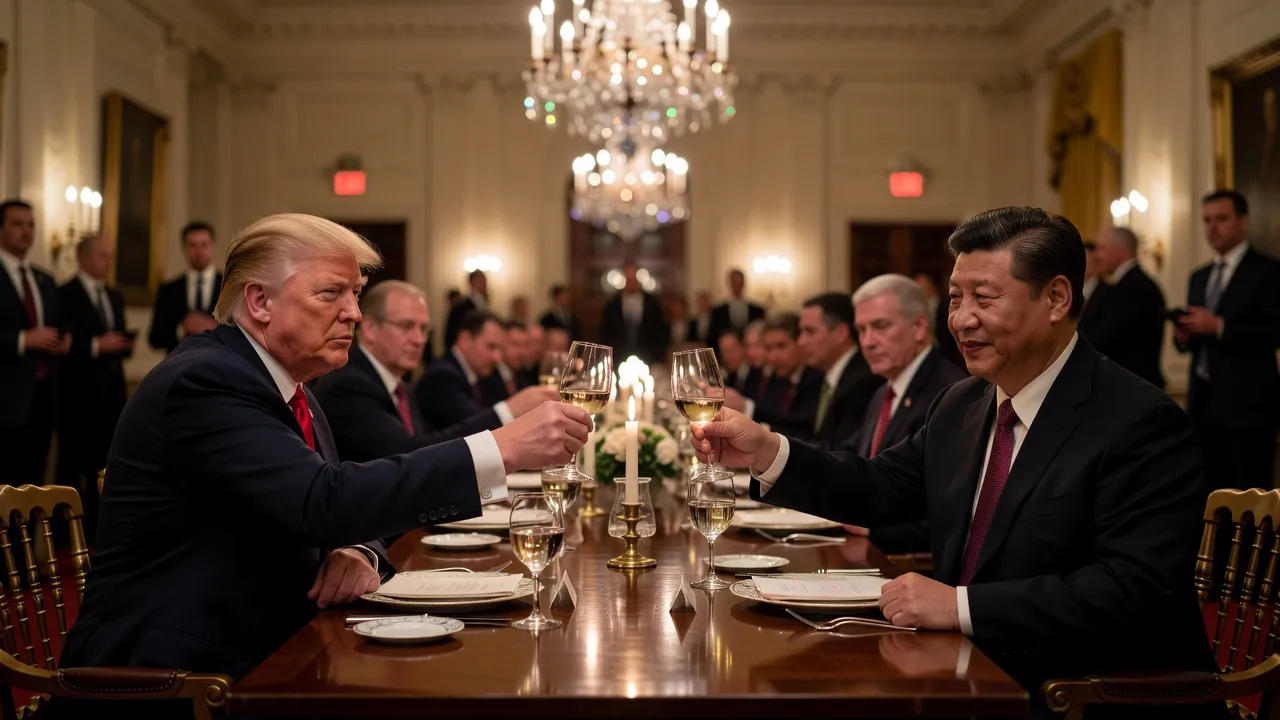
Buenos Aires, September 25, 2026. The Argentine press details above all what has not changed at the end of the Trump-Xi summit in Washington: the trade truce between the two largest economies in the world, simply extended until January 10, without a fundamental agreement on rare earths, agricultural trade, artificial intelligence, or Taiwan. Ámbito recalls that Xi Jinping arrived on Wednesday, September 23, for his first state visit to Washington in eleven years, received by Trump on the Andrews base tarmac with a red carpet, artillery salutes, and a flyover of B-1 bombers — a protocol that the Republican had already reserved for Vladimir Putin in 2025, in Alaska.
The Secretary of the Treasury, Scott Bessent, confirmed, on the eve of the summit, that the Busan agreement, which was supposed to expire on November 10, was extended "until January 10, to give us more time on the economic front," according to remarks relayed by Ámbito. The discussions with Chinese Vice Premier He Lifeng, which began over the weekend in New York, also resulted in a technological cybersecurity protocol and the opening of a dialogue on $30 billion in tariffs, without any announced result on Thursday, September 24.
On Thursday, at the White House, Xi pleaded for "peaceful coexistence" and "healthy" competition, which must "remain within certain limits": "a race where each seeks to catch up with the other, not an arm-wrestling match where one wins and the other loses," according to El Cronista. He warned that China and the United States "have a lot to gain from cooperation and will both lose with confrontation." Trump, for his part, mentioned "considerable" advances towards a more "balanced" trade relationship.
Clarín highlights the Chinese reading of the reception: for Fudan Institute Dean Wu Xinbo, quoted by The Paper, the pomp translates to Trump's "respect" and his desire to score points before the November midterm elections. Infobae notes that the state dinner brought together technology leaders, while Ámbito, in a broader analysis, emphasizes that these summits "also affect Argentina," caught between the Sino-American technological competition and the parallel expansion of the BRICS and the Shanghai Cooperation Organization, where Xi had traveled before Washington.