DOMINANT ANGLE
Kuala Lumpur views the extended trade truce between Washington and Beijing as a temporary reprieve, not a resolution, for a Malaysian economy heavily reliant on trade flows between its two largest partners.
Dominant angle identified — does not reflect unanimity of this country’s media
KEY POINTS
- 01
Treasury Secretary Scott Bessent announced on Wednesday a two-month extension of the Sino-American trade truce, which was set to expire in November.
- 02
Trump personally welcomed Xi Jinping on the tarmac of Joint Base Andrews on Wednesday, a first in over sixty years for an American president receiving a foreign leader.
- 03
Trump stated that China and the US agree not to impose new controls on AI, which he now calls "Super Intelligence".
ANALYSIS
Kuala Lumpur, September 25, 2026. For the Malaysian economy, which relies on trade flows between Washington and Beijing, Thursday's meeting at the White House between Donald Trump and Xi Jinping is first and foremost seen through a concrete lens: the two-month extension of the Sino-American trade truce, announced on Wednesday by US Treasury Secretary Scott Bessent, as it was due to expire in November. No lifting of the tariffs imposed last year by Washington has been announced, and both sides say they want to avoid plunging back into the trade war that these same tariffs had triggered.
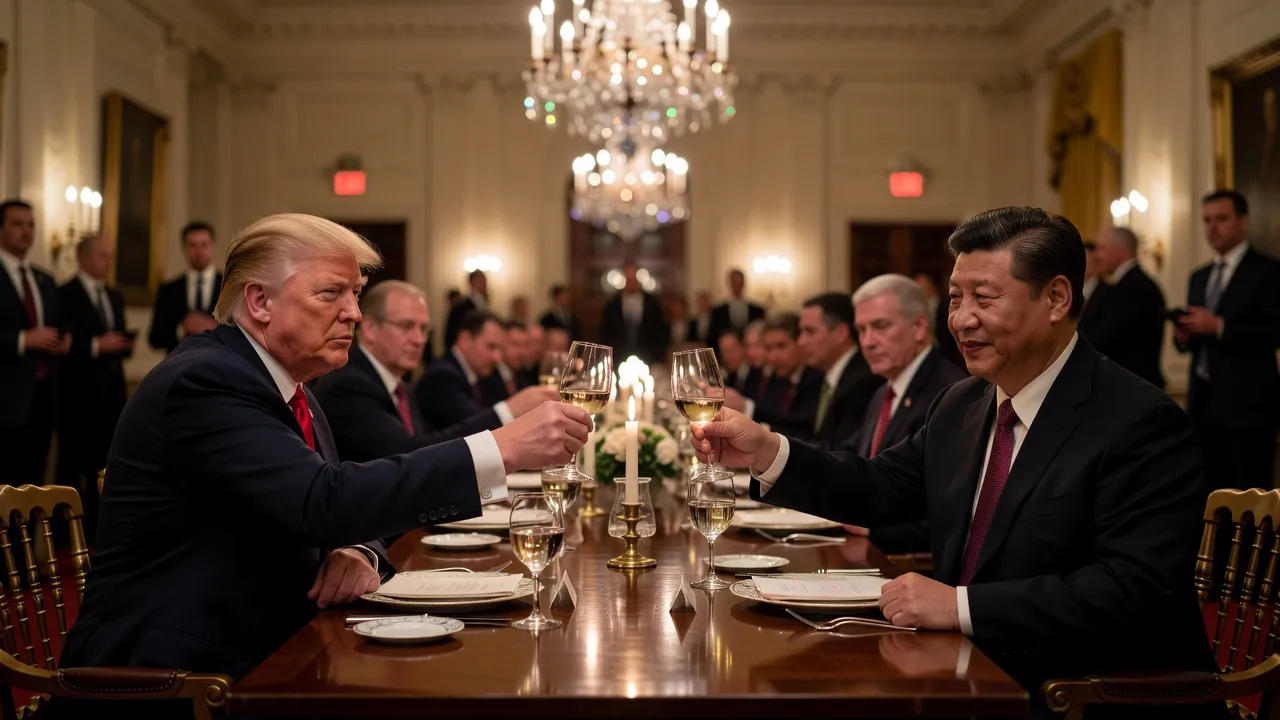
The protocol, on the other hand, was meticulously observed down to the smallest detail. Xi Jinping arrived in Washington on Wednesday for his first visit to the United States in nearly three years; Trump personally welcomed him on the tarmac of Joint Base Andrews, a first in over sixty years for an American president receiving a foreign leader. On Thursday, the day included a welcome on the South Lawn of the White House, a military flyover, talks in the Oval Office, and a state dinner. Xi called for China and the United States to be "partners rather than rivals," according to Chinese state media cited by the Malaysian press, and advocated for competition to be maintained "within reasonable limits."
On technology, a sensitive area for Malaysia's electronics and semiconductor industries, Trump stated on social media that no new controls were needed on what he now calls "Super Intelligence": "this is also China's position," he wrote. He also described Xi, 73, as "strong, sharp, and in shape," after rumors about the Chinese leader's health. However, none of these issues led to a quantified or dated agreement, beyond the sole extension of the truce.
Behind the displayed friendship, tensions remain: the Malaysian press notes that the summit leaves the trade war, Beijing's diplomatic and economic support for Iran, as well as Taiwan and technology, hanging in the balance - issues that directly impact the supply chains that Malaysia relies on, caught between its two main trading partners. Further meetings between Trump and Xi are already being discussed at the upcoming APEC and G20 summits, a sign that Kuala Lumpur will have to continue to navigate, summit after summit, a Sino-American relationship that remains to be negotiated rather than stabilized.
SOURCES (2)
- The Sun MYMEDIUM
- The VibesMEDIUM