
DOMINANT ANGLE
Dhaka is measuring the gap between the staging of the Trump-Xi summit and the lack of breakthrough on trade, rare earths or artificial intelligence, with only the trade truce having been extended by two months.
Dominant angle identified — does not reflect unanimity of this country’s media
KEY POINTS
- 01
The trade truce, which was set to expire on November 10, has been extended by only two months, until January 10, according to Treasury Secretary Scott Bessent.
- 02
Xi Jinping has drawn red lines on AI, Taiwan, and Iran, calling for the development of artificial intelligence "always under human control".
- 03
The state dinner brought together tech leaders (Musk, Cook, Huang, Altman), a sign that trade and AI dominated the agenda without resulting in any concrete announcements.
ANALYSIS
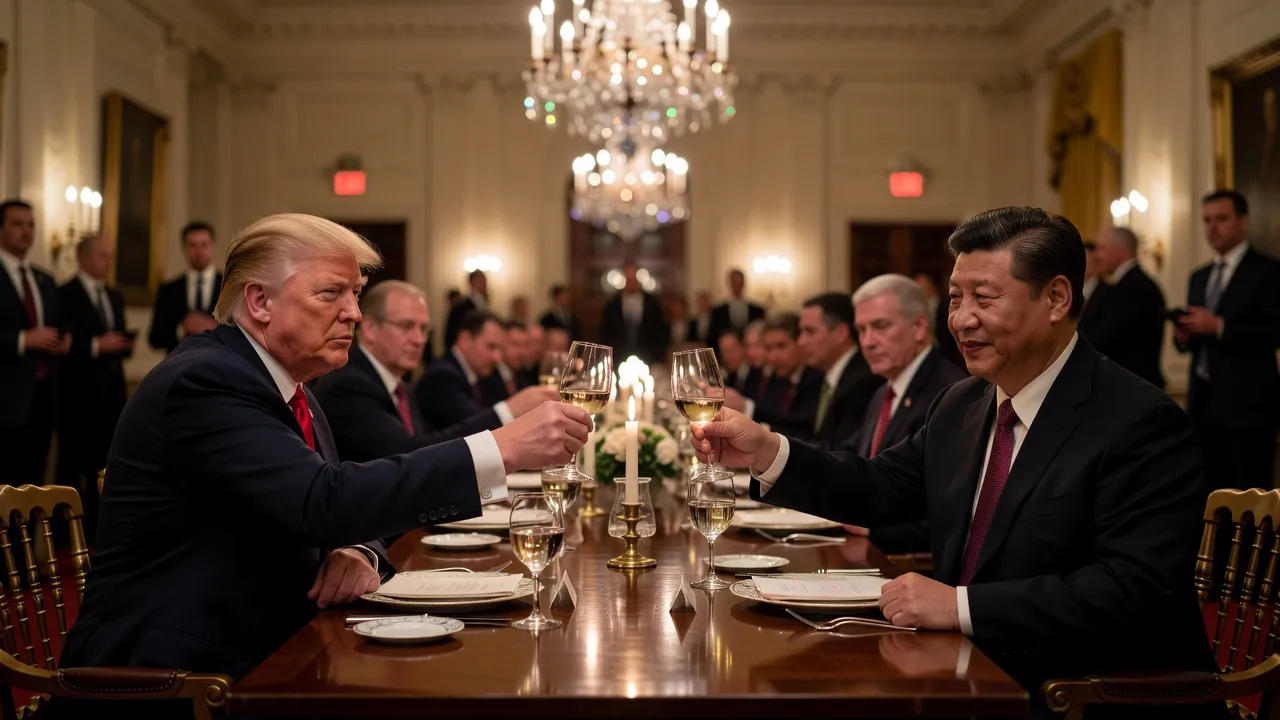
Dacca, Friday, September 25, 2026. Bangladeshi newspapers sum up the Washington summit in one image: a lot of pomp, little substance. The Daily Star and TBS News report that Donald Trump reserved an unprecedented welcome for Xi Jinping at Joint Base Andrews on Wednesday, with a military parade, a flyover by a B-1 bomber, and a tour of the Marine One helicopter, before a state dinner on Thursday where the American president offered his guest an eagle statue. The local press notes that this pomp occurred "after a day of pomp and ceremony that masked deep tensions" between the two powers, according to a phrase taken from The Daily Star.
What Dacca retains above all is what was not achieved. The trade truce, which was supposed to expire on November 10, was extended by only two months, until January 10, according to Treasury Secretary Scott Bessent, cited by TBS. Disagreements remain intact on export controls for rare earths and semiconductors, as well as on Beijing's ties with Iran. For an export-oriented economy like Bangladesh, dependent on textile and technological supply chains, the lack of a trade breakthrough between Washington and Beijing is seen as a signal of prolonged uncertainty rather than appeasement.
The presence, at the dinner, of American tech big names, Elon Musk, Apple's Tim Cook, Nvidia's Jensen Huang, and OpenAI's Sam Altman, confirms, according to TBS, that trade and artificial intelligence dominated the agenda of the visit, without any concrete announcement coming out of it. Xi Jinping set his own red lines on AI, Taiwan, and the war in Iran, advocating for the development of artificial intelligence "always under human control", in contrast to a more casual Trump on these risks.
Despite Trump's warm words about their "very great friendship" and the "considerable progress" mentioned, the Bangladeshi press highlights the contrast with Xi's measured tone, who called on the two countries to "coexist in peace" and act as "responsible great powers". Protesters gathered in front of the White House chanted "Xi Jinping is not welcome" and "Free Hong Kong", the articles recall.
For Dacca, this summit confirms above all the fragility of a balance between the two giants on which depend, indirectly, the commercial outlets and technological investments of Bangladesh.