
DOMINANT ANGLE
Ottawa is particularly mindful of the American double standard on trade: Washington is extending its own truce with Beijing while lecturing Canada over a far more modest agreement on Chinese electric vehicles.
Dominant angle identified — does not reflect unanimity of this country’s media
KEY POINTS
- 01
Washington announced on Wednesday a two-month extension of the trade truce with Beijing, now set for January 10, according to Treasury Secretary Scott Bessent.
- 02
In January, 49,000 Chinese electric vehicles were accepted with a tariff reduced from 100% to 6.1%, in exchange for a decrease in Chinese duties on Canadian canola, peas, lobster, and crab.
- 03
Xi Jinping urged Trump, according to the Xinhua agency, to "adhere to the correct position of opposing Taiwan's independence", with no known public response to date.
ANALYSIS
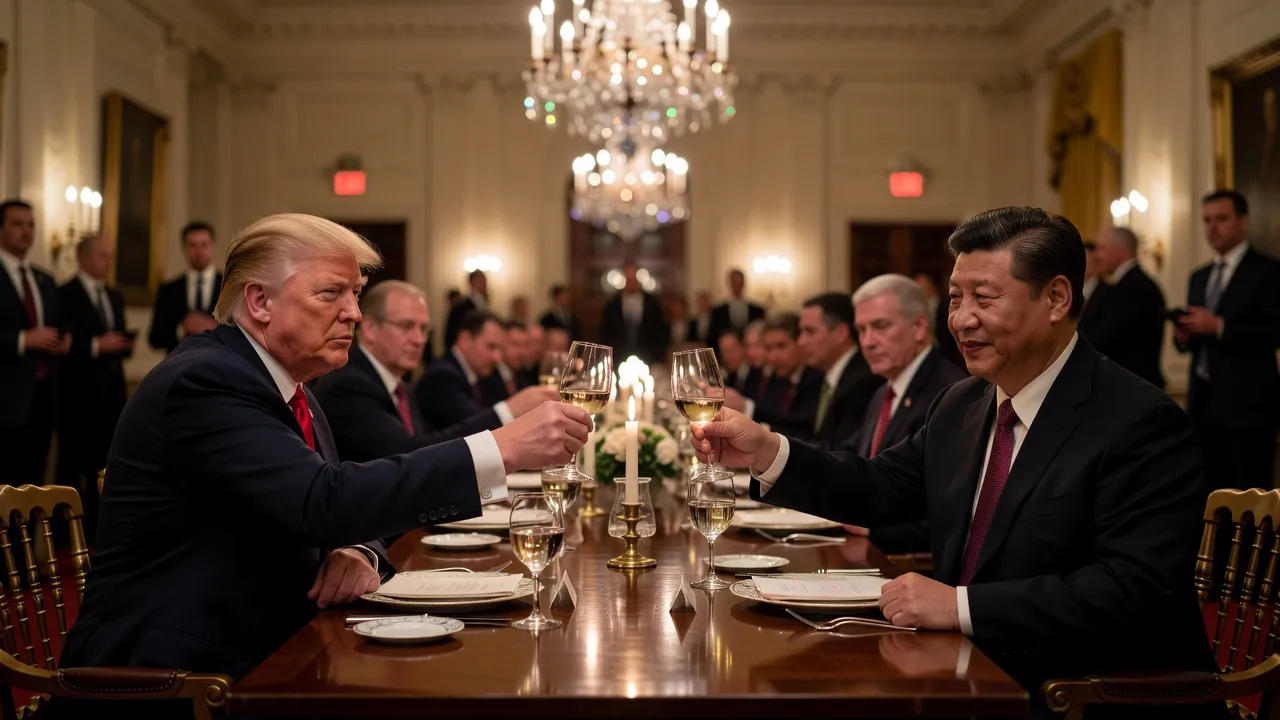
Ottawa, September 25, 2026. For the Canadian press, the Trump-Xi summit in Washington is more about staging than diplomacy — and it mainly highlights, by contrast, Ottawa's trade policy towards Beijing. Xi Jinping was welcomed on Wednesday on the tarmac of Andrews Air Force Base by Donald Trump, with a 30-meter red carpet, honor guard, and a flyover of B-1 bombers. The American president called his counterpart a "great leader," while his administration extended, on the same day, the bilateral trade truce by two months, until January 10, according to an announcement by Treasury Secretary Scott Bessent. On Thursday, the summit at the White House — less than two hours of closed-door talks, with no official statement released — was followed by a state dinner that included a list of guests "heavy with tech CEOs," between Chilean bars in sesame crust and protesters chanting "China out of Hong Kong" in front of the gates. Xi pleaded for "healthy and limited" competition rather than a zero-sum confrontation, and urged Trump, according to the Xinhua agency, to "adhere to the correct position of opposing Taiwan's independence" — a request that remained without a public response, while Washington has already delayed a $14 billion US arms contract for Taipei by several months. But it's the discrepancy with the Canadian file that is drawing attention in Ottawa. CBC notes that Washington, in the midst of a charm offensive towards Beijing, continues to scold Prime Minister Mark Carney for a much more modest agreement concluded in January: the entry of 49,000 Chinese electric vehicles in exchange for a tariff reduced from 100% to 6.1%, against a reduction in Chinese duties on Canadian canola, peas, lobster, and crab. Commerce Secretary Howard Lutnick said, "Carney has a problem with us, he gets on a plane and goes to China?" while Transportation Secretary Sean Duffy predicted that Carney would "regret" his decision. Jia Wang, from the China Institute at the University of Alberta, sees this as a demonstration that Washington demands from its partners what it allows itself. The Canadian press, while covering the pomp of the summit — bombers, fanfare, tea planned for Friday between the two presidential couples — mainly retains this commercial double standard, more than the issues of AI, Taiwan, or Iran, which were left without any announced progress.
SOURCES (3)
- Globe and MailMEDIUM
- National PostMEDIUM