
DOMINANT ANGLE
Bamako sees the Trump-Xi summit as another round in the Sino-American technological race, rather than a diplomatic breakthrough.
Dominant angle identified — does not reflect unanimity of this country’s media
KEY POINTS
- 01
Donald Trump welcomed Xi Jinping on Wednesday at Andrews Air Force Base, with a red carpet, national anthems, cannon salutes, and a flyover by two B-1 bombers
- 02
No progress was made public on trade, rare earths, or artificial intelligence despite discussions focused on these issues
- 03
In response to DeepSeek, Alibaba is developing its own AI models and Huawei is working on the semiconductor issue, with Chinese models already rivaling the best American models in reasoning and programming despite limited access to the most powerful chips
ANALYSIS
Bamako, September 25, 2026. The summit between Donald Trump and Xi Jinping in Washington, draped in unusual protocol, is of less interest in Bamako for its ceremonial gestures than for what it reveals about the technological rivalry between the two powers, on a dossier where no progress has been made public.
On Wednesday, at Andrews Air Force Base, Donald Trump welcomed his Chinese counterpart for a three-day state visit focused on trade, rare earths, and artificial intelligence. The two leaders stood side by side at the end of a red carpet, in front of the flags of the two countries, while an orchestra of the US Air Force played the national anthems and cannon salutes were fired; two B-1 bombers flew over the base during the welcome.
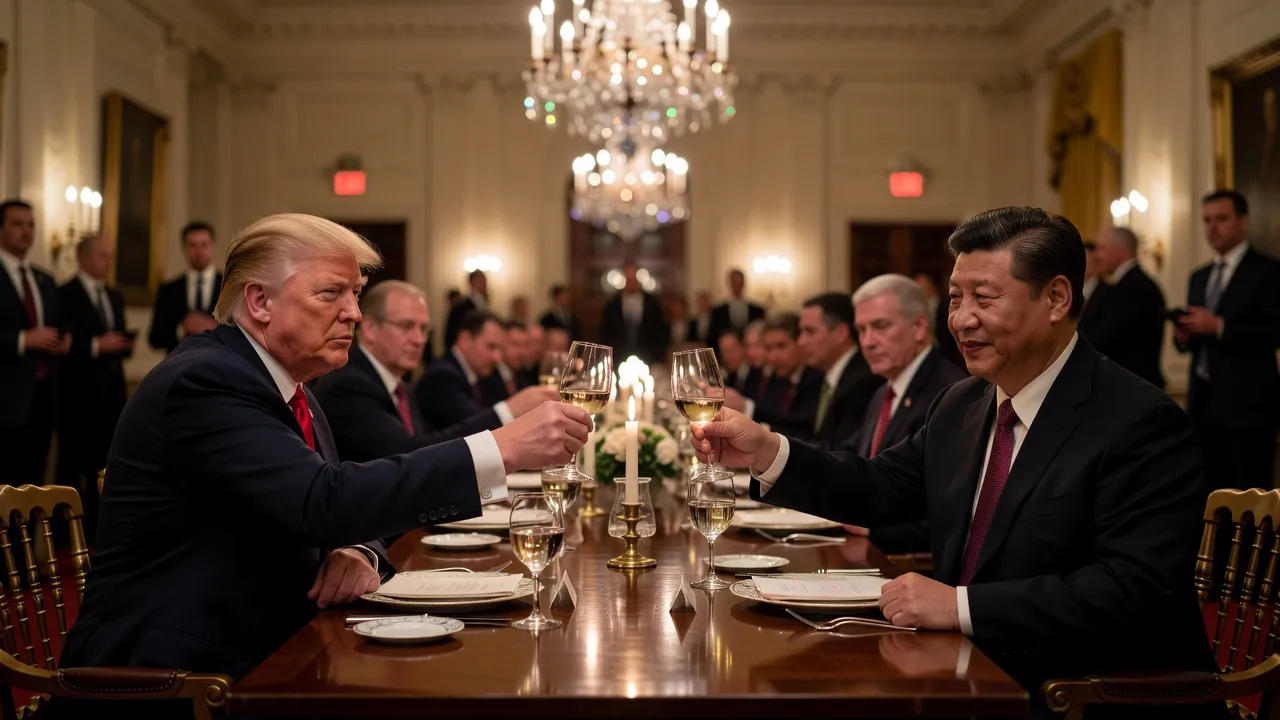
At the White House, Trump mentioned in front of journalists the ballroom of the presidency, whose construction is "ahead of schedule", regretting that it was not ready for the state dinner organized on Thursday in honor of Xi Jinping. Asked about Iran, he replied: "I will talk about that and many other subjects, but everything is progressing, including on that point." On the trafficking of fentanyl from China, described by his director of counter-terrorism as a "war waged by other means", Trump judged the situation "not good", recalling the customs duties and sanctions already imposed on Beijing.
But it is on the terrain of artificial intelligence that the Sino-American rivalry is most concretely played out for the press consulted in Bamako. DeepSeek remains the most well-known face of Chinese AI, but the landscape is broader: Alibaba is developing its own models as well as the necessary computer infrastructure, while Huawei is tackling the problem of semiconductors. Despite limited access to the most powerful chips, Chinese models are already rivaling the best American models in reasoning and programming, and Beijing is betting on open models, less expensive and therefore more widely disseminated.
For Bamako, the decor of the summit - red carpet, state dinner, pandas promised to the Atlanta zoo - should not obscure the essential: no progress has been announced on trade, Taiwan, or artificial intelligence, while the latter already concentrates the essence of the competition between Washington and Beijing.