
DOMINANT ANGLE
Ottawa is gauging Donald Trump's reversal in light of his political weakening: a president who suspends the law he signed a month earlier, just three weeks before the midterm elections.
Dominant angle identified — does not reflect unanimity of this country’s media
KEY POINTS
- 01
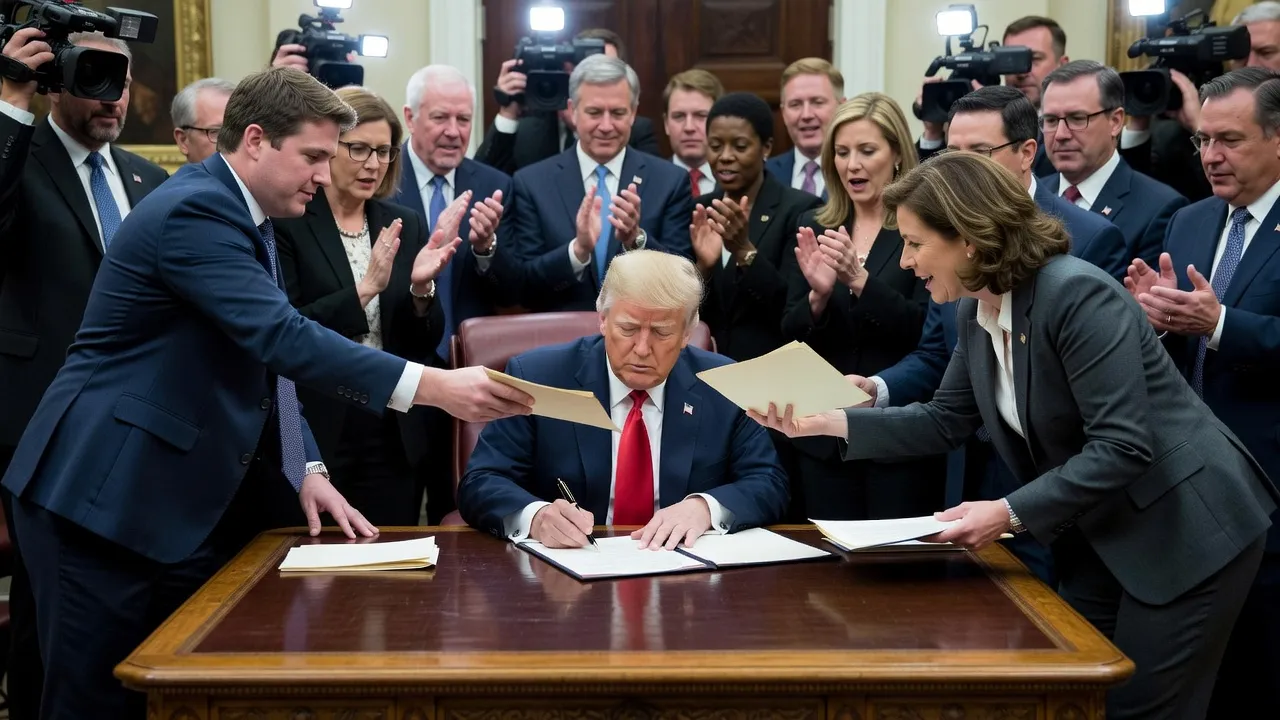
On Friday, October 16, Trump signed a decree putting on hold the package of sanctions against Russia, two days before the deadline set by the law he had signed himself the previous month (CBC, Global News).
- 02
The reversal comes a week after the announcement of a purchase of Russian diesel, as Trump's ratings are near historic lows ahead of the November 3 election (CBC).
- 03
On Saturday, October 17, Zelensky called for defending the Graham law, without directly criticizing Trump, and reported a massive Russian strike against more than 15 energy sites (CBC).
ANALYSIS
Ottawa, October 18, 2026. Canada's major media outlets are treating the suspension of sanctions against Russia as a U-turn by the US president, largely based on dispatches from the Associated Press reproduced by CBC, Global News, and the Globe and Mail.
On Friday, October 16, Donald Trump signed a decree that puts on hold a "vast package of sanctions" targeting the Russian economy, informing Congress that this pause was in the national interest. CBC notes that the White House did not immediately explain this justification. The text, which bears the name of Senator Lindsey Graham, who died in July, had been promulgated by Trump himself last month; the suspension comes two days before the deadline set by law for its implementation. The media recall that Graham, a close ally of the president, had returned from Ukraine at the time of his death, and that his colleagues had voted on the text in a bipartisan manner in his memory. Global News notes that Trump "changed his mind" on Friday and that the decision has sparked condemnation from Democratic members of Congress.
The Canadian narrative immediately situates the decision in the context of US domestic politics. The articles recall that Trump announced a week earlier the purchase of Russian diesel to lower energy prices, that an AP-NORC poll on October 1 shows Americans disapproving of his handling of the war against Iran and blaming him for the price hike, and that his popularity ratings are near historic lows, as Republicans try to retain control of both chambers in the November 3 election.
The second part, published on Saturday, October 17, gives the floor to Volodymyr Zelensky. He regrets that a decision was made "to disregard" the Graham law, thanks Democrats and Republicans who supported it, and urges his supporters to defend it: "This law could have helped a lot, and still can." However, he avoids directly criticizing Trump. CBC relays his assessment of a massive strike against more than fifteen energy sites, with four cruise missiles and 332 attack drones launched overnight, including all missiles and 289 drones neutralized according to the Ukrainian air force. The articles evoke fears of a Ukraine exposed to the approach of winter.
The coverage remains factual and little editorialized: it quotes few Canadian experts and does not develop either the position of Ottawa or the consequences for customers of Russian oil and gas.
SOURCES (3)
- Globe and MailMEDIUM
- Global NewsMEDIUM