
DOMINANT ANGLE
The United States is experiencing a power struggle: the suspension of a law that Trump himself enacted is pitting lawmakers from both parties against the White House, ahead of the midterm elections.
Dominant angle identified — does not reflect unanimity of this country’s media
KEY POINTS
- 01
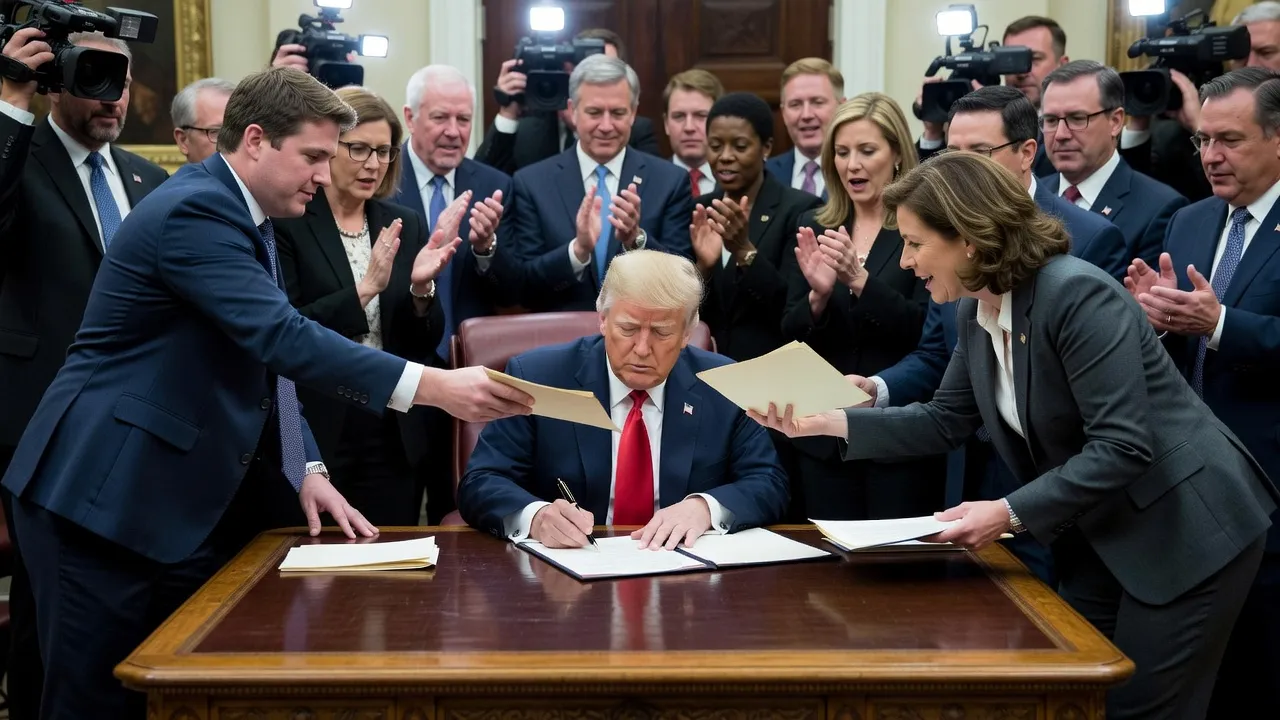
Trump signed a decree on Friday, October 16, suspending the bulk of the Graham law, citing "the national interests of the United States", two days before its implementation.
- 02
The Senate had passed the law by 86 votes to 11; Tillis, Cornyn, and Bacon, Republicans, criticize the decree.
- 03
According to ABC, the Russian strike that night targeted more than 15 Ukrainian energy sites with 4 missiles and 332 drones.
ANALYSIS
The United States, October 17, 2026. On Friday, October 16, in the evening, Donald Trump signed a decree suspending the bulk of the Lindsey O. Graham law on sanctions against Russia and Iran, which Congress had voted on and he himself had enacted in September. The text was set to take effect on Sunday, October 18. According to CNBC, it provided for customs duties of up to 500% on Russian products and up to 100% on countries among the top five buyers of Russian oil or gas, including China and India. The decree invokes "national interest": Trump writes that he has transmitted a certification to Congress to this effect. The previous sanctions remain in place.
The American press first places the issue in the context of Congress. The text had gathered 86 votes against 11 in the Senate, recalls The Hill. Republican Senator Thom Tillis judges the decision "beyond irresponsible" and asks what the president does not understand about the application of a law. His colleague John Cornyn asserts that "Lindsey would be appalled", and Representative Don Bacon writes that "the President is prolonging the war, not ending it". On the Democratic side, Don Beyer denounces a "surrender" to Putin. Axios emphasizes that these bipartisan criticisms come just a few weeks before the midterm elections and force Republican candidates to defend the president's relationship with Moscow.
The energy context is mentioned in almost all articles. The decree comes a week after the agreement on Russian diesel: 300,000 tonnes immediately, 500,000 in November, and then one million. CNBC specifies that Washington has suspended sanctions on Russian diesel exports until April 2027, to ease the supply penalized by the war with Iran. NBC and Time note that Trump blames Kiev for its strikes on Russian oil infrastructure, while Time notes that the war in Iran has a greater impact on prices.
On Saturday, October 17, Volodymyr Zelensky denounced an "American sanctions blackout" that "only encourages" Putin, according to NBC. NPR and ABC report that he called on his supporters to defend the law, while avoiding direct criticism of Trump, and that a massive Russian strike targeted more than 15 energy sites, with four cruise missiles and 332 drones. Time reads the decree as a sign of the deterioration of relations between Washington and Kiev. Bloomberg mentions economic and diplomatic openings for Moscow.