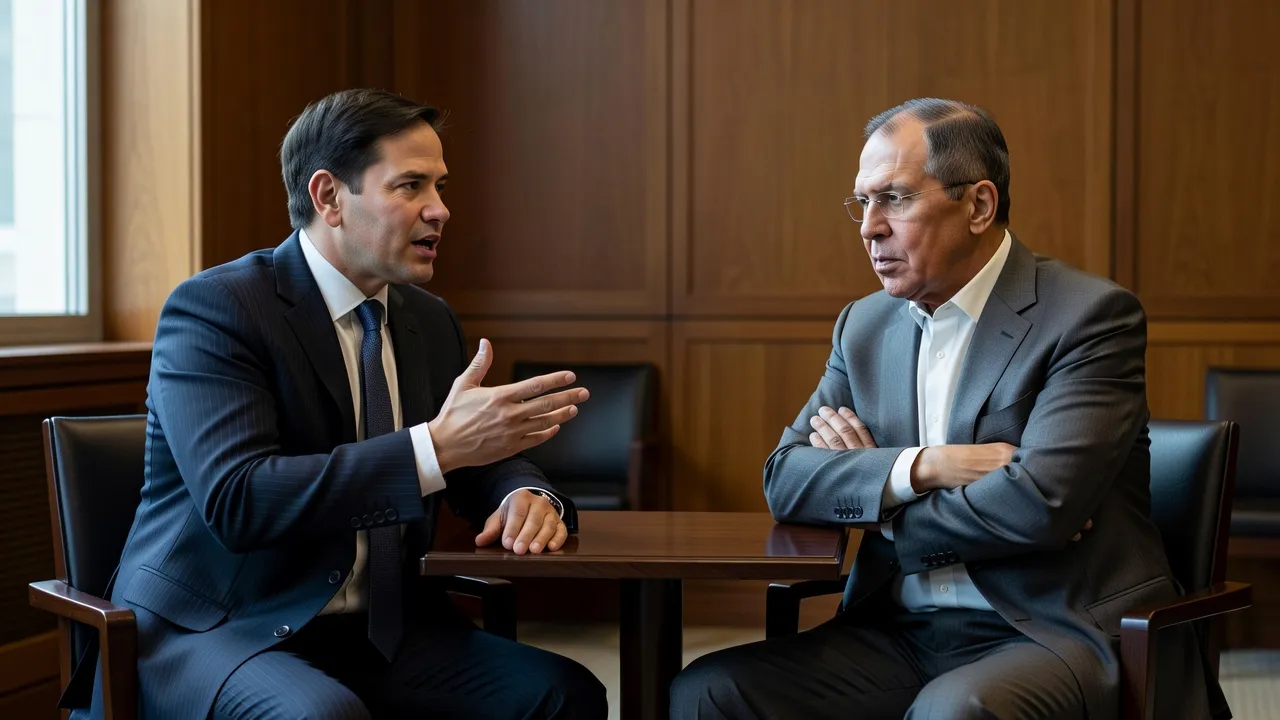
Washington invites Vladimir Putin to the G20 summit in Miami, and the Kremlin says it is "grateful"
published on
countries
sources
articles
The invitation extended to Vladimir Putin for the G20 in Miami has sparked differing interpretations of its actual significance, with sources close to the Kremlin, cited by Bloomberg, deeming it unlikely that the Russian president will attend, instead opting for the APEC summit in Shenzhen in mid-November, a view shared by Donald Trump, who has expressed uncertainty about a potential meeting in Miami.
No meeting has been set: Moscow has not confirmed its attendance and the matter remains, according to the Kremlin, at the stage of examination through diplomatic channels.
An invitation received with doubt
Questioned in New York after receiving Volodymyr Zelensky, Donald Trump was less affirmative than his Secretary of State about holding a meeting with Vladimir Putin in Miami: "I know I'm going to meet him. We've already had a meeting in Alaska. I think he'd be ready to have another one. But in Miami, I'm not sure," he said, as quoted by the Hungarian daily HVG.
The Kremlin's diplomatic advisor, Iouri Ouchakov, meanwhile specified that Putin's participation in the summit "has not even been discussed yet," according to the Hungarian website Telex. Sources close to the Kremlin, cited by the Bloomberg agency, consider it unlikely that the Russian president will travel to Miami: he is instead expected to attend the APEC summit hosted by Xi Jinping in Shenzhen in mid-November.
Putin has not attended a G20 summit in person since 2019, according to the Swedish press.
Other gestures in New York
The invitation comes in a week where other channels have opened or been extended between Washington and Moscow. Before the meeting between Marco Rubio and Sergey Lavrov, the Russian Ministry of Foreign Affairs had stated that "our main disagreements do not arise with the Americans, but with the Europeans", who are accused of adopting positions deemed "radical and ideological", according to the Greek daily To Vima.
« Siergieju, tell your boss that's enough »
The Kremlin has also described the US refusal to grant a visa to Russian Deputy Foreign Minister Alexander Alimov as a "hostile act", as reported by Chinese channel CGTN, which prevented him from traveling to New York before the General Assembly. Presidential envoy Kirill Dmitriev was to meet with US representatives Steve Witkoff and Jared Kushner in New York, continuing a dialogue launched at the Kremlin in early September.
Before the General Assembly, Polish Foreign Minister Radosław Sikorski addressed Sergey Lavrov directly, recalling that Poland and NATO would not let Russia gain the upper hand on the ground.
On the ground, the war continues
On Tuesday night into Wednesday, Russian drone strikes targeted Kyiv, hitting railway infrastructure, warehouses, and gas stations. According to municipal authorities cited by CBC News, the attack killed at least two people and injured 22, one of the deadliest since summer.
In response, Ukraine struck two Russian refineries, while Moscow targeted a petroleum and gas facility in southern Ukraine, which is now deemed irreparable, according to Canadian press reports.
Volodymyr Zelensky outlined the terms of the energy ceasefire he is proposing: a mutual halt to strikes targeting electricity, heating, and water supply, without a unilateral suspension of Ukrainian attacks on Russian refineries, reports Colombian daily La República. He also proposed exchanging future deliveries of Patriot missiles promised by Germany for 2027-2028 for US stocks available this winter; Donald Trump has " neither rejected nor accepted" the idea.
Zelensky also expressed willingness for a maritime ceasefire in the Black Sea based on proposals from Egypt, India, and Turkey, putting the onus on Russia to respond, according to Channel News Asia.
Security readings in the East
Several capitals close to Russia are reading the G20 announcement through the prism of their own security, rather than as a sign of appeasement. The head of the Czech internal security service, Michal Koudelka, told the Guardian, as reported by the Estonian press, that Russia could test NATO's defense with a limited incursion "in months, not years".
« A pilot flies in the wrong direction, and suddenly an active combat is engaged »
The Twenty-Seven also extended on Tuesday for six months to three years the sanctions targeting nearly 3,000 individuals and entities linked to the war; to obtain this compromise, oligarchs Alisher Usmanov and Mikhail Fridman were removed from the common list, with Estonia announcing that it would apply its own national sanctions to them.
The Swedish reference daily Dagens Nyheter described the invitation as an "early Christmas gift" to Vladimir Putin; the Polish website RMF24 read it similarly, as a favor offered to Moscow without any counterpart on the ground.
Putin has not attended a G20 summit in person since the arrest warrant issued against him by the ICC in 2023.
The summit is to be held at the Trump National Doral, the US president's golf club in Miami.
Lavrov said that Russia would not have a "break" in its military operation during negotiations.
Finnish President Alexander Stubb, also invited to the G20, said he would go to Miami.
How each country reads it
28 perspectives, each in the voice of that country's press.
 Canada
Ottawa is tempering the diplomatic enthusiasm on display in New York: as long as the strikes continue on energy infrastructure, the Canadian press judges the resumption of dialogue to be more symbolic than effective on the ground.
2 sources
 Chile
ChileSantiago sees Putin's invitation to the G20 in Miami as an extension of a Trump method already in place: receiving in New York leaders with whom Washington disagrees, from Zelensky to Venezuelan President Delcy Rodríguez, while leaving Moscow to respond with measured gratitude.
2 sources
 China
ChinaBeijing views the invitation to Vladimir Putin for the G20 in Miami in light of an energy truce that is still uncertain and persistent diplomatic frictions between Moscow and Washington at the UN.
2 sources
 Argentina
Buenos Aires is viewing the invitation extended to Vladimir Putin through the lens of its own relationship with Marco Rubio, who was received by Javier Milei in New York on Tuesday, rather than directly commenting on its implications.
2 sources
 Brazil
Brasília is gauging the impact of the invitation extended by Washington to Vladimir Putin for the G20 in Miami, having presided over the summit two years ago, and sees it as a test of diplomatic method rather than a step towards peace in Ukraine.
3 sources
 Singapore
Singapore views the US invitation to Vladimir Putin less as a protocol gesture than as a sign of a possible truce on the grain and energy routes that its imports depend on.
2 sources
 Colombia
Bogotá sees the same diplomatic gesture behind the invitation to Putin: receiving, in the same week of the UN, those with whom Washington disagrees, from Delcy Rodríguez to Zelensky, and then the Kremlin in December.
2 sources
 Estonia
Tallinn is gauging the invitation extended to Vladimir Putin in light of warnings from its own intelligence services: a Russia that could test NATO in the coming months, while Washington mentions a limited pause regarding grains and energy.
2 sources
 Finland
Helsinki is sending a dual signal: President Alexander Stubb confirms he will attend the G20 summit in Miami in December, at the same table where Washington has invited Vladimir Putin, while Kyiv is simultaneously waving the risk of a Russian strike targeting Finland.
4 sources
 France
Paris is separating the invitation extended to Vladimir Putin for the G20 in Miami from the reality on the front, where Sergey Lavrov has just closed the door to any pause in the war, just hours after Volodymyr Zelensky said he was ready for an energy moratorium and Emmanuel Macron called for a "double moratorium" on strikes.
5 sources
 Greece
Athens sees the invitation extended by Washington to Vladimir Putin for the G20 in Miami as a reopened channel with Moscow, which Russian emissary Kirill Dmitriev has already begun to test in New York.
2 sources
 Hungary
Budapest is examining the diplomatic mechanics of the invitation to Vladimir Putin for the G20 summit in Miami, between the enthusiasm displayed by Marco Rubio and the skepticism of Donald Trump himself regarding the actual holding of a meeting.
4 sources
 Iran
IranTehran is particularly mindful of the very personal backdrop to the invitation: Putin invited to the G20 summit in Miami, set to take place at Trump's golf club, while Moscow responds with caution and Kiev takes a tougher tone at the UN.
5 sources
 Italy
ItalyRome is eyeing the calculated caution with which Moscow has accepted the American invitation to the G20 in Miami, without seeing the outline of a thaw with Kiev.
3 sources
 Lithuania
Vilnius is gauging the invitation extended to Vladimir Putin in light of the front line: on the same day, Sergey Lavrov refused in front of the UN to stop the war, and Kyiv is demanding guarantees before any summit.
3 sources
 Latvia
Riga is weighing the Rubio-Lavrov rapprochement in New York through the prism of its own security, more than that of a future summit: the warning from the US Secretary of State about the risk of the war spreading to NATO's eastern flank holds more attention from Latvia than the diplomatic perspective itself.
3 sources
 Norway
Oslo is measuring Putin's invitation to the G20 in Miami against the backdrop of a war that continues: Zelensky is proposing a limited ceasefire for energy infrastructure but admits he is not sure if Russia is ready.
2 sources
 Peru
PeruLima sees the invitation to Vladimir Putin for the G20 in Miami as the diplomatic extension of the same UN week, where Marco Rubio is pushing for an energy truce while Volodymyr Zelensky accuses Moscow of recruiting fighters in 47 countries.
2 sources
 Poland
Warsaw denounces the invitation extended to Vladimir Putin for the G20 in Miami as a concession offered to Moscow, while Russia refuses any pause in the fighting beyond grain and energy.
3 sources
 Portugal
Lisbon questions the meaning of the invitation extended to a leader who has been the subject of an arrest warrant from the International Criminal Court since 2023, while Moscow already refuses to see it as a simple pause in the war.
3 sources
 Romania
Bucharest fears that the diplomatic opening between Washington and Moscow will overshadow the most concrete warning of the week: the risk, highlighted by Marco Rubio, that the war will spread through sabotage or mistake to Ukraine's neighboring countries.
3 sources
 Serbia
Belgrade sees Putin's invitation to the G20 in Miami as proof that Washington is breaking with the "Biden logic" towards the EU and London, while Kiev takes a tougher stance and refuses to travel to Moscow.
2 sources
 Russia
Moscow welcomes an invitation that it sees as a sign of American seriousness, while refusing to view it as a pause in the fighting.
5 sources
 Sweden
Stockholm is deciphering the invitation extended to Vladimir Putin for the G20 in Miami as a double-edged gesture, between a desired opportunity for dialogue wanted by Washington and an anticipated gift to Moscow according to the critical reading of the Dagens Nyheter.
5 sources
 Ukraine
Kyiv is dissociating Washington's diplomatic gesture from any real progress towards peace: Moscow welcomes the G20 invitation without conceding anything on the ground, where Sergey Lavrov rules out any pause in the "special military operation" during negotiations.
3 sources
 United States
The United States links the invitation extended to Vladimir Putin for the G20 in Miami to Donald Trump's personal method, which multiplies diplomatic one-on-ones rather than waiting for a prior settlement in Ukraine.
4 sources
 South Africa
Pretoria is downplaying the invitation extended to Vladimir Putin for the G20 in Miami by contrasting it with the ongoing Russian strikes targeting Kyiv despite the Lavrov-Rubio talks.
2 sources
 Germany
Berlin is receiving the invitation extended to Vladimir Putin with caution, focusing less on the diplomatic gesture than on Marco Rubio's warning of a risk of the conflict spreading to other countries, including Germany itself.
2 sources
What the comparison reveals
Common ground and differences in coverage across the media analysed.
What the media report in common
Marco Rubio announced on Wednesday, September 23, 2026, that Vladimir Putin is invited to the G20 summit on December 14 and 15 in Miami, immediately after his meeting with Sergey Lavrov on the sidelines of the United Nations General Assembly in New York; only Canadian and Norwegian coverage, focused on other meetings of the same week, does not make direct mention of it.
No perspective reports an effective ceasefire at the time of the announcement: Russian officials (Lavrov, Peskov) rule out or do not confirm any pause in military operations, and the proposals for an energy or grain truce mentioned by Kyiv and Washington remain conditional on reciprocity from the other party.
Where media coverage diverges
Conditions for a Limited Truce
Perspectives respond differently to the question of whether the conditions for a limited truce on energy and grain strikes are met: some relay the hope expressed by Marco Rubio of a possible agreement between Moscow and Kyiv, others report the explicit rejection of any pause by the Russian officials themselves.
Scope of the Invitation
On the question of whether the invitation constitutes a useful diplomatic method or a concession offered to Moscow without a reciprocal gesture, perspectives are divided between a reading that presents it as a legitimate dialogue channel and a reading that sees it as a premature gesture.
Coverage aligned with this reading
Coverage that diverges
Effective Meeting in Miami
On the question of whether a meeting between Trump and Putin will actually take place at the Miami summit, some perspectives relay confidence in the holding of an expanded summit, others report doubt expressed by Donald Trump himself or by sources close to the Kremlin.
Coverage aligned with this reading
This grouping describes the publications analysed, not the position of these countries’ populations or of their governments.
The full text, country by country
Canada
DOMINANT ANGLE
Ottawa is tempering the diplomatic enthusiasm on display in New York: as long as the strikes continue on energy infrastructure, the Canadian press judges the resumption of dialogue to be more symbolic than effective on the ground.
KEY POINTS
- Rubio met with Lavrov in New York on Wednesday, September 23, 2026, as the Kremlin believed there were "for now no preconditions" for peace talks.
- Trump and Zelensky spoke for 40 minutes on Tuesday, September 22, 2026, without a signed agreement, Kyiv demanding more Patriot missiles in the face of an expected Russian winter campaign against its power grid.
- The strikes continued on both sides on Wednesday: two dead and about twenty injured in Kyiv, while Ukraine bombed two Russian refineries.
ANALYSIS
Ottawa, September 24, 2026. In New York, Secretary of State Marco Rubio met with his Russian counterpart, Sergei Lavrov, on Wednesday, September 23, 2026, on the sidelines of the United Nations General Assembly, as Ukrainian President Volodymyr Zelensky addressed the assembly. CBC News recalls that the Kremlin had warned, even before this meeting, that there were "for the time being no preconditions" for moving towards a path of peace negotiations. This caution displayed by Moscow contrasts, for the Canadian press, with the optimistic tone of Donald Trump, who had assured on Tuesday, September 22, 2026, during his meeting with Zelensky, that "we will conclude an agreement".
According to the Globe and Mail and CBC News, no agreement was signed during this 40-minute meeting: Kyiv requested more Patriot missiles to protect itself from a Russian winter campaign targeting its power grid, and discussed a possible bilateral ceasefire limited to energy targets. Trump had claimed the previous week that such an agreement had been reached between Kyiv and Moscow, before the truce collapsed the next day, when gas stations in Kyiv were hit and Ukraine bombed a Russian refinery in response.
The facts reported by the Canadian press illustrate this gap between diplomatic discourse and the reality on the ground. On the night of Tuesday to Wednesday, Russia struck Kyiv with drones, killing two people and injuring about twenty, one of the heaviest attacks since summer, according to municipal authorities cited by CBC News. At the same time, Ukraine hit two Russian refineries, while Moscow targeted an oil and gas facility in southern Ukraine, now deemed irreparable.
Before the General Assembly, Zelensky warned that Kyiv would make the winter "deeply painful" for Russia if no energy ceasefire was concluded before the cold weather, while evoking the role that Xi Jinping could play with Vladimir Putin. Putin, absent from the General Assembly - Lavrov represented Moscow - remains accused by Western governments of sabotage and espionage, recalls the Globe and Mail. For the Canadian press, the diplomatic relaunch is therefore more of a gesture of openness than a verifiable step towards a ceasefire.
Chile
DOMINANT ANGLE
Santiago sees Putin's invitation to the G20 in Miami as an extension of a Trump method already in place: receiving in New York leaders with whom Washington disagrees, from Zelensky to Venezuelan President Delcy Rodríguez, while leaving Moscow to respond with measured gratitude.
KEY POINTS
- Kremlin spokesman Dmitri Peskov stated that Russia would guarantee Zelensky's security if he traveled to Moscow, without setting a date for a Putin-Trump meeting (La Tercera).
- Before the UN General Assembly, Zelensky stated that Putin never thinks it's "enough" and cited more than 248,000 Russian soldiers killed between January and August 2026 (La Tercera).
- Donald Trump met with Venezuelan interim president Delcy Rodríguez in New York, the first Venezuelan presidential presence at the General Assembly since 2018, to discuss energy, mining, and security (BioBioChile).
ANALYSIS
Santiago, September 24, 2026. From Santiago, the press views Vladimir Putin's invitation to the G20 summit in Miami in December as the logical follow-up to a week of diplomacy already marked in New York by Washington's gestures towards leaders with whom the United States openly disagrees.
La Tercera reports that Kremlin spokesman Dmitri Peskov stated on Wednesday that Russia would guarantee Volodymyr Zelensky's security if he traveled to Moscow to meet Putin, while specifying that no date had been set for a summit meeting with Donald Trump. "There are no details about a possible meeting at the highest level, but if we talk about availability, the president is prepared," Peskov said, adding that unprepared summits "are simply a waste of time." On the same day, at the UN podium, Zelensky warned that for Putin "it's never enough," citing over 248,000 Russian soldiers killed between January and August 2026 and accusing Moscow of pursuing war rather than peace.
The newspaper also highlights the persistence of the Kremlin's language towards Kiev, with Peskov referring to the Ukrainian authorities as the "leader of the Kiev regime" — a phrase repeated verbatim in the report, without critical perspective.
BioBioChile, for its part, details the "historic" meeting between Donald Trump and Venezuelan interim president Delcy Rodríguez at the Lotte New York Palace hotel, on the sidelines of the UN General Assembly — the first Venezuelan presidential presence at this event since 2018. The two leaders discussed cooperation on energy, mining, and security, in the presence of Marco Rubio, Scott Bessent, Susie Wiles, and Stephen Miller. Rodríguez praised Trump's support for Venezuela's "reinsertion" into "multilateral spaces."
For the Chilean press, this accumulation of gestures — guarantees offered to Zelensky, reception of Rodríguez, and now Putin's invitation to Miami — outlines a method: Washington chooses to invite to the table those it rhetorically combats, even if it means letting Moscow respond with measured gratitude, without a calendar commitment. None of the articles consulted directly detail the terms of Russian participation in the Miami summit in December.
China
DOMINANT ANGLE
Beijing views the invitation to Vladimir Putin for the G20 in Miami in light of an energy truce that is still uncertain and persistent diplomatic frictions between Moscow and Washington at the UN.
KEY POINTS
- The Kremlin described the US refusal to grant a visa to Russian Deputy Foreign Minister Alexander Alimov before the UN General Assembly as a "hostile" act (CGTN).
- Volodymyr Zelensky warned at the UN that Kyiv would make the winter "painful" for Russia if talks on an energy ceasefire failed before the cold weather sets in (SCMP).
- Kyiv and its allies are seeking to secure limited agreements on energy infrastructure and Black Sea transport before winter, fearing new Russian strikes (SCMP).
ANALYSIS
Beijing, September 24, 2026. The announcement made on Wednesday by US Secretary of State Marco Rubio to invite Vladimir Putin to the G20 summit in Miami in December reaches the Chinese press in a climate of unresolved tensions between Moscow and Washington at the United Nations. Kremlin spokesman Dmitri Peskov expressed his gratitude for the invitation, specifying that it would be handled through usual diplomatic channels. But the media followed in Beijing, CGTN and the South China Morning Post, mainly retain the signs of friction that preceded this gesture of openness.
CGTN reports that the Kremlin qualified the US refusal to grant a visa to Russian Deputy Foreign Minister Alexander Alimov as a "hostile act", preventing him from traveling to New York ahead of the General Assembly. According to Peskov, this decision violates US obligations as the host country of the UN headquarters; Moscow announced that it would raise the issue with Washington. The contrast is clear: on the one hand, a presidential invitation to the G20; on the other hand, a refusal of entry opposed to a high-ranking Russian diplomat the same week.
The South China Morning Post, for its part, retains the warning launched on Wednesday by Volodymyr Zelensky at the UN tribune. The Ukrainian president warned that if the talks on a limited ceasefire on energy infrastructure and transport in the Black Sea failed before winter, Kyiv would have "no other choice" but to make the cold season "painful" for Russia. Rubio nevertheless expressed confidence that Moscow and Kyiv had signaled a common interest in such a limited pause, distinct from a global ceasefire.
For the Chinese press, the invitation to the G20 is therefore part of a sequence where the diplomacy displayed by Washington coexists with acts of mutual distrust and a war that continues on the ground. None of the media in the corpus consulted directly mentions the modalities of the Miami summit or the issue of an International Criminal Court warrant targeting Putin; attention remains focused on the fragile balance between gestures of appeasement and power struggles that persist in New York as well as on the Ukrainian energy front.
Argentina
DOMINANT ANGLE
Buenos Aires is viewing the invitation extended to Vladimir Putin through the lens of its own relationship with Marco Rubio, who was received by Javier Milei in New York on Tuesday, rather than directly commenting on its implications.
KEY POINTS
- Javier Milei met with Marco Rubio on Tuesday in New York to "review the bilateral agenda" and ratify Argentine-American cooperation (Ámbito).
- According to Ámbito, the bilateral relationship between Argentina and the United States covers economic, trade, energy, security, and defense areas.
- Volodymyr Zelensky spoke with Donald Trump on Tuesday and the two leaders agreed on the need to end the war against Russia "before winter" (Infobae).
ANALYSIS
Buenos Aires, September 24, 2026. As Marco Rubio announced on Wednesday the invitation of Vladimir Putin to the G20 summit scheduled for December in Miami, the Argentine press kept its eyes turned to another meeting of the same Secretary of State: his meeting, on Tuesday in New York, with President Javier Milei, on the sidelines of the 81st United Nations General Assembly.
According to Ámbito, the meeting allowed the two officials to "review the bilateral agenda and ratify the continuity of cooperation between Argentina and the United States". The media situates this interview in an intensification of the Milei government's foreign policy agenda, which "maintains an alignment with Washington" and seeks to deepen its cooperation with the Trump administration in economic, commercial, energy, security, and defense areas — the same administration that, through Rubio's voice, is now extending a hand to Moscow for Miami. On the same day, Milei was also to address the General Assembly and meet with business leaders in New York.
Infobae, for its part, situates this bilateral diplomacy in the turmoil of the second day of the General Assembly, marked by the expected speeches of Iranian President Massoud Pezeshkian — his first intervention since the US-Israeli strikes in February — and his Ukrainian counterpart Volodymyr Zelensky. The media recalls that Zelensky spoke with Donald Trump on Tuesday, with whom he agreed on the need to put an end to the war against Russia "before winter" — an objective that overlaps, without referencing it, the logic of the invitation launched to Putin. The Security Council was also to hear, for the first time, the leaders of OpenAI, Anthropic, and Hugging Face on the risks of artificial intelligence.
In this same context, Milei was to defend Argentine sovereignty over the Malvinas Islands before the Assembly on Wednesday. None of the two available articles mentions the invitation made to Putin or the Kremlin's reaction: the Argentine coverage of the UN week remains focused on its own bilateral and territorial interests, leaving the Russian-American issue in the background of an agenda considered, on the Argentine side, more urgent.
Brazil
DOMINANT ANGLE
Brasília is gauging the impact of the invitation extended by Washington to Vladimir Putin for the G20 in Miami, having presided over the summit two years ago, and sees it as a test of diplomatic method rather than a step towards peace in Ukraine.
KEY POINTS
- Marco Rubio handed over the invitation to the G20 in Miami (December 14-15) to Sergey Lavrov on Wednesday, September 23, on the sidelines of the UN General Assembly in New York
- Zelensky said on Tuesday, September 22, that he is ready to stop strikes against Russian energy infrastructure if Moscow does the same, while saying he is unaware of the Russian position
- In his September 23 speech at the UN, Zelensky accused Russia of having citizens of 47 countries fight, citing India, Cuba, and South Africa
ANALYSIS
Brasília, September 24, 2026. The Brazilian press is closely following the invitation extended by Washington on Wednesday to Vladimir Putin for the G20 summit to be held on December 14 and 15 in Miami. According to the Folha de S.Paulo, US Secretary of State Marco Rubio handed over the invitation to his Russian counterpart Sergey Lavrov on the sidelines of the United Nations General Assembly in New York, stating that "if Putin accepts, he will have the chance to discuss with Trump". The Kremlin, according to the same source, had earlier said it was "ready" for such a meeting, without directly commenting on the invitation.
The newspaper recalls that this would be the second meeting between the two leaders since Trump's return to the White House, after the symbolically charged military summit held in Alaska in August - an episode where the US President had taken up a significant part of Russia's rhetoric on the war in Ukraine, without concrete results. Rubio also mentioned the possible presence of Chinese leader Xi Jinping, who arrived in Washington this week, Beijing having, according to Moscow, sought to organize a tripartite meeting last month.
For Brasília, which hosted the G20 two years ago, this episode illustrates how the format remains hostage to bilateral balances rather than the multilateral issues it is supposed to address. The local press also relays the statements of Volodymyr Zelensky, who said on Tuesday that he was "ready" to stop strikes against Russian energy infrastructure if Moscow does the same, while acknowledging that he is unaware of Russia's position. The Jornal de Brasília notes that Trump had announced an agreement between Kiev and Moscow on this point last week, which was later denied by both capitals.
The G1 reports on Zelensky's speech to the United Nations General Assembly on Wednesday, accusing Russia of forcing citizens of 47 countries, including India, Cuba, and South Africa, to fight, and stating that Moscow has conquered just over 1,000 km² of Ukrainian territory this year. For Brazilian diplomacy, which is accustomed to catering to Moscow within the BRICS while defending dialogue, the G20 invitation confirms that Washington intends to make the Miami summit an instrument of its own negotiation with Russia, rather than a neutral platform between powers.
Singapore
DOMINANT ANGLE
Singapore views the US invitation to Vladimir Putin less as a protocol gesture than as a sign of a possible truce on the grain and energy routes that its imports depend on.
KEY POINTS
- Marco Rubio announced on Wednesday that Vladimir Putin was invited to the G20 in Miami in December, hoping "that Putin accepts this invitation"
- Kremlin spokesman Dmitri Peskov said that Russia was "grateful" and would handle the proposal through diplomatic channels
- Volodymyr Zelensky said he was ready for a Black Sea maritime truce based on Egyptian, Indian and Turkish proposals, as global wheat prices rose for Asian importers
ANALYSIS
Singapour, 24 September 2026. The local press, relaying Reuters dispatches via the Straits Times and Channel News Asia, is more interested in the repercussions on trade routes that the city-state depends on than the diplomatic protocol of the invitation extended by Washington to Vladimir Putin for the G20 summit in Miami in December. After meeting with Russian Foreign Minister Sergei Lavrov in New York on the sidelines of the United Nations General Assembly, Secretary of State Marco Rubio presented the invitation as an opportunity for dialogue: "To resolve problems, you have to meet with people you don't agree with," he said, hoping that Putin "accepts this invitation." Kremlin spokesman Dmitry Peskov responded that Moscow was "grateful" and "would announce its decision through diplomatic channels."
It is Rubio's mention of a limited ceasefire, concerning attacks on grain deliveries and energy facilities, that is drawing attention in Singapour, a logistics hub and wheat importer. Channel News Asia reports that Ukrainian President Volodymyr Zelensky said he was ready, before the General Assembly, for a maritime ceasefire in the Black Sea based on Egyptian, Indian, and Turkish proposals, leaving the responsibility for the response to Moscow: "We are waiting for Russia's response," he said. The media outlet emphasizes that major wheat importers in Asia, the Middle East, and Africa are already suffering from the surge in global prices linked to the almost complete halt in commercial traffic in the Black Sea.
The Straits Times notes, however, that Lavrov judged, before the Security Council, that Moscow would not stop the war while potential discussions were ongoing, and that the Kremlin has ruled out any idea of a hasty summit, a spokesman deeming it "inappropriate to hold a summit before the work has been done at the expert level." Russian envoy Kirill Dmitriev, who left for New York to meet with representatives of the Trump administration, is also expected to discuss economic and energy cooperation between Washington and Moscow, according to the same sources.
For Singapour, whose open economy depends on the stability of grain and energy supply chains, the Miami invitation is seen primarily as a test of Russia's willingness to secure these flows, rather than a personal rapprochement between Donald Trump and Vladimir Putin.
Colombia
DOMINANT ANGLE
Bogotá sees the same diplomatic gesture behind the invitation to Putin: receiving, in the same week of the UN, those with whom Washington disagrees, from Delcy Rodríguez to Zelensky, and then the Kremlin in December.
KEY POINTS
- Trump met with Volodímir Zelensky for 40 minutes on Tuesday in New York; according to Zelensky, the two men discussed a possible bilateral ceasefire limited to energy targets, but not a unilateral suspension of Ukrainian strikes on Russian refineries (La República).
- Zelensky proposed exchanging future deliveries of Patriot missiles that Germany is to provide in 2027-2028 for available US stocks this winter; Trump neither rejected nor accepted the idea (La República).
- On the same Tuesday, Trump met face-to-face with Venezuelan interim president Delcy Rodríguez for the first time in New York, surrounded by Marco Rubio, Scott Bessent, Susie Wiles, and Stephen Miller; Rodríguez described the meeting as "histórico" (Portafolio).
ANALYSIS
Bogotá, September 24, 2026. The invitation extended by Washington to Vladimir Putin for the G20 in Miami in December — confirmed on Wednesday by Secretary of State Marco Rubio after his meeting with Sergei Lavrov at the UN — is seen from Bogotá as part of a week in which Trump has multiplied one-on-one meetings with leaders at odds with Washington. The Colombian press is focusing more on this format than on the gesture towards Moscow itself.
On Tuesday, in New York, Trump met with Volodymyr Zelensky for 40 minutes on the sidelines of the General Assembly. According to the Ukrainian president, quoted by La República, the two men discussed efforts to end the war, "including a possible bilateral ceasefire on energy-related targets," but not a unilateral suspension of Ukrainian attacks on Russian refineries. Zelensky also proposed exchanging future Patriot deliveries that Germany is to provide in 2027-2028 for American stocks as early as this winter; Trump did not "reject the idea," without accepting it either.
On the same Tuesday, Trump met with Venezuelan interim president Delcy Rodríguez for their first face-to-face exchange, surrounded by Rubio, Scott Bessent, Susie Wiles, and Stephen Miller, according to Portafolio. Rodríguez described the meeting as "historic" and mentioned a "strengthening of bilateral relations" and a "cooperation agenda," while Washington is relaunching discussions on oil, mining, and security with Caracas.
This is the thread that the Colombian press is linking to the invitation addressed to Putin: a diplomacy that, in the same week, is opening channels with Caracas, negotiating with Kiev on arms and energy strikes, and extending a hand to Moscow for December. Rubio justified his approach by stating that "we must meet with people we disagree with" — a phrase that Bogotá reads as a common doctrine for these three cases rather than an isolated gesture towards the Kremlin. The Kremlin, through Dmitry Peskov, said it was "grateful," specifying that the invitation would be handled through usual diplomatic channels.
In Bogotá, it is finally noted that neither the grain and energy truce mentioned by Rubio nor the rapprochement with Caracas are concluded agreements: these are open doors, in a week where Washington has preferred the negotiating table to a rupture with several capitals.
Estonia
DOMINANT ANGLE
Tallinn is gauging the invitation extended to Vladimir Putin in light of warnings from its own intelligence services: a Russia that could test NATO in the coming months, while Washington mentions a limited pause regarding grains and energy.
KEY POINTS
- Marco Rubio announced on Wednesday that Putin was invited to the G20 in Miami in December, after meeting Sergei Lavrov at the UN
- The head of the Czech security service, Michal Koudelka, told the Guardian that Russia could test NATO's defense with a limited incursion "in months, not years"
- The Twenty-Seven extended on Tuesday for six months to three years the sanctions targeting nearly 3,000 individuals and entities linked to Russian aggression, with national sanctions being applied to Usmanov and Fridman, who were removed from the common list
ANALYSIS
Tallinn, September 24, 2026. On Wednesday, US Secretary of State Marco Rubio announced, after meeting his Russian counterpart Sergey Lavrov on the sidelines of the United Nations General Assembly, that the United States was inviting Vladimir Putin to the G20 summit in December in Miami. The Estonian press reports this soberly: Russia remains a member of the G20, despite its exclusion from the G8 after the illegal annexation of Crimea in 2014. If Putin were to attend, it would be his second visit to the United States since the return of Donald Trump, after the Alaska summit in August 2025, which had not led to any major breakthrough.
But the Miami agenda is read in Tallinn through a closer calendar: that of European intelligence warnings. The head of the Czech internal security service, Michal Koudelka, told The Guardian that Russia could, "in months, not in years", test NATO's defense with a limited incursion into a neighboring country, provocations or fake operations. For a country bordering Russia, this warning carries more weight than Rubio's promise that "to solve problems, you have to meet with people you don't agree with".
The invitation coincides with concrete news for Estonia: on Tuesday, the Twenty-Seven agreed to extend for six months to three years the sanctions targeting nearly 3,000 individuals and entities linked to Russian aggression. To obtain this compromise, oligarchs Alisher Usmanov and Mikhail Fridman were removed from the list — Estonia announced that it would apply its own national sanctions to them. Washington also informed Tallinn that the rotational presence of US troops in Estonia would continue, with a new unit arriving in November.
The Estonian press also relays Volodymyr Zelensky, who is ready to meet with Putin and willing to negotiate with Moscow a moratorium on strikes against energy infrastructure, a proposal that Washington must transmit to the Kremlin. Trump, on Tuesday at the UN, estimated that the war would end "faster than people think", citing 25,000 deaths per month and his law on Russian oil sanctions carried by Senator Lindsey Graham. Zelensky warned on the same day that Russia is preparing a new large-scale attack, after a security meeting with British Prime Minister Andy Burnham in New York.
Finland
DOMINANT ANGLE
Helsinki is sending a dual signal: President Alexander Stubb confirms he will attend the G20 summit in Miami in December, at the same table where Washington has invited Vladimir Putin, while Kyiv is simultaneously waving the risk of a Russian strike targeting Finland.
KEY POINTS
- Marco Rubio announced Vladimir Putin's invitation to the G20 summit, scheduled in Miami on December 14 and 15, after a meeting with Sergey Lavrov in New York.
- President Alexander Stubb, also invited to the summit, confirmed his participation: "For now, I'm going to Miami."
- Volodymyr Zelensky judged the risk of a Russian strike targeting countries bordering Russia or Belarus as "really very high", explicitly citing the country.
ANALYSIS
Helsinki, September 24, 2026. US Secretary of State Marco Rubio announced on Wednesday that Vladimir Putin had been invited to the G20 summit, scheduled to take place in Miami on December 14 and 15, after meeting with Russian Foreign Minister Sergei Lavrov on the sidelines of the United Nations General Assembly in New York. "To resolve issues, you have to meet with people you disagree with," he justified, according to MTV Uutiset. Kremlin spokesman Dmitry Peskov responded that Russia was "grateful" for the invitation: "We have seen the information in the media and the minister's statements. We appreciate this invitation," he said, quoted by Iltalehti, specifying that a decision would be made "through diplomatic channels." However, Kremlin diplomatic advisor Yuri Ushakov tempered this on the same day: Putin's participation "has not even been discussed yet." Sources close to the Kremlin, cited by Bloomberg, consider it unlikely that the Russian president will travel to Miami; instead, he is expected to attend the APEC summit organized by Xi Jinping in Shenzhen in mid-November. Putin has not attended a G20 summit since 2019.
For Finland, the stakes are direct: President Alexander Stubb has also been invited to the summit, and he confirmed his participation at a press conference in New York: "For now, I'm going to Miami." He hopes that the discussions will lead to a meeting between Donald Trump, Vladimir Putin, and Volodymyr Zelensky, while acknowledging that "there is still a way to go." The issue takes on particular significance after the warning issued by Zelensky in New York: the Ukrainian president judged the risk of a Russian strike, by drones, missiles, or on the ground, targeting countries bordering Russia or Belarus - explicitly mentioning Finland. Zelensky also stated before the General Assembly that Russia is recruiting citizens from 47 countries as soldiers. On the same day, Helsinki and Kyiv signed a bilateral agreement on drones, a sign of the strengthened military ties between the two capitals. The Kremlin, for its part, maintains that it is up to Zelensky to travel to Moscow to negotiate.
France
DOMINANT ANGLE
Paris is separating the invitation extended to Vladimir Putin for the G20 in Miami from the reality on the front, where Sergey Lavrov has just closed the door to any pause in the war, just hours after Volodymyr Zelensky said he was ready for an energy moratorium and Emmanuel Macron called for a "double moratorium" on strikes.
KEY POINTS
- On Tuesday, September 22, at the UN podium, Emmanuel Macron advocated for a "double moratorium" on strikes against energy sites in Russia and Ukraine.
- On Wednesday, September 23, before the Security Council, Sergey Lavrov responded: "We will not pause our special military operation," accusing Europe of wanting to "supply arms" to Ukraine.
- Kiev criticized Paris for obtaining the removal of sanctions against Russian oligarch Alisher Usmanov in Brussels, in exchange for the pardon of a French detainee in Azerbaijan.
ANALYSIS
Paris, Thursday, September 24, 2026. In New York, where the United Nations General Assembly week is coming to a close, the invitation extended by Washington to Vladimir Putin for the G20 in Miami in December adds to a diplomatic chaos that Paris had attempted to organize around a single idea: a limited ceasefire on infrastructure. On Tuesday, September 22, at the UN podium, Emmanuel Macron pleaded for a "double moratorium" on strikes against energy sites in Russia and Ukraine. Volodymyr Zelensky, who was received by Donald Trump on the same day, said he was "ready" to suspend attacks on Russian installations "on condition that Moscow does the same".
The response came the next day from Sergei Lavrov, the head of Russian diplomacy, before the Security Council: "We will not pause our special military operation," he said, accusing Europe of wanting "to obtain a pause to use it to supply arms" to Ukraine. It is in this context that the American invitation fits: Secretary of State Marco Rubio summarized the logic with a phrase repeated in the French press, "to solve problems, you have to meet with the people you disagree with". No meeting is announced as imminent, but Miami is presented as an opportunity for Putin to meet Trump and other leaders.
On the ground, diplomacy has not suspended anything. On Wednesday, two people were killed and 43 injured in Kiev in drone strikes that damaged a gas station and a business center, while a Russian attack hit a cargo ship in Odessa, killing its Ukrainian captain. At the podium, Volodymyr Zelensky denounced Putin's "madness" and claimed that Moscow is mobilizing citizens from 47 countries, including North Korea, to prolong the war.
The sequence is complicated, from a French perspective, by a collateral dispute: Kiev has criticized Paris for obtaining, in Brussels, the withdrawal of sanctions targeting Russian oligarch Alicher Ousmanov, in exchange for the release of a French detainee in Azerbaijan. Zelensky sees this as a breach in the sanctions front intended to deprive Moscow of the means to finance the war - at the very moment when Washington is opening the door to Putin for an international summit.
Greece
DOMINANT ANGLE
Athens sees the invitation extended by Washington to Vladimir Putin for the G20 in Miami as a reopened channel with Moscow, which Russian emissary Kirill Dmitriev has already begun to test in New York.
KEY POINTS
- Marco Rubio announced on Wednesday, September 23, in New York that Trump had invited Putin to the G20 in Miami in December, stating: "We hope he will accept the invitation."
- No official Russian confirmation has been given; an in-person presence would be Putin's first participation in a G20 summit since 2019.
- The Russian Ministry of Foreign Affairs claims its disagreements are with Europeans rather than Americans, while Kirill Dmitriev is heading to the United States to continue the dialogue initiated at the Kremlin with Witkoff and Kushner.
ANALYSIS
Athens, September 24, 2026. The Greek press is reporting without hesitation the announcement made on Wednesday, September 23, in New York by US Secretary of State Marco Rubio: Donald Trump has invited Vladimir Putin to participate in the G20 summit to be held in December in Miami. Naftemporiki, which followed the meetings held on the sidelines of the United Nations General Assembly, reports Rubio's words after his meeting with Russian Foreign Minister Sergei Lavrov: "We hope he will accept the invitation," he said, before adding a phrase picked up by the Athens title: "If we only meet with people we agree with, we won't solve any problems."
The newspaper emphasizes, however, that nothing is certain on the Russian side: no official confirmation has been given about a possible trip by Putin to Miami. If he goes, it would be his first in-person participation in a G20 summit since 2019 — a detail that Naftemporiki highlights to measure the scope of the American gesture.
To Vima mainly retains the statement released by the Russian Ministry of Foreign Affairs before the Rubio-Lavrov meeting: Moscow asserts that "our main disagreements do not arise with the Americans, but with the Europeans," who are accused of adopting "radical and ideological" positions aligned with Brussels. The text mentions a "considerable" potential for cooperation between the two permanent members of the Security Council, which has remained largely unexploited according to Moscow, and notes that Washington's policy at the UN has become "more realistic" since Trump's return to the White House.
Naftemporiki links this move to the announced visit of Kirill Dmitriev, Putin's special envoy, who is to meet with representatives of the Trump administration in New York — a continuation, according to Reuters, of the dialogue begun in early September at the Kremlin with Steve Witkoff and Jared Kushner. The day before, on Tuesday, September 22, Volodymyr Zelensky had asked Trump to organize a trilateral meeting with Putin, judging that world leaders must act "as quickly as possible" to put an end to the war.
None of the newspapers consulted mention at this stage an official Greek reaction to the Miami summit project.
Hungary
DOMINANT ANGLE
Budapest is examining the diplomatic mechanics of the invitation to Vladimir Putin for the G20 summit in Miami, between the enthusiasm displayed by Marco Rubio and the skepticism of Donald Trump himself regarding the actual holding of a meeting.
KEY POINTS
- Marco Rubio announced on Wednesday, after a 50-minute meeting with Sergey Lavrov in New York, that Vladimir Putin was invited to the G20 in Miami in December.
- Donald Trump expressed uncertainty that a meeting with Putin would take place in Miami: "But in Miami, I'm not sure."
- Dmitry Peskov stated on Wednesday in Moscow that Putin is ready to meet Trump, while Moscow continues to refuse a trilateral format with Zelensky before a finalized peace agreement.
ANALYSIS
Budapest, September 24, 2026. The Hungarian press is particularly focused on the gap between the enthusiasm displayed by Marco Rubio and the caution of Donald Trump himself regarding the actual holding of a meeting with Vladimir Putin at the G20 summit in Miami in December. On Wednesday, in New York, on the sidelines of the United Nations General Assembly, the US Secretary of State announced the invitation after a 50-minute conversation with Sergey Lavrov. According to 444, Rubio explained that such a summit would give Putin "the opportunity to meet not only with the President [of the United States], but also with world leaders," adding: "If you only meet with people you agree with, the meetings will be very pleasant, but you won't solve problems. To solve problems, you need to meet with people you don't agree with."
Telex specifies that, according to Meduza, Rubio hopes Putin will accept the invitation, which could lay "the foundation for a broader agreement," while also recalling that other leaders invited to the summit are advocating for increased diplomatic isolation of Russia. In Moscow, Kremlin spokesman Dmitry Peskov reiterated on Wednesday, via the state news agency TASZSZ, that Putin "is ready" to meet with Trump, without any concrete details having been fixed yet.
However, the Hungarian press emphasizes that Trump himself was much less affirmative than his Secretary of State. Asked in New York, where he had just received Volodymyr Zelensky for a 40-minute tête-à-tête, he replied, quoted by HVG: "I know I'm going to meet him. We've already had a meeting in Alaska. I think he'd be ready to have another one. But in Miami, I'm not sure."
Hungarian headlines also note that Zelensky has long been calling for a trilateral format with Trump and Putin, an option that Moscow rules out: according to Peskov, a summit meeting would only make sense if a peace agreement had already been negotiated in detail, and Putin continues to offer Zelensky to come and meet him in Moscow, an invitation systematically refused by Kiev. Index HU finally recalls that Trump himself had addressed Putin as early as Tuesday, from the UN podium, publicly urging him to end the war against Ukraine.
Iran
DOMINANT ANGLE
Tehran is particularly mindful of the very personal backdrop to the invitation: Putin invited to the G20 summit in Miami, set to take place at Trump's golf club, while Moscow responds with caution and Kiev takes a tougher tone at the UN.
KEY POINTS
- Rubio confirms Putin's invitation to the December G20 in Miami, at Trump's golf club according to Tabnak
- A Kremlin spokesperson, quoted by TASS via Mehr News, indicates that no high-level meeting has been confirmed but that "the president is ready"
- Zelensky asserts to the UN that Russia has mobilized nationals from 47 countries, including Ghana, Nepal, India, and China, according to Asr Iran and YJC
ANALYSIS
Tehran, Thursday, September 24, 2026. The Iranian press reported on Wednesday the confirmation by US Secretary of State Marco Rubio of the invitation addressed by Donald Trump to Vladimir Putin for the G20 summit scheduled for December in Miami. Tabnak, citing the Fars agency, highlights a detail that other dispatches have been silent about: the meeting is to be held "at the American president's golf club", a location already mentioned by rumors as early as April. Rubio justifies the invitation as follows: "To resolve problems, you have to meet with people you disagree with." He says he hopes Putin "accepts this invitation" and recalls that Trump had also mentioned, in September 2025, the possibility of inviting Chinese President Xi Jinping to the same meeting.
On the Russian side, Mehr News, via the TASS agency, reports the position of a Kremlin spokesman who rules out any concrete announcement of an immediate bilateral meeting: "There is no precise information about a high-level meeting. If it's a Russian-American meeting, the president is ready." The same spokesman recalls that Putin and Trump have "always emphasized, during their phone conversations, their willingness to organize a new meeting if necessary".
Mehr News and Khabar Online detail the meeting held on Wednesday in New York, on the sidelines of the 81st UN General Assembly, between Sergei Lavrov and Marco Rubio: a closed-door interview, without an initial statement to the press, the first since their meeting in July in Manila, on the sidelines of ASEAN, which had lasted barely thirty minutes. Khabar Online specifies that the TASS agency had, at the time of publication, not yet released any details about the exact content of the Lavrov-Rubio meeting.
On the Ukrainian front, Asr Iran and YJC relay the speech by Volodymyr Zelensky at the UN podium, where the Ukrainian president announces a "very difficult winter" and claims that Putin is targeting Ukrainian territory beyond just the Donbass. Zelensky also claims that Russia has mobilized citizens from 47 countries, citing Ghana, Nepal, Tajikistan, India, China, Cuba, Belarus, Yemen, and South Africa, and warns against an extension of the conflict to NATO member countries.
Italy
DOMINANT ANGLE
Rome is eyeing the calculated caution with which Moscow has accepted the American invitation to the G20 in Miami, without seeing the outline of a thaw with Kiev.
KEY POINTS
- Marco Rubio confirmed Vladimir Putin's invitation to the G20 in Miami in December; Peskov responded by being "grati per l'invito" and promised to handle the matter through diplomatic channels.
- At the UN, Zelensky stated that Russia is having soldiers from 47 countries fight and estimated the number of Russian soldiers killed or seriously injured in eight months at 248,000, with 63,000 drone attacks.
- After the Trump-Zelensky meeting, Peskov stated that "al momento, non ci sono presupposti per avviare negoziati di pace" with Ukraine, while also asserting that Russia "rimane aperta a tali negoziati".
ANALYSIS
Rome, September 24, 2026. The Italian press first notes the contrast between the American announcement and Moscow's caution. On Wednesday, following the meeting between Donald Trump and Volodymyr Zelensky in Washington, Secretary of State Marco Rubio confirmed the invitation to Vladimir Putin for the G20 summit in Miami in December. Kremlin spokesman Dmitri Peskov responded from New York, where the Russian delegation was represented by Sergei Lavrov: "We are grateful for the invitation and welcome it favorably. We will make a decision and proceed to work on the issue through diplomatic channels," he said, according to the ANSA agency, without setting a schedule or mentioning an imminent bilateral meeting with Trump.
On the same day, Volodymyr Zelensky spoke at the 81st United Nations General Assembly in New York, just before the invitation was made public. He called Vladimir Putin "patient zero" who should be "stopped", denying him any "space for action" to spread, in his view, this evil in Europe and the world. The Ukrainian president claimed that Russia is engaging soldiers from 47 countries in its war, warning these countries that they are unaware of what Moscow is doing with their citizens. He estimated the cost of the conflict over the past eight months: 248,000 Russian soldiers killed or seriously injured, more than 2,000 missiles fired at Ukraine, and 63,000 drone attacks.
The Italian press also notes a distinct and tougher response from the Kremlin, formulated after the Trump-Zelensky meeting: Peskov judged that "at the moment, there are no prerequisites for starting peace negotiations" with Ukraine, while ensuring that Russia "remains open to such negotiations". He denounced a growing "militarization" of Ukraine by Europeans.
This double reading - Moscow's cautious response to the Miami invitation, and Zelensky's denunciation of a Putin deemed insatiable after having retained 17 million square kilometers - outlines, for the Roman press, an American diplomacy that opens a framework for dialogue without the underlying positions having yet changed.
Lithuania
DOMINANT ANGLE
Vilnius is gauging the invitation extended to Vladimir Putin in light of the front line: on the same day, Sergey Lavrov refused in front of the UN to stop the war, and Kyiv is demanding guarantees before any summit.
KEY POINTS
- Marco Rubio announced on Wednesday the invitation of Vladimir Putin to the G20 summit in Miami, just after meeting with Sergey Lavrov in New York
- Sergey Lavrov stated to the UN Security Council that Russia "does not intend to stop its special military operation" after more than four years of war
- Volodymyr Zelensky said he is ready to stop strikes on Russian energy facilities if Moscow does the same, while ignoring the Kremlin's position on this point
ANALYSIS
Vilnius, September 24, 2026. The Lithuanian press reported on Wednesday the announcement by US Secretary of State Marco Rubio: Vladimir Putin is invited to the G20 summit to be held later this year in Miami. "To resolve problems, you have to meet with people you disagree with," Mr. Rubio said to New York journalists, just after meeting with Russian Foreign Minister Sergei Lavrov at a hotel in Manhattan, on the sidelines of the United Nations General Assembly. "We hope he will accept this invitation," he added, presenting the summit as an opportunity for the Russian president to dialogue with the American president and other world leaders.
Lithuanian headlines (15min, Kauno diena, Verslo žinios) placed this announcement just after the statement made the same day by Sergei Lavrov before the UN Security Council: Russia "does not intend to stop its special military operation," he affirmed, accusing Europe of wanting to take advantage of a pause in the fighting to arm Kyiv. Ukrainian Foreign Minister Andrii Sybiha responded to him, saying that this phrase "said it all," adding: "Russia's war against Europe is no longer hybrid. Instead of preserving peace, Russia is spreading war. This is everyone's problem."
Mr. Rubio also urged Moscow and Kyiv to agree on a limited energy truce, stating that both sides had shown interest. This would not put an end to the war, he specified, but could lay the groundwork for a broader agreement. Ukrainian President Volodymyr Zelensky had said on Tuesday that he was ready to stop striking Russian energy facilities if Moscow did the same, while acknowledging that he was unaware of the Kremlin's position on this point.
Before the General Assembly on Wednesday, Zelensky recalled that Vladimir Putin was, in his opinion, willing to lose 248 soldiers for every square kilometer conquered this year, or a little over 1,000 square kilometers in eight months, of which Kyiv has already retaken a significant part. He also mentioned the sending of North Korean troops to reinforce the most fragile Russian lines.
In Vilnius, this juxtaposition - a cordial invitation on one side, Russia's refusal to cease fire on the other - fuels the usual caution of the Baltic media towards any prospect of a Trump-Putin meeting without a clear commitment from Moscow on the ground.
Latvia
DOMINANT ANGLE
Riga is weighing the Rubio-Lavrov rapprochement in New York through the prism of its own security, more than that of a future summit: the warning from the US Secretary of State about the risk of the war spreading to NATO's eastern flank holds more attention from Latvia than the diplomatic perspective itself.
KEY POINTS
- Rubio met with Sergey Lavrov behind closed doors on Wednesday in New York and stated that both Russia and Ukraine had shown interest in a limited ceasefire on energy and grain
- Kremlin spokesperson Dmitry Peskov told Interfax that there are "currently no conditions" for a peace settlement, while reiterating the invitation to Zelensky to come to Moscow
- Rubio warned that the war could spread to other countries through sabotage or incident, citing the example of "a pilot flying in the wrong direction", in a context of repeated violations of NATO airspace
ANALYSIS
Riga, September 24, 2026. The Latvian press is reading the diplomatic gestures surrounding the UN General Assembly in New York through the prism of regional security, more than that of a future summit. On Wednesday, US Secretary of State Marco Rubio met behind closed doors with his Russian counterpart, Sergei Lavrov. According to Rubio, Russia and Ukraine have both shown interest in a limited ceasefire, focusing on grain deliveries and energy infrastructure. On the Ukrainian side, Volodymyr Zelensky confirmed that he is ready to stop strikes against Russian energy facilities "if Moscow does the same," specifying that he is unaware of Russia's real position on this point. He expressed gratitude that Washington is transmitting this proposal to the Russians.
Kremlin spokesman Dmitry Peskov tempered the surrounding optimism: "there are currently no conditions" for discussions to move towards a peace settlement, he told the Interfax agency, while reiterating the invitation to Zelensky to come to Moscow, where "the necessary security guarantees" would be assured. Peskov described the idea of an immediate summit meeting as "inopportune" as long as the work at the expert level is not completed.
But it's another aspect of Rubio's remarks that is particularly noteworthy in Riga: his warning about the risk of the Russian war against Ukraine spreading to other countries, through sabotage, cyberattacks, or simple incidents. "A pilot flies in the wrong direction, and suddenly an active combat is engaged," illustrated the US Secretary of State, in direct reference to the repeated violations of NATO airspace on its eastern flank and the drone incidents recorded in recent months. NATO judged in September that Russian actions "continue to test" the Allies' preparedness. Polish Prime Minister Donald Tusk mentioned, based on intelligence information, a growing threat also targeting countries supporting Kyiv — a concern shared by Latvia, a Russian border state and member of the Alliance. For Riga, the announcement of a Washington-Moscow dialogue, as welcome as it is for energy de-escalation, does not dispel this immediate risk of derailment on the margins of the Alliance.
Norway
DOMINANT ANGLE
Oslo is measuring Putin's invitation to the G20 in Miami against the backdrop of a war that continues: Zelensky is proposing a limited ceasefire for energy infrastructure but admits he is not sure if Russia is ready.
KEY POINTS
- Zelensky proposed on X a limited ceasefire for attacks on energy infrastructure ("electricity, heating and water supply"), while writing: "I'm not sure Russia is ready."
- Norwegian Prime Minister Jonas Gahr Støre and Finnish President Alexander Stubb met with Zelensky in New York on Wednesday; Norway will maintain its support for Ukraine at 85 billion crowns next year.
- Stubb spoke at the UN Security Council on behalf of the Nordic countries to call for strengthening and expanding support for Ukraine.
ANALYSIS
Oslo, Thursday, September 24, 2026. In Oslo, the invitation extended by Washington to Vladimir Putin for the G20 summit in Miami in December is viewed through the prism of a war that has not ceased. Norwegian media do not directly report Marco Rubio's announcement, but rather place it in the context of negotiations conducted this week in New York, on the sidelines of the United Nations General Assembly.
According to Dagbladet, Volodymyr Zelensky announced, in a message posted on X on Tuesday night, that he had proposed to Donald Trump a limited ceasefire regarding attacks on energy infrastructure: "We are ready for this if they do not attack our energy system - electricity, heating, and water supply," he wrote. The Ukrainian president asks that Washington transmit this proposal to the Russians, and that Trump involve Chinese President Xi Jinping, whom he is to meet the next day: "He has influence over Putin." But Zelensky remains cautious about Russian willingness: "I am not sure that Russia is ready," he wrote, in contrast to the optimism displayed by Trump regarding Putin's intentions. It is in this context that Marco Rubio was to meet with Sergey Lavrov in New York, a meeting that Dagbladet presents as a possible framework for transmitting the Ukrainian proposal.
The second axis of the Norwegian narrative is national. Aftenposten reports that Prime Minister Jonas Gahr Støre and Finnish President Alexander Stubb met with Zelensky on Wednesday in New York, on the sidelines of the General Assembly, to discuss the intensification of Russian strikes, Western support, and the prospects for a total or partial ceasefire. "It is valuable to have this type of confidential discussion," Støre said, recalling that he had initiated these discussions during Zelensky's visit to Norway a few weeks earlier. He confirms that Norway will maintain its support for Kiev at a level of 85 billion crowns next year, with a military focus, and priority given to air defense. Stubb, at the Security Council on behalf of the Nordic countries, has set the goal: to strengthen and expand support for Ukraine for a just and lasting peace.
For Oslo, the opening of a multilateral framework like the G20 has significance only if it is accompanied by verifiable gestures on the ground, starting with this energy ceasefire, whose outcome remains uncertain, even in the eyes of Kiev.
Peru
DOMINANT ANGLE
Lima sees the invitation to Vladimir Putin for the G20 in Miami as the diplomatic extension of the same UN week, where Marco Rubio is pushing for an energy truce while Volodymyr Zelensky accuses Moscow of recruiting fighters in 47 countries.
KEY POINTS
- Zelensky stated before the UN Security Council: "We know that Russia is using citizens of 47 countries in its war," citing two North Korean soldiers captured and handed over to South Korea.
- Marco Rubio revealed on Wednesday that Washington was pushing for Russia and Ukraine to stop their attacks on energy infrastructure.
- Zelensky warned that Ukrainian forces would target Russian heating and energy facilities this winter in response to Russian strikes against Ukrainian civilian infrastructure.
ANALYSIS
Lima, Thursday, September 24, 2026. In the Peruvian press, the invitation issued by Washington to Vladimir Putin for the G20 summit in Miami, in December, is still only being reported indirectly, through other announcements made the same week by Secretary of State Marco Rubio on the sidelines of the United Nations General Assembly in New York. Andina and Gestión report that Rubio revealed on Wednesday that Washington "was pressing for Russia and Ukraine to cease attacks on energy infrastructure": a pressure for a partial pause that, according to the diplomatic context of the week, could cover grain deliveries and energy facilities of the two countries.
This announcement is being compared, in the same columns, to the speech given by Ukrainian President Volodymyr Zelensky before the UN Security Council. Zelensky accused Russia of having recruited fighters from 47 nationalities: "We know that Russia is using citizens of 47 countries in its war," he said, citing the capture of two North Korean soldiers who have since been returned to South Korea. The Ukrainian president also warned that his forces would target Russian heating and energy facilities this winter, in response to the strikes that Moscow has been directing against Ukrainian civilian infrastructure since the start of the conflict.
For the Lima press, these two threads - American pressure for a pause in energy strikes, and the Ukrainian warning for winter - set the real backdrop against which the G20 invitation is being made: a summit diplomacy that is advancing in parallel with a war where civilian infrastructure remains a claimed target. Rubio justified the American line with the financial argument: "when someone provides more money to Russia through trade, they give it more time for this war," he said, adding that Washington intended to "limit trade with the aggressor".
None of the Peruvian media outlets consulted have detailed the Kremlin's reaction to the Miami invitation or the list of leaders expected to attend the summit. Local coverage is still focused on the UN sequence of Wednesday - Zelensky's accusation, Rubio's pressure - rather than the December summit itself.
Poland
DOMINANT ANGLE
Warsaw denounces the invitation extended to Vladimir Putin for the G20 in Miami as a concession offered to Moscow, while Russia refuses any pause in the fighting beyond grain and energy.
KEY POINTS
- Marco Rubio announced Vladimir Putin's invitation to the G20 summit in Miami in December, after meeting with Sergey Lavrov on the sidelines of the UN General Assembly.
- According to Rubio, Russia and Ukraine have expressed interest in a limited ceasefire solely regarding attacks on wheat and energy.
- Before the UN General Assembly, Polish Minister Radosław Sikorski addressed Lavrov: "Siergieju, powiedz swojemu szefowi, że już wystarczy".
ANALYSIS
Warsaw, September 24, 2026. Poland is receiving with evident mistrust the invitation issued by Washington to Vladimir Putin for the G20 summit in Miami, in December. On Wednesday, after meeting with Russian Foreign Minister Sergey Lavrov on the sidelines of the United Nations General Assembly, Secretary of State Marco Rubio announced that Russia and Ukraine "have expressed their interest" in a limited ceasefire, concerning attacks on grain and energy. He warned that the war could spread to other regions, through a hybrid act, sabotage, or misunderstanding.
This announcement comes as Sergey Lavrov, at the UN Security Council podium, ruled out any pause in the "special military operation", accusing Europeans of wanting to take advantage of a truce to rearm Kiev. It is in this climate that Polish Foreign Minister Radosław Sikorski spoke before the General Assembly, addressing Lavrov directly: "Siergieju, tell your boss that's enough". He recalled that Poland, with half of Russia's GDP, and NATO, with twenty-five times this GDP, would not let Moscow win: "You can still kill many people, but you cannot win."
President Karol Nawrocki delivered a speech in the same vein, stating that "Poland is not seeking confrontation" but is strengthening its alliances and modernizing its army to avoid war, not to wage it. He denounced Russian hybrid operations, sabotage, and cyberattacks as elements of a long-term destabilization strategy, and called on the international community for a firm and common response.
For Warsaw, the invitation to Putin changes nothing in the analysis: Moscow has made no concessions on the ground, and the ceasefire mentioned by Rubio only concerns grain and energy, not the cessation of combat. The Polish press is extensively relaying Rubio's warnings about the risk of conflict escalation, echoing Polish concerns about a hybrid war targeting NATO's eastern flank. The Kremlin, through Dmitry Peskov's voice, is grateful for the American invitation — a gesture that Warsaw reads as a diplomatic victory offered to Moscow without any counterpart on the battlefield.
Portugal
DOMINANT ANGLE
Lisbon questions the meaning of the invitation extended to a leader who has been the subject of an arrest warrant from the International Criminal Court since 2023, while Moscow already refuses to see it as a simple pause in the war.
KEY POINTS
- Washington has formally invited Vladimir Putin to the G20 summit on December 14 and 15, 2026, in Miami, Marco Rubio announced on September 23 after a meeting with Sergey Lavrov in New York.
- Putin has not personally attended a G20 summit since the International Criminal Court issued an arrest warrant for him in 2023, according to the Jornal Económico.
- Sergey Lavrov stated before the UN Security Council that Russia will not suspend its military operation during any potential negotiations with Ukraine.
ANALYSIS
Lisbon, September 24, 2026. The formal invitation extended by Washington to Vladimir Putin for the G20 summit, to be held on December 14 and 15 in Miami, is seen by the Portuguese press less as a gesture of openness and more as an unanswered question: since the International Criminal Court issued an arrest warrant against the Russian president in 2023, he has not attended a G20 summit in person, recalls the Jornal Económico. Marco Rubio, US Secretary of State, announced the invitation on Wednesday, September 23, in New York, after a closed-door meeting with his Russian counterpart, Sergei Lavrov, on the sidelines of the United Nations General Assembly. He presented this gesture as an opportunity for Putin to dialogue not only with Donald Trump but also with other leaders, hoping it "will be accepted". Rubio defended his logic: one must meet with people one disagrees with to resolve problems, rather than only gathering those who already agree. Asked about a possible energy truce, he stated that Moscow and Kiev had both shown interest in a limited ceasefire covering grains and energy. At the time of publication of these articles, the Kremlin had not officially reacted to the announcement, while Sergei Lavrov, at the UN Security Council, warned that Russia "will not interrupt" its military operation during any negotiations, accusing Europeans of seeking only a tactical pause to rearm Kiev. The Portuguese press links this firmness to the only known precedent between Putin and Trump: their meeting in Alaska on August 15, 2025, which remained without concrete results after the American proposal, initially accepted by Moscow, was rejected by European leaders. Kremlin spokesman Dmitry Peskov also assured that Volodymyr Zelensky's security would be guaranteed if he traveled to Moscow, while judging that a Russian-American summit organized without preparatory work would be "a waste of time". According to the Jornal Económico, neither the Kremlin nor Zelensky had commented on the invitation itself at the time of publication.
Romania
DOMINANT ANGLE
Bucharest fears that the diplomatic opening between Washington and Moscow will overshadow the most concrete warning of the week: the risk, highlighted by Marco Rubio, that the war will spread through sabotage or mistake to Ukraine's neighboring countries.
KEY POINTS
- Marco Rubio warned that the war could "metastasize and spread to other places" through hybrid attacks, sabotage, or miscalculation, after his meeting with Lavrov in New York.
- Dmitri Peskov confirmed that Putin "remains ready" for a new meeting with Trump, without concrete details, and reiterated that Zelensky could "come to Moscow".
- Lavrov told the UN Security Council that Russia "will not pause" its military operation, while Kiev noted that 14 of the 15 Council members support partial ceasefires on energy and grain.
ANALYSIS
Bucharest, September 24, 2026. As Washington mentions an invitation from Vladimir Putin to the G20 summit in Miami in December and the Kremlin says it is "grateful", the Romanian press mainly retains, from the diplomatic week in New York, the most direct warning for its own neighbors: that of Marco Rubio on the risk of conflict extension.
Received on the sidelines of the United Nations General Assembly by Russian Foreign Minister Sergei Lavrov, the US Secretary of State warned against a war that could "metastasize and spread to other places" through a hybrid attack, sabotage, or "a simple mistake". Asked about the attempted sabotage that Berlin attributes to Russia after the discovery of an explosive drone near a Ukrainian transport plane at Leipzig airport, Rubio did not "directly address this case" in his response, according to Digi24 - a sign, for Bucharest, that the file remains open without a firm American response.
On the diplomatic front, Kremlin spokesman Dmitry Peskov confirmed that Vladimir Putin "remains ready" for a new meeting with Donald Trump, but without "concrete details" at this stage; he reiterated that Volodymyr Zelensky could, if he wished, "come to Moscow". Peskov also accused the United Kingdom of "fueling Russophobic sentiments", joined, in his view, by Germany and France.
At the UN Security Council, Lavrov ruled out any pause: "we will not make a pause in our special military operation", he said, accusing Europe of wanting a respite to rearm Kiev. Across from him, Ukrainian Foreign Minister Andrii Sybiha reiterated that Kiev was ready for a complete and immediate ceasefire, recalling that 14 of the 15 members of the Security Council, including the United States and China, support partial truces targeting energy and grain.
At the podium, Zelensky also called on 47 countries to prevent their citizens from fighting for Russia, and proposed a maritime armistice in the Black Sea based on options presented by Egypt, India, and Turkey.
For Romania, a border state of Ukraine and a NATO member, these statements weigh more than the protocol of a December summit: they confirm that no pause is guaranteed on the ground, while the hypothesis of a cross-border incident remains, in Washington's own words, a "real" concern.
Serbia
DOMINANT ANGLE
Belgrade sees Putin's invitation to the G20 in Miami as proof that Washington is breaking with the "Biden logic" towards the EU and London, while Kiev takes a tougher stance and refuses to travel to Moscow.
KEY POINTS
- Kremlin spokesman Dmitri Peskov stated that Russia is "grateful" for the invitation to Putin to the G20 and that Moscow will review it through diplomatic channels.
- Russian envoy Kirill Dmitriev pitted the Trump administration, which is in favor of dialogue with Moscow, against the EU and the UK, which he says are "stuck in the logic" of Joe Biden.
- Volodymyr Zelensky, questioned by Russian journalists about a visit to Moscow, replied: "I can only come to Moscow in a rocket!"
ANALYSIS
Belgrade, September 24, 2026. The Serbian press first notes the Kremlin's reaction to the invitation issued by Washington. Spokesman Dmitri Peskov told RIA Novosti that Russia was "grateful" for the invitation addressed to Vladimir Putin for the G20 summit, to be held on December 14 and 15, 2026, in Miami, Florida, after the announcement by Secretary of State Marco Rubio. Moscow, Peskov specified, "will determine its position" and examine the invitation "through diplomatic channels".
The domestic policy angle dominates the Serbian treatment. On the sidelines of the UN General Assembly in New York, Russian envoy for investments Kirill Dmitriev opposed the Trump administration's method, "attached to preserving dialogue with Russia and resolving problems together", to the European Union and the United Kingdom, which he judges "mired in the logic" of former President Joe Biden. Dmitriev is himself to travel to New York for new talks with American envoys Steve Witkoff and Jared Kushner, after their meeting with Putin at the Kremlin earlier this month.
On the Ukrainian side, the tone remains tense. Volodymyr Zelensky, questioned by Russian journalists asking when he would go to Moscow to discuss a truce, replied: "I can only come to Moscow in a rocket!" The day before, during an interview with Donald Trump, the latter cut him off, preventing him from answering journalists' questions about Ukrainian strikes against Russian refineries, preferring to discuss the price of diesel.
Before the General Assembly, Zelensky called for strengthened sanctions and stated that the Russian army had lost 248,964 men, killed or wounded, between January and August, according to Ukrainian data. He warned that the conflict also threatened the Baltic countries and Moldova. Ukrainian Foreign Minister Andrii Sybiha pleaded at the Security Council for an "immediate and unconditional ceasefire", while Zelensky said he was ready for a truce in the Black Sea based on Egyptian, Indian, and Turkish proposals, shifting the responsibility to respond to Russia.
Russia
DOMINANT ANGLE
Moscow welcomes an invitation that it sees as a sign of American seriousness, while refusing to view it as a pause in the fighting.
KEY POINTS
- Kremlin spokesperson Dmitri Peskov told Interfax: "we are grateful to the American side for this invitation," specifying that the matter will be handled through diplomatic channels.
- The meeting between Sergei Lavrov and Marco Rubio in New York lasted 52 minutes; immediately after, Lavrov stated before the UN Security Council that Russia will not pause the "special military operation" during negotiations.
- Analyst Pavel Kochkine (ИСКРАН), quoted by Vedomosti, believes that choosing Rubio as a messenger shows that Washington is "serious", while Bloomberg had deemed the likelihood of Putin attending the G20 rather than the APEC summit in China "extremely low".
ANALYSIS
Moscow, September 24, 2026. The Kremlin is expressing satisfaction. On Wednesday, US Secretary of State Marco Rubio announced that Vladimir Putin had been invited to the G20 summit, scheduled for December 14 and 15 in Miami, following a 52-minute conversation with Russian Foreign Minister Sergei Lavrov on the sidelines of the United Nations General Assembly in New York. Kremlin spokesperson Dmitry Peskov reacted immediately: "We have heard this invitation, we are grateful to the American side for this invitation, we welcome this invitation, and we will determine the next steps, handling the matter through diplomatic channels," he told the Interfax agency.
For Moscow, the choice of emissary is important. Researcher Pavel Kochkin, from the Institute of the USA and Canada (ИСКРАН), quoted by Vedomosti, emphasizes that the invitation transmitted by Rubio - whom he refuses to describe as a "dove" towards Russia - signals that Washington "is serious" in its desire to continue dialogue despite the circumstances. He sees this as a "good sign" for the solidity of diplomacy, while recalling that both parties are starting from scratch and seeking new formulas.
This diplomatic episode does not, however, erase Moscow's line on the ground. Immediately after his meeting with Rubio, Lavrov stated before the UN Security Council that Russia would not suspend its "special military operation" during potential negotiations, contrary to Europe's wish, which he accuses of only wanting to "gain a reprieve". He said Moscow is ready to negotiate a "just peace". Rubio, for his part, judged that a limited ceasefire regarding grain and energy remained a difficult objective, while affirming that Washington would try to achieve it.
The Bloomberg agency had reported, two days before the announcement, that Putin was planning to go to China for the APEC summit and miss the G20, with sources considering it "extremely unlikely" that he would join Trump in Florida. The Kremlin is meanwhile maintaining its position that a meeting with Volodymyr Zelensky could only take place in Moscow. Presidential envoy Kirill Dmitriev welcomed on X a Trump administration that, he said, "prioritizes continuous dialogue with Russia", while the EU and the UK "remain stuck in Bidenthink". Kommersant, more reserved, describes a UN week where discussions on Ukraine brought "no breakthrough solution".
Sweden
DOMINANT ANGLE
Stockholm is deciphering the invitation extended to Vladimir Putin for the G20 in Miami as a double-edged gesture, between a desired opportunity for dialogue wanted by Washington and an anticipated gift to Moscow according to the critical reading of the Dagens Nyheter.
KEY POINTS
- Marco Rubio confirmed on Wednesday Vladimir Putin's invitation to the G20 summit in Miami in December, a meeting that Russia, a full member, has not attended since 2019.
- Dagens Nyheter describes the announcement as a "tidig julklapp till Putin" (early Christmas present for Putin) and a "kalldusch" (cold shower) for Ukraine's supporters.
- At the UN, Volodymyr Zelensky referred to Putin as "patient zero" while Sergey Lavrov ruled out any pause in Russia's "special military operation".
ANALYSIS
Stockholm, September 24, 2026. The Swedish press is reporting without hesitation the confirmation, on Wednesday, by US Secretary of State Marco Rubio: Vladimir Putin is invited to the G20 summit to be held in Miami in December. Rubio announced this to journalists gathered in New York on the sidelines of the UN General Assembly, shortly after a meeting with Russian Foreign Minister Sergei Lavrov. "To solve problems, you have to invite those with whom you disagree, which is why we invited President Putin," he said, according to Sveriges Radio. The G20 brings together the world's largest economies; Russia is a full member, but Putin has not attended any of its meetings since 2019.
If Expressen and Sveriges Radio limit themselves to factual confirmation, presenting the invitation as an opportunity for Putin to speak directly to Trump and other leaders, Dagens Nyheter takes a much more critical tone. Under the pen of Karl Dalén, the reference daily qualifies the announcement as a "tidig julklapp till Putin" - an early Christmas gift to the Russian leader - and a "kalldusch", a cold shower, for all those who support Ukraine. Dalén sees a Trump administration willing to try anything in the face of stalled negotiations, even choosing a "strange timing".
The summit comes as diplomacies are stirring in New York. Lavrov, who represented Russia in Putin's absence at the General Assembly, ruled out any pause in what he calls the "special military operation", accusing European countries of wanting to "pump the Kiev regime with arms" in the event of a truce. At the podium, Volodymyr Zelensky called Putin the "patient zero" of a war that "continues to spread" and demanded that Russia "pay" for its "folly" with the lives of its own citizens, rather than those of foreign nationals enlisted. He also confirmed that he had discussed with Trump a limited energy truce, saying he was ready to reach any kind of agreement with Moscow on this ground.
For the Swedish press, the equation remains open: a diplomatic gesture presented as an opportunity for dialogue in Washington, read in Stockholm as a possible advantage offered to Moscow before any concrete result on the ground.
Ukraine
DOMINANT ANGLE
Kyiv is dissociating Washington's diplomatic gesture from any real progress towards peace: Moscow welcomes the G20 invitation without conceding anything on the ground, where Sergey Lavrov rules out any pause in the "special military operation" during negotiations.
KEY POINTS
- Marco Rubio announced on Wednesday the invitation of Vladimir Putin to the G20 summit in Miami in December, after meeting with Sergey Lavrov in New York
- Sergey Lavrov stated before the UN Security Council: "We will not suspend the special military operation during negotiations in any form"
- Volodymyr Zelensky said he is "ready for an energy ceasefire" on condition that Russia stops its strikes on the Ukrainian electrical grid, heating, and water supply
ANALYSIS
Kyiv, September 24, 2026. Kyiv is dissociating Washington's diplomatic gesture from any real progress on the ground. On Wednesday, Secretary of State Marco Rubio announced that Vladimir Putin had been invited to the G20 summit in Miami in December, after meeting with Russian Foreign Minister Sergei Lavrov in New York on the sidelines of the 81st UN General Assembly. "We think this is an opportunity for him to exchange not only with the President [Trump] but with other world leaders," Rubio said, adding that he hoped Putin would accept. Kremlin spokesman Dmitry Peskov responded that Russia welcomes the invitation; Ukrainian press NV Ukraine describes this gesture as addressed to "dictator" Putin by the "authorities of the aggressor country".
The Ukrainian press notes especially the gap between this gesture and the reality of the front. On the same Wednesday, before the UN Security Council, Lavrov ruled out any military pause: "We will not suspend the special military operation during negotiations in any form." Ukrainian Foreign Minister Andrii Sybiha retorted that fourteen of the fifteen members of the Security Council support a ceasefire and that only one aggressor is blocking it.
Received by Donald Trump on September 22 in New York, Volodymyr Zelensky reiterated that Kyiv accepts a reciprocal energy truce: "We are ready for an energy ceasefire," he said, on condition that Moscow stops its strikes on the Ukrainian power grid, heating, and water supply. He specified that no American pressure had been imposed on him to unilaterally stop strikes on Russian refineries. Rubio himself recognized the difficulty of the exercise, noting that both sides consider energy a strategic objective of their war.
Peskov also repeated that there are currently no preconditions for peace talks, while reaffirming that Zelensky should come to Moscow to meet Putin, where "all necessary security guarantees" would be provided; a summit meeting would be premature before prior work at the expert level. Asked by Russian journalists about the date of this trip, Zelensky replied sarcastically: "By rocket."
United States
DOMINANT ANGLE
The United States links the invitation extended to Vladimir Putin for the G20 in Miami to Donald Trump's personal method, which multiplies diplomatic one-on-ones rather than waiting for a prior settlement in Ukraine.
KEY POINTS
- Zelensky proposed an energy truce during his meeting with Trump, conditioned on the cessation of Russian strikes on Ukrainian energy, electrical, and hydraulic infrastructure (NPR, Bloomberg).
- Zelensky asked Trump to organize a trilateral meeting with Putin "as soon as possible" to end the war (CNBC).
- Zelensky judged the risk of a Russian attack on another European country bordering Russia or Belarus to be "very high" (Fox News).
ANALYSIS
The United States, September 24, 2026. Secretary of State Marco Rubio announced on Wednesday that Vladimir Putin was invited to the G20 summit scheduled for December in Miami, just hours after meeting his Russian counterpart Sergey Lavrov on the sidelines of the United Nations General Assembly in New York. "To solve problems, you have to meet with people you don't agree with," Rubio justified, presenting the summit as an opportunity for the Russian president to exchange with Donald Trump and other leaders, without a meeting being set. The Kremlin, through Dmitry Peskov, said it was "grateful" for the invitation, specifying that it would be handled through diplomatic channels.
The announcement comes in a busy week for Trump's personal diplomacy. Received at the White House the day before, Volodymyr Zelensky asked the American president to organize a trilateral meeting with Putin, judging that it is necessary to move "as quickly as possible" to end the war. According to Zelensky, the two sides discussed an energy truce: Kyiv is ready to stop its strikes on Russian refineries if Moscow renounces targeting Ukrainian energy, electrical, and hydraulic infrastructure in return. "I think the most important move President Trump can make – he can organize a trilateral meeting where the leaders can raise all the sensitive issues and try to end the war," Zelensky summarized, quoted by CNBC. Rubio said he was confident that such a pause, also covering grain deliveries, was achievable.
The American press is also relaying Zelensky's warning, who judged the risk of Russia attacking a European border country to be "very high", seeing it as an attempt by Moscow to divide the continent's unity to weaken support for Kyiv. At the UN, where nearly 130 heads of state spoke, Putin did not make the trip — Lavrov represented Moscow, while Trump received Xi Jinping for a separate summit in Washington on the same day.
For the US capital, the December invitation is seen less as a concession than as a demonstration of method: multiplying channels — Kyiv, Moscow, Beijing — rather than waiting for a settlement prior to any meeting. It remains to be seen whether the energy truce mentioned by Rubio and Zelensky, or the Trump-Putin meeting itself, will come to fruition before Miami.
South Africa
DOMINANT ANGLE
Pretoria is downplaying the invitation extended to Vladimir Putin for the G20 in Miami by contrasting it with the ongoing Russian strikes targeting Kyiv despite the Lavrov-Rubio talks.
KEY POINTS
- Lavrov and Rubio expressed a common interest on Wednesday in a limited ceasefire covering agricultural and energy targets, according to Business Day.
- The same day, the Kremlin judged that the conditions for future peace talks had still not been met and that no high-level meeting was planned.
- Russian drone strikes on Kyiv killed at least two people and injured 22 others just hours after the meeting between Zelensky and Trump in New York.
ANALYSIS
Pretoria, September 24, 2026. The invitation extended by Washington to Vladimir Putin for the G20 summit in Miami in December is being met with skepticism in the South African press, which points to facts that remind us that the war is ongoing. According to Business Day, US Secretary of State Marco Rubio and Russian Foreign Minister Sergei Lavrov held discussions on Wednesday, September 23, 2026, on the sidelines of the United Nations General Assembly in New York, where "both parties expressed interest in a limited ceasefire targeting agricultural and energy targets." On the same day, the Kremlin announced that the conditions for future peace negotiations "had still not been met" and that no high-level meeting was planned.
This disconnect between diplomatic gestures and the reality on the ground structures the South African reading of the episode. Just hours after the meeting between Volodymyr Zelensky and Donald Trump in New York, Russia bombed Kyiv with drones, targeting railway infrastructure, warehouses, and gas stations: at least two dead and 22 injured, according to municipal authorities, one of the heaviest strikes since Moscow deployed jet-propelled drones this summer, which are faster and more difficult to intercept. The mayor of Kyiv, Vitali Klitschko, reported that a nine-story non-residential building had been hit, as well as a business center and warehouses.
At the UN podium, Zelensky urged world leaders to continue to strangle Russian revenues, estimating that "Russia's revenues must remain a target" and that any easing of sanctions would be misplaced "when Ukrainians live every day under the threat of missiles and drones." On Telegram, he warned that intelligence indicated that Russia was preparing "a new massive attack" against Ukraine. Asked by the Wall Street Journal, he said that Putin "is neither winning nor losing" the war, but remains unwilling to negotiate directly.
Putin, absent from the General Assembly - he has not attended in several years - was represented by Lavrov, who assured the Security Council that Moscow remained ready to negotiate a lasting peace but refused a simple pause, which it deemed would allow Kyiv to rearm. For the South African press, the invitation to the Miami summit is part of this ongoing contradiction between announcements of rapprochement and the continuation of a war on the ground, where the front lines have barely moved in months.
Germany
DOMINANT ANGLE
Berlin is receiving the invitation extended to Vladimir Putin with caution, focusing less on the diplomatic gesture than on Marco Rubio's warning of a risk of the conflict spreading to other countries, including Germany itself.
KEY POINTS
- Rubio announced on Wednesday the invitation to Putin to the December G20 summit in Miami, at the Trump National Doral, after a meeting with Lavrov in New York.
- Peskov stated that Russia was grateful for the invitation, which will be followed up through diplomatic channels.
- Lavrov rejected any idea of a ceasefire before the UN Security Council, claiming that only Europe would want a pause to continue arming Ukraine.
ANALYSIS
Berlin, Thursday, September 24, 2026. German diplomacy surrounding the war in Ukraine is dominating the German press, between a surprise invitation and persistent mistrust in the face of an uncertain ceasefire. From New York, where the United Nations General Assembly was held, Secretary of State Marco Rubio announced on Wednesday that Washington was inviting Vladimir Putin to the G20 summit scheduled for December in Miami, at the Trump National Doral, according to the FAZ. Rubio justified the move with a phrase repeated by the press: "To solve problems, you also have to meet with people you don't agree with." Kremlin spokesman Dmitri Peskov said that Moscow was grateful for the invitation, which would be followed up through diplomatic channels.
The Tagesschau, however, emphasizes that the prospect of a ceasefire remains vague. Rubio expressed confidence that a limited pause in combat was possible, focusing on attacks on grain deliveries and energy facilities, as Ukraine and Russia had, according to him, shown a common interest after his meeting with Sergei Lavrov. But the Russian minister dampened this optimism shortly afterwards before the Security Council, rejecting any idea of a ceasefire: only Europe, he claimed, would want such a pause to continue arming Ukraine. Volodymyr Zelensky, who was received by Trump the day before, reiterated his willingness to stop strikes on Russian energy facilities, a gesture that Washington must transmit to Moscow; Peskov has already dismissed this partial proposal, saying he prefers a comprehensive settlement of the conflict.
The FAZ is focusing on another, more sensitive issue for Berlin: Rubio said he fears an extension of the Russian conflict to other countries, citing hybrid attacks or acts of sabotage, without explicitly mentioning the drone incident in Leipzig. It is this risk of contagion, rather than the summit protocol, that the German press is highlighting, also describing the atmosphere of the General Assembly as "cynical routine". Zelensky has also announced an agreement with Finland on joint drone production, which he said is open to other countries like Canada or Australia, while Lavrov was the sole representative of Russia at the UN podium, as Putin did not attend.
Explore every perspective on this subject across 28 countries.
Compare viewpoints and see where they diverge.