
DOMINANT ANGLE
Moscow welcomes an invitation that it sees as a sign of American seriousness, while refusing to view it as a pause in the fighting.
Dominant angle identified — does not reflect unanimity of this country’s media
KEY POINTS
- 01
Kremlin spokesperson Dmitri Peskov told Interfax: "we are grateful to the American side for this invitation," specifying that the matter will be handled through diplomatic channels.
- 02
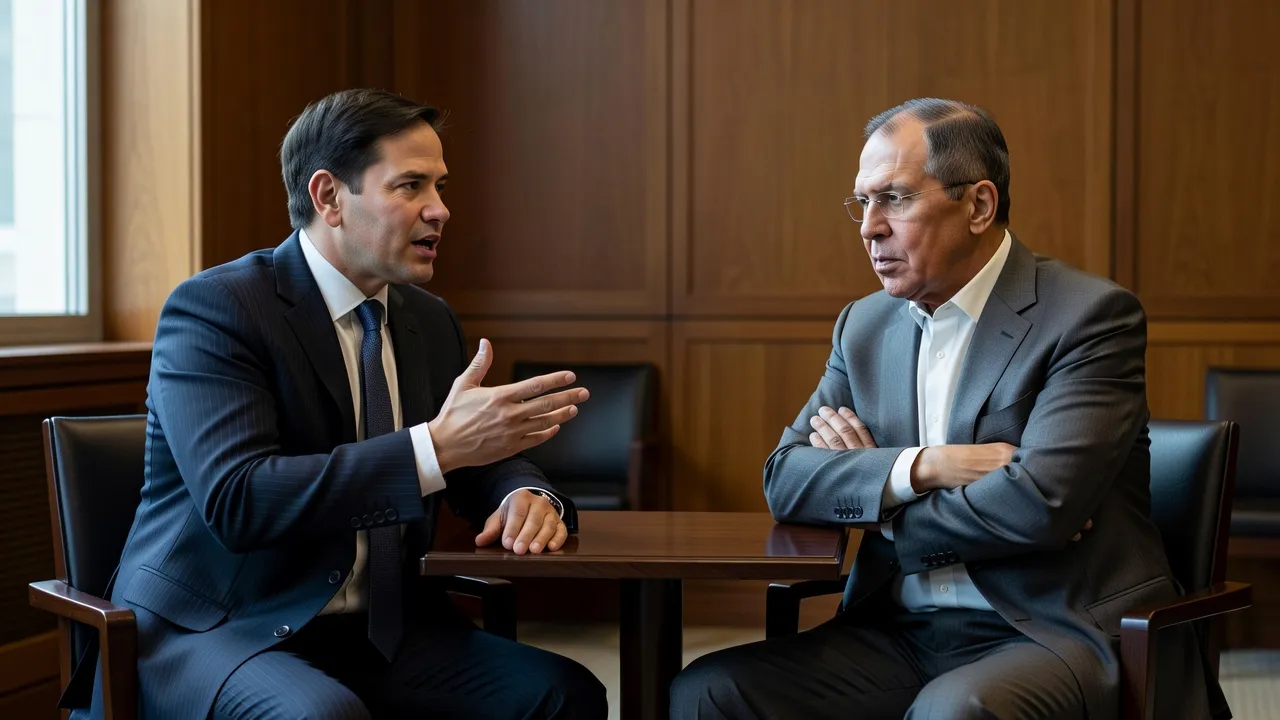
The meeting between Sergei Lavrov and Marco Rubio in New York lasted 52 minutes; immediately after, Lavrov stated before the UN Security Council that Russia will not pause the "special military operation" during negotiations.
- 03
Analyst Pavel Kochkine (ИСКРАН), quoted by Vedomosti, believes that choosing Rubio as a messenger shows that Washington is "serious", while Bloomberg had deemed the likelihood of Putin attending the G20 rather than the APEC summit in China "extremely low".
ANALYSIS
Moscow, September 24, 2026. The Kremlin is expressing satisfaction. On Wednesday, US Secretary of State Marco Rubio announced that Vladimir Putin had been invited to the G20 summit, scheduled for December 14 and 15 in Miami, following a 52-minute conversation with Russian Foreign Minister Sergei Lavrov on the sidelines of the United Nations General Assembly in New York. Kremlin spokesperson Dmitry Peskov reacted immediately: "We have heard this invitation, we are grateful to the American side for this invitation, we welcome this invitation, and we will determine the next steps, handling the matter through diplomatic channels," he told the Interfax agency.
For Moscow, the choice of emissary is important. Researcher Pavel Kochkin, from the Institute of the USA and Canada (ИСКРАН), quoted by Vedomosti, emphasizes that the invitation transmitted by Rubio - whom he refuses to describe as a "dove" towards Russia - signals that Washington "is serious" in its desire to continue dialogue despite the circumstances. He sees this as a "good sign" for the solidity of diplomacy, while recalling that both parties are starting from scratch and seeking new formulas.
This diplomatic episode does not, however, erase Moscow's line on the ground. Immediately after his meeting with Rubio, Lavrov stated before the UN Security Council that Russia would not suspend its "special military operation" during potential negotiations, contrary to Europe's wish, which he accuses of only wanting to "gain a reprieve". He said Moscow is ready to negotiate a "just peace". Rubio, for his part, judged that a limited ceasefire regarding grain and energy remained a difficult objective, while affirming that Washington would try to achieve it.
The Bloomberg agency had reported, two days before the announcement, that Putin was planning to go to China for the APEC summit and miss the G20, with sources considering it "extremely unlikely" that he would join Trump in Florida. The Kremlin is meanwhile maintaining its position that a meeting with Volodymyr Zelensky could only take place in Moscow. Presidential envoy Kirill Dmitriev welcomed on X a Trump administration that, he said, "prioritizes continuous dialogue with Russia", while the EU and the UK "remain stuck in Bidenthink". Kommersant, more reserved, describes a UN week where discussions on Ukraine brought "no breakthrough solution".