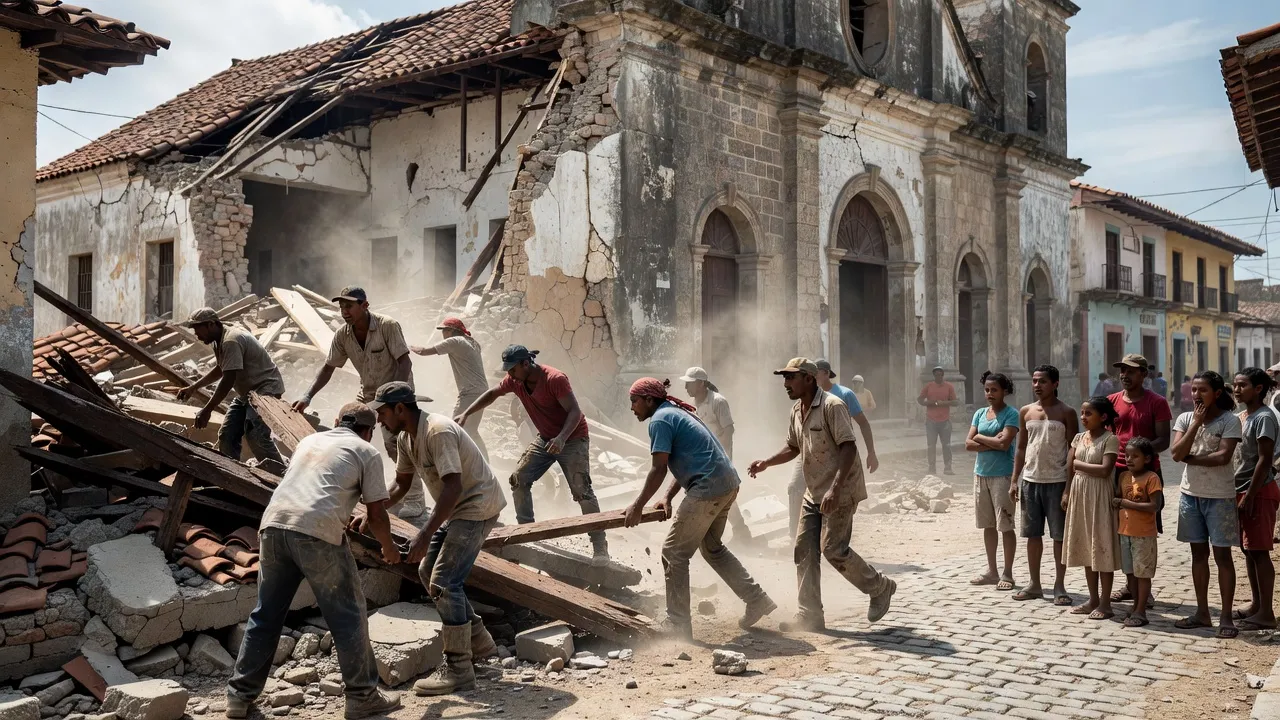
Magnitude 7.7 earthquake in Panama: buildings collapse in the centre of the country, tsunami alert lifted
published on
countries
sources
articles
More divergent than 54% of recent comparable stories (reference: 90 recent stories measured with the same method).
In Penonomé, a tower of the cathedral collapsed and the back of a hotel fell onto vehicles, according to a report by the Efe agency. The initial reports published on Friday, October 9, however, reported no damage: the picture became clearer as the dispatches came in.
No deaths have been confirmed in the preliminary reports, the tsunami alert has been lifted, and traffic through the Panama Canal is reported as normal.
Penonomé and the isolated provinces
According to the Efe agency, as reported by El Nacional (Venezuela), one of the two towers of the San Juan Bautista cathedral collapsed while Bishop Edgardo Cedeño and priests were inside. A side of the governance seat fell, as did the back of the Dos Continentes hotel onto vehicles; the occupants had time to get out. In this report conducted with the rescue teams, no deaths or injuries were reported.
« We are scared. We are only two old people here. The house is cracked. »
Descriptions of the cathedral vary by source. CBS and NBC, citing Omar Smith from Civil Protection, speak of a cracked cathedral. Tagesschau and El Nacional mention a collapsed tower. Ámbito (Argentina) specifies that the hotel collapse affected the ground floor and the first floor, without destroying the entire building.
Elsewhere, Primicias (Ecuador) reports that four people trapped in a hotel in Tonosí were rescued by firefighters. Politiken and VG cite Health Minister Fernando Boyd: Herrera, Coclé, and Los Santos are the most affected areas, and Los Santos is no longer accessible by the usual road. Authorities are trying to reach it by air. La Repubblica (Italy) notes that, according to the water agency Idaan, the capital's main drinking water plant is operating at 20% of its capacity.
Successive reports are emerging
The reports are from different times. 20 Minutes writes that, according to the AFP dispatch, no victims or damage had been reported "for the time being". G4Media (Romania) notes that no immediate damage had been reported. Later, AFP quotes René García, head of the Emergency Operations Center: two people trapped under collapsed buildings in Veraguas, no deaths "so far".
« We are facing a major catastrophe »
The most detailed count comes from Sinaproc, reported by EFE, then Infobae and RPP. It counts around 300 evacuees and more than 400 affected buildings: 142 homes, 188 schools, 20 health facilities, 13 churches, and nine bridges. Government Minister Dinoska Montalvo, for her part, cites damage to schools, health centers, churches, hotels, and roads, according to La Tercera (Chile).
On the extent of the damage, the headlines give different answers. According to SBS (Australia), José Raúl Mulino spoke of a "major catastrophe"; VG (Norway) reports "a large catastrophe" and roads "completely collapsed"; RFI quotes a "great disaster". CBC writes that the country "seems to have escaped" widespread destruction. The RFI correspondent judges the material damage to be limited, comparing it to the earthquake in Colombia on August 10.
This comparison is based on a toll that is not counted in the same way everywhere. For Colombia, RFI reports at least 321 deaths, Colombian authorities 335 according to Spanish and Venezuelan press, The Age and the Globe and Mail at least 289, VG at least 280. The epicenter is also located in different ways: Pitaloza Arriba in most texts, Tonosí in HuffPost España and Expansión, Panama City in the Arutz Sheva brief.
Tsunami alert coast by coast
Eleven presses from the corpus (Switzerland, Chile, Germany, Finland, Mexico, Norway, Poland, Romania, Sweden, Turkey, United States) open with the USGS measures and the tsunami alert. This count measures the opening angle of the articles retained for analysis, not the attention of their readers.
In Chile, La Cuarta and Publimetro report at 15:07 the first bulletin from SHOA, then a state of precaution for Easter Island, with a possible wave arrival at 22:41 island time. SHOA cancelled the threat at 16:18 for Rapa Nui and the entire coast. In Ecuador, Expreso reports that Risk Management Secretary Carolina Lozano announced the lifting at 14:03 on X, after Inocar's bulletin No. 3. The Peruvian Navy wrote that the earthquake "does not generate a tsunami on the Peruvian coast", according to Diario Correo.
The sources do not give the same duration or the same number of countries. Vanguardia (Mexico) indicates that the risk had passed about an hour later, RMF24 (Poland) less than two hours later, the Daily Mail about three hours later, and VG a lifting at midnight. Sveriges Radio reports on ten countries, Bianet and Berlingske on nine, Daily Sabah on five.
Aid, nationals, and flights
Several governments have reacted. According to El Universo, Daniel Noboa wrote that Ecuador is ready to provide assistance; El Comercio (Ecuador) notes that his message does not specify the nature of this assistance. Delcy Rodríguez wrote "¡Panamá no está sola!" offering Venezuela's assistance, without specifying which (El Nacional). El Comercio (Peru) attributes the same phrase to Colombian President Abelardo de la Espriella. Contrapunto reports Marco Rubio's announcement of a mobilization of American resources at Panama's request.
Assistance to nationals occupies a significant place in the press of several countries. The Mexican SRE indicates that no Mexicans are affected (Vanguardia), the Colombian Chancellerie opens an emergency WhatsApp (Semana), Ecuador has around 3,000 residents in Panama (Expreso), and Uruguay has released three numbers, after Yamandú Orsi's call to Mulino (Montevideo Portal, El Observador). In the United States, the embassy wrote on X that it was evaluating potential damage, according to NBC and Fox News.
On the transportation side, the Colombian Aerocivil has designated seven alternate airports: San Andrés, Cartagena, Barranquilla, Santa Marta, Cali, Rionegro, and Montería. Portafolio notes that the main challenge will be the return of diverted aircraft after the resumption of Copa Airlines flights. According to the Venezuelan press (Descifrado, Contrapunto), the company is offering changes without fees until October 31.
The USGS announced 8.0, then 7.6, then 7.7; the University of Panama measured 7.2 according to several media outlets.
Venezuela: at least 6,509 dead as of August 24; Colombia: August 10 earthquake, 335 dead.
Power outages in six provinces according to Naturgy; two subway lines suspended; seven flights rerouted to Costa Rica.
Located about 200 km from the epicenter, it is operating normally; about 90 ships are waiting at its two ends.
Key figures
What the comparison reveals
Common ground and differences in coverage across the media analysed.
What the media report in common
An earthquake with a magnitude of 7.6 to 7.7 according to the USGS struck Panama on Friday, October 9, at a depth of about 10 km, near Pitaloza Arriba (Herrera province).
A tsunami alert targeting several Pacific countries, from Panama to Mexico, was issued and then lifted in the following hours.
Buildings were damaged or collapsed in the center of the country, particularly in Penonomé (cathedral, hotel), according to agency reports.
Where media coverage diverges
Magnitude retained
Question: what magnitude should be given to the main earthquake? Part of the press retains 7.7 (revised USGS), others 7.6, and several also cite 7.2 measured by the Institute of Geosciences of the University of Panama.
Location of the epicentre
Question: where to locate the epicentre? Most articles cite Pitaloza Arriba (Herrera), a Spanish article mentions Tonosí, an Argentine article also cites Tonosí, and Arutz Sheva talks about Panama City.
Extent of damage
Question: are the damages limited or major? CBC, RFI, Reuters via ARY mention a country that has avoided general destruction; VG, Svenska Dagbladet, Politiken report the 'catastrophe' formula from Mulino and collapsed roads and buildings.
This grouping describes the publications analysed, not the position of these countries’ populations or of their governments.
Blind spots
What the coverage of each country leaves aside, while others put it forward.
 United States
- USGS estimate of economic losses between 1 % and 10 % of Panama's GDP
- normal operation of the canal
 Chile
Chile- normal operation of the Panama Canal
- closure and reopening of Tocumen Airport
Understand the context
- JUN 24, 2026Earthquakes of magnitude 7.2 and 7.5 in Venezuela
- AUG 10, 2026Earthquake of magnitude 7.4 in Colombia
- OCT 9, 2026Earthquake of magnitude 7.7 in Panama, followed by a 6.6-magnitude aftershock
How each country reads it
Preview: 3 of 30 media perspectives. Syntheses of the media analysed — not direct quotations. Method & limitations
 United Kingdom
London is focused on the immediate human toll of the Panamanian earthquake: collapsed buildings, residents trapped under rubble, and testimonials from victims, before any economic or political analysis.
4 sources · View sources
 Argentina
Buenos Aires is gauging the extent of the Panamanian earthquake through images of panic and the tally of damage, from the collapsed hotel in Penonomé to the official toll of 27 minor injuries.
4 sources · View sources
 Australia
Canberra is gauging the Panamanian earthquake in terms of global trade: the Australian press is highlighting the spared canal and the USGS's estimated loss range of between 1% and 10% of Panama's GDP.
4 sources · View sources
The full text, country by country
United Kingdom
DOMINANT ANGLE
London is focused on the immediate human toll of the Panamanian earthquake: collapsed buildings, residents trapped under rubble, and testimonials from victims, before any economic or political analysis.
KEY POINTS
- According to the BBC, around 4.6 million people experienced moderate to severe shaking, according to the USGS, from a magnitude 7.7 earthquake at a depth of 12 km.
- The Pacific Tsunami Warning Center targeted nine countries before confirming, about three hours after the earthquake, that the threat had passed (Daily Mail).
- President Mulino wrote on X that the event "must not be used to generate alarm and disorder" (The Guardian).
ANALYSIS
London, 10 October 2026. The British press is treating the earthquake that struck Panama on Friday, 9 October, as a catastrophe with visible initial damage, although no official toll has been established. The BBC describes a "massive" 7.7-magnitude earthquake, whose epicentre was located about 10 km from Pitaloza Arriba, and cites the USGS as saying that some 4.6 million people felt moderate to strong tremors. It notes that the depth, a mere 12 km, increases the risk of severe effects on the surface.
The narrative is organised around images. The BBC mentions videos that appear to show buildings collapsing in Penonomé and Soná, including a man calling out to potential victims trapped under the rubble, a cathedral with one side and a spire collapsed, and a hotel almost entirely destroyed. It specifies that no victims had been reported at this stage and that the extent of the damage remained uncertain, with significant aftershocks complicating the situation. The Daily Mail mentions people trapped under the rubble, including a hotel that fell on an occupied car, and split roads.
The Independent gives a voice to the victims. It shows elderly people in tears in the street and quotes Ricardo Brown, 74, in Las Minas: "We are afraid. We are only two old people here. The house is cracked." It also reports the assessment of Omar Smith, head of civil protection, who signals impacts in Chitré and the province of Los Santos.
The Guardian focuses on crisis communication. President José Raúl Mulino asked a minister to call for calm and wrote on X that the event "should not be used to generate alarm and disorder". The newspaper cites local newspaper La Prensa on the evacuation of schools and housing, and publishes a photo of a highway sectioned off west of the capital. Its initial figure, 7.6, differs from that of the other titles.
On a regional level, the Daily Mail and the Independent recall that the Pacific Tsunami Warning Centre initially targeted nine countries, from Mexico to Colombia, before lifting the threat about three hours later. The Independent stresses that the Panama Canal, an essential trade route, was not affected, and that earthquakes of this force are rare in the country. The Daily Mail adds a more alarmist tone by referring to the risk of a megathrust earthquake on the Pacific Ring of Fire.
Argentina
DOMINANT ANGLE
Buenos Aires is gauging the extent of the Panamanian earthquake through images of panic and the tally of damage, from the collapsed hotel in Penonomé to the official toll of 27 minor injuries.
KEY POINTS
- According to the Sinaproc report cited by EFE/Infobae: at least 27 minor injuries, around 300 evacuees, and over 400 affected buildings, with no fatalities.
- The USGS revised the magnitude from 8.0 to 7.6 and then 7.7; the epicenter was approximately 10 km deep near Pitaloza Arriba (Herrera), 240 km from the capital.
- The tsunami alert targeted nine Pacific countries before being lifted; the closure of Tocumen resulted in seven flights being rerouted to Costa Rica.
ANALYSIS
Buenos Aires, October 10, 2026. For the Argentine press, the earthquake that struck Panama on Friday, October 9, at 12:56 local time (2:56 pm in Argentina, La Nación specifies) is told primarily through images. La Nación dedicates an article to the videos "captured by citizens and tourists" that have gone viral, showing collapsed buildings, roads cut in two, and falling debris. In Penonomé, in the province of Coclé, a witness filmed from his car exclaims: "The Dos Continentes hotel has fallen. Half of the hotel has fallen."
The media detail the chronology of the measures. Perfil and Ámbito recall that the USGS initially estimated the magnitude at 8.0, then reduced it to 7.6 and finally to 7.7; the epicenter was located about 10 kilometers deep near Pitaloza Arriba, in the province of Herrera, some 240 kilometers from the capital. Ámbito, which still titles with 7.6, specifies that the collapse of the hotel affected the ground floor and the first floor without destroying the entire building, and that the San Juan Bautista cathedral and the provincial government headquarters were also damaged.
The tsunami alert occupies an important place. La Nación lists the affected countries (Panama, Colombia, Ecuador, Peru, Nicaragua, Guatemala, El Salvador, Mexico, Chile, and Hawaii) and notes that the alert was lifted a few hours later. Ámbito headlines the alert "in 9 countries".
The practical consequences are closely followed. Infobae reports that the temporary closure of Tocumen airport caused seven flights to be diverted to Juan Santamaría, in Costa Rica, where the operator AERIS assures that activity is "totally normal". Perfil mentions preventive evacuations in Panama and the fear of aftershocks.
The most complete report comes from an EFE dispatch reproduced by Infobae: at least 27 minor injuries, around 300 evacuees, and more than 400 affected buildings (142 homes, 188 schools, 20 health facilities, 13 churches, nine bridges), with no fatalities or missing persons according to Sinaproc. The dispatch also indicates that the Panamanian Geosciences Institute reduced the magnitude to 7.5 and that more than a hundred aftershocks have been recorded. The initial reports, however, remained cautious: La Nación wrote that the authorities "did not yet report any victims or material damage".
Australia
DOMINANT ANGLE
Canberra is gauging the Panamanian earthquake in terms of global trade: the Australian press is highlighting the spared canal and the USGS's estimated loss range of between 1% and 10% of Panama's GDP.
KEY POINTS
- The USGS estimates economic losses between 1 and 10 % of Panama's GDP (ABC News).
- The canal, about 200 km from the epicentre, is operating normally; around 90 vessels, including bulk carriers, are affected according to ABC.
- The 2026 earthquakes in Venezuela (more than 6,500 dead) and Colombia (at least 289 dead) serve as the regional backdrop (The Age, SMH).
ANALYSIS
Canberra, October 10, 2026. In the Australian press, the magnitude 7.7 earthquake that struck Panama on Friday, October 9, is first presented as a rare and powerful event that left the canal unscathed. SBS headlines a "rare" earthquake that "spares" the canal. The article states that the tremors caused buildings and roads to collapse in the center of the country, but spared "the critical commercial route" that is the canal. ABC News specifies that it is located about 200 kilometers from the epicenter and "operating normally". The channel adds that around 90 ships, including bulk carriers, were affected.
ABC also picks up the USGS estimate, which suggests that economic losses could represent between 1 and 10% of Panama's gross domestic product. This range gives the coverage its numerical backbone.
The human aspect follows, carried by testimonials collected by the agencies. Ricardo Brown, 74, in Las Minas, in the province of Herrera, says: "The house cracked, and we're afraid it will fall on us." In Panama, Salomon Andion, 46, evacuated his 15-story building twice after aftershocks. The head of emergency operations, Rene Garcia, told AFP that no deaths had been reported, but people were trapped in collapsed structures, near a church in Veraguas and in a hotel in Coclé. PerthNow mentions a historic building's tower collapsed in Penonomé, two suspended metro lines, and the closure of all schools.
The Age and the Sydney Morning Herald, which publish the Associated Press dispatch, put the earthquake into a regional black series: two earthquakes of 7.2 and 7.5 in Venezuela in June, over 6,500 dead; a 7.4 earthquake in Colombia in August, at least 289 dead. They quote President José Raúl Mulino, who calls for calm: "What happened should not be used to sow alarm or disorder." SBS also reports his words: "We are facing a major catastrophe".
On the scientific level, ABC cites Nestor Luque, director of the Panama Institute of Geosciences: the earthquake comes from an active fault system where constraints accumulate before being released. The figures diverge according to the titles: a depth of 10 km for the USGS in The Age, 12.6 km in ABC and PerthNow. The tsunami alert is lifted.
 Belgium
DOMINANT ANGLE
Brussels recounts the Panama earthquake through its victims: shocked witnesses, collapsed buildings and roads, rescue efforts underway in the center of the country.
KEY POINTS
- Magnitude 7.7 earthquake 10 km from Pitaloza Arriba (Herrera), followed by a 6.6 magnitude aftershock according to the USGS
- Preliminary toll: at least two people injured and trapped in Veraguas, no fatalities reported according to René García, head of the Emergency Operations Center
- Penonomé Cathedral damaged, San Atanasio church collapsed, power outage in six provinces; canal traffic normal
ANALYSIS
Brussels, October 10, 2026. The Belgian press reports on a 7.7 magnitude earthquake that occurred on Friday, October 9, in Panama, at 12:56 local time according to the United States Geological Survey (USGS), with an epicenter 10 km from Pitaloza Arriba, in the province of Herrera (central-south). The Libre Belgique, citing an AFP dispatch, reports on the panic in the capital, the collapse of buildings and roads, and a preliminary toll of at least two injured, with no reported deaths.
The French-language account relies on witnesses. Juana Alveo, 38, a cashier in Penonomé, about 130 kilometers from the epicenter, says: "It was horrible, we had never experienced that. My daughter was stuck at school." Luis Poveda, a factory worker in Santiago de Veraguas, says he is in shock and has no news from his family. Teacher Ariel Apolayo describes a shock that felt "stronger, and even stronger," to the point that "cars were swaying." AFP journalists observed several collapsed buildings and a damaged cathedral in Penonomé, as well as damage in the fishing village of Santa Catalina, in the province of Veraguas.
The head of the Emergency Operations Center, René García, indicates that no deaths have been reported "so far" and that two people are trapped under collapsed buildings in Veraguas.
On the Dutch-speaking side, VRT NWS reports that the shock was felt off the southern coast, as far as the capital, and lists the damage: the cathedral and buildings in Penonomé, the historic church of San Atanasio, in the province of Los Santos, which is said to have collapsed, cracks in roads, power outages in six provinces. The capital's international airport suspended its activities before gradually reopening, while traffic through the canal remained normal.
VRT also mentions the 6.6 magnitude aftershock according to the USGS, the dozens of secondary shocks, and the tsunami alert issued for several countries on the west coast of Central and South America. The media outlet places the event on the Pacific Ring of Fire, 40,000 kilometers long, where earthquakes are frequent.
Neither of the two articles reports on a reaction from President Mulino or a definitive toll; the Belgian coverage remains focused on the damage and the people affected.
 Brazil
DOMINANT ANGLE
Brasília is analyzing the Panamanian earthquake by the numbers: revised magnitude from 8.0 to 7.7, shallow depth, comparison to the largest earthquakes in history, and tsunami alert lifted.
KEY POINTS
- The USGS initially estimated the magnitude at 8.0, then at 7.6, before setting it at 7.7, with an epicenter 10 km from Pitaloza Arriba (Estadão, G1).
- According to civil protection cited by G1, no deaths were confirmed but injured people had been hospitalized; a hotel in Penonomé partially collapsed.
- The Canal Authority announced normal operations; Veja notes that the waterway handles 5% of international maritime trade.
ANALYSIS
Brasília, October 10, 2026. For the Brazilian press, the earthquake that struck Panama on Friday, October 9, is first and foremost an event to be explained. G1 published an analysis titled "entenda o que significa a magnitude 7,7": an earthquake of 7.0 to 7.9 is "large" and can cause severe damage, but magnitude alone does not tell the whole story, as depth, distance from the epicenter, and soil type are also factors. The media emphasizes the depth of around 12 kilometers, which increases the intensity felt on the surface.
The revision of the magnitude is mentioned in almost all the articles: the USGS initially announced 8.0, then 7.6, and finally 7.7. Another G1 article puts the event into historical perspective: Valdivia (Chile, 1960, magnitude 9.5, around 1,655 deaths), Alaska in 1964 (9.2), and Chile in 2010 (8.8, 523 deaths). According to this text, the Panamanian earthquake remains "distant from the destructive power" of the largest recorded earthquakes.
Damage is reported through images and eyewitness accounts. Veja and Estadão describe a partially collapsed hotel in Penonomé, the San Juan Bautista cathedral affected, and power outages in six provinces. Veja quotes President José Raúl Mulino: "O desastre que estamos enfrentando é grande", with roads "totally destroyed". Folha also reports his call for calm on X: "Não se deve usar o ocorrido para gerar alarme e desordem". According to the civil protection bulletin cited by G1, no deaths were confirmed, but injured people were taken to the hospital.
The national angle focuses on Brazilians on the ground. G1 gives a voice to Roque Freitas, a guide who has been living in the capital for 16 years, who describes fallen awnings in the Casco Antiguo and evacuated buildings, and to journalist Laís Gomes, who was evacuated from a restaurant: "Todos começaram a gritar".
From an economic perspective, the canal is mentioned in a factual manner. Agência Brasil and Jornal de Brasília report the Canal Authority's statement that operations are normal; Veja specifies that the waterway handles 5% of international maritime trade. The media finally relays the tsunami alert: the American system targeted the coasts of Panama, Colombia, Costa Rica, Ecuador, Peru, Nicaragua, Guatemala, El Salvador, and Mexico, before withdrawing the alert. Jornal de Brasília recalls that earthquakes are not common in the Panamanian capital, which is more exposed in the province of Chiriquí.
 Canada
DOMINANT ANGLE
Ottawa is nuanced in its assessment of the Panamanian earthquake: Canadian media highlights real material damage but notes the absence, in the initial hours, of deaths and injuries, unlike the deadly tremors in Venezuela and Colombia.
KEY POINTS
- The USGS measured two earthquakes of magnitude 7.7 and 6.6 in Panama on Friday, October 9, with an epicenter at a depth of 10 km near Pitaloza Arriba (Herrera).
- Seismologists from the University of Panama recorded more than 45 aftershocks, according to the Globe and Mail.
- The Panama Canal and the Cobre Panamá mine reported normal operations, and Tocumen Airport lifted its flight suspension, according to CBC.
ANALYSIS
Ottawa, October 10, 2026. Canada's capital is closely following the earthquake in Panama, which is being covered by The Globe and Mail and CBC News as a catastrophe that could have been worse. According to the United States Geological Survey (USGS), two earthquakes of magnitude 7.7 and 6.6, followed by aftershocks, struck the country on Friday, October 9, in the afternoon. The first earthquake, felt as far as Colombia, was centered about 10 kilometers southwest of the isolated town of Pitaloza Arriba, in the central province of Herrera. The USGS initially evaluated it at 8, then at 7.6, before setting it at 7.7.
The Globe and Mail focuses on the images: buildings collapsed near the epicenter, deep cracks in the roads, evacuations throughout the country. Seismologists from the University of Panama recorded more than 45 aftershocks, including several of magnitude 5.8, 5.5, and 5.2. The newspaper collects the testimony of Rosendo Domínguez, 60, from Herrera: "Everyone is outside, frightened," he told the Associated Press. President José Raúl Mulino called for calm on X: what happened should not be used to "cause alarm or disorder".
CBC News takes a more reassuring tone. The country "seems to have escaped" widespread destruction, writes the public broadcaster: no deaths or injuries were reported immediately, the Panama Canal and the Cobre Panamá copper mine were operating normally, and Tocumen Airport lifted its flight suspension. Mulino traveled to Penonomé, halfway between the epicenter and the capital, where buildings collapsed and a church was damaged. In Panama, evacuated office workers wondered how to get home in the traffic jams.
Both media outlets put the event into a regional series: two earthquakes of magnitude 7.2 and 7.5 struck the state of La Guaira, Venezuela, in June, killing more than 6,500 people, according to The Globe and Mail, and the one of 7.4 in Colombia, in August, killed at least 289 people. CBC mentions more than 300 deaths in Colombia. This comparison structures the Canadian reading: the fear of a new heavy toll, tempered by initial findings that are less somber.
 Switzerland
DOMINANT ANGLE
Bern is gauging the Panamanian earthquake by the numbers and the tsunami alert: revised magnitudes, threatened coastlines and then the threat lifted, before the damage assessment.
KEY POINTS
- The USGS revised the magnitude from 7.6 to 7.7, while the Honolulu Alert Center had announced 8.0 and a depth of 33 km (SRF News).
- The tsunami alert targeted the coasts of nine countries, from Panama to Mexico, before being lifted (SRF News).
- According to Le Temps, earthquakes in the Panamanian capital are unusual, with seismic activity mainly concentrated in the province of Chiriquí.
ANALYSIS
Berne, October 10, 2026. The Swiss press is covering the Panamanian earthquake of Friday, October 9, from the angle of measurement and alert rather than destruction. SRF News leads with the "Tsunami-Warnung": a 7.7 magnitude earthquake struck the southern coast of Panama at 12:56 local time, according to the USGS, with its epicenter about ten kilometers from Pitaloza Arriba, at a depth of ten kilometers, in the south-central part of the country.
The editorial offices are emphasizing the discrepancies in measurement. The USGS initially estimated the magnitude at 7.6 before revising it to 7.7, while the Pacific Tsunami Warning Center in Honolulu had announced 8.0 and a depth of 33 kilometers. Le Temps, which relies on AFP, notes a similar initial estimate of 8, revised to 7.6 and then to 7.7. This instability in the numbers structures the narrative, as does the chronology of the alert: SRF lists the affected coasts (Panama, Colombia, Costa Rica, Ecuador, Peru, Nicaragua, Guatemala, El Salvador, Mexico), then specifies that the threat has been lifted.
The human toll remains in the background. SRF writes that, according to initial reports, there were "no deaths and no major destruction," and Le Temps notes that no victims have been reported. The damage cited is sporadic: the San Juan Bautista cathedral in Penonomé was damaged, according to "La Prensa," a hospital was evacuated where a nurse was caring for patients, and there were power outages in several provinces. The government suspended afternoon classes throughout the country, and Tocumen airport interrupted its activity.
The testimonies are brief. SRF quotes Rosendo Domínguez, 60, from the province of Herrera, who was contacted by the Associated Press: objects fell in the kitchen, "everyone is outside and afraid." Le Temps reports that hundreds of people evacuated buildings in Panama, according to AFP.
The seismic context is recalled by Le Temps: earthquakes in the capital are unusual, with most seismic activity concentrated in the province of Chiriquí, in the west. The newspaper mentions several significant aftershocks, including one of magnitude 6, and authorities assessing damage in Herrera, Azuero, Veraguas, and Los Santos. Neither article discusses the canal or the economic consequences.
Chile
DOMINANT ANGLE
Santiago is analyzing the Panamanian earthquake through the prism of tsunami risk: the SHOA alert for Easter Island, lifted in just over an hour, takes precedence over the damage report in Panama.
KEY POINTS
- The SHOA cancelled the tsunami threat for Easter Island and the entire coastline at 16:18, about an hour after the first bulletin at 15:07 (La Cuarta, Publimetro).
- The cited magnitude varies by source: 7.7 for the USGS, 7.5 for the Geosciences Institute of the University of Panama, with an initial estimate of 8.0 (La Tercera, Publimetro).
- Mulino speaks of a "major disaster"; Panamanian authorities reported no fatalities at this stage (La Tercera).
ANALYSIS
Santiago, October 10, 2026. In Chile, the Panama earthquake is first assessed in terms of the national alert system. La Cuarta and Publimetro reported the tremor at 2:56 pm, Chilean time, on Friday, October 9, with a magnitude of 7.7 and a depth of 12.6 km according to the USGS, after an initial estimate of 8.0. At 3:07 pm, the Hydrographic and Oceanographic Service of the Navy (SHOA) issued a first "informational status" bulletin for the entire coastline, and then a precautionary status for Easter Island, with a possible wave arrival at 10:41 pm, island time.
The Deputy Minister of the Interior and government spokesperson, Claudio Alvarado, recalled this schedule during a press conference, according to Cooperativa. The Senapred established a precautionary status, and according to La Cuarta and Publimetro, evacuation of the island's coastline was considered. At 4:18 pm, the SHOA canceled the threat for Rapa Nui and the entire coast: "according to modeling by the SNAM and PTWC", the earthquake did not meet the conditions for a tsunami in Chile. The SHOA specifies that surveillance continues and that this bulletin is the last, unless new information becomes available.
La Tercera dedicates a second section to Panama. President José Raúl Mulino speaks of a "major disaster" with roads "completely collapsed"; Government Minister Dinoska Montalvo mentions damage to schools, health centers, churches, hotels, and roads, with no reported victims at this stage. The Geosciences Institute of the University of Panama revised the magnitude to 7.5 in the afternoon, which explains the divergent figures (7.5, 7.6, 7.7) published by Chilean media.
Cooperativa gives the floor to two Chileans. Jorge Urbano Gatica, who has been living in Panama since 2011, believes that "one takes it more calmly" than people not used to earthquakes, but adds that "nobody here was psychologically prepared". Guillermo Sepúlveda, a passenger on a flight approaching Tocumen Airport, recounts that the plane was diverted to Cartagena de Indias, the airport being closed and evacuated.
The coverage remains factual and focused on the national experience: determining whether the threat concerns the territory, how the Navy's protocol worked, and how compatriots experienced the event. The economic stakes of the canal or Panama's domestic policy do not appear in the articles from the pool.
 Colombia
DOMINANT ANGLE
Bogotá is measuring the Panamanian earthquake by its practical fallout: flights rerouted to seven Colombian airports, canal in service, assistance to nationals and no tsunami threat on the Colombian Pacific.
KEY POINTS
- Aerocivil has designated seven alternate airports for flights rerouted from Tocumen, which is temporarily closed.
- According to Semana, the Canal Authority indicates that operations "continue with normality"; 5% of international maritime trade passes through it.
- The Chancellerie reported no affected nationals and Dimar ruled out a tsunami threat in the Colombian Pacific.
ANALYSIS
Bogotá, October 10, 2026. The Colombian press is covering the earthquake that struck Panama on Friday, October 9, primarily from the perspective of proximity. According to El Colombiano, the tremor was felt in Cartagena, Medellín, and Chocó. The Colombian Geological Service initially reported a magnitude of 8.0 at a depth of 33 km; the USGS later revised the value to 7.7, with the epicenter located 10 km from Pitaloza Arriba, as reported by Semana, which also mentioned an initial estimate of 8 and then 7.6.
The air travel aspect is taking center stage. Tocumen Airport, an "important air connection hub in Latin America" according to Semana, was temporarily closed. Aerocivil designated seven alternate airports (San Andrés, Cartagena, Barranquilla, Santa Marta, Cali, Rionegro, and Montería) and offered Colombia's technical capabilities to Panama. Portafolio notes that Copa Airlines has resumed flights after Tocumen's reopening, warns of delays, and is offering changes without penalty; the main challenge will be returning the rerouted aircraft.
The canal is being covered from a commercial angle. Semana quotes the Canal Authority: operations "continue with normality," emergency protocols are activated, and facilities are being inspected. It recalls that 5% of international maritime trade passes through the canal. La République reports mobile phone outages among several operators, and a separate article details the free insurance Panama is offering to tourists for ten days, specifying that an earthquake-related event is still subject to policy exclusions.
The consular aspect is being highlighted: the Chancellerie has opened a WhatsApp emergency line and an email address for Colombians in Panama, and indicates that no affected Colombian nationals have been reported. According to the UNGRD, the Dimar rules out any tsunami threat on Colombia's Pacific coast.
The damage in Panama is being reported second-hand: a hotel partially collapsed in Penonomé, a church was damaged, and there are cracks in buildings, with no deaths announced at this stage according to Panamanian authorities. El Colombiano collects the testimony of a Colombian woman on the 23rd floor in Panama, who mentions the metro being inspected, and gas and water being cut off as a precaution; El Tiempo tells the story of a woman from Cali who is reliving the earthquake of August 10 in Cali.
 Germany
DOMINANT ANGLE
Berlin is measuring the Panamanian earthquake in terms of seismic risk and tsunami alert, with agency coverage focused on USGS data and its revised magnitude.
KEY POINTS
- According to the USGS, as cited by the Tagesschau, the earthquake reached a magnitude of 7.7, at a depth of about ten kilometers near Pitaloza Arriba (Herrera province), followed by dozens of aftershocks.
- The Handelsblatt notes that the magnitude was initially announced at 8.0 before being corrected to 7.6, and that the tsunami alert targeted Mexico, Guatemala, Costa Rica, Colombia, Ecuador, and Peru.
- The Tagesschau reports damage to the San Juan Bautista cathedral in Penonomé, a hotel, the provincial administration building, and the Santiago cathedral, as well as the lifting of the tsunami alert.
ANALYSIS
Berlin, October 10, 2026. The German press is treating the Panama earthquake as a geophysical event first, and a human one second, largely relying on the United States Geological Survey (USGS).
The Tagesschau, headlining "Schweres Erdbeben erschüttert Panama" (Severe earthquake shakes Panama), reports a magnitude of 7.7. The epicenter was located at a depth of about ten kilometers, ten kilometers southwest of the isolated town of Pitaloza Arriba, in the central province of Herrera. It notes that dozens of aftershocks followed, that buildings shook in Panama City, where residents took to the streets, and that the tremors were felt as far as Colombia.
The Handelsblatt, in a report from the first hour, highlights the uncertainty of the initial measurements: the magnitude had initially been given as 8.0 before being revised to 7.6 by the USGS. It mentions a tsunami alert for large parts of Central and South America and cites the Pacific coasts of Mexico, Guatemala, El Salvador, Nicaragua, Costa Rica, Colombia, Ecuador, and Peru. It relies on Reuters witnesses to describe the tremors in Panama City and Costa Rica, and specifies that initial reports did not mention any damage.
The Tagesschau, in a later report, details the damage reported by Panamanian media: a tower of the San Juan Bautista cathedral in Penonomé, in the province of Coclé, a hotel, and the headquarters of the provincial administration, as well as damage to the Santiago cathedral, in the province of Veraguas. It indicates that the government has suspended afternoon classes throughout the country and that residents have left, as a precaution, shops, schools, and buildings.
Regarding the alert, the channel reports that the Pacific Tsunami Warning Center in Honolulu has lifted the threat for the nine countries: "Die Gefahr gefährlicher Wellen sei vorüber" (The danger of dangerous waves is over). It specifies that no information on potential casualties was available at this stage.
The two sources stick to the facts measured and attributed to American agencies, without editorializing, without quoting President Mulino, or addressing the situation of the canal or the airport.
 Denmark
DOMINANT ANGLE
Copenhagen relays the Panamanian earthquake through a news agency dispatch: first a tsunami alert, then the assessment of destroyed roads and buildings and an isolated province.
KEY POINTS
- The 7.7-magnitude earthquake triggered a tsunami alert in several Central and South American countries, which was lifted about two hours later (Berlingske, DR).
- President Mulino speaks of a "omfattende katastrofe"; Health Minister Fernando Boyd says Los Santos is inaccessible by road (Politiken, according to AFP).
- Traffic in the Panama Canal remained normal according to Reuters, while the capital's airport was temporarily closed (Berlingske, Politiken).
ANALYSIS
Copenhagen, October 10, 2026. Danish coverage follows the rhythm of the agencies: three media outlets, Berlingske, DR Nyheder, and Politiken, pick up Reuters and AFP, and the narrative evolves over the course of Friday evening.
The first phase is that of the alert. Berlingske headlines with the "tsunamivarsel i ni lande": a 7.7 magnitude earthquake triggered tsunami warnings in Central and South America, lifted "knap to timer" later, around 10 pm Danish time, according to the American tsunami alert system. DR, in a brief text based on Reuters, lists the countries affected by the NOAA (Costa Rica, Ecuador, Peru, Nicaragua, Guatemala, El Salvador, Mexico) and notes that the quake, which occurred in the province of Herrera, was felt in Panama and San José. Berlingske also details the revisions of the magnitude, initially 8.0, then 7.6, and finally 7.7, and a focus located at a depth of 12.6 kilometers, which, the newspaper writes, "kan medføre større skade" than a deeper earthquake. It recalls that earthquakes are "relativt sjældne" in Panama.
The second phase, carried by Politiken, is that of the damage. The newspaper, citing AFP, writes that buildings and roads are destroyed, that the tremors lasted about a minute according to the civil protection, and that no deaths have been reported yet. In Panama, residents fled skyscrapers in panic; a 46-year-old resident, Salomon Andion, said he left his 15-story building: "Jeg var bange". President José Raúl Mulino states: "Vi står over for en omfattende katastrofe", and specifies that some roads have collapsed. Health Minister Fernando Boyd designates Herrera, Coclé, and Los Santos as the most affected areas; Los Santos is no longer accessible by road, and authorities are trying to reach it by air.
Politiken adds that the capital's international airport was temporarily closed and flights were diverted. Berlingske, earlier in the evening, indicated that traffic remained normal in the Panama Canal, where technicians were checking the condition.
The coverage remains factual and without a special correspondent: the figures, testimonies, and official quotes come from the agencies. The texts do not contain a human toll, due to the lack of confirmed deaths or injuries, and do not dwell on the country's preparedness or the regional context.
 Ecuador
DOMINANT ANGLE
Quito is measuring the Panamanian earthquake by its own coast: the tsunami alert lifted by Inocar, then the solidarity of President Noboa towards the "Panamanian brothers".
KEY POINTS
- On October 9, Carolina Lozano announced at 14h03 the lifting of the tsunami alert for the coast, after bulletin #3 from Inocar.
- Daniel Noboa wrote that aid is ready to be provided to Panama; the Chancellerie has opened two channels for the some 3,000 residents in this country.
- The Geosciences Institute of Panama counted 107 aftershocks; the USGS revised the magnitude from 8.0 to 7.6 then 7.7, according to El Comercio.
ANALYSIS
Quito, October 10, 2026. For Ecuadorian media, the 7.7 magnitude earthquake that occurred on Friday, October 9 at 12:56 local time in Panama is first and foremost an event that affected the national coastline. Expreso reports that the Secretary of Risk Management, Carolina Lozano, announced on X at 14:03: "Cancelada alerta de tsunami para las Costas Ecuatorianas". The Instituto Oceanográfico y Antártico de la Armada (Inocar) had previously published its bulletin No. 3 lifting the alert for the continental and insular coasts. El Comercio lists the countries affected by the American system's notice, including Chile and El Salvador, which also cancelled the alert.
The press then describes the effect on daily life. Expreso shows the Santa Elena peninsula, where the start of the long holiday weekend on October 9 took place "with normality": a tourist from Salinas assures that he "knew nothing would happen", while the authorities ask to respect the flags due to the swell. El Comercio and El Universo also follow the flights: the Tocumen airport, temporarily closed, has resumed operations, and two Copa Airlines flights to Panama landed in Guayaquil.
Regarding the damage, the headlines repeat the dispatches from EFE and AFP. Primicias mentions hotels and buildings collapsed, four people found trapped in a hotel in Tonosí and rescued by firefighters, as well as an isolated locality by road. El Comercio quotes the director of the Institute of Geosciences, Néstor Luque, who counts 107 aftershocks, and notes that the magnitude figures have evolved, from 8.0 to 7.6 and then 7.7: "conviene seguir los datos oficiales". No deaths have been confirmed in the initial reports.
The political and consular aspect occupies a clear place. Daniel Noboa wrote: "Ecuador está preparado para brindar ayuda y colaborar en las labores de atención a nuestros hermanos panameños". The Chancery has opened two assistance channels, a number at +507 and an email address, for the approximately 3,000 Ecuadorians residing in Panama according to official figures. Primicias recalls that Noboa had met with his counterpart José Raúl Mulino in Guayaquil on September 4. El Universo quotes the President of the Assembly, Mishel Mancheno, and Carolina Lozano, who says she is "attentive to the international call" of Panama.
The Panama Canal, where between 3% and 5% of global trade passes according to Primicias, is operating normally. In total, the Ecuadorian account prioritizes coastal risk management, the continuity of travel, and diplomatic solidarity over the analysis of Panamanian damage.
 Spain
Spain
DOMINANT ANGLE
Madrid is measuring the Panamanian earthquake by the numbers from the USGS and the series of seismic catastrophes that have been hitting Latin America since June.
KEY POINTS
- Earthquake of magnitude 7.7 at a depth of 10 km, 12 km from Tonosí and approximately 239 km from the capital, at 12:56 local time, according to the USGS (initially estimated magnitude of 7.6).
- Tsunami alert issued for the Pacific coasts of Colombia, Ecuador, Guatemala, and Nicaragua, then cancelled; aftershocks of magnitude 6.1, 6.0, and 5.3.
- Previous earthquakes mentioned: Venezuela, June 24 (7.2 and 7.5), at least 6,509 deaths as of August 24; Colombia, August 10 (7.4), 335 deaths and 4,516 injured.
ANALYSIS
Madrid, October 10, 2026. The Spanish press is covering the Panamanian earthquake based on dispatches, starting with data from the USGS. HuffPost España and Expansión report that a 7.7 magnitude earthquake shook the southeast of Panama on Friday, October 9, at a depth of 10 kilometers, according to the United States Geological Service. The epicenter is located 12 kilometers from the town of Tonosí, about 239 kilometers from the capital. The tremor occurred at 12:56 local time (17:56 GMT). Initially estimated at 7.6, the magnitude was revised to 7.7 by the USGS.
HuffPost España specifies that the US tsunami alert system issued an alert for the Pacific coast of Colombia, Ecuador, Guatemala, and Nicaragua a few minutes after the tremor, which was then cancelled. Aftershocks of magnitude 6.1, 6.0, and 5.3 were felt.
Regarding damage, the account remains measured. In Panama, several buildings in the old banking district were evacuated as a precaution, as reported by the Efe agency. According to HuffPost España, Panamanian media report damage to at least one building in Penonomé, the capital of the Coclé province, about 150 kilometers from the capital. No human toll is mentioned in these texts, which only report preventive evacuations and initial damage reported in the Coclé province.
The framing is mainly comparative. Both media outlets recall the recent series of earthquakes in Latin America. In Venezuela, two earthquakes of magnitude 7.2 and 7.5 on June 24 caused massive destruction in La Guaira, about thirty kilometers from Caracas. The latest report from the Venezuelan government, dated August 24, reports at least 6,509 deaths, 14,239 moderately affected homes, and 11,001 severely damaged homes. In Colombia, a 7.4 magnitude earthquake on August 10 affected 500 municipalities in 16 departments, with 335 deaths and 4,516 injured, according to Colombian authorities.
This choice puts Panama in a chain of regional catastrophes. The statements of the Panamanian authorities, the state of the canal, and the situation of the rescue efforts are not addressed in these two articles. Expansión reproduces the same factual basis, without the tsunami alert or the detailed aftershocks reported by HuffPost España.
 Finland
DOMINANT ANGLE
Helsinki is analyzing the Panamanian earthquake through the lens of seismic risk: corrected magnitude, geography of the tsunami alert, and rarity of the phenomenon, more than the human toll.
KEY POINTS
- Yle, HS, and Iltalehti report a magnitude of 7.6 according to the USGS, MTV 7.7; the USGS had initially announced 8.
- Yle: power outages in at least six provinces, according to Naturgy; airport and two subway lines interrupted as a precaution.
- HS: the tsunami alert issued for several Latin American coasts was lifted later, according to Reuters.
ANALYSIS
Helsinki, October 10, 2026. The Finnish press is treating the earthquake of Friday, October 9, as a continuously updated agency dispatch, backed by the USGS. Yle, Helsingin Sanomat, Iltalehti, and MTV Uutiset locate the epicenter near Pitaloza Arriba, at a depth of approximately 10 kilometers, and rely on Reuters, AFP, and AP.
The figures vary from one title to another. Yle, HS, and Iltalehti report a magnitude of 7.6, while MTV reports 7.7. Yle and Iltalehti recall that the USGS initially announced 8 before correcting. Iltalehti specifies that the shock was recorded at 19:56, Finnish time; HS situates it "Friday evening, Finnish time" and judges it "very strong".
The tsunami aspect occupies a central place. Yle lists the coasts targeted by the American alert center: Costa Rica, Ecuador, Peru, Nicaragua, Guatemala, El Salvador, Mexico, as well as Hawaii, and notes that the Chilean hydrographic institute issued its own alert. HS indicates that the warning was later lifted, according to Reuters.
The damage is described with restraint. Yle quotes the electricity company Naturgy: the power is cut in at least six provinces; Panamanian television shows residents leaving buildings; the international airport and two metro lines in the capital are interrupted as a precaution. HS mentions damaged or collapsed buildings in Penonomé and Chitré, and emphasizes that the capital, more than 200 kilometers from the epicenter, experienced panic although earthquakes are rare there. MTV recalls that such earthquakes are "rare" in Panama and that the canal functioned normally.
The human toll remains outside the scope: HS writes that there is "for the time being" no information on potential casualties. The four texts, published in the first hours, do not mention President Mulino or the organization of relief efforts; the dominant reading is that of seismic risk and alert mechanics. Yle adds that the earthquake was also felt in Costa Rica and Colombia, according to witnesses and local media, and that many aftershocks have been reported, the strongest reaching 6; its article, signed with the mention "Reuters, AFP, AP", remains in the process of being updated.
 France
DOMINANT ANGLE
Paris is assessing the human toll of the Panamanian earthquake as reports come in: panic in the capital, buildings collapsed in the center, two injured and no deaths announced, with a still provisional toll.
KEY POINTS
- Earthquake of magnitude 7.7 on Friday, October 9 at 12:56 local time, epicenter ten kilometers from Pitaloza Arriba (Herrera province), according to the USGS.
- Preliminary report from the Emergency Operations Center: two people injured and trapped in Veraguas, no fatalities "so far".
- The Panama Canal Authority indicates that operations are continuing "normally" during the inspection of facilities.
ANALYSIS
Paris, October 10, 2026. The French press is following the 7.7 magnitude earthquake that struck Panama on Friday, October 9, at 12:56 local time (7:56 pm in Paris), through AFP dispatches relayed by BFMTV, Le Monde, 20 Minutes, Sud Ouest, and France 24. According to the USGS, the epicenter was located ten kilometers from Pitaloza Arriba, in the province of Herrera (central-south). The American agency initially announced a magnitude of 8, corrected to 7.6, then to 7.7.
The first reports emphasize the panic: in Panama, "hundreds of people evacuated buildings," and classes are suspended in all schools. The preliminary toll, given by René García, head of the Emergency Operations Center, reports two people injured by the collapse of buildings in Veraguas and no deaths "so far." AFP journalists observed several collapsed buildings and a damaged cathedral in Penonomé, in the province of Coclé, as well as damage in the fishing village of Santa Catalina.
The voice of the inhabitants takes a prominent place. Juana Alveo, a cashier in Penonomé, recounts: "It was horrible, we had never experienced that. My daughter was stuck at school." Luis Poveda, a factory worker in Santiago de Veraguas, says he is "in shock" and was unable to reach his family. Professor Ariel Apolayo describes a increasingly strong shock: "The cars were swaying."
The headlines differ on the extent. Ouest-France quotes President José Raul Mulino, who mentions buildings "completely collapsed" and over a hundred aftershocks. RFI, through its correspondent, reports that Mulino lamented a "great disaster" while calling not to spread false information, and judges the material damage to be limited, comparing it to the earthquake in Colombia on August 10, which killed at least 321 people.
The tsunami alert issued in the eastern Pacific and the fate of the canal are treated as secondary elements: the Canal Authority indicates that operations are continuing "normally" and that the facilities are being inspected. The press finally recalls that earthquakes are unusual in the capital and occur mainly in the province of Chiriquí, in the west.
 Israel
DOMINANT ANGLE
Israel is particularly focused on the human face of the Panamanian earthquake: frightened residents in cracked houses, a canal that was spared, and a tsunami alert that was ultimately lifted.
KEY POINTS
- The Jerusalem Post, citing the USGS, reports a 7.7 magnitude earthquake on Friday, October 9, near the southern coast of Panama, at a depth of 12.6 km.
- In Penonomé, the tower of a historic building and several balconies collapsed; two lines of the Panama metro were suspended and schools closed.
- The Panama Canal is unaffected and the American alert system no longer indicates any tsunami threat.
ANALYSIS
Jérusalem, October 10, 2026. The Israeli press is covering the Panamanian earthquake through two very different channels: a detailed dispatch from the Jerusalem Post, and a brief alert from Arutz Sheva (Israel National News), published in emergency.
The Jerusalem Post, relying on the USGS, describes a 7.7 magnitude earthquake that occurred on Friday, October 9, near the southern coast of Panama, at a depth of 12.6 kilometers. The epicenter was located near the rural community of La Pitaloza, in a sparsely populated area of the province of Herrera, on the Pacific coast. The newspaper emphasizes that earthquakes of this magnitude are rare in the country and that buildings have been damaged, but that the Panama Canal, a critical commercial route, has not been affected.
The account focuses on the inhabitants. Television images show elderly people crying in the street during the aftershocks. Ricardo Brown, 74, reached by phone from Las Minas, in the province of Herrera, confides: "We are afraid. We are only two old people here. The house has cracked, and we fear it will collapse on us." The head of civil protection, Omar Smith, told Telemetro Reporta that Chitré, the capital of Herrera, and the coast of the province of Los Santos had suffered impacts.
The newspaper also relays videos from La Prensa: in Penonomé, a city located halfway between the epicenter and the capital, the tower of a historic building collapsed, as well as several balconies of a residential building. In Panama, two metro lines were temporarily suspended as a precaution, and the Ministry of Education ordered the closure of schools throughout the country. The tremors were felt as far as San José, Costa Rica, according to a Reuters witness.
Regarding the tsunami threat, the Jerusalem Post notes that, after initial fears, the American alert system finally indicated that no alert, watch, or threat was in effect.
Arutz Sheva, on the other hand, broadcast a brief report stating that a 7.6 magnitude earthquake had struck Panama City, the capital, and that American authorities were warning of a possible tsunami along the coasts of Panama and Colombia. This brief report contains no toll or details on the damage.
 Italy
Italy
DOMINANT ANGLE
Rome is closely monitoring the emergency in real time: the Italian press reports on damaged buildings, panic, and disrupted services, and assistance to nationals through the Farnesina.
KEY POINTS
- Earthquake of magnitude 7.6 according to the USGS (ANSA, La Repubblica), 14 km southwest of Pitaloza Arriba, followed by a second shock of magnitude 6.
- In Penonomé, a town of around 20,000 inhabitants, several buildings with collapsed facades; the main water plant of the capital is operating at 20% of its capacity (La Repubblica).
- The Farnesina and the Italian embassy are monitoring the situation; Antonio Tajani is following developments and the Crisis Unit can be reached (Adnkronos).
ANALYSIS
Rome, October 10, 2026. The Italian press is covering the earthquake that struck Panama on Friday, October 9, in real-time, using reports from the USGS and AFP. ANSA and La Repubblica report a 7.6-magnitude earthquake, located 14 kilometers southwest of Pitaloza Arriba, followed by a second shock of magnitude 6, according to Panamanian TV station RPC.
The first hours are described as scenes of panic. La Repubblica mentions hundreds of people leaving their homes, and according to images from local media, several buildings with collapsed facades in Penonomé, a town of around 20,000 inhabitants, the capital of the province of Coclé, presented as one of the most affected areas. ANSA mentions cracked buildings and debris in the streets. No victims have been reported at this stage in the three articles.
Essential services occupy a significant place. The international airport has suspended its activities as a precaution, schools are closed, and firefighters are checking the solidity of buildings in Coclé, Veraguas, and Azuero. La Repubblica also reports power outages and indicates that the water agency, Idaan, signals that the main water treatment plant in the capital is operating at 20% of its capacity, a situation repeated in other facilities in the country.
On the political level, ANSA quotes President José Raúl Mulino, who has requested a report from his ministers and called for calm: "There is no reason to use the event to generate alarm and disorder." The authorities are urging the population not to saturate phone lines to allow for rescue efforts.
The tsunami alert forms a second part of the story. The American system had signaled a potential threat to nine countries in the eastern Pacific, from Ecuador to Mexico, before withdrawing it; ANSA's headline states that the United States excludes the risk of a tsunami.
The Italian angle comes from Adnkronos: the Farnesina and the Italian embassy in Panama are monitoring the situation, Foreign Minister Antonio Tajani is following developments, and the embassy's and Crisis Unit's phone numbers are published for the attention of Italian citizens. The articles do not mention the canal or a human toll beyond the reported absence of victims.
 Mexico
DOMINANT ANGLE
Mexico City is measuring the Panamanian earthquake in terms of the tsunami alert that included its coast and the protection of its nationals, more than the damage on the ground.
KEY POINTS
- The USGS initially announced 8.0 before revising to 7.6 and then 7.7, at a depth of 10 km; the Panamanian institute reported 7.2 (El Financiero, Vanguardia).
- The SRE reports no Mexicans affected and publishes the embassy's emergency number, 6705-6215 (Vanguardia, El Financiero).
- The Geosciences Institute counts about 107 aftershocks; civil protection reports at least two injured and one person rescued from the rubble of a church (El Siglo de Torreón).
ANALYSIS
Mexico, October 10, 2026. In the Mexican press, the earthquake on Friday, October 9, is first and foremost a matter of measures and alerts. El Financiero recalls that the USGS had announced a magnitude of 8.0 before revising it to 7.6, then to 7.7, with a depth of 10 kilometers. Vanguardia notes that the Geosciences Institute of the University of Panama had reported 7.2, a figure also mentioned in Reforma's reference to the Centenario bridge. The epicenter is located near either Tonosí or Pitaloza Arriba, approximately 239 kilometers from the capital. El Financiero specifies that the tremor occurred at 12:56 local time, followed by a 6.9 magnitude aftershock revised to 6.6.
The second thread is the tsunami, as Mexico was among the affected countries. Vanguardia indicates that the Pacific Tsunami Warning Center had mentioned possible "dangerous waves" from Costa Rica to Mexico, via Ecuador, Peru, and Guatemala. El Informador details the alerts from El Salvador, with an estimated arrival time of 14:37, and from Chile, which placed Easter Island on precautionary alert. According to Vanguardia, the center later deemed the risk to have passed approximately one hour later.
The third thread is consular. The SRE expressed its solidarity with the Panamanian people and government and stated that no Mexicans were affected at this stage. It communicated the emergency number of the embassy, 6705-6215, which was reported by El Financiero and Vanguardia.
The damage is treated more briefly, mainly in the dispatches. El Norte, citing AFP, reports that President José Raúl Mulino speaks of a "great disaster," with buildings collapsed and roads cut off, without any reported victims. El Siglo de Torreón cites the Geosciences Institute, which counts approximately 107 aftershocks, as well as the civil protection agency: at least two injured and one person found alive under the rubble of a church. The newspaper also notes that the tremor was felt throughout the country.
The human story is told through anecdotes: El Financiero dedicates an article to the sports presenters of the program A La Candela, who left the set in Santiago de Veraguas during a live broadcast. The newspaper concludes by recalling that major earthquakes have already struck Latin America in recent months, with Venezuela mentioned.
 Norway
DOMINANT ANGLE
Oslo is deciphering the Panamanian earthquake first through its scientific measurement and the logic of the tsunami alert, with a Norwegian seismologist as a guarantee, before assessing the damage.
KEY POINTS
- According to the USGS, the 7.7-magnitude earthquake had its epicenter at a depth of about 10 to 12 kilometers near Pitaloza Arriba, followed by a 6.6-magnitude aftershock.
- President Mulino speaks of a "great catastrophe" and roads that are "completely collapsed"; no deaths were reported, but the toll could change (VG).
- The tsunami alert, issued for nine countries including Panama, was lifted at midnight from Friday to Saturday (VG).
ANALYSIS
Oslo, October 10, 2026. The Norwegian press is covering the Panama earthquake with its own timeline: the quake struck around 8 pm, Norwegian time, on Friday, October 9. Aftenposten recalls that the magnitude was initially measured at 8, then lowered to 7.6, before being revised to 7.7 according to the USGS. The newspaper emphasizes these revisions and the subsequent alert.
The journal quotes Volker Oye, research director at the Norsar foundation, cited by the NTB agency: "A magnitude 7.6 earthquake is very powerful. I understand that a tsunami alert was issued." Aftenposten specifies that the epicenter was located about 10 kilometers deep near Pitaloza, some 300 kilometers southwest of the city of Panama, and that a 6.6 magnitude aftershock followed. A subheading indicates that the phenomenon was "visible on Norwegian stations".
The American system's alert targeted Costa Rica, Ecuador, Peru, Nicaragua, Guatemala, El Salvador, and Mexico, with waves of 1 to 3 meters above sea level possible on some Panamanian coasts. VG reports that the warning, which also covered Colombia, was lifted at midnight, on the night of Friday to Saturday.
On the ground, VG reports the words of President José Raúl Mulino: "We are facing a great catastrophe". Some roads have "completely collapsed" and the toll could evolve in the hours or days to come, but no deaths were reported. Health Minister Fernando Boyd identifies Herrera, Coclé, and Los Santos as the most affected areas and is seeking a way to access them by air, as Los Santos is no longer accessible by the usual road. The international airport of the capital was temporarily closed, then reopened. Colombia, Ecuador, and Guatemala have offered emergency aid.
VG puts the event into a regional series, according to the AP agency: at least four earthquakes with a magnitude above 7 in Latin America this year. In June, two earthquakes of 7.2 and 7.5 in Venezuela killed more than 6,500 people, with at least 190 buildings collapsed in the state of La Guaira. In August, the 7.4 magnitude earthquake in Colombia killed at least 280 people, the strongest in the country since the beginning of the century. Both titles stick to the facts and official sources, without editorial commentary.
 Peru
Peru
DOMINANT ANGLE
Lima is measuring the Panamanian earthquake by the human toll and its own citizens: injured, evacuated, affected schools, then consular assistance and end of the alert for the Peruvian coast.
KEY POINTS
- According to the Sinaproc report as reported by RPP: 27 minor injuries, around 300 evacuated, over 400 buildings affected (142 homes, 188 schools), with no fatalities.
- The Hydrography and Navigation Directorate of the Navy has ruled out a tsunami on the coast.
- The foreign ministry expresses its solidarity and has opened an assistance line at the general consulate in Panama for nationals (+507 6866 2294).
ANALYSIS
Lima, October 10, 2026. Peruvian media are covering the earthquake that struck Panama on Friday, October 9, from three angles: the material and human toll, the tsunami threat in the Pacific, and assistance to nationals.
According to the USGS, cited by Andina, the 7.7-magnitude earthquake had its epicenter 10 kilometers from Pitaloza Arriba, in the province of Herrera, at 12:56 local time. It was felt for about a minute in Panama, where thousands of people left buildings; the agency mentions the collapse of some buildings in the center of the country. Gestión and Correo, which cite EFE, note the preventive evacuation of buildings in the old banking district. Several reports locate the epicenter near Tonosí, 239 kilometers from the capital, and recall that the initial magnitude of 8.0 or 7.6 was corrected to 7.7.
RPP publishes the most detailed report, according to the Civil Protection (Sinaproc): 27 minor injuries, about 300 evacuees, and more than 400 affected buildings, including 142 homes, 188 schools, 13 churches, seven hotels, and nine bridges. No deaths or missing persons are reported. The Panamanian Geosciences Institute reduced the magnitude to 7.5, with over a hundred aftershocks. Correo reports the temporary closure of Tocumen Airport.
The tsunami aspect occupies an important place. The Hydrography Directorate of the Navy ruled out any danger for the Peruvian coast: "No genera tsunami en litoral peruano". Correo recalls that the American alert targeted the coasts of Colombia, Ecuador, Guatemala, and Nicaragua, and that Chile lifted the precaution for Easter Island after the correction from 8.0 to 7.7 by the Pacific Tsunami Warning Center.
Finally, the press relays reactions. The Peruvian Chancellery expresses "its sentiments of solidarity", is monitoring the situation, and publishes the phone number and email of the Consulate General in Panama. President José Raúl Mulino thanked Peru, among other countries, according to Correo. El Comercio quotes Colombian President Abelardo de la Espriella: "¡Panamá no está sola!". Correo also reports messages from Rubén Blades, Sech, and Farruko, who offer their help.
 Philippines
DOMINANT ANGLE
Manila is gauging the Panamanian earthquake by its impact on infrastructure and trade: power outages, airport closed, canal spared, losses estimated by the USGS at up to 10% of GDP.
KEY POINTS
- According to GMA News, the USGS estimates economic losses at 1% to 10% of Panama's GDP.
- The Panama Canal, approximately 203 km from the epicenter, was operating normally, with around 90 ships waiting at both ends (GMA News, LSEG data).
- Naturgy reports a power outage in six provinces and Tocumen Airport has suspended its flights (GMA News).
ANALYSIS
Manille, October 10, 2026. The Philippine press reports on the 7.7 magnitude earthquake that struck Panama on Friday, October 9, and first notes its material and economic consequences.
GMA News headlines an earthquake that "damages buildings, disrupts electricity and air traffic." According to the USGS, the shock occurred at a depth of 12.6 km and victims were possible. More than a dozen aftershocks followed. The newspaper quotes Ricardo Brown, 74, in the province of Herrera: "We are afraid. We are only two old people here. The house cracked, and we fear it will fall on us."
The economic aspect takes center stage. The Panama Canal, about 203 km from the epicenter, was operating normally, GMA News specifies. About 90 ships, bulk carriers, tankers, and container ships, were waiting at both ends to transit or dock, according to LSEG data. The USGS estimates that economic losses could represent 1% to 10% of Panama's GDP. Supplier Naturgy reports a power outage in six provinces, and Tocumen International Airport, a regional hub, suspended its flights.
The scientific explanation is brief. Nestor Luque, director of the Panama Institute of Geosciences, attributes the earthquake to the Azuero Sona fault system, which had been accumulating long-term stress: "an active fault system that, from time to time, releases this amount of energy." GMA recalls that major earthquakes are rare in the country.
The Inquirer, which reprints agency dispatches, describes from Penonomé buildings and roads collapsed in the center of the country, with no immediate victim toll. According to the National Civil Protection System, the shock, which was not very deep, lasted about one minute and was felt in this country of approximately 4.5 million inhabitants. In Panama, about 200 km from the epicenter, residents evacuated skyscrapers in panic.
Another Inquirer dispatch locates the epicenter about 10 km southwest of Pitaloza Arriba, in the province of Herrera, at a depth of 10 km. The USGS had initially announced a magnitude of 8, revised to 7.6 and then to 7.7. The earthquake was also felt in neighboring Colombia.
 Pakistan
DOMINANT ANGLE
Islamabad is weighing the Panamanian earthquake in terms of its impact on trade: the canal and Tocumen airport are more important than the damage in the central provinces.
KEY POINTS
- According to the USGS, as cited by Geo News, economic losses could reach 1% to 10% of Panama's GDP.
- The Panama Canal and the Cobre Panama mine have reported normal operations, and Tocumen Airport has lifted its flight suspension (ARY News, according to Reuters).
- Approximately 43,000 people lived in areas with at least severe exposure, compared to nearly 1.4 million during the Venezuelan earthquakes in June (ARY News).
ANALYSIS
Islamabad, October 10, 2026. Almost all Pakistani media outlets are reporting the same story: a 7.7-magnitude earthquake struck southern Panama on Friday, October 9, at a depth of approximately 12.6 km, according to the USGS, but the country "seems to have escaped" widespread destruction. ARY News, citing Reuters, reports on an earthquake that shook the nation "without major destruction," and notes that over 40 aftershocks have followed.
The commercial aspect takes center stage. According to ARY, the Panama Canal and the Cobre Panama copper mine have reported normal operations, and Tocumen International Airport has lifted its flight suspension. Geo News specifies that the canal, approximately 203 km from the epicenter, is functioning normally, with around 40 ships waiting at each end, according to LSEG data, totaling around 90. The media also cites the USGS, which estimates possible economic losses between 1% and 10% of Panama's GDP.
The human toll is treated in a more subdued manner. Geo News and Business Recorder report the testimony of Ricardo Brown, 74, in Las Minas (Herrera province): "The house cracked, and we're afraid it will collapse on us." Business Recorder mentions the collapse of a historic building's tower in Penonomé, fallen balconies, two suspended metro lines in Panama, and the closure of schools decided by the Ministry of Education. Geo adds a power outage in six provinces, according to supplier Naturgy.
The scientific explanation comes from the director of the geosciences institute, Nestor Luque: the Azuero-Sona active fault system accumulates stress and "occasionally releases this amount of energy." Business Recorder notes that earthquakes of this magnitude are rare in Panama.
The regional comparison also structures ARY's narrative: the twin earthquakes in Venezuela in June killed several thousand people, and the one in Colombia in August killed over 300. The USGS estimates that 43,000 Panamanians were exposed to at least a severe shock, compared to nearly 1.4 million in Venezuela.
In contrast, Daily Times wrote an earlier brief focused on the tsunami alert: the American system targeted Panama, Colombia, Costa Rica, Ecuador, Peru, Nicaragua, Guatemala, El Salvador, and part of Mexico, with an alert for Hawaii, and at the time reported "no immediate reports of casualties or damage." None of the four provided texts report the final human toll or mention a Pakistani reaction.
 Poland
DOMINANT ANGLE
Warsaw assesses the Panamanian earthquake based on the figures and the tsunami alert: revised magnitude from 8.0 to 7.7, nine countries threatened, then alert lifted, with little human toll at this stage.
KEY POINTS
- The USGS downgraded the magnitude from 8.0 to 7.7, while the Earth Sciences Institute of the University of Panama estimates it at 7.2 (Gazeta Prawna).
- The American system alerted nine countries, including Mexico and Colombia, before lifting the threat less than two hours later (RMF24).
- According to TVN, a hotel collapsed in Penonomé; Tocumen airport suspended its activities and the canal is operating normally (RMF24).
ANALYSIS
Warsaw, October 10, 2026. Polish media are treating the earthquake of Friday, October 9, as an event first measured, then confirmed. Rzeczpospolita and RMF24 report that it struck at 12:56 local time (19:56 in Poland), with a magnitude that the USGS initially gave as 8.0 before revising it to 7.7. Gazeta Prawna and Rzeczpospolita add that the Earth Sciences Institute of the University of Panama estimates it at 7.2. The locations vary from one title to another: 12 km or 14.5 km southwest of Pitaloza Arriba, at a depth of 12.6 km, 33 km, or 10 km, depending on the source.
The tsunami alert occupies a central place, even in the headlines. Gazeta Prawna lists the coasts targeted by the American system: Panama, Colombia, Costa Rica, Ecuador, Peru, Nicaragua, Guatemala, El Salvador, and Mexico, with waves expected "within three hours". RMF24 also mentions Hawaii and specifies that the threat was ruled out "less than two hours later". Rzeczpospolita notes that Chile and El Salvador had issued their own warnings, also lifted.
On the ground, the first accounts come from Panamanian television TVN, cited by several titles: a hotel collapsed in Penonomé, in the center of the country, a church and the seat of local authorities are damaged. Evacuation protocols for buildings have been activated, including in the capital, and the Ministry of Education has canceled afternoon classes. Rzeczpospolita reports more than 45 aftershocks, the strongest at 6.4.
The logistical dimension is noted without comment: Tocumen International Airport has suspended its activities to assess safety, flights have been diverted, including to Colombia, and the administration of the Panama Canal indicates that this "key route for maritime trade" is functioning normally.
Caution dominates the assessment: RMF24, Gazeta Prawna, and Rzeczpospolita write that no deaths, injuries, or people trapped under the rubble have been reported at this stage, and Rzeczpospolita emphasizes that the extent of the destruction has not been confirmed. The Polish account thus remains factual, drawn from agencies and local media, without its own reporting on the ground or a quote from President Mulino.
 Portugal
DOMINANT ANGLE
Lisbon is tracking the aftermath of the Panamanian earthquake based on updates from the USGS and Civil Protection, noting the evacuations, damage to the central provinces, and the lifting of the tsunami alert.
KEY POINTS
- A 7.7-magnitude earthquake (revised from 7.6) struck Panama on Friday, October 9, followed a few hours later by a 6.6-magnitude aftershock, according to the USGS.
- Omar Smith, from Civil Protection, reports damage in the provinces of Veraguas, Herrera, and Los Santos, with several injured and a cracked cathedral in Penonomé.
- SAPO reports the closure of the international airport and power outages in six provinces; President Mulino has called for calm.
ANALYSIS
Lisbon, October 10, 2026. The Portuguese press is treating the Panamanian earthquake as a sequence of alerts, as the dispatches come in. SAPO Notícias leads with "Sismo de magnitude 7.7 abala Panamá. Há risco de tsunamis": the tremor occurred on the afternoon of Friday, October 9, at a depth of approximately 12.6 km, according to its first report, near Pitaloza Arriba, according to the American USGS. The shock was felt with intensity in the capital, some 200 kilometers from the epicenter, where hundreds of people left buildings.
The story becomes clearer with the aftershock. RTP Notícias and SAPO headline the "novo sismo de magnitude 6,6", which occurred a few hours after the first, whose magnitude was revised from 7.6 to 7.7. The two media outlets report that the epicenter is located in the central-south region, at a depth of 10 km, with massive evacuations and material damage, and no confirmed casualties at this stage. They quote the USGS: at least five secondary shocks of magnitude greater than 5, including one of 5.8 south of El Cacao. The local geosciences institute counts more than ten strong aftershocks, some close to 6, and seismologists from the University of Panama more than 45 in total.
Details of the damage come from the Civil Protection agency. Its representative, Omar Smith, cited by SAPO according to the Telemetro Reporta channel, locates the damage in the central provinces of Veraguas, Herrera, and Los Santos. He mentions several injured people, including one person hit by debris from a partially collapsed structure in Penonomé, about 150 km from the capital, as well as a partial collapse and cracks in the cathedral on the main square. The capital, known for its hundreds of skyscrapers, has reported no damage.
SAPO adds that the international airport is closed and that electricity has been temporarily cut off in six provinces. President José Raúl Mulino called for calm on social media. RTP specifies that the USGS had issued a tsunami alert in the eastern Pacific; SAPO notes that the risk was later lifted.
Observador, for its part, titles its 2-hour radio bulletin: "Registado segundo sismo de magnitude 6,6 no Panamá poucas horas após o primeiro de 7,7". The text, automatically transcribed, opens with national political news. None of the articles mention any Portuguese nationals affected, or analysis of the tectonic causes or economic consequences.
 Romania
DOMINANT ANGLE
Bucharest is analyzing the Panamanian earthquake through its mechanics: magnitude, shallow depth, and tsunami alert, with marked caution regarding the actual extent of the damage.
KEY POINTS
- Mediafax: magnitude 7.7 earthquake at a depth of 12 km, epicenter approximately 10 km from Pitaloza Arriba; the USGS estimates 4.6 million people felt moderate to strong tremors.
- G4Media: the USGS revised its magnitude to 7.6 (10 km deep) after an initial estimate of 8, according to Reuters; no immediate damage reported in Panama.
- Tsunami alert: Colombia, Costa Rica, Chile, and Mexico cited by Mediafax; Colombia, Ecuador, and a large part of the Pacific coast by G4Media (via Agerpres).
ANALYSIS
Bucharest, October 10, 2026. Romania's coverage of the earthquake that occurred in Panama on Friday, October 9, is based on two press articles, those of Mediafax and G4Media, which largely reproduce international dispatches. The tone is factual and cautious, focusing on the parameters of the phenomenon rather than its human consequences.
Mediafax reports on a 7.7 magnitude earthquake that "damaged buildings" and triggered a tsunami alert for several countries in the region, including Colombia, Costa Rica, Chile, and Mexico. The media outlet specifies that "the extent of the damage and the possible death toll are not known." It cites the USGS, which states that approximately 4.6 million people felt moderate to strong tremors, and locates the epicenter about 10 kilometers from Pitaloza Arriba, in the central-south of the country, at a depth of 12 kilometers. The article adds an educational explanation: shallow earthquakes can cause more damage on the surface because the waves reach buildings and infrastructure more quickly.
In terms of images, Mediafax remains reserved. Videos broadcast on social networks appear to show collapsed buildings in Penonomé and Soná, but they have not been independently verified by the BBC, so the extent of the destruction "remains uncertain." The article also mentions the panic in the capital, about 200 kilometers from the epicenter, where, according to AFP, many people were evacuated from buildings.
G4Media, more brief, gives a magnitude of 7.6 at a depth of 10 kilometers near the southern coast, according to the USGS, which, according to Reuters, revised downward an initial estimate of 8. The media outlet indicates that no immediate damage was reported in Panama, with television images showing people leaving buildings. It relays, via Agerpres, the alert from the American system for a large part of the Pacific coast of Central America, as well as for Colombia and Ecuador. The tremor was felt in Panama and as far as the capital of Costa Rica, according to a Reuters witness.
The two articles therefore differ on the magnitude (7.7 versus 7.6), depth (12 versus 10 kilometers), and list of threatened countries. Neither mentions the reactions of the Panamanian authorities, the canal, or the lifting of the alert, which reflects a very early state of information.
 Sweden
DOMINANT ANGLE
Stockholm is deciphering the Panamanian earthquake to the rhythm of USGS revisions and NOAA alerts, with the tsunami warning lifted and the canal intact at the forefront.
KEY POINTS
- The USGS downgraded the magnitude from 8.0 to 7.7, at a depth of 10 km near Pitaloza Arriba, according to Svenska Dagbladet.
- The NOAA announced waves of 1 to 3 meters on the Panamanian coast, then lifted the alert around 22:30 Swedish time.
- President Mulino speaks of a "stor katastrof" and calls for calm; the canal, 200 km from the epicenter, is operating normally according to Reuters via Sveriges Radio.
ANALYSIS
Stockholm, October 10, 2026. The Swedish press is covering the Panamanian earthquake in real-time alert mode, following the revisions of the USGS and NOAA. Svenska Dagbladet has opened a continuous feed: the earthquake, initially estimated at a magnitude of 8.0, was downgraded to 7.7 by the American geological institute, at a depth of 10 kilometers, near Pitaloza Arriba. The alert arrived "strax innan klockan 20.00 svensk tid", Friday, October 9.
The tsunami aspect is taking center stage. Svenska Dagbladet details the wave heights announced by NOAA: 1 to 3 meters above sea level on the Panamanian coast, 0.3 to 1 meter in Ecuador, less than 0.3 meters for Chile, Colombia, Costa Rica, El Salvador, Guatemala, Honduras, Mexico, Nicaragua, and Peru. Around 22:30 Swedish time, NOAA lifted the alert. Sveriges Radio headlines a tsunami "in ten countries" before specifying that the alert has been lifted and that the Panama Canal, 200 kilometers from the epicenter, is functioning as usual, according to Reuters.
The initial reports are cautious about the human toll. Svenska Dagbladet initially writes that there is "no information" on injured people and reports a 6.6-magnitude aftershock around 22:30. Dagens Nyheter, behind its paywall, notes that the earthquake cut power in six regions and that, according to Reuters, such strong tremors are unusual in the country. Aftonbladet relies on social media videos showing buildings in Panama shaking and residents evacuated into the street.
In a second phase, the narrative shifts to the terrain and political speech. Svenska Dagbladet and Aftonbladet pick up the same dispatch: President Mulino speaks of a "stor katastrof" while calling for calm. His message on X, quoted: what happened should not be used to create concern and chaos. According to AFP, witnesses describe destroyed infrastructure and collapsed buildings; the fate of potential victims remains uncertain. In Panama, about 200 kilometers from the epicenter, Salomon Andion, evacuated from a 15-story building, describes strong and long tremors.
The treatment is that of a dispatch: little analysis, no correspondent on the ground, magnitude and wave figures repeated from agencies and American services. The articles do not specify the affected provinces or the cultural damage, and the location of the epicenter varies between "south" and "center" of the country according to the versions.
 Turkey
DOMINANT ANGLE
Ankara is weighing the figures of the Panamanian earthquake: a revised magnitude of 8.0 to 7.6, a tsunami alert extended to nine countries and a toll still to be established.
KEY POINTS
- Bianet: the USGS initially announced a magnitude of 8.0 at a depth of 33 km, revised to 7.6 and 10 km; the University of Panama measured 7.2.
- The Pacific Tsunami Warning Center mentioned dangerous waves on the coasts of nine countries, from Panama to Mexico, according to Bianet.
- Daily Sabah: damage concentrated in Veraguas, Herrera, and Los Santos, cathedral collapsed in Penonomé, no injuries reported immediately.
ANALYSIS
Ankara, October 10, 2026. In the Turkish press, the earthquake that struck Panama on Friday, October 9, is initially treated as a scientific event with figures changing from hour to hour. Bianet recalls that the United States Geological Survey (USGS) had initially announced a magnitude of 8.0 at a depth of 33 kilometers, before revising it to 7.6 and 10 kilometers. Daily Sabah, which relies on the Associated Press, also reports a magnitude of 7.6 and locates the epicenter about 10 kilometers southwest of the isolated town of Pitaloza Arriba, in the province of Herrera.
Bianet highlights a discrepancy between institutions: the Geosciences Institute of the University of Panama measured 7.2, then reported an aftershock of 6.0. The media indicates that the earthquake occurred at 12:56 local time (20:56 in Turkey) and was felt across a large part of the country.
The tsunami alert takes center stage. According to Bianet, the Pacific Tsunami Warning Center mentioned dangerous waves on the coasts of Panama, Costa Rica, Colombia, Ecuador, Peru, Nicaragua, Guatemala, El Salvador, and Mexico, some of which could be reached within three hours. Daily Sabah cites an alert from the American Meteorological Service for five countries.
On the ground, Daily Sabah quotes Rosendo Domínguez, a 60-year-old resident of Herrera: "We felt it very strongly," he says, mentioning overturned objects and everyone's fear. The newspaper relays images from local television showing a Catholic cathedral collapsing and the facade of a hotel falling onto a car in Penonomé, in the province of Coclé. Omar Smith, from the Civil Protection agency, reports damage in the provinces of Veraguas, Herrera, and Los Santos, with no damage reported in the capital and its skyscrapers.
Both newspapers emphasize the absence of victims in the first hours. Daily Sabah quotes President José Raúl Mulino, who calls for calm on X: what happened "should not be used to spread alarm or disorder." The newspaper places the event in the Pacific "ring of fire," an arc of 40,000 kilometers of volcanoes and faults. The issues of the canal, Tocumen airport, or the political management of the crisis do not appear in the selected texts, which focus on the seismic risk and real-time information.
United States
DOMINANT ANGLE
The United States is deciphering the Panamanian earthquake through the measures of the USGS and the tsunami alert center, with instructions to American nationals as a secondary focus.
KEY POINTS
- The USGS initially estimated the earthquake at 8.0 before downgrading it to 7.7, according to Fox News, with a 6.6-magnitude aftershock later in the day.
- According to Omar Smith, from Civil Protection, damage is concentrated in the provinces of Veraguas, Herrera, and Los Santos, with several injured and a cracked cathedral in Penonomé.
- The Pacific Tsunami Warning Center targeted Panama and eight other countries before deeming the threat eliminated, according to NBC and CBS.
ANALYSIS
Washington, October 10, 2026. The major American media outlets are covering the earthquake that occurred on Friday, October 9, primarily through its measurements, which are provided by the United States Geological Survey. NBC News reports that a 7.7 magnitude earthquake shook the central coast of Panama, "according to the U.S. Geological Survey", at 1:56 p.m. Eastern Time. Fox News specifies that the USGS initially evaluated the quake at 8.0 before revising it to 7.7. The three networks locate the epicenter near the isolated community of Pitaloza Arriba.
The narrative then follows the aftershocks. NBC and CBS mention a second quake of magnitude 6.6, approximately three hours later according to NBC, two and a half hours according to CBS, with an epicenter about ten kilometers west of Río Grande, on the Pacific coast. NBC adds that seismologists from the University of Panama have recorded over 45 aftershocks, many of which were too weak to be felt.
The tsunami aspect occupies an important place. Fox News details the forecast from the alert center: waves of 3 to 10 feet above sea level were possible on certain Panamanian coasts, 1 to 3 feet in Ecuador, less than one foot in Colombia, Costa Rica, El Salvador, Guatemala, Mexico, Nicaragua, and Peru. CBS notes that the center later deemed the threat eliminated.
Regarding the damage, CBS and NBC cite Omar Smith, from the Panamanian Civil Protection: it is concentrated in the provinces of Veraguas, Herrera, and Los Santos, with several injured, including one person hit by debris from a partially collapsed structure in Penonomé, and a cracked cathedral. In Panama City, buildings shook and residents took to the streets, with no reported damage. The testimony of Rosendo Domínguez, 60, is reported: "Everyone is outside, scared." CBS reports President José Raúl Mulino's call not to use the event to "cause alarm or disorder". Fox specifies that the human toll was not yet known.
A final thread is national: the United States Embassy in Panama indicated on X that it is assessing potential damage and seeking to locate its citizens, and invites Americans to register with the Department of State's STEP program. The subject of the canal does not appear in the provided articles.
 Uruguay
DOMINANT ANGLE
Montevideo is gauging the Panamanian earthquake in terms of diplomatic solidarity and protection of its nationals: Orsi's call to Mulino, consular emergency numbers, no Uruguayans affected.
KEY POINTS
- President Yamandú Orsi called José Raúl Mulino to express solidarity and offer assistance, according to the Cancillería; no Uruguayans are reported to be affected.
- The Ministry of Foreign Relations released three emergency numbers (diplomatic guard, foreign assistance, consulate in Panama).
- El Observador recalls that this is the third major earthquake in the region in four months, after Venezuela (at least 6,509 deaths according to Caracas) and Colombia.
ANALYSIS
Montevideo, October 10, 2026. The Uruguayan press is addressing the Panama earthquake primarily through the lens of diplomacy and assistance to nationals. El Observador and Subrayado report that President Yamandú Orsi has contacted his counterpart José Raúl Mulino to express Uruguay's solidarity after the 7.7 magnitude earthquake that occurred on Friday, October 9. According to the Cancillería, he has "made himself available to help in this initial emergency phase." The ministry specifies that "no Uruguayan" has been reported as affected at this stage.
Montevideo Portal focuses on the practical aspect: the Ministry of Foreign Relations has released three numbers, a diplomatic guard, foreign assistance, and an emergency cell phone number for the consulate in Panama, for Uruguayans on the ground or their relatives who remained in the country. The media also notes divergent measures: the Geosciences Institute of the University of Panama recorded a magnitude of 7.2 at a depth of 4 kilometers, while the USGS reported 7.6 at 10 kilometers. It describes hundreds of people evacuating buildings and saturated phone lines.
Regarding the damage, the articles reproduce agency dispatches. The epicenter is located 10 km from Pitaloza Arriba, in the province of Herrera; part of a hotel collapsed in Penonomé, a church suffered serious damage, and a road is cracked in Veraguas. Workers cited by AFP in Santiago de Veraguas recount running out, with power lines swaying. The Panamanian civil protection estimates the damage in Herrera, Azuero, Veraguas, and Los Santos; the media reports injuries, without official figures.
El Observador broadens the scope by headlining that this earthquake is "the third of great magnitude in the region in four months." It recalls the two 7.2 and 7.5 magnitude earthquakes on June 24 in Venezuela, in La Guaira, and the balance sheet communicated on August 24 by Caracas: at least 6,509 deaths, 14,239 moderately affected homes, and 11,001 severely damaged homes. The newspaper also mentions the tsunami alert from the American system for the coasts of Colombia, Ecuador, Guatemala, and Nicaragua, as well as the precaution decreed by the Chilean navy for Easter Island. The same article cites aftershocks of 6.1, 6.0, and 5.3.
The reports remain factual and sober, without editorialization, and place Uruguay in a position of potential support rather than a concerned witness.
 Venezuela
DOMINANT ANGLE
Caracas is drawing parallels between the Panamanian earthquake and its own tremors in June: the press is highlighting Delcy Rodríguez's offer of aid and the memory of a national toll of 6,509 dead.
KEY POINTS
- Delcy Rodríguez wrote "¡Panamá no está sola!" and offered assistance, without specifying the type of aid (El Nacional, Contrapunto).
- In Penonomé, a tower of the San Juan Bautista cathedral collapsed and the rear of the Dos Continentes hotel fell onto vehicles, with no reported deaths or injuries at the time of Efe's report.
- The latest official report as of August 24, for the June 24 earthquakes, states at least 6,509 deaths (Efecto Cocuyo).
ANALYSIS
Caracas, October 10, 2026. Venezuelan media are covering the 7.7 magnitude earthquake that struck Panama on Friday, October 9 at 12:56 (local time), placing it in a regional series. Efecto Cocuyo and Contrapunto recall that two earthquakes of 7.2 and 7.5 devastated La Guaira on June 24, about thirty kilometers from Caracas, and that the latest official report, dated August 24, reports at least 6,509 deaths, as well as a 7.4 earthquake in Colombia on August 10 (335 deaths according to Colombian authorities).
On the facts, El Nacional relies on Efe dispatches from Penonomé, the capital of the Coclé province: one of the two towers of the San Juan Bautista cathedral collapsed while Bishop Edgardo Cedeño and priests were inside, a side of the governance seat collapsed, and the back of the Dos Continentes hotel fell onto vehicles, whose occupants had time to get out. During Efe's report with the rescue teams, no deaths or injuries were reported. In Panama, buildings in the old banking district were evacuated, two metro lines were suspended, and classes were canceled throughout the country, according to Analitica.
The magnitudes vary from one title to another (7.2, 7.6, and then 7.7 after revision by the USGS, after initial estimates of 8.0), and the epicenter is located near Tonosí, 239 km from the capital. El Nacional and Contrapunto detail the lifting of the tsunami warning by the American system less than three hours after its issuance, for nine Pacific countries. Descifrado and Contrapunto report the temporary closure and then the resumption of operations at Tocumen airport, and Copa Airlines has reopened its flights with changes at no cost until October 31.
President José Raúl Mulino called for calm: "no se debe usar lo sucedido para generar alarmas y desorden". The Venezuelan political aspect is more marked: interim President Delcy Rodríguez wrote "¡Panamá no está sola!" offering her assistance without specifying its nature, and El Nacional recalls that the government's management after La Guaira had been deemed insufficient by Transparencia Venezuela. El Pitazo relays the solidarity message from María Corina Machado, hosted in Panama, and Contrapunto announces Marco Rubio's announcement of a mobilization of American resources at Panama's request.
Explore every perspective on this subject across 30 countries.
Compare viewpoints and see where they diverge.